

How to Become a Forward Deployed Engineer: Certifications, Tools, and Roadmap
 Suyash Raizada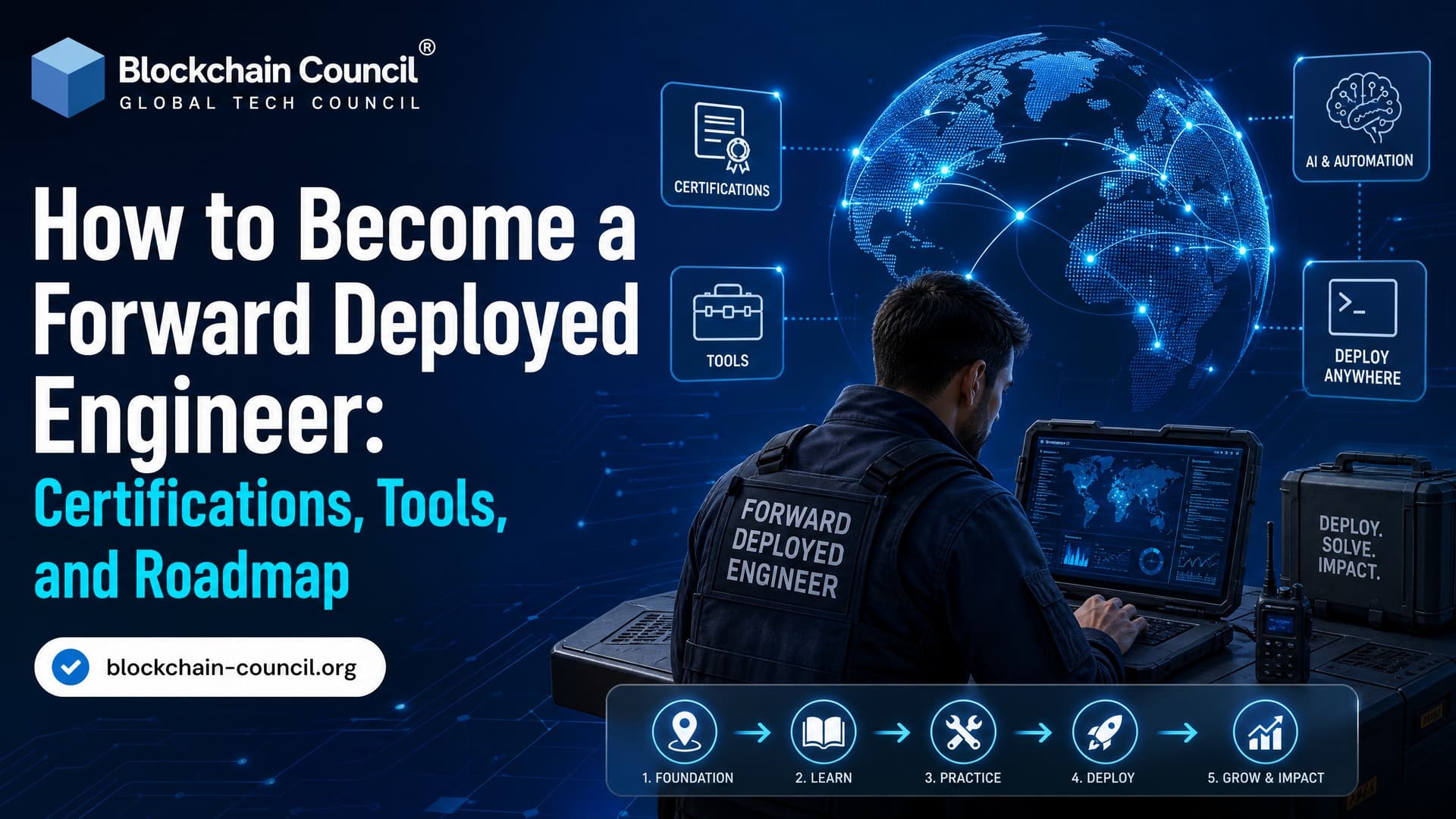
How to become a forward deployed engineer is a practical question, not a career branding exercise. An FDE is a senior engineer embedded close to the customer, responsible for turning messy business problems into working systems, often AI systems, inside real enterprise environments.
The role sits between software engineering, solution architecture, applied AI, product thinking, and consulting. You write code. You debug production issues. You run discovery calls. You explain trade-offs to a security review board. Then you ship the fix before the pilot loses momentum.

To be blunt, this is not an entry-level shortcut into AI. The best forward deployed engineers have shipped production software, understand data and cloud infrastructure, and can speak clearly with non-technical stakeholders without hiding behind jargon. Follow a practical roadmap to become a Forward Deployed Engineer by mastering cloud platforms, AI systems, solution architecture, and customer-facing technical skills through a Forward Deployed Engineer Certification, developing production ML expertise with an MLOps Certification, and building professional visibility through a Digital Marketing Course.
What Is a Forward Deployed Engineer?
A forward deployed engineer, often shortened to FDE, works directly with customers to design, deploy, adapt, and maintain complex technology in the customer environment. The model is widely associated with enterprise software companies such as Palantir, where engineers worked alongside customer teams instead of staying separated inside a central product group.
In AI-first companies, the FDE role has become more visible because large language models, retrieval systems, agents, data pipelines, and enterprise controls rarely work out of the box. A demo chatbot is easy. A production assistant connected to SharePoint, Salesforce, ServiceNow, Okta, private databases, and audit logs is not.
What FDEs Actually Own
Discovery: finding the real operational problem, not just accepting the first requirement.
Solution design: mapping workflows, data sources, APIs, permissions, and constraints.
Deployment: building and shipping systems into cloud, hybrid, or customer-controlled environments.
Iteration: measuring adoption, fixing failures, improving performance, and retiring weak features.
Stakeholder trust: communicating with engineering, product, security, legal, and executive teams.
That last point matters. If you cannot explain why a RAG system returns different answers after a document re-index, you will struggle in front of enterprise users.
Forward Deployed Engineer vs Solutions Engineer vs Software Engineer
The overlap is real, but the incentives differ.
Software engineer: usually builds core product capabilities for many users.
Solutions engineer: often supports pre-sales, demos, technical scoping, and proof-of-concept work.
Forward deployed engineer: stays deeper in the implementation loop and is expected to engineer customer-specific systems that survive production use.
A strong FDE can write backend services, reason about data architecture, work with APIs, and manage client expectations. The role is not technical support with a better title. It is closer to production engineering plus applied consulting.
Skills You Need to Become a Forward Deployed Engineer
1. Software Engineering Fundamentals
Start here. No certification can replace the ability to build reliable software.
Python for data, automation, and AI workflows
TypeScript or JavaScript for web applications and integration layers
Java, Go, or C# where enterprise backends require them
Git, pull requests, testing, API design, and basic system design
REST, GraphQL, authentication, background jobs, and error handling
You should be comfortable reading logs, tracing a failed request, and writing a small service from scratch. In interviews, expect questions about trade-offs. Why choose a queue over a synchronous API call? When is a relational database better than a document store? These questions reveal whether you have built real systems.
2. Data, Cloud, and DevOps
Most FDE work touches enterprise data. Learn SQL well. Not just SELECT statements. Learn joins, indexes, query plans, access controls, schema drift, and how bad source data breaks beautiful AI demos.
You also need at least one major cloud platform: AWS, Azure, or Google Cloud. Pick one and get useful. Containers are non-negotiable, so learn Docker. Kubernetes helps, but do not start there unless your target companies use it heavily.
Practical tools to know include:
Docker and Docker Compose
GitHub Actions, GitLab CI, or Azure DevOps
PostgreSQL, MySQL, Snowflake, or BigQuery
Terraform basics for infrastructure as code
Datadog, Grafana, Prometheus, CloudWatch, or OpenTelemetry for observability
3. Applied AI and GenAI
Modern FDE roles often focus on AI deployment. You do not need to be a research scientist, but you must know how AI systems behave under production constraints.
LLM APIs from providers such as OpenAI, Anthropic, Google, and Azure OpenAI
Prompt design and evaluation
Embeddings and vector search
RAG architecture
AI agents and tool calling
Model monitoring, latency, cost, and safety controls
Here is a detail that trips up many beginners: embedding dimensions must match your vector index. If you create a pgvector or Pinecone index for 1536-dimensional vectors and then switch to OpenAI text-embedding-3-large, which produces 3072-dimensional embeddings by default, inserts or queries can fail with dimension mismatch errors. That is not a model theory issue. It is deployment hygiene.
4. Security and Enterprise Integration
Enterprise customers will ask hard questions. Where is the data stored? Who can read prompts? Are logs redacted? Does the system respect role-based access control? Can users export audit trails?
An FDE should understand:
OAuth 2.0, OpenID Connect, SAML, and API keys
Role-based access control and attribute-based access control
Secrets management with tools such as AWS Secrets Manager, Azure Key Vault, HashiCorp Vault, or Doppler
Data residency, retention, and encryption basics
Secure integration with CRMs, ERPs, ticketing tools, and internal databases
If your AI assistant ignores document permissions, it is not production-ready. It is a data leak waiting to happen.
Best Certifications for Forward Deployed Engineers
FDE-specific certifications are still new, but the field is becoming more structured. The strongest path combines practical projects with targeted credentials.
Dedicated FDE Certifications
Forward Deployed Engineer Certification: focused on AI deployment, enterprise integration, and end-to-end solution delivery.
These help if your resume already shows engineering ability. If you lack production experience, use certifications as a structure for building projects, not as a substitute.
AI and Blockchain Council Learning Paths
For AI-heavy FDE roles, Blockchain Council certifications can support the applied AI layer of your roadmap. Relevant options include the Certified Artificial Intelligence (AI) Expert, Certified Generative AI Expert, and Certified Prompt Engineer. If you want to work in Web3 or deeptech deployments, add the Certified Blockchain Expert to understand decentralized systems, smart contracts, and enterprise blockchain use cases.
Choose based on your target role:
AI deployment FDE: prioritize generative AI, prompt engineering, RAG, and cloud integration.
Enterprise data FDE: focus on SQL, data pipelines, security, and system design.
Web3 or blockchain FDE: pair blockchain fundamentals with backend engineering and security.
Forward Deployed Engineer Tools You Should Know
Tool stacks vary, but these categories appear repeatedly in FDE job descriptions.
Core Engineering Stack
Python, TypeScript, Java, or Go
FastAPI, Flask, Express, Spring Boot, or similar frameworks
PostgreSQL, Redis, Elasticsearch, or OpenSearch
GitHub, GitLab, or Bitbucket
Docker, Kubernetes, and CI/CD pipelines
AI and RAG Stack
OpenAI API, Azure OpenAI, Anthropic Claude, Google Gemini, or open-source models
LangChain, LlamaIndex, or custom orchestration
pgvector, Pinecone, Weaviate, Milvus, or Elasticsearch vector search
Airflow, Dagster, dbt, or managed data pipeline tools
Evaluation tools such as Ragas, promptfoo, or custom test sets
Use frameworks carefully. LangChain and LlamaIndex are useful for prototypes, but I would not hide every production workflow behind a framework abstraction. For critical customer deployments, explicit code is often easier to debug at 11 p.m. when a data connector fails.
Customer Delivery Stack
Jira, Linear, Asana, or Azure Boards
Notion, Confluence, Google Docs, or Microsoft Loop
Slack, Microsoft Teams, and shared incident channels
Miro or FigJam for workflow mapping
Loom or recorded walkthroughs for enablement
Roadmap: How to Become a Forward Deployed Engineer
Stage 1: Build Production Software Skills, 6 to 18 Months
Get serious about software engineering. Build APIs, deploy them, monitor them, and maintain them. If you are early in your career, aim for software engineer, backend engineer, data engineer, DevOps engineer, or implementation engineer roles first.
Build one serious project: a customer support AI assistant that ingests documents, stores embeddings, answers questions with citations, logs feedback, and enforces user permissions. Deploy it to AWS, Azure, or GCP.
Stage 2: Add Data and AI Integration, 6 to 18 Months
Learn RAG properly. Ingest PDFs, HTML, tickets, and database records. Test chunking strategies. Measure retrieval quality. Track hallucinations. Add human review for high-risk actions.
Do not fine-tune first. Most enterprise AI failures are retrieval, data quality, permissions, or workflow problems. Fine-tuning is useful, but it is not a magic repair kit for poor architecture.
Stage 3: Get Customer-Facing Experience, 6 to 24 Months
Volunteer for implementation work, technical account support, solution design, or pilot projects. Run workshops. Write runbooks. Translate vague asks into scoped delivery plans.
Practice saying no clearly. A customer may ask for a fully autonomous agent to update financial records. The safer first version might draft recommendations, require approval, and write every action to an audit log. That is good engineering judgment.
Stage 4: Add Certifications and Structured Training, 3 to 12 Months
Use FDE-focused certifications to validate your direction. Add Blockchain Council AI certifications if your target roles involve GenAI, prompt engineering, or AI product deployment. Keep building while you study.
Your portfolio should show:
Architecture diagrams
Working deployments
Security considerations
Monitoring dashboards
Before-and-after business metrics where possible
Stage 5: Apply for FDE Roles
Target AI product companies, enterprise SaaS firms, data platforms, cybersecurity vendors, blockchain infrastructure companies, and deeptech startups. Search for titles such as forward deployed engineer, deployed engineer, implementation engineer, solutions architect, customer engineer, AI solutions engineer, and field engineer.
In interviews, tell deployment stories. Include constraints, trade-offs, failure modes, and measurable outcomes. A strong story beats a long list of tools.
Is Forward Deployed Engineering Right for You?
This role fits you if you like ambiguity, travel or close customer contact, fast iteration, and owning outcomes. It is a poor fit if you want quiet, isolated coding with stable requirements and minimal meetings.
The upside is real. FDEs work close to high-value business problems and often build the first production version of systems that later become product features. The pressure is real too. Strategic customers expect answers, and internal teams may expect you to bridge product gaps with custom work.
Next Step
Pick one path this week. If you are a developer, build a production-grade RAG app with authentication, logging, and deployment. If you are already in AI or implementation work, formalize your skills with an FDE certification and add Blockchain Council's Certified Generative AI Expert or Certified Prompt Engineer as your applied AI layer.
Then document the build. FDE hiring managers do not just want to know what you studied. They want proof that you can ship, explain, fix, and improve real systems with a customer watching.
FAQs
1. What is a Forward Deployed Engineer?
A Forward Deployed Engineer (FDE) is a technical professional who works directly with customers to deploy, customize, integrate, and optimize technology solutions. FDEs bridge the gap between engineering teams and end users, ensuring products deliver real business value.
2. What does a Forward Deployed Engineer do on a daily basis?
A typical FDE works on customer implementations, system integrations, technical troubleshooting, workflow automation, solution architecture, stakeholder communication, and deployment optimization. They often collaborate with engineering, product, and customer success teams.
3. Why is Forward Deployed Engineering a growing career path?
As organizations increasingly adopt AI, cloud computing, SaaS platforms, and enterprise software, the need for professionals who can successfully deploy and customize these technologies has grown significantly. FDEs help ensure successful implementation and customer adoption.
4. What educational background is required to become a Forward Deployed Engineer?
Many FDEs come from backgrounds in computer science, software engineering, information technology, data science, or related technical fields. However, practical skills and real-world experience are often just as important as formal education.
5. Which certifications can help someone become a Forward Deployed Engineer?
Certifications in cloud computing, AI, DevOps, software engineering, cybersecurity, and enterprise architecture can be valuable. Specialized certifications such as Certified Forward Deployed Engineer™ can also help professionals develop relevant deployment and customer-facing technical skills.
6. What programming languages should aspiring Forward Deployed Engineers learn?
Python, JavaScript, Java, Go, SQL, and Bash are among the most commonly used languages. Python is especially valuable due to its widespread use in automation, AI, and enterprise integrations.
7. Which cloud platforms should a Forward Deployed Engineer understand?
Knowledge of cloud platforms such as AWS, Microsoft Azure, and Google Cloud Platform (GCP) is highly beneficial because many enterprise deployments rely on cloud-based infrastructure and services.
8. What AI-related skills are useful for Forward Deployed Engineers?
Understanding AI workflows, large language models (LLMs), AI agents, machine learning concepts, data pipelines, prompt engineering, and model deployment strategies can significantly enhance an FDE's capabilities.
9. What DevOps tools should Forward Deployed Engineers learn?
Popular tools include Docker, Kubernetes, Git, GitHub, GitLab, Jenkins, Terraform, Ansible, and CI/CD platforms that help automate deployment and infrastructure management.
10. Why are API integration skills important for Forward Deployed Engineers?
Most enterprise applications need to communicate with other systems. Understanding APIs, authentication methods, webhooks, and integration frameworks enables FDEs to connect multiple technologies effectively.
11. What role do databases play in Forward Deployed Engineering?
FDEs frequently work with databases to migrate data, integrate systems, optimize performance, and troubleshoot deployment issues. Familiarity with SQL and NoSQL databases is highly valuable.
12. What soft skills are essential for a successful Forward Deployed Engineer?
Communication, problem-solving, stakeholder management, consulting, adaptability, presentation skills, and customer relationship management are critical because FDEs regularly work with both technical and non-technical stakeholders.
13. How can someone gain practical experience as a Forward Deployed Engineer?
Professionals can build experience through internships, implementation projects, cloud deployments, open-source contributions, consulting engagements, and enterprise software implementation projects.
14. What industries hire Forward Deployed Engineers?
Technology companies, SaaS providers, AI startups, cybersecurity firms, healthcare organizations, financial institutions, manufacturing companies, logistics providers, and government agencies frequently hire FDEs.
15. What tools are commonly used by Forward Deployed Engineers?
Common tools include GitHub, Docker, Kubernetes, Postman, Jira, Confluence, Terraform, AWS, Azure, GCP, Datadog, Splunk, Slack, and various API management platforms.
16. How long does it take to become a Forward Deployed Engineer?
The timeline varies based on prior experience. Professionals with a software engineering or cloud background may transition within one to two years, while newcomers may require additional time to build technical and deployment expertise.
17. What is a recommended roadmap for becoming a Forward Deployed Engineer?
A common roadmap includes learning programming fundamentals, cloud computing, databases, APIs, DevOps tools, AI technologies, enterprise architecture, and customer-facing consulting skills. Hands-on deployment experience is essential throughout the journey.
18. How important is AI knowledge for modern Forward Deployed Engineers?
AI knowledge is becoming increasingly important as organizations deploy AI-powered solutions, AI agents, and intelligent automation systems. FDEs who understand AI deployments often have a competitive advantage.
19. What career opportunities can follow a Forward Deployed Engineering role?
Experienced FDEs often move into roles such as Solutions Architect, Enterprise Architect, Technical Consultant, Customer Engineering Manager, Product Manager, Technical Program Manager, or AI Solutions Specialist.
20. Is Forward Deployed Engineering a good career for the future?
Yes. As enterprises continue investing in AI, cloud technologies, automation, and digital transformation, Forward Deployed Engineers are expected to remain highly valuable professionals who help organizations successfully implement and scale emerging technologies.
Related Articles
View All
AI & ML
Is the Certified Forward Deployed Engineer Certification Worth It in 2026? A Complete Review
The Certified Forward Deployed Engineer certification validates the technical, consulting, and customer-facing skills needed for one of tech's fastest-growing roles. Discover whether it's worth pursuing in 2026, who should earn it, and the career opportunities it can unlock.

AI & ML
Why Top Tech Companies Are Hiring Forward Deployed Engineers in 2026
Top technology companies are hiring Forward Deployed Engineers to bridge the gap between engineering and customers, accelerate AI deployments, and deliver tailored enterprise solutions. Learn why demand for this role is growing in 2026.

AI & ML
How LLMs Work in Openclaw: Models, Agents, Tools, and Local Setups
Learn how OpenClaw uses LLMs as pluggable reasoning engines for agents, tools, local models, cloud providers, and JSON-based workflows.
Trending Articles
AWS Career Roadmap
A step-by-step guide to building a successful career in Amazon Web Services cloud computing.
How Blockchain Secures AI Data
Understand how blockchain technology is being applied to protect the integrity and security of AI training data.
What is AWS? A Beginner's Guide to Cloud Computing
Everything you need to know about Amazon Web Services, cloud computing fundamentals, and career opportunities.