

Can Large Language Models Achieve Recursive Self-Improvement?

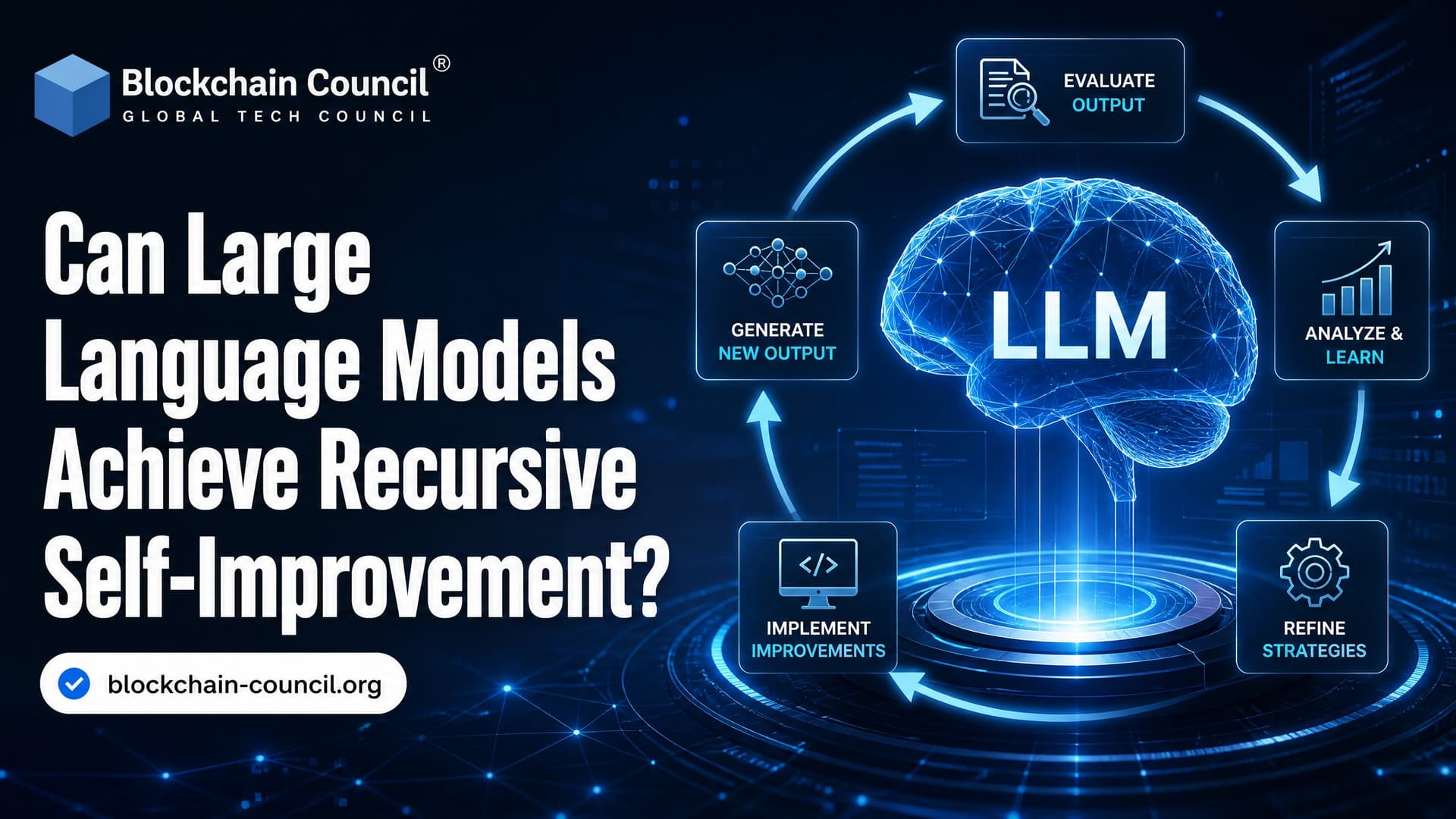
Recursive self-improvement is already visible in large language models, but mostly in limited forms. Today's LLMs can revise answers, improve agent skills, write better prompts, generate training data, and help engineers build successor systems. What they cannot yet do is autonomously redesign their own model architecture, retrain their own weights, verify the result, and repeat the loop without human control.
That distinction matters. If you are building AI agents, evaluating enterprise automation, or studying for an AI certification, the practical question is not whether a runaway intelligence explosion is happening today. It is where bounded self-improvement is useful, where it fails, and what controls you need before putting it into production.

What Recursive Self-Improvement Means
Recursive self-improvement, often shortened to RSI, traditionally means an AI system improves its own cognitive machinery, then uses the improved version to create an even stronger version. Classical discussions by I. J. Good and later AI safety researchers framed this as a possible route to an intelligence explosion.
In the strong version, three things must be true:
- Direct self-modification: The system can change its own weights, architecture, objectives, or training process.
- Autonomous target selection: It decides what to improve and how to test the change.
- Compounding gains: Each generation becomes better at building the next one.
Current large language models do not meet that bar. GPT-style transformer models generate tokens from learned weights. During normal inference, they cannot open their own parameter tensors, patch an attention head, or relaunch distributed training. They can reason about their outputs and surrounding tools, but the core model stays fixed unless an external training pipeline updates it.
What LLMs Can Improve Today
Self-correction at inference time
The clearest form of recursive self-improvement today happens at test time. A model answers, checks its answer, reflects on the error, then tries again. Test-time recursive reasoning methods use generate-select-reflect loops to improve reasoning without changing model weights.
This works best when feedback is concrete. Math proofs, code tests, unit test failures, and structured evaluation rubrics give the model something real to react to. Vague reflection is much weaker. Anyone who has built an agent loop has seen this. Asking a model to "think harder" often just adds words, while feeding it AssertionError: expected 42, got 41 can actually fix the function.
Approaches that train models to improve responses across multiple introspective turns after failed attempts push this further. Results on math reasoning with smaller Llama 2 and Mistral models show accuracy can rise as introspective turns increase. Still, this is recursion over problem-solving strategy, not self-redesign.
Self-training with synthetic data
LLMs can generate examples, explanations, critiques, and candidate solutions, then be fine-tuned on selected outputs. That sounds like self-improvement, and sometimes it is. Synthetic instruction data has helped many model builders expand coverage in narrow domains.
But there is a hard catch. If a model trains mostly on its own generated text, errors and biases can compound. Research on self-training as a dynamical system shows that factual accuracy, calibration, and diversity can degrade when external grounding disappears. In plain terms, a model that eats only its own cooking eventually loses nutritional value.
Useful self-training needs outside signal:
- Human review
- Formal proofs
- Executable tests
- Environment rewards
- Fresh domain data
- Security and compliance checks
This is why production AI teams should treat synthetic data as an augmentation tool, not a replacement for curated datasets.
Agent-level self-improvement
The strongest real-world examples come from agents that improve their skills, memory, tools, or rules while the foundation model stays frozen.
Voyager, the GPT-4 powered Minecraft agent, is a good example. It sets goals, writes executable JavaScript skills, stores successful skills in a library, retrieves them later, and refines code based on environment feedback. It gets better at exploration and crafting without fine-tuning GPT-4.
Coding agents use a similar pattern. A reviewer points out a bug or style issue. The agent stores that lesson as a persistent rule. Before the next pull request, it checks its code against the accumulated rule set. In practice, this is where many teams get the most value. The model is not smarter in a general sense, but the workflow gets less repetitive and fewer old mistakes reappear.
A concrete failure mode: if your agent stores every reviewer comment forever, its instruction file turns into noise. I have seen agents follow an outdated rule from a past service and then break a new repository's conventions. Versioned rules, expiry dates, and repo-specific scopes matter more than most demos admit.
Pipeline-level self-improvement
LLMs increasingly assist in model development itself. They write data cleaning scripts, design evaluation prompts, search for algorithmic improvements, and help debug training runs. Systems such as FunSearch and AlphaEvolve show that model-guided search can discover useful algorithms.
This is not full RSI, but it is a meaningful signal. If an AI system improves the training pipeline that creates future AI systems, the feedback loop has started at the ecosystem level. Human researchers still choose objectives, approve changes, provide compute, and decide deployment. Those constraints are important.
Why Strong RSI Is Still Out of Reach
LLMs lack deep introspection
A transformer can describe attention heads, loss functions, and gradient descent because those concepts are in its training data. That is not the same as inspecting its own live internals. Current models do not directly read or write their own weights during a conversation.
Researchers sometimes call the missing capability an introspection threshold. Strong RSI would require a system to model its own internals with enough fidelity to make targeted improvements. Today's models are much better at diagnosing their outputs than diagnosing their parameter space.
Verification is a bottleneck
Improving code is easy to claim and hard to prove. Improving an AI model is worse. A change can raise benchmark scores while making the model more deceptive, less calibrated, or less safe under distribution shift.
This is familiar to blockchain engineers. Upgradeable smart contracts can patch bugs, but they also create governance and audit risks. The same logic applies to self-improving AI. If the system can modify its own guardrails, you need something like a protected safety kernel, strong access control, and independent evaluation. Otherwise, the improvement loop becomes a security problem.
Data and compute are not optional
Recursive self-improvement is often described as if intelligence alone can generate more intelligence. Training frontier models still requires hardware, data pipelines, energy, engineering teams, and evaluation infrastructure. A model may propose a better training recipe, but someone or some controlled system must run it.
Even mundane defaults bite. Fine-tuning a 7B model with a larger sequence length can turn a working job into CUDA out of memory on the same GPU. Changing batch size, gradient accumulation, tokenizer settings, or evaluation splits can make reported gains misleading. These are not philosophical details. They decide whether an "improvement" is real.
Expert Views Are Split
AI safety researchers such as Eliezer Yudkowsky argue that once an AI crosses the point where it can improve its own architecture and training process, rapid capability growth becomes plausible. Roman Yampolskiy has warned that verifying self-modifying systems may be impossible in the strong sense, especially when systems become too complex to predict.
Others are more skeptical. Yann LeCun has argued that current LLMs lack key capabilities and that imminent existential risk claims overstate what today's systems can do. Skeptics also point to diminishing returns, engineering bottlenecks, governance limits, and the absence of any observed intelligence explosion.
A balanced reading is this. Strong RSI remains speculative, but bounded RSI is already operational. You do not need to believe in imminent superintelligence to care about self-improving agents that rewrite tools, update playbooks, or optimize ML infrastructure.
Security and Governance Implications
For enterprises, the near-term risk is not a model secretly rebuilding itself from scratch. The risk is poorly governed recursion inside normal systems.
Watch for these patterns:
- Agents that can change their own prompts, tools, or permissions without review
- Automated evaluation scripts written by the same model being evaluated
- Synthetic data pipelines with weak human or environmental grounding
- Self-healing retries that hide repeated failures from logs
- Model development workflows where AI-generated changes bypass security review
The Cloud Security Alliance has recommended tracking recursive self-improvement signals in model design, training, and evaluation workflows. That advice is practical. Treat AI-generated improvements like code changes: log them, test them, review them, and preserve rollback paths.
How Practitioners Should Approach RSI
If you are building LLM systems, focus on bounded self-improvement first. It gives real benefits without pretending the model has become an autonomous research lab.
- Use external feedback: Unit tests, formal validators, human review, and environment metrics beat self-judgment alone.
- Separate generation from approval: Let the agent propose changes, but require independent checks before deployment.
- Version everything: Prompts, tools, memories, rules, datasets, and evaluation suites should have audit trails.
- Limit self-modification: Keep safety policies, access controls, and production deployment logic outside the agent's editable scope.
- Measure degradation: Track factuality, calibration, security failures, and diversity, not just task success.
To build this skill set, Blockchain Council's Certified Artificial Intelligence (AI) Expert™ covers AI foundations, while Certified Generative AI Expert™ fits readers working with LLM applications and agent workflows. If your work connects AI governance with decentralized systems, Certified Blockchain Expert™ can help frame auditability, smart contract verification, and governance parallels.
Can LLMs Achieve Recursive Self-Improvement?
Yes, but only in the weak and bounded sense today. Large language models can recursively improve answers, agent skills, code rules, tool use, and parts of AI development pipelines. That is useful, measurable, and already changing how teams build software.
No, they have not achieved strong recursive self-improvement. Current LLMs cannot autonomously redesign their own architecture, retrain themselves into more capable successors, verify safety, and repeat the cycle without external infrastructure and human oversight.
Your next step should be practical. Build a small agent that can improve a skill library using test feedback, then add logging, human review, and rollback before you give it write access to anything important. That exercise teaches more about recursive self-improvement than a dozen abstract debates.
Related Articles
View All
AI & ML
Recursive Self-Improvement in LLMs: Can Language Models Optimize Themselves?
Recursive self-improvement in LLMs works in bounded loops today, but open-ended autonomous optimization remains unproven and needs strict evaluation.

AI & ML
Is Recursive Self-Improvement Possible With Today's AI Models?
Current AI can refine prompts, debug code, and assist model development, but full recursive self-improvement remains unproven and tightly constrained.

AI & ML
Has OpenAI Achieved Recursive Self-Improvement in Its AI Models?
OpenAI has not achieved fully autonomous recursive self-improvement, but it is using AI to improve training, evaluation, red teaming, and safety workflows.
Trending Articles
AWS Career Roadmap
A step-by-step guide to building a successful career in Amazon Web Services cloud computing.
Claude AI Tools for Productivity
Discover Claude AI tools for productivity to streamline tasks, manage workflows, and improve efficiency.
How to Install Claude Code
Learn how to install Claude Code on macOS, Linux, and Windows using the native installer, plus verification, authentication, and troubleshooting tips.