

AI Agents & Agentic AI: When AI Starts Thinking, Planning & Acting
 Suyash Raizada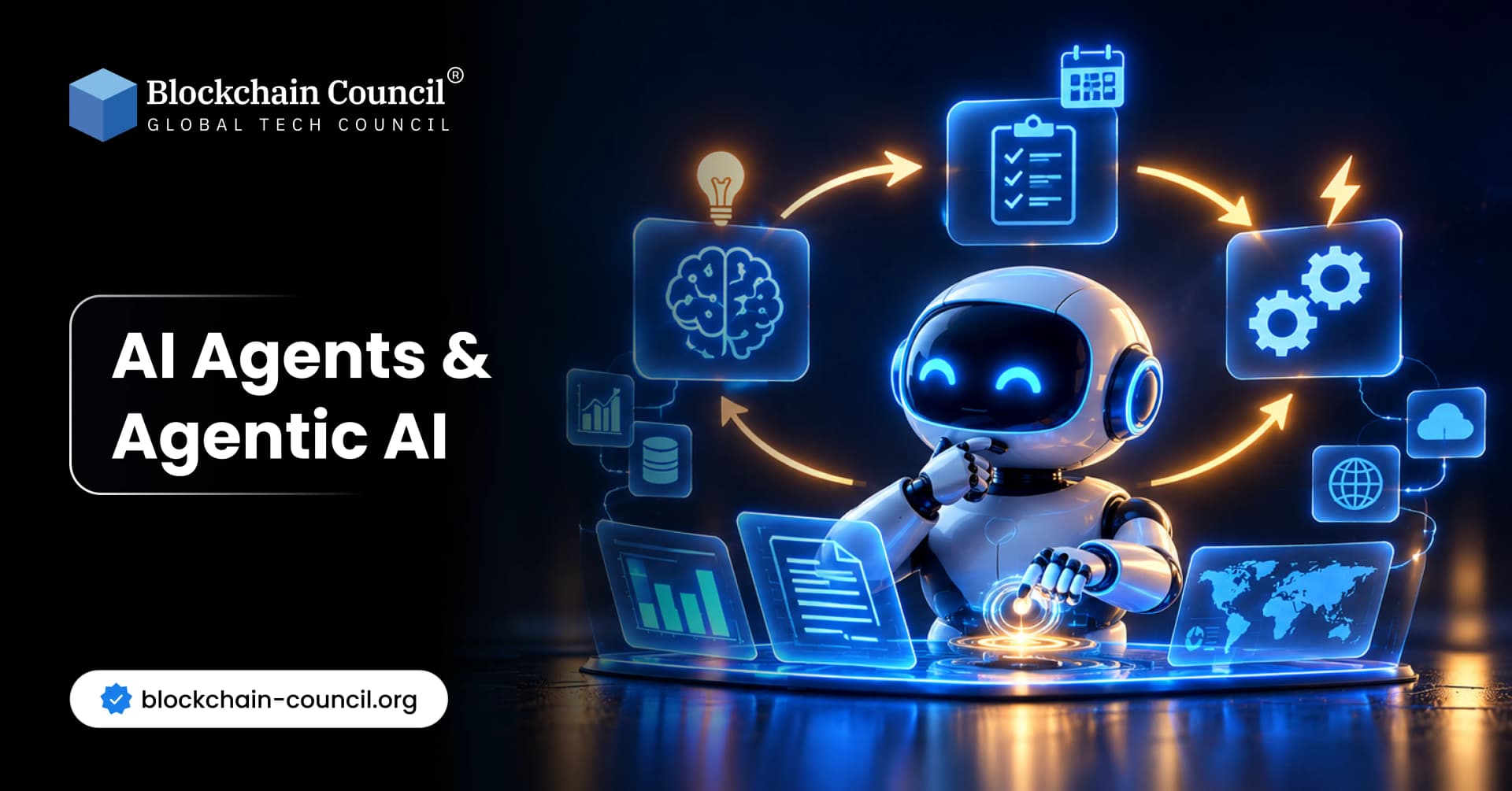
For years, AI mostly answered questions. Now it increasingly takes action: booking, researching, coding, filing, and following up on its own. This shift is what people mean by AI Agents & Agentic AI, and it is one of the biggest changes in how software works. In this guide, we explain the ideas in plain language for beginners, with enough technical depth for professionals. If you want a strong foundation before diving in, the Certified Artificial Intelligence (AI) Expert program covers the core concepts these systems are built on.
What Is an AI Agent?
An AI agent is a software system that pursues a goal by deciding what to do, using tools, and acting on the results, with limited human help. Instead of only producing text, it can search the web, query a database, run code, send a message, or update a record.

The Four Core Traits
Goal-driven: It works toward an outcome, such as “find three suppliers and compare prices.”
Autonomous: It chooses its own next steps within set limits.
Tool-using: It connects to outside software to get things done.
Adaptive: It checks results and changes course if something fails.
A Simple Example
Ask a regular AI model to plan a business trip and you get a list of suggestions. Ask an agent, and it can check your calendar, search flights, compare options against your budget, and prepare bookings for your approval. The difference is action.
The idea is old. Researchers have studied software agents for decades, and a classic textbook defines an agent as anything that perceives its environment and acts on it. What changed recently is that large language models gave agents a flexible “brain” that understands plain language and can reason about open-ended tasks.
AI Agent vs Chatbot
Chatbots and agents can look similar on screen, but they work very differently. Professionals who want to specialise in building such systems can explore the Certified Agentic AI Expert program, which focuses on designing autonomous, goal-driven AI.
Feature | Chatbot | AI Agent |
|---|---|---|
Main job | Answer and converse | Complete tasks |
Behaviour | Reacts to each message | Plans and acts across many steps |
Tools | Usually none or limited | Searches, apps, databases, code |
Memory | Often just the chat | Can store and recall information |
Human role | Asks every step | Sets the goal and reviews results |
Not a Strict Line
Many products blend both. A customer support bot that only answers FAQs is a chatbot. One that checks your order, issues a refund within policy, and updates the ticket is behaving like an agent. Think of it as a spectrum of autonomy rather than two separate boxes.
How AI Agents Perceive, Reason and Act
Most agents run on a loop that repeats until the job is done: perceive, reason, act, observe.
Perceive: Take in information, such as the user’s goal, documents, search results, or sensor data.
Reason: Decide what to do next, usually through a language model.
Act: Carry out a step, such as calling a tool or sending a request.
Observe: Read the result and feed it back into the next round of reasoning.
The ReAct Pattern
A well-known approach called ReAct, introduced by researchers in 2022, has the model alternate between reasoning in words and taking actions. For example, the agent thinks “I need the latest price,” calls a search tool, reads the result, and then thinks again. Many modern agents follow a version of this pattern.
Why Observation Matters
The loop is what separates agents from one-shot answers. If a tool fails, the agent can retry, choose another tool, or ask for help. This self-correction is powerful, but it also means mistakes can compound if the agent misreads a result, so checkpoints and limits matter.
Tools and Tool Calling
Tools are what give agents hands. A tool can be a search engine, calculator, code runner, email service, calendar, database, or any software with an interface.
How Tool Calling Works
The model is told which tools exist and what each one does. When it decides to use one, it produces a structured request, usually in a format like JSON, naming the tool and its inputs. The surrounding software runs the tool and returns the result to the model, which continues reasoning.
Open Standards for Connecting Tools
Connecting every tool one by one used to be slow, so the industry created shared standards.
Model Context Protocol (MCP): Introduced by Anthropic in November 2024 as an open way for AI systems to connect to tools and data. In December 2025 it moved to the Agentic AI Foundation, hosted by the Linux Foundation, with major companies as founding members. Thousands of MCP servers have since been published.
Agent2Agent (A2A): A protocol from Google, now also under the Linux Foundation, that lets agents from different vendors communicate. It reached version 1.0 in 2026.
Safety With Tools
Tools create risk. An agent with access to email or payments can do real damage if it errs or is tricked. Good practice includes least-privilege access, approval steps for sensitive actions, activity logs, and defences against prompt injection, where hidden instructions in a webpage or file try to hijack the agent.
Planning and Task Decomposition
Complex goals cannot be solved in one move. Agents use planning to break a big goal into smaller steps, then work through them.
Task Decomposition
Task decomposition means splitting a goal into manageable subtasks. If the goal is “write a market report,” the plan might be: define the scope, collect data, analyse trends, draft sections, check facts, and format the result.
Planning Styles
Plan first, then execute: The agent drafts a full plan up front, which is clear but can be rigid.
Step by step: It decides each move after seeing the last result, which is flexible but can wander.
Hybrid with replanning: It makes a plan and revises it when conditions change. This is common in practice.
Where Planning Fails
Agents can get stuck in loops, pick the wrong subtask, or lose track of the main goal on long jobs. Clear goals, success criteria, step limits, and review points reduce these problems. A human who can say “stop” or “try again” remains a valuable safeguard.
Agent Memory
Without memory, an agent forgets everything the moment a task ends. Memory lets it keep useful information.
Types of Memory
Short-term memory: The current task and conversation, held in the model’s context window.
Long-term memory: Facts, preferences, and past results stored outside the model, often in a database, and retrieved when relevant.
Working memory: Notes and intermediate results the agent writes down while solving a problem.
Procedural memory: Saved instructions or skills for how to do recurring tasks.
Retrieval and Limits
Long-term memory commonly relies on retrieval, where the agent searches stored information and brings back only what matters, a technique closely related to retrieval-augmented generation. More memory is not always better. Irrelevant or outdated information can confuse an agent, and stored personal data raises privacy and security duties.
As organisations deploy agents, someone must oversee how they are configured, what they remember, which permissions they hold, and how well they perform. The Certified AI Agents Manager program addresses this management side, which is becoming as important as building the agents themselves.
Agentic AI Explained
The two terms are related but not identical. An AI agent is a single system that acts toward a goal. Agentic AI is the broader approach and capability: AI systems that show autonomy, planning, tool use, and adaptation, often coordinating several agents across a larger process.
A Helpful Way to Think About It
AI agent: A worker.
Agentic AI: The whole way of working, in which AI takes initiative, makes decisions within limits, and carries out multi-step processes.
Levels of Autonomy
Agentic systems vary in how much freedom they have. Some only suggest actions for a human to approve. Others act automatically on low-risk tasks and escalate hard cases. A few run end to end in narrow, well-tested areas. Most organisations start with approvals and widen autonomy as trust is earned.
Where the Market Stands
Analysts at Gartner forecast that 40 percent of enterprise applications will include task-specific AI agents by the end of 2026, up from under 5 percent in 2025. McKinsey’s survey found 23 percent of respondents scaling an agentic system somewhere in their business, with another 39 percent experimenting. Yet Gartner also expects over 40 percent of agentic AI projects to be cancelled by the end of 2027 because of cost, unclear value, or weak risk controls, and it warns about “agent washing,” where products are labelled agentic without real capability.
Single-Agent vs Multi-Agent Systems
Single-Agent Systems
One agent handles the whole task with a set of tools. This is simpler to build, test, and debug, and it often works well for focused jobs, such as answering support tickets or summarising documents.
Multi-Agent Systems
Several agents work together, each with a role. One agent might plan, another research, another write, and another review. They pass information among themselves, sometimes coordinated by a manager agent.
Common Patterns
Orchestrator and workers: A lead agent assigns tasks to specialists.
Pipeline: Agents hand work down a fixed chain.
Debate or review: One agent critiques another’s output to catch errors.
Swarm: Many agents work in parallel on pieces of a large job.
Trade-Offs
Multi-agent setups can handle bigger and more varied tasks, and specialised roles can improve quality. They also cost more, are harder to debug, and can fail through miscommunication or runaway loops. A sound rule is to start with a single agent and add more only when there is a clear reason.
Autonomous Workflows
An autonomous workflow is a business process in which agents carry out most steps with minimal human intervention, from trigger to finish. Unlike a fixed script, an agentic workflow can handle variation, make judgment calls, and adapt.
Anatomy of an Agentic Workflow
Trigger: An event starts it, such as a new email, a support ticket, or an alert.
Understand: The agent interprets the request and gathers context.
Plan and act: It uses tools and other systems to complete steps.
Check: It validates the result against rules.
Escalate or finish: It either completes the task or sends it to a person.
Log and learn: It records what happened for audit and improvement.
Guardrails That Matter
Strong workflows include human-in-the-loop approval for high-stakes actions, clear permissions, spending limits, monitoring, and detailed logs. Observability matters, because you must be able to see what an agent did and why. Building these systems touches software, data, security, and cloud skills, so a broad technical profile helps. The Tech Certification catalog is a useful place to explore how adjacent skills fit together.
Real-World Agentic AI Applications
Customer service: Agents resolve routine issues, process refunds, and escalate complex cases with full context.
Software development: Coding agents write, test, and fix code, and open changes for human review.
Research and analysis: Agents gather sources, compare findings, and draft summaries.
Sales and marketing operations: They qualify leads, personalise outreach, and update records.
Finance and compliance: They reconcile transactions, flag anomalies, and prepare reports for auditors.
IT operations: They detect incidents, diagnose causes, and apply approved fixes.
Healthcare administration: They handle scheduling, coding support, and documentation, with strict privacy controls.
Supply chain: They monitor shipments, predict delays, and suggest alternatives.
Cautions
Results depend heavily on data quality, clear processes, and oversight. Pilot in a small area, measure value, and expand carefully. Always keep humans accountable for decisions that affect people, money, or safety.
Conclusion
AI Agents & Agentic AI mark a move from AI that talks to AI that acts. Agents perceive, reason, use tools, plan, and remember, and agentic systems combine them into workflows that can handle real business processes. The promise is large, and so is the need for care: clear goals, limited permissions, human oversight, and honest measurement of value. Whether you build, manage, or simply work alongside these systems, the ability to explain them clearly is a major advantage. A credential such as the Marketing Certification can help professionals present AI solutions with clarity, build trust, and grow their influence.
FAQs
1. What Are AI Agents?
AI agents are software systems that use AI models to work toward specific goals. Depending on their design, they can interpret instructions, choose actions, use tools, and evaluate results. Unlike a basic chatbot that primarily generates responses, an AI agent may carry out multiple steps to complete a task.
2. What Is Agentic AI?
Agentic AI refers to AI systems designed to pursue goals through planning, decision-making, tool use, and multi-step execution. These systems can respond to intermediate results and adjust their approach when needed. Their level of autonomy depends on the model, available tools, permissions, and safeguards.
3. What Is the Difference Between AI Agents and Agentic AI?
An AI agent is an individual system or component that performs tasks using AI capabilities. Agentic AI describes the broader approach of designing AI systems that can take goal-directed actions with varying degrees of autonomy. The terms are closely related and are sometimes used interchangeably.
4. How Do AI Agents Work?
AI agents typically receive a goal, interpret the request, determine a possible course of action, and use available tools to perform tasks. They may inspect tool results and repeat the process until they reach a stopping condition. Instructions, memory, access permissions, and evaluation mechanisms help guide their behavior.
5. Can AI Agents Think and Reason Like Humans?
AI agents can perform reasoning-like tasks, such as breaking problems into steps, comparing options, and selecting actions. However, their processing is not equivalent to human thought or consciousness. They can make mistakes, misunderstand context, and produce incorrect conclusions, so their decisions should be evaluated appropriately.
6. What Are the Main Components of an AI Agent?
An AI agent commonly includes an AI model, instructions, tools, a task or goal, and a mechanism for managing its execution. Some agents also use memory, external data sources, planning mechanisms, and safety controls. The exact architecture depends on the complexity and purpose of the application.
7. What Is the Role of Planning in Agentic AI?
Planning helps an AI agent break a larger goal into smaller, manageable actions. For example, a research agent might identify relevant sources, gather information, compare findings, and prepare a report. Planning can improve task organization, although the agent may still need to revise its approach when circumstances change.
8. How Do AI Agents Use Tools to Complete Tasks?
AI agents can use tools such as web search, APIs, databases, code execution environments, and business applications. The model selects an available tool, provides the required inputs, and uses the returned information to determine the next step. Tool access must be configured by the application, and sensitive actions may require approval.
9. What Is the Difference Between an AI Chatbot and an AI Agent?
A traditional chatbot primarily responds to user messages, while an AI agent may also perform actions across a sequence of steps. For example, a chatbot might explain how to schedule a meeting, whereas an appropriately configured agent could check calendar availability and prepare a booking. Modern chatbots can also use tools, so the distinction depends on their actual capabilities rather than their interface.
10. What Are the Different Types of AI Agents?
AI agents can be categorized by how they make decisions and interact with their environment. Traditional classifications include simple reflex agents, model-based agents, goal-based agents, utility-based agents, and learning agents. Modern AI applications also include tool-using agents, coding agents, research agents, and multi-agent systems.
11. What Are Multi-Agent Systems?
Multi-agent systems involve multiple agents working together or coordinating their activities. Each agent may specialize in a particular task, such as research, analysis, writing, or verification. An orchestration mechanism coordinates their work, manages handoffs, and combines results when appropriate.
12. What Is the Difference Between Single-Agent and Multi-Agent AI?
A single-agent system uses one agent to manage a task, potentially with access to several tools. A multi-agent system divides work among multiple agents with distinct roles or capabilities. Multi-agent architectures can help with complex workflows, but they may also introduce additional costs, coordination challenges, and opportunities for errors.
13. How Is Agentic AI Used in Business?
Businesses can use agentic AI for customer support, document processing, research, software development, data analysis, and workflow automation. For example, an agent could gather information from approved sources, prepare a report, and route it for human review. Practical benefits depend on task suitability, integration quality, reliability, and appropriate oversight.
14. Can AI Agents Automate Digital Marketing Tasks?
Yes, appropriately configured AI agents can assist with keyword research, content planning, campaign reporting, competitor research, and performance-data analysis. They can gather information, identify patterns, and prepare recommendations using connected tools. Human review remains important for factual accuracy, brand consistency, advertising budgets, and publishing decisions.
15. What Is the Role of Memory in Agentic AI?
Memory helps an AI agent retain or retrieve information relevant to its tasks. Short-term context can support the current workflow, while persistent memory may preserve selected information across sessions. Effective memory management requires relevance filtering, updates, access controls, and protection of sensitive data.
16. What Are the Benefits of Agentic AI?
Agentic AI can help automate multi-step tasks, reduce repetitive work, coordinate tools, and support faster information processing. It may also help teams manage workflows that require several related actions. These benefits are not automatic and depend on system design, task complexity, data quality, and human supervision.
17. What Are the Risks and Limitations of AI Agents?
AI agents can make incorrect decisions, misuse tools, misunderstand instructions, or rely on inaccurate information. Systems with broad permissions may also create privacy, security, financial, or operational risks. Testing, restricted permissions, activity logging, clear stopping conditions, and human approval for high-impact actions can help reduce these risks.
18. How Can Developers Make AI Agents Safer and More Reliable?
Developers can define clear instructions, limit tool permissions, validate inputs and outputs, and test agents against realistic scenarios. Additional safeguards can include human approval for consequential actions, monitoring, audit logs, and limits on execution time or spending. Reliability should be measured continuously because performance may vary across tasks and conditions.
19. What Skills Are Needed to Build AI Agents?
Useful skills include programming, API integration, prompt engineering, data handling, workflow design, and testing AI outputs. Familiarity with Python or JavaScript, retrieval systems, tool calling, and agent frameworks can be valuable. Beginners can start with a simple agent that uses one tool before developing more complex workflows.
20. What Is the Future of AI Agents and Agentic AI?
AI agents are likely to become increasingly integrated into business software, development environments, research tools, and everyday workflows. Improvements in tool use, context management, coordination, and evaluation may enable more complex tasks to be automated. However, dependable adoption will also require stronger safeguards, transparent monitoring, suitable human oversight, and clear accountability.
Related Articles
View All
AI & ML
From Agentic AI to AGI & Super AGI: Where Is Artificial Intelligence Heading?
Follow the path from Agentic AI to AGI & Super AGI. Learn what AGI means, how it differs from today’s AI, what superintelligence could be, and the opportunities, risks, and alignment challenges ahead.

AI & ML
AI Loops, Harnesses & Autonomous Systems: The Architecture Behind Agentic AI
Learn how AI Loops, Harnesses & Autonomous Systems work. Understand the observe-reason-act-evaluate cycle, why agents need a harness, guardrails, evaluation, and long-running tasks.

AI & ML
NVIDIA’s New AI Models: Nemotron 3.5 Lightning, Cosmos 3 and the Future of Agentic AI
Explore NVIDIA Nemotron 3.5 Lightning and Cosmos 3, how they support agentic and Physical AI, and what these models reveal about NVIDIA’s broader vision for autonomous intelligent systems.
Trending Articles

Top 5 DeFi Platforms
Explore the leading decentralized finance platforms and what makes each one unique in the evolving DeFi landscape.
What is AWS? A Beginner's Guide to Cloud Computing
Everything you need to know about Amazon Web Services, cloud computing fundamentals, and career opportunities.
Claude AI Tools for Productivity
Discover Claude AI tools for productivity to streamline tasks, manage workflows, and improve efficiency.