

Best AI tools for small business marketing
 Suyash Raizada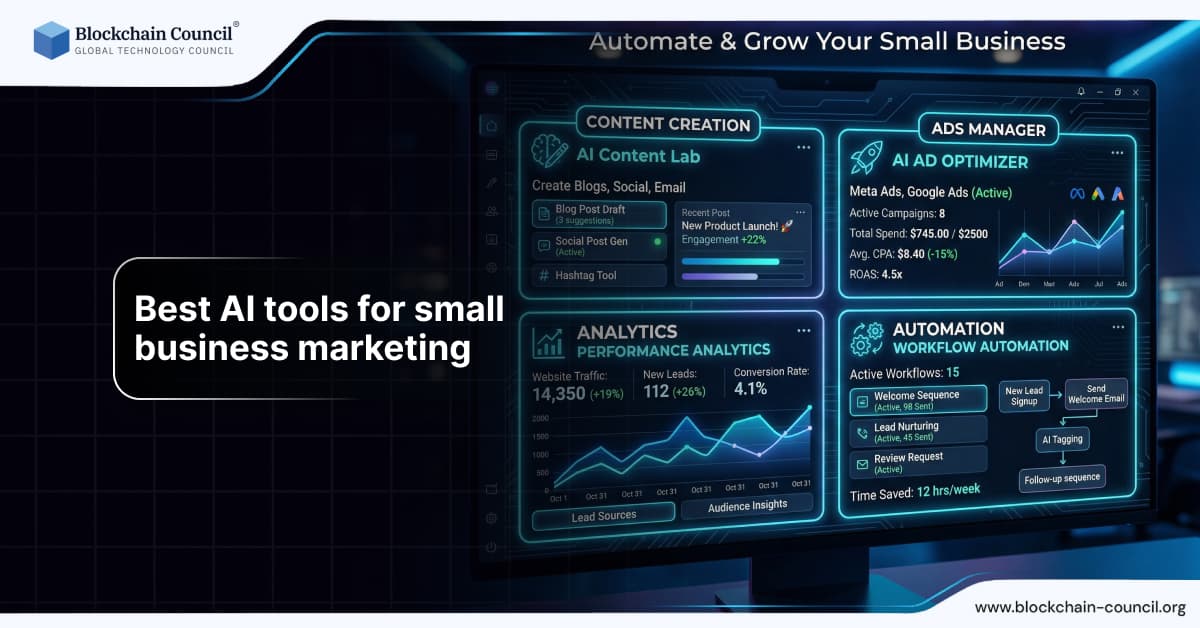
Best AI tools for small business marketing have become dramatically more capable heading into 2026. What once required a dedicated content writer, SEO specialist, paid ads manager, and analyst can now be handled by a smaller team using AI for faster drafts, sharper targeting, and clearer reporting. The latest generation of tools combines generative AI with SEO datasets, predictive analytics, and workflow automation, allowing small businesses to compete without enterprise budgets.
This guide covers the best AI tools for small business marketing across content, ads, SEO, and analytics, plus guidance on building a stack that fits your goals and constraints.

What Changed in AI Marketing Tools by 2026
Three developments are shaping how small businesses use AI marketing tools today:
All-in-one marketing automation is replacing tool sprawl. Platforms built for small businesses now combine SEO, content, ads, analytics, and conversion tooling in a single interface. This matters when you lack the time to maintain multiple subscriptions and integrations.
SEO tooling is tightly coupled with AI writing. Several platforms blend AI writing with live SEO recommendations using competitive SERP analysis and keyword data. Some support one-click publishing to platforms like WordPress.
Visibility is expanding beyond Google. Modern tools increasingly track brand and content presence in AI answer engines such as ChatGPT, Perplexity, and Claude alongside traditional Google performance, including sentiment analysis and AI-search content recommendations.
How to Evaluate the Best AI Tools for Small Business Marketing
Before selecting tools, clarify a few practical criteria:
Primary channel: content-led SEO, paid acquisition, email lifecycle, or social.
Data access: does the tool integrate with GA4, Search Console, ad platforms, and your CRM?
Time-to-value: many tools have low learning curves, but even non-marketers should plan for initial setup time to configure brand voice, tracking, and workflows.
Budget: entry pricing ranges from roughly $7.50 per month for basic writing assistants to $49 per month for broader content tools, and higher for advanced SEO strategy platforms.
Governance: confirm privacy policies, user permissions, and how the vendor uses your data for model training, particularly if you handle customer data.
Best AI Tools for Small Business Marketing by Category
1. Content Creation Tools (Blogs, Landing Pages, Social, Sales Collateral)
Content is often the most practical starting point because AI can accelerate drafting, repurposing, and consistency across channels.
Jasper AI: Strong for brand-consistent content across formats including ads, emails, and blog sections. It is widely used for tone matching and repeatable templates, which helps small teams maintain a recognizable voice at scale.
Copy.ai: Suited to multi-channel workflows and sales outreach automation. It works well for teams that need high variation quickly, such as cold email sequences, product messaging, and social snippets.
Writesonic (including Chatsonic): A solid option for SEO-oriented blog posts and landing pages. Small businesses use it to publish timely content faster by combining AI drafting with factual research workflows.
Rytr: A budget-friendly choice for short-form copy, product descriptions, and quick drafts when you need volume at a low starting price.
Pictory: Useful for converting blog content into short videos for channels like TikTok and Instagram Reels, enabling content repurposing without a dedicated video editor.
Practical tip: Use AI to generate a first draft, then add local proof points such as photos, case studies, service area details, and pricing ranges, and verify claims against current sources. This improves both trust and conversion rates.
2. SEO Optimization Tools (Research, Briefs, On-Page Scoring, Content Grading)
SEO tools deliver some of the highest ROI for small businesses because they reduce research overhead and help you publish content aligned with search intent.
Frase: Known for automated content briefs and SERP analysis. It reduces research time significantly by automating competitive research and outlining, with some users reporting reductions of up to 80%.
Surfer SEO: Popular for real-time optimization during writing. It provides on-page recommendations and content scoring, with integrations into writing tools and WordPress used across professional workflows.
Clearscope: Strong for content grading against top-ranking pages. Useful when your goal is to earn featured snippets and improve topical coverage for local services and niche queries.
MarketMuse: More strategy-oriented, valuable when you want topic modeling and content planning insights rather than page-level optimization alone.
ContentShake AI: Produces SEO-optimized articles from a single prompt and supports multiple languages, which benefits businesses serving multilingual communities or entering new markets.
A repeatable SEO workflow:
Start with a brief tool (Frase or similar) to map intent and analyze competitors.
Draft with your preferred writing tool (Jasper, Writesonic, or Copy.ai).
Optimize with a scoring tool (Surfer SEO or Clearscope).
Publish to WordPress and track performance in GA4 and Search Console.
Discover AI tools that automate campaigns, personalize content, and improve ROI through an AI powered marketing course, while enhancing implementation with a Python certification and understanding AI systems via an AI certification.
3. Ads and Email Automation Tools (Bidding, Targeting, Lifecycle)
Paid growth can become expensive quickly when campaigns run without active management. AI helps by optimizing bids, surfacing patterns, and triggering lifecycle messaging based on user behavior.
Trellis: Focused on improving e-commerce ad ROI by automatically updating keyword bids and testing pricing based on market trends. This reduces manual tuning for operators managing multiple campaigns.
ActiveCampaign: Known for behavior-based triggers and automation, enabling small businesses to run lifecycle campaigns that respond to page visits, clicks, and purchases.
MailerLite: Useful for practical email improvements including subject line suggestions and performance-driven iteration on sends.
Practical tip: Before enabling automation on ad campaigns, set clear guardrails: target CPA or ROAS thresholds, audience exclusions, creative testing cadence, and budget caps. AI optimization works best when the objective is unambiguous.
4. Analytics and Predictive Tools (Lead Scoring, Churn Prediction, Attribution)
Analytics is where AI moves you from reporting on the past to informing future decisions. Rather than only describing what happened, these tools help forecast what is likely to happen next.
HubSpot: Offers AI-assisted lead scoring and reporting that helps small teams prioritize follow-up and detect shifts in performance. Most effective when paired with clean lifecycle stages and consistent CRM hygiene.
GA4: Still central to web analytics, particularly when events, conversions, and channel groupings are configured to reflect your actual business model.
Pecan AI: Focuses on predictive analytics including churn and purchase propensity forecasts, enabling targeted retention campaigns and proactive outreach.
Practical tip: Start with three metrics you can act on weekly, for example: qualified leads, conversion rate by landing page, and cost per lead by channel. Expand to predictive models once your tracking foundation is stable.
All-in-One Platforms: When a Unified Approach Makes Sense
If managing separate tools creates too much overhead, a unified platform can be the right path. Some platforms centralize SEO, content, ads, analytics, and conversion workflows in one interface, reducing setup complexity for local businesses and lean teams. The tradeoff is less flexibility compared to best-in-class point solutions.
All-in-one tooling tends to work well when you need:
One dashboard for performance across channels
Consistent tracking and attribution without custom integrations
CRM and conversion alignment without heavy engineering work
AI-search visibility monitoring across emerging answer engines
Emerging Focus: Optimizing for AI Search Beyond Google
Marketing teams are increasingly optimizing for discovery in AI answer engines. This involves monitoring whether your brand or content is cited, how it is characterized, and which pages are being used as sources. Purpose-built tools are beginning to offer AI-search tracking, sentiment analysis, and recommendations tailored to how LLM-driven engines surface information.
Small businesses can prepare by taking these steps:
Publish source-worthy pages: clear service descriptions, FAQs, pricing guidance, author bios, and current policies.
Strengthen entity signals: consistent name, address, and phone details across directories, structured data where appropriate, and uniform brand naming.
Update content on a regular schedule: refresh key pages quarterly so AI engines and users encounter current, accurate information.
Suggested Stacks for Common Small Business Scenarios
Local Service Business (Plumber, Clinic, Agency)
SEO: Frase for briefs + Surfer SEO for on-page optimization
Content: Jasper for brand voice consistency
Analytics: GA4 + HubSpot lead scoring if you have an active sales pipeline
E-Commerce Store (Shopify or Similar)
Ads: Trellis for bid and keyword optimization
SEO: Surfer SEO for category and blog optimization
Email: ActiveCampaign for lifecycle triggers
Analytics: GA4 paired with a predictive tool like Pecan AI for churn propensity
Solo Creator or Early-Stage Startup
Content: Writesonic or Copy.ai for speed and variation
SEO: Frase to reduce research time
Repurposing: Pictory for short-form video from existing content
Risks and Best Practices
Quality control: AI drafts can be generic. Add unique expertise, local proof, and real customer questions to differentiate your content.
Accuracy: Validate all factual claims, particularly in regulated industries such as health, finance, and legal services.
Privacy: Avoid inputting sensitive customer data into third-party tools unless you have a clear data handling policy and the vendor supports appropriate controls.
Over-reliance: Keep a human in the loop for positioning decisions, offer design, and final content approvals.
Conclusion
The best AI tools for small business marketing in 2026 go well beyond writing assistants. They are integrated systems for creating content, improving SEO, optimizing ad spend, and forecasting performance, often at price points that small teams can justify. Start with your most constrained area, typically content production or SEO research, select tools that connect cleanly with your analytics stack and CRM, and build a simple weekly operating rhythm around measurable outcomes.
Leverage AI-driven marketing tools for growth and efficiency by mastering strategies through a Digital marketing course, optimizing decisions via a machine learning course, and building automation workflows with an Agentic AI Course.
FAQs
1. What are AI tools for small business marketing?
AI tools are software solutions that use artificial intelligence to automate and optimize marketing tasks. They help businesses improve efficiency and decision-making. These tools are widely used for content creation, analytics, and customer engagement.
2. How can AI tools benefit small businesses?
AI tools help automate repetitive tasks and save time. They improve targeting and personalization in marketing campaigns. This leads to better results and higher ROI.
3. Are AI tools affordable for small businesses?
Many AI tools offer free or low-cost plans suitable for small businesses. Pricing varies based on features and usage. Affordable options make AI accessible to startups.
4. What are common AI tools used in marketing?
Common tools include chatbots, email automation platforms, and analytics tools. They help manage campaigns and customer interactions. These tools improve marketing efficiency.
5. Can AI tools improve customer engagement?
Yes, AI tools analyze user behavior to deliver personalized experiences. They provide instant responses through chatbots. This improves customer satisfaction.
6. How does AI help in content marketing?
AI tools can generate content ideas, write drafts, and optimize text. They save time and improve consistency. This supports effective content strategies.
7. What is AI-driven email marketing?
AI-driven email marketing uses automation and personalization to send targeted emails. It improves open rates and conversions. It also saves time for marketers.
8. Can AI tools help with social media marketing?
Yes, AI tools schedule posts, analyze performance, and suggest content. They help maintain consistent engagement. This improves brand visibility.
9. What is predictive analytics in marketing?
Predictive analytics uses AI to forecast customer behavior and trends. It helps businesses make informed decisions. This improves marketing strategies.
10. Are AI tools easy to use?
Most AI tools are designed with user-friendly interfaces. They require minimal technical knowledge. This makes them accessible to beginners.
11. Can AI tools replace human marketers?
AI tools support marketers but do not replace them completely. Human creativity and strategy are still essential. AI enhances productivity.
12. How do AI chatbots work?
AI chatbots use natural language processing to understand queries. They provide automated responses instantly. This improves customer support.
13. Can AI tools improve ad targeting?
Yes, AI analyzes user data to deliver relevant ads. It improves click-through and conversion rates. This maximizes ad performance.
14. What is automation in marketing?
Automation involves using AI tools to handle repetitive tasks like emails and ads. It saves time and reduces errors. This increases efficiency.
15. Are AI tools secure for business use?
Most AI tools include security features to protect data. However, businesses should choose trusted platforms. Data privacy is important.
16. How do AI tools improve ROI?
AI optimizes campaigns and reduces wasted spending. It helps target the right audience. This leads to better returns on investment.
17. Can AI tools help startups compete with larger companies?
Yes, AI tools provide advanced capabilities at lower costs. They level the playing field for small businesses. This improves competitiveness.
18. What industries use AI marketing tools?
Industries like e-commerce, real estate, and healthcare use AI tools. They benefit from automation and insights. AI is widely applicable.
19. What is the future of AI in marketing?
AI will continue to drive personalization and automation. It will become essential for marketing strategies. Businesses will rely more on AI tools.
20. Should small businesses invest in AI tools?
Yes, investing in AI tools improves efficiency and growth. It helps businesses scale faster. It is a valuable long-term investment.
Related Articles
View All
AI & ML
YouTube Introduces Business Agents for YouTube Ads
YouTube is introducing Business Agent for ads, allowing shoppers to ask product questions, research purchases, and receive personalized guidance directly within YouTube ads.

AI & ML
OpenAI Launches GPT-6.1 Terra: What’s New?
OpenAI has launched GPT-6.1 Terra, a faster and cheaper mid-tier model with stronger computer use, better image understanding and fewer errors. See what is new, what it costs, and who can use it.

AI & ML
Built to Catch AI Cheating: Rethinking Pre-Employment Assessments with HireValid
Explore how HireValid is rethinking pre-employment assessments with AI-resistant test design, integrity signals, candidate evidence, and human review to address AI-assisted cheating.
Trending Articles
The Role of Blockchain in Ethical AI Development
How blockchain technology is being used to promote transparency and accountability in artificial intelligence systems.
What is AWS? A Beginner's Guide to Cloud Computing
Everything you need to know about Amazon Web Services, cloud computing fundamentals, and career opportunities.
Claude AI Tools for Productivity
Discover Claude AI tools for productivity to streamline tasks, manage workflows, and improve efficiency.