

YouTube Introduces Business Agents for YouTube Ads
 Suyash Raizada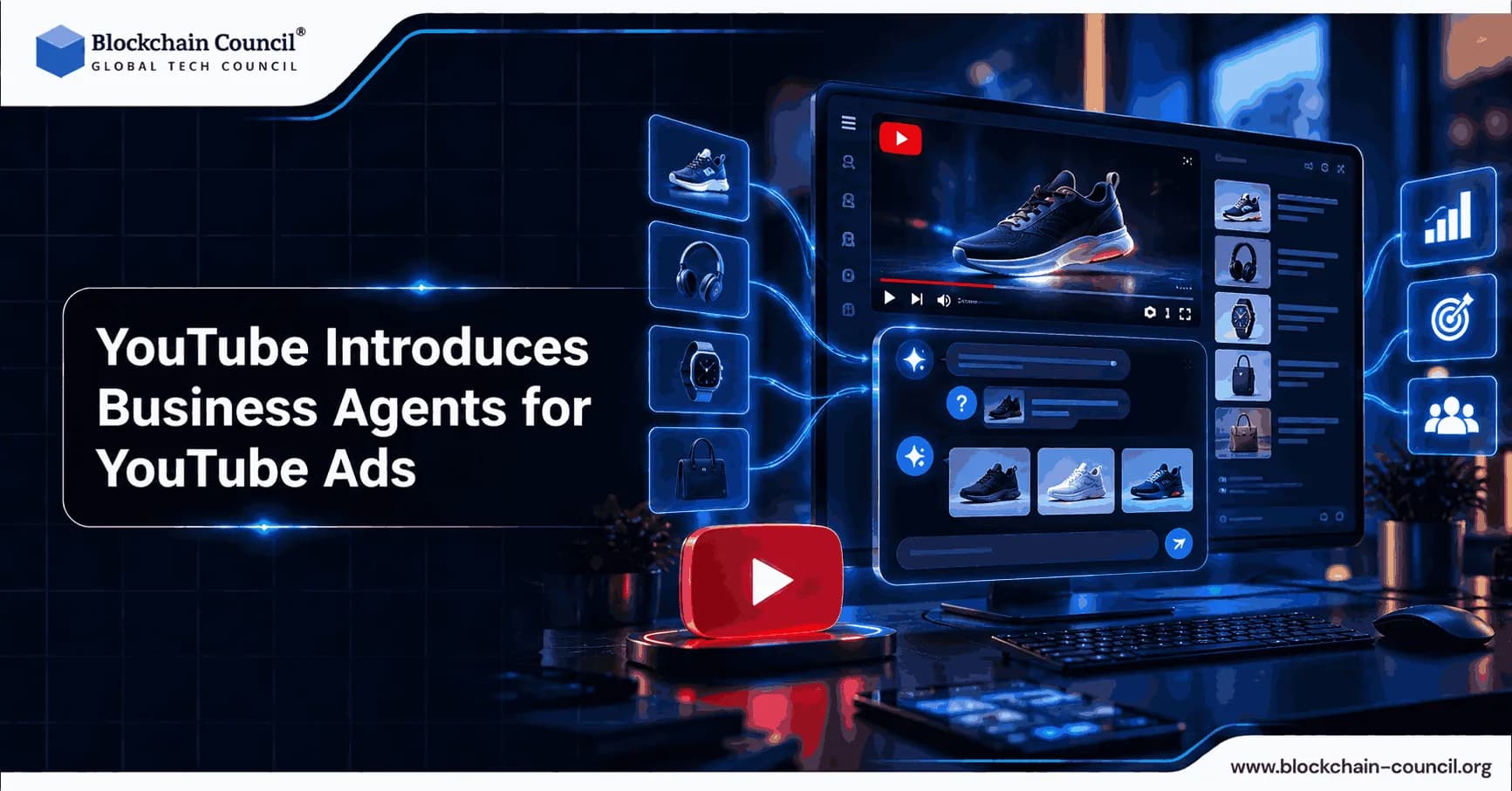
YouTube is changing the way people shop while they watch. Google has started testing a feature called Business Agent inside YouTube Ads, letting viewers ask questions about a product directly inside a video ad and get answers without ever leaving the video. This is one of the clearest signs yet that advertising on YouTube is moving from simple video promotion toward full conversational commerce. For marketers, agency teams, and business owners who want to stay ahead of this shift, this is also a good moment to build real skills in applied AI. Professionals who want a structured, credential-backed path into this space often start with a Certified Agentic AI Expert program, since agentic tools like Business Agent are becoming a normal part of digital advertising rather than a passing trend.
In this article, we will explain what Business Agent is, how it works inside YouTube Ads, why Google is rolling it out now, and what it means for brands, marketers, and everyday viewers. We will keep things simple enough for a complete beginner while still giving enough depth for professionals who manage ad accounts every day.

Understanding Business Agent and Why It Is Entering YouTube Ads
Business Agent is not a brand-new invention. Google first introduced a conversational feature on merchant brand profiles in Search, allowing shoppers to chat with a brand and get answers pulled from product data stored in Merchant Center. That early version has now evolved into a fuller product called Business Agent, and Google is expanding it into new surfaces, including YouTube video ads.
Here is the simple version of how it works. A viewer sees a product-focused video ad on YouTube. Instead of just watching and clicking through to a website, they can ask a direct question, such as whether a jacket comes in a certain size or whether a blender can crush ice. The agent answers using the brand's own product information, pulled from Merchant Center, so the response reflects the retailer's actual catalog rather than a generic chatbot guess.
This matters because it turns the ad itself into a mini research session. Instead of hoping a landing page answers every doubt a shopper has, the ad can now handle some of that back-and-forth right where the viewer already is. Because this area of digital marketing is evolving quickly, many professionals are choosing to strengthen their foundation with a Certified Artificial Intelligence (AI) Expert credential, which covers the core AI concepts behind tools like this one, including how machine learning models process language and generate responses in real time.
A Beta Built for Eligible U.S. Retailers First
As of now, this feature is being tested as a beta with eligible retailers in the United States. Google has not published full eligibility criteria or a firm timeline for other countries, which is fairly typical for early-stage advertising features. Brands interested in testing it should keep an eye on their Google Ads and Merchant Center dashboards, since eligibility notices for beta programs usually appear there first.
How Business Agent Fits Into YouTube's Bigger Shopping Push
YouTube has been building toward shoppable video for years. Shopping ads first appeared on YouTube search results and home feeds, then expanded with sitelinks, product carousels, and Shopping ads tied to search intent. Business Agent is the next layer on top of that history, and it arrives alongside two other connected updates from Google.
AI performance insights in Merchant Center are now generally available in Australia, Canada, India, New Zealand, and the United States. This tool compares a retailer's visibility with other brands across Google's AI Mode and AI Overviews results, then suggests specific actions to improve how often a brand's products show up in AI-generated answers.
The Universal Commerce Protocol (UCP) is also expanding. This is Google's open standard designed to support the full shopping journey, from product discovery through checkout, inside conversational experiences. Merchants using UCP-powered checkout can now enable cart transfer to their own websites and test enhanced checkout flows. These capabilities are rolling out gradually in the U.S., with Australia and Canada planned for next year.
Put together, these three pieces sketch out a more complete picture of what Google calls agentic commerce. A YouTube ad can prompt a question, the brand's product data can shape the answer, and the purchase itself can move through Google's checkout infrastructure with far fewer steps than before.
Why the Product Feed Is More Important Than Ever
None of this works well without accurate, detailed product data. Business Agent pulls directly from a retailer's product feed inside Merchant Center, meaning the quality of a brand's titles, descriptions, pricing, availability, and custom attributes now shapes real customer conversations happening in real time. Google has reported that merchants who follow core Merchant Center feed best practices saw an average conversion lift of around 5% in the following month. Retailers have also started adding conversational attributes to their feeds so the agent has richer context to draw from. In one case Google has cited, roughly half of relevant AI Mode recommendations for a major retail brand incorporated these conversational attributes.
This is a good moment for marketing teams, feed managers, and ecommerce operators to treat their product data as a communication tool rather than simple back-office housekeeping. A messy or outdated feed does not just hurt Shopping ad performance anymore; it can directly produce a wrong or confusing answer inside a live conversation with a potential customer.
What This Means for Marketers, Small Businesses, and Everyday Advertisers
If you are new to YouTube advertising, here is the plain-language takeaway: your video ad can now talk back. A shopper watching a product demo does not have to guess whether an item fits their needs; they can ask right there and get an answer grounded in the brand's actual catalog. For professionals managing campaigns, this changes how creative, product data, and checkout experiences need to work together.
A few practical steps businesses can take right now include:
Auditing product titles, descriptions, and attributes inside Merchant Center for accuracy and completeness
Making sure pricing, availability, and shipping details are consistent across the feed, the website, and customer support scripts
Watching for beta eligibility notices if the business sells to U.S. customers
Setting up proper measurement, such as holdout groups or geo-based testing, before assuming every assisted purchase from the agent is a truly new sale
That last point deserves extra attention. A completed purchase following an in-ad conversation does not automatically prove the agent changed the outcome. It may simply have assisted a shopper who was already going to buy. Retailers testing this feature should build measurement into their plan from day one rather than treating every conversation-influenced sale as pure incremental revenue.
Because agentic advertising touches creative, ecommerce, data feeds, and analytics all at once, no single department can own it alone. Media teams typically manage the YouTube creative, ecommerce teams manage the feed and checkout, and analytics teams manage measurement. Teams that want a shared technical vocabulary across these groups often turn to a broader Tech Certification path, which helps non-engineers understand how AI systems, APIs, and structured data pipelines actually function behind the scenes. This kind of cross-functional literacy is becoming just as valuable as creative skill when a single feature update can touch four different teams at once.
What Retailers Still Cannot Fully Measure
Google's announcement leaves a few practical questions open. There is no published reporting dashboard yet specifically for conversations happening inside a YouTube ad through Business Agent, though Google has said analytics for UCP capabilities are coming soon. Brands should treat AI visibility metrics, like share of voice in AI Mode, as one input among many rather than a full replacement for traditional conversion and profitability reporting. Share of voice can tell you where your brand shows up, but it cannot by itself tell you whether that visibility is translating into profitable sales.
Why Video Is Becoming the New Storefront
There is a reason Google chose YouTube for this expansion rather than keeping Business Agent limited to Search. Video already plays an outsized role in how people research purchases, especially for products where fit, features, or use cases are hard to judge from a still image. A viewer watching a product demonstration is already in a research mindset, which makes that moment a natural place to answer follow-up questions instantly.
This same appetite for interactive, story-driven video content is showing up in other corners of the internet too. One emerging application is AI microdrama, where generative AI helps bring serialized stories, characters, and fictional worlds to life. Much like Business Agent is turning a simple product ad into an interactive research moment, AI microdrama platforms are turning short-form storytelling into something viewers can shape and engage with directly, rather than just watch passively. Both trends point in the same direction: audiences increasingly expect video content, whether it is an ad or a story, to respond to them rather than simply play in front of them.
Preparing Your Team and Career for Agentic Advertising
YouTube's move toward Business Agent is part of a much larger shift happening across digital marketing, where AI agents are taking on tasks that used to require a human on the other end of a chat window or phone call. This shift is creating real demand for people who understand both the marketing side and the technical side of these tools.
For marketing professionals specifically, staying current with how AI is reshaping campaign strategy, audience targeting, and customer conversations has become part of the job description rather than an optional extra. A structured Marketing Certification can help marketers connect traditional campaign skills, like audience segmentation and creative testing, with the newer realities of conversational and agentic ad formats. Whether someone is running YouTube campaigns for a small business or managing enterprise ad budgets, understanding how tools like Business Agent actually work under the hood makes it much easier to set realistic expectations, brief creative teams correctly, and explain results to leadership.
The Bigger Picture for YouTube Ads
Business Agent inside YouTube Ads is still a beta, and Google has been upfront that several details, including full eligibility rules, international rollout timing, and detailed conversation analytics, are still being worked out. But the direction is clear. YouTube ads are shifting from a one-way broadcast format into a two-way conversation, backed by the same product data that already powers Shopping campaigns and Merchant Center.
For advertisers, the near-term task is refreshingly practical: keep product data accurate, keep messaging consistent across every customer touchpoint, and build proper measurement before scaling any beta feature. For professionals and businesses that want to be ready for what comes after this beta, now is a sensible time to build stronger AI and marketing fundamentals, since agentic advertising features like this one are unlikely to be a one-time experiment.
Frequently Asked Questions
1. What Is Business Agent for YouTube Ads?
Business Agent for YouTube ads is an AI-powered conversational feature that allows eligible retailers to provide product assistance directly within YouTube ads. Viewers can ask questions about products and receive tailored answers without leaving the YouTube experience. The feature is currently being tested as a beta in the U.S. for eligible retailers.
2. How Does Business Agent Work in YouTube Ads?
Business Agent is embedded directly within eligible YouTube advertisements. A viewer can interact with the agent, ask product-related questions, and receive information designed to help with their purchase research.
3. Why Is YouTube Introducing AI Business Agents?
The feature is designed to help bridge the gap between discovering a product and researching whether it is suitable for a particular need. Instead of requiring viewers to leave YouTube and search elsewhere, the Business Agent can provide conversational assistance within the ad experience.
4. What Can Viewers Ask a YouTube Business Agent?
Viewers can ask questions about products, features, specifications, use cases, and other purchase-related information. The goal is to support more detailed product research through a conversational interaction.
5. Can Business Agent Answer Complex Product Questions?
Yes. Google says the YouTube Business Agent experience allows viewers to conduct self-directed research and ask complex product questions. The agent provides tailored guidance based on the retailer's product information and available business data.
6. Does Business Agent Replace Traditional YouTube Ads?
No. Business Agent adds a conversational layer to eligible advertising experiences rather than replacing YouTube advertising altogether. Traditional YouTube campaigns can still use video ads, audience targeting, bidding, creative assets, and performance measurement.
7. How Is Business Agent Different From a Traditional Chatbot?
A traditional chatbot is often accessed through a website, application, or separate messaging interface. Business Agent is integrated directly into the YouTube advertising experience, allowing viewers to interact with an AI assistant while researching a product from an ad.
8. How Could Business Agent Change YouTube Advertising?
It could make YouTube ads more interactive by turning a traditionally one-way advertising format into an opportunity for conversation. Instead of only watching an advertisement, viewers can potentially ask questions and receive information that supports their purchase research.
9. How Can Business Agent Help Retailers?
Retailers can use the feature to provide product information while potential customers are actively engaging with an advertisement. This could help businesses address common product questions earlier in the customer journey and potentially reduce friction between discovery and consideration.
10. How Does AI Improve Product Discovery on YouTube?
AI can make product discovery more interactive by allowing viewers to ask questions instead of relying solely on predefined advertising messages. Conversational assistance can help users explore product information based on their individual questions and interests.
11. Can Business Agent Help Customers Make Purchase Decisions?
Business Agent is designed to provide information and guidance that can support product research and purchasing decisions. However, customers should still evaluate product information, pricing, availability, policies, and other relevant details before making a purchase.
12. Does Business Agent Keep Users on YouTube?
One of its key purposes is to provide product research within the YouTube context. Google says viewers can ask questions and receive tailored guidance without leaving YouTube, potentially reducing the need to switch between multiple websites or applications during research.
13. What Role Does Gemini Play in Google's Advertising AI?
Google is increasingly using Gemini across its advertising products and AI-powered marketing tools. At Google Marketing Live 2026, Google described Gemini as a core technology behind new advertising, creative, measurement, and agentic marketing capabilities.
14. How Is Business Agent Related to Google's Other Marketing Agents?
Business Agent is part of Google's broader move toward agentic marketing tools. Other products, including Ask Advisor, are designed to connect marketing data and provide AI-assisted recommendations and actions across Google Ads, Google Analytics, Merchant Center, and other marketing products.
15. What Are the Benefits of AI Agents in Advertising?
AI agents can potentially reduce friction in customer interactions, provide information faster, automate parts of marketing workflows, and help advertisers respond to user needs more dynamically. Their usefulness depends on the accuracy of the information, quality of the underlying data, and how the experience is designed.
16. Could Business Agent Improve YouTube Ad Engagement?
It could create additional opportunities for engagement because viewers can interact with an advertisement instead of simply watching it. However, engagement and business results will depend on factors such as product relevance, creative quality, audience intent, agent accuracy, and the overall campaign strategy.
17. Is YouTube Business Agent Available to Everyone?
No. Google currently describes Business Agent for YouTube ads as a beta available to eligible retailers in the United States. Availability, eligibility, and supported features may change as Google expands the program.
18. How Could AI Agents Affect the Future of YouTube Advertising?
AI agents could make advertising increasingly conversational and interactive. Future advertising experiences may allow consumers to ask questions, compare products, receive personalized information, and move toward actions such as shopping or lead generation within increasingly integrated digital experiences.
19. What Are the Challenges of AI-Powered Business Agents in Advertising?
Important challenges include providing accurate product information, maintaining appropriate privacy and security practices, avoiding misleading responses, and ensuring that AI-generated guidance remains aligned with the advertiser's actual products and policies. Advertisers will also need to monitor agent performance and customer interactions.
20. What Does Business Agent Mean for the Future of Digital Advertising?
Business Agent represents a shift from advertising as a primarily one-way communication channel toward more conversational experiences. As AI agents become more integrated into Search, YouTube, shopping, and marketing platforms, advertisers may increasingly combine video, product information, conversation, and conversion pathways within a single customer journey.
Related Articles
View All
AI & ML
How LLMs Work in Openclaw: Models, Agents, Tools, and Local Setups
Learn how OpenClaw uses LLMs as pluggable reasoning engines for agents, tools, local models, cloud providers, and JSON-based workflows.

AI & ML
How Prompt, Loop, and Context Engineering Shape Reliable AI Agents
Learn how prompt, loop, and context engineering improve AI agent reliability, enterprise GenAI workflows, orchestration, guardrails, and governance.

AI & ML
Top GPT 5.6 Use Cases in Blockchain, Web3, Cybersecurity, and Business
Explore GPT 5.6 use cases across blockchain, Web3, cybersecurity, and business, with practical workflows, risks, and certification paths.
Trending Articles
What is AWS? A Beginner's Guide to Cloud Computing
Everything you need to know about Amazon Web Services, cloud computing fundamentals, and career opportunities.

Can DeFi 2.0 Bridge the Gap Between Traditional and Decentralized Finance?
The next generation of DeFi protocols aims to connect traditional banking with decentralized finance ecosystems.
How to Install Claude Code
Learn how to install Claude Code on macOS, Linux, and Windows using the native installer, plus verification, authentication, and troubleshooting tips.