

AI Translator Earbuds

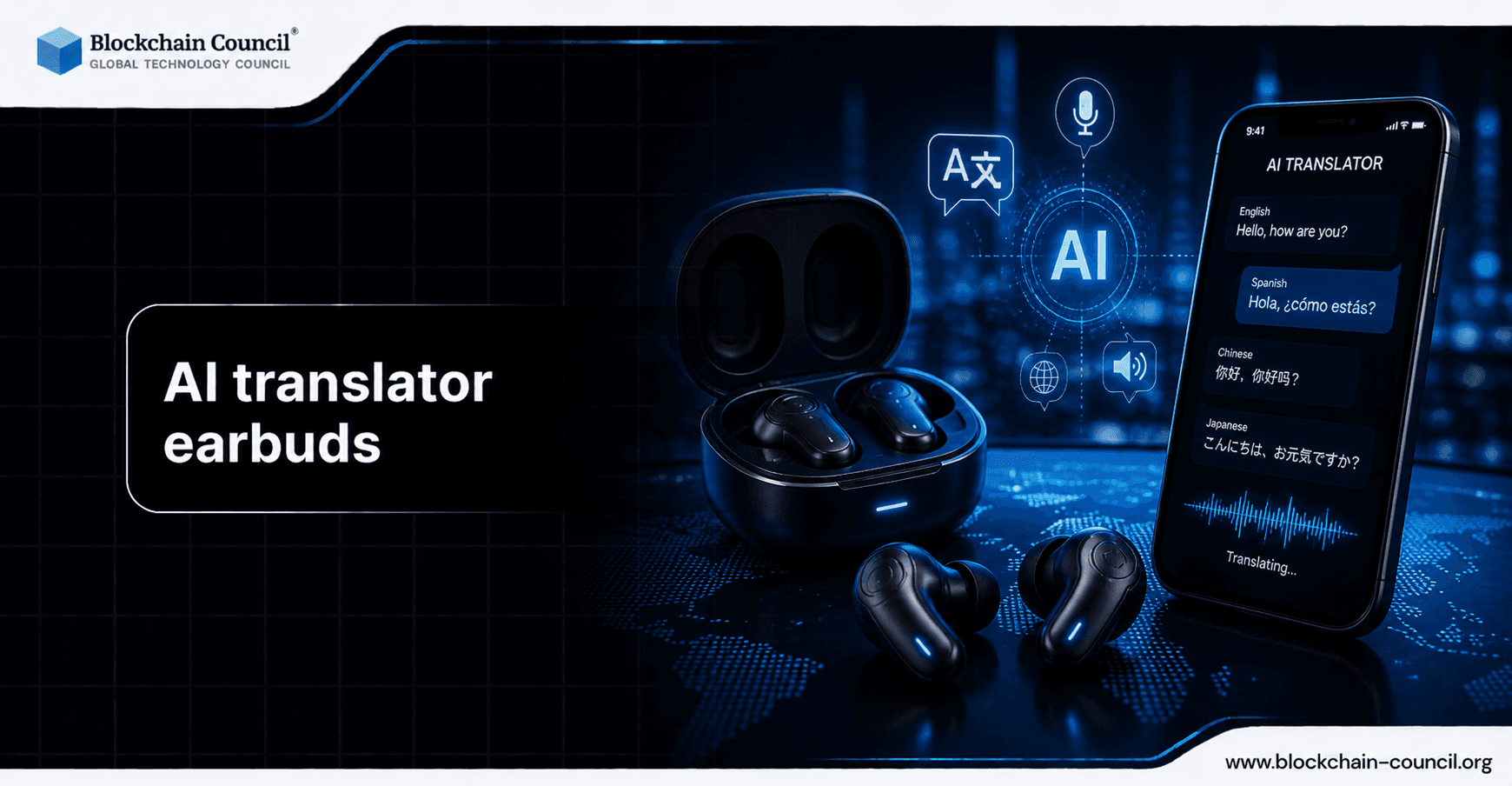
Language barriers have long been one of the biggest challenges in global communication. Whether in travel, business, or education, the inability to understand different languages can limit opportunities and create misunderstandings. However, advancements in artificial intelligence have introduced innovative solutions, one of the most notable being AI translator earbuds.
These smart devices combine speech recognition, machine translation, and audio output to enable real-time language translation. With the ability to translate conversations instantly, AI translator earbuds are transforming how people communicate across cultures and regions.

This article explores the technology behind AI translator earbuds, their features, applications, recent developments, benefits, challenges, and future potential. It also highlights the importance of AI expertise through certifications such as AI expert certification, Claude AI Certification, and ChatGPT Expert certification.
What Are AI Translator Earbuds?
AI translator earbuds are wireless earphones equipped with artificial intelligence that can translate spoken language in real time. These devices capture speech, process it using AI algorithms, and deliver translated audio directly to the user.
They typically include:
Speech recognition systems
Natural language processing (NLP)
Machine translation engines
Audio playback capabilities
The goal is to provide seamless, real-time communication between speakers of different languages.
How AI Translator Earbuds Work
Speech Recognition
The earbuds capture spoken words and convert them into text using speech recognition technology.
Language Processing
Natural language processing analyzes the text to understand context, grammar, and meaning.
Machine Translation
AI models translate the processed text into the target language.
Audio Output
The translated text is converted back into speech and delivered through the earbuds.
This entire process occurs within seconds, enabling near real-time communication.
Key Features of AI Translator Earbuds
Real-Time Translation
Users can communicate instantly without waiting for manual translation.
Multi-Language Support
Most devices support dozens of languages, making them suitable for global use.
Noise Cancellation
Advanced noise reduction improves accuracy in noisy environments.
Mobile App Integration
Many earbuds connect to smartphone apps for enhanced functionality.
Offline Mode
Some devices offer offline translation for limited languages.
Recent Developments in AI Translator Earbuds
Improved Accuracy
Advancements in AI models have significantly improved translation accuracy and contextual understanding.
Faster Processing
Modern devices offer near-instant translation with minimal delay.
Integration with Generative AI
Some earbuds are integrating generative AI technologies to improve conversational flow.
Enhanced Voice Recognition
AI systems are becoming better at recognizing accents and dialects.
Real-World Applications
Travel and Tourism
Travelers use AI translator earbuds to communicate with locals, navigate unfamiliar environments, and enhance their experiences.
Business Communication
Professionals use these devices for international meetings and negotiations, reducing language barriers.
Education
Students use AI earbuds to learn new languages and interact with global peers.
Healthcare
Medical professionals use translation devices to communicate with patients from different linguistic backgrounds.
Digital Marketing
Businesses use AI tools to reach global audiences. Professionals can enhance their skills through the AI powered digital marketing course.
Software Development
Developers create and improve translation systems. Programs like the AI Powered coding expert Course support these skills.
Benefits of AI Translator Earbuds
Breaking Language Barriers
These devices enable communication across languages, promoting global interaction.
Convenience
Compact and easy to use, they provide instant translation without additional devices.
Improved Efficiency
They save time compared to manual translation methods.
Accessibility
AI earbuds make translation accessible to a wide range of users.
Challenges and Limitations
Accuracy Issues
Translation accuracy may vary depending on language complexity and context.
Dependence on Internet
Some features require an internet connection.
Privacy Concerns
Processing speech data raises concerns about data security.
Cost
High-quality devices can be expensive.
Importance of AI Skills
As AI technologies evolve, understanding them becomes essential. Certifications such as:
help professionals stay competitive in the job market.
Future of AI Translator Earbuds
The future includes:
More accurate and context-aware translations
Support for additional languages
Integration with augmented reality devices
Improved offline capabilities
AI translator earbuds will continue to evolve, making global communication even more seamless.
Best Practices for Using AI Translator Earbuds
Speak clearly and at a moderate pace
Use supported languages for best results
Ensure proper device setup
Update software regularly
Ethical Considerations
Users and developers must ensure:
Responsible data usage
Privacy protection
Transparency in AI systems
Conclusion
AI translator earbuds are transforming global communication by breaking down language barriers and enabling real-time interaction. Their applications across travel, business, education, and healthcare demonstrate their potential to improve connectivity and understanding.
As technology continues to advance, these devices will become more accurate, accessible, and integrated into daily life. However, responsible use and continuous improvement are essential to maximize their benefits.
FAQs
1. What are AI translator earbuds?
AI translator earbuds are wireless devices that use artificial intelligence to translate spoken language in real time. They capture speech, process it using AI, and deliver translated audio. These devices make communication across languages easier. They are widely used in travel and business. Their popularity is growing. They represent modern communication tools.
2. How do AI translator earbuds work?
They use speech recognition to capture spoken words and convert them into text. Natural language processing analyzes the text for meaning. Machine translation converts it into another language. The output is delivered as audio. This process happens quickly. It enables real-time communication.
3. Are AI translator earbuds accurate?
Accuracy has improved significantly with advanced AI models. However, it may vary depending on language and context. Complex sentences can be challenging. Noise can affect performance. Continuous improvements are being made. Accuracy is increasing over time.
4. What languages do AI translator earbuds support?
Most devices support multiple languages, often dozens. Popular languages are usually included. Some rare languages may not be supported. Updates may add more languages. Users should check compatibility. Support is expanding.
5. Can AI translator earbuds work offline?
Some models offer offline translation for limited languages. However, full functionality often requires internet access. Offline mode may have reduced accuracy. It is useful in certain situations. Users should plan accordingly. Connectivity improves performance.
6. Who can use AI translator earbuds?
Anyone can use these devices, including travelers, students, and professionals. They are designed to be user-friendly. No technical expertise is required. They are accessible to a wide audience. Adoption is increasing. They are versatile tools.
7. What are the benefits of AI translator earbuds?
Benefits include real-time translation, convenience, and improved communication. They save time and reduce misunderstandings. They enhance global interaction. Users can communicate easily. Efficiency improves. They are valuable tools.
8. What are the limitations of AI translator earbuds?
Limitations include accuracy issues and dependence on internet connectivity. Privacy concerns may arise. Costs can be high for advanced models. Some languages are not supported. Users must be aware. Improvements are ongoing.
9. Are AI translator earbuds secure?
Security depends on the manufacturer and software. Users should avoid sharing sensitive information. Data privacy policies should be reviewed. Responsible use is important. Security measures are improving. Awareness is necessary.
10. How do AI translator earbuds help travelers?
They allow travelers to communicate with locals easily. Navigation becomes simpler. Cultural experiences improve. Language barriers are reduced. Confidence increases. Travel becomes more enjoyable.
11. Can businesses use AI translator earbuds?
Yes, businesses use them for international communication. Meetings and negotiations become easier. Efficiency improves. Miscommunication is reduced. Global collaboration increases. They are useful tools.
12. How do AI translator earbuds improve education?
Students can learn languages more effectively. Communication with international peers improves. Learning becomes interactive. Understanding increases. Teachers can use them as tools. Education benefits significantly.
13. What is the future of AI translator earbuds?
The future includes better accuracy and more languages. Integration with other devices will increase. Offline capabilities will improve. Adoption will grow. Innovation will continue. They will become more advanced.
14. Are AI translator earbuds expensive?
Prices vary depending on features and quality. Basic models are affordable. Advanced devices can be costly. Costs are decreasing over time. Value depends on usage. Investment may be worthwhile.
15. Can AI translator earbuds replace human translators?
They cannot fully replace human translators. Complex language nuances require human understanding. AI works best for basic communication. Human expertise is still needed. Collaboration is important. Balance is key.
16. How do AI translator earbuds handle accents?
Modern AI systems are improving in recognizing accents. Accuracy varies depending on the model. Training data affects performance. Continuous updates improve results. Users may need to speak clearly. Performance is improving.
17. What technologies are used in AI translator earbuds?
Technologies include speech recognition, NLP, and machine learning. These systems analyze and translate language. Audio processing is also used. Integration improves functionality. Technology evolves rapidly. Capabilities are expanding.
18. How can I choose the best AI translator earbuds?
Consider features such as language support, accuracy, and connectivity. Check reviews and specifications. Budget is important. Compatibility with devices matters. Testing helps. Informed decisions are better.
19. Why are AI translator earbuds important?
They break language barriers and improve communication. Global interaction becomes easier. They support travel, business, and education. Efficiency increases. Innovation drives their importance. They are essential tools.
20. How can I learn more about AI technologies?
You can learn through courses, certifications, and practice. Online resources provide valuable information. Hands-on experience is important. Learning from experts helps. Staying updated is essential. Knowledge improves skills.
Related Articles
View All
AI & ML
Built to Catch AI Cheating: Rethinking Pre-Employment Assessments with HireValid
Explore how HireValid is rethinking pre-employment assessments with AI-resistant test design, integrity signals, candidate evidence, and human review to address AI-assisted cheating.

AI & ML
AI-Era Hiring Needs AI-Proof Tests: How HireValid Is Redefining Talent Assessment
Explore how HireValid is rethinking talent assessment for the AI era with job-relevant tests, anti-cheating design, integrity signals, and human-reviewed evidence of candidate ability.

AI & ML
Google Launches Gemini 4 Argon: Features and Capabilities
Google has launched Gemini 4 Argon, its flagship AI model for coding, finance, law, cybersecurity and science. Learn its key features, availability, pricing and safety details.
Trending Articles
The Role of Blockchain in Ethical AI Development
How blockchain technology is being used to promote transparency and accountability in artificial intelligence systems.

Top 5 DeFi Platforms
Explore the leading decentralized finance platforms and what makes each one unique in the evolving DeFi landscape.
How Blockchain Secures AI Data
Understand how blockchain technology is being applied to protect the integrity and security of AI training data.