

AI Prompts That Can Restore Old Photos in Seconds
 Suyash Raizada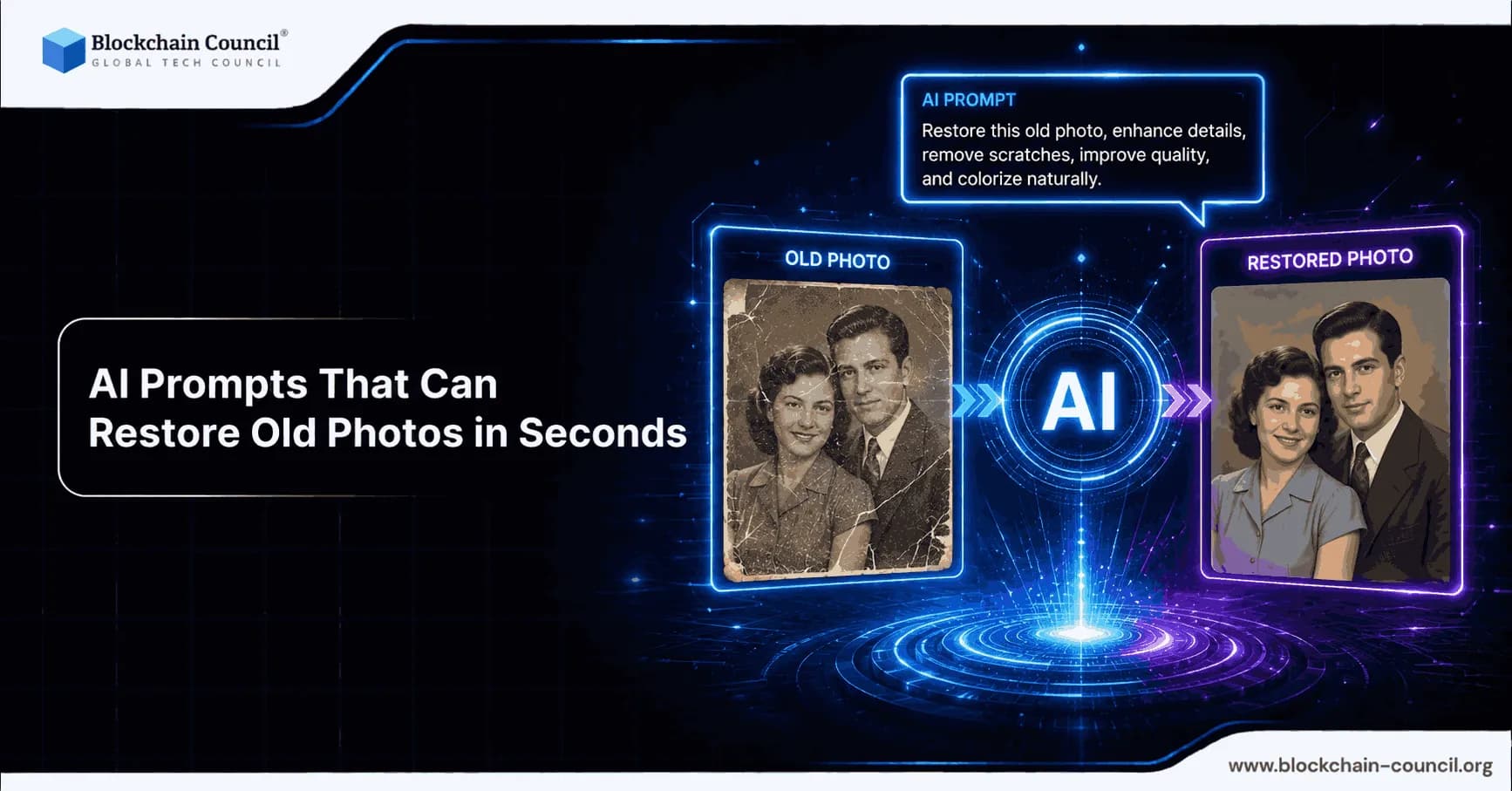
Old photographs preserve some of life’s most valuable memories. Family portraits, childhood snapshots, wedding pictures, and historical images often carry emotional and cultural significance. Unfortunately, many old photos become damaged over time due to fading, scratches, stains, tears, blur, or low resolution. Traditionally, restoring these images required professional editing skills and expensive software. Today, artificial intelligence is changing that process completely.
Modern AI tools can now restore old photographs within seconds using carefully written prompts. These prompts guide AI systems to repair damage, sharpen faces, colorize black-and-white images, remove noise, and improve image quality automatically. What once required hours of manual editing can now be completed with a single instruction. Humanity spent decades carefully storing family photos in dusty boxes only to discover the future solution was typing “remove scratches and enhance details” into a chatbot. Astonishingly efficient species.

As AI-generated content and automation continue growing, professionals are increasingly improving their AI instruction-writing abilities through the Prompt engineering certification, which helps users master advanced prompting techniques for AI systems.
At the same time, businesses and creators are pursuing the AI Expert certification to understand practical AI implementation strategies across industries.
What Is AI Photo Restoration?
AI photo restoration refers to the use of artificial intelligence algorithms to repair, improve, and enhance damaged or old images automatically. AI models analyze visual patterns, recognize missing details, and reconstruct image quality using deep learning techniques.
Modern AI restoration tools can:
Remove scratches and stains
Repair torn photographs
Sharpen blurry faces
Enhance image resolution
Colorize black-and-white photos
Reduce image noise
Restore faded details
Improve lighting and contrast
These tools use advanced computer vision systems trained on millions of images to predict and recreate realistic visual details.
Why AI Prompts Matter in Photo Restoration
AI restoration tools work best when users provide clear and detailed prompts. A prompt acts as an instruction that tells the AI what improvements should be applied to the image.
For example, instead of simply writing:
“Restore this image”
A more effective prompt would be:
“Restore this old black-and-white family portrait by removing scratches, sharpening facial details, improving lighting, and preserving natural skin texture.”
The second prompt gives the AI clearer direction, leading to better results.
Importance of Prompt Engineering
Prompt engineering has become one of the most valuable AI skills because AI output quality depends heavily on instruction quality.
Professionals learning advanced prompting techniques are increasingly enrolling in the Prompt engineering certification to improve AI-generated image, text, and automation workflows.
Apparently humanity invented machines capable of recreating century-old photographs, then discovered the hardest part was still “writing good instructions.” Some traditions never disappear.
How AI Restores Old Photos
AI restoration systems rely on deep learning and neural networks to analyze image damage and reconstruct missing information.
Facial Recognition and Enhancement
AI tools can identify faces in old photos and restore missing details such as:
Eyes
Skin texture
Hair definition
Facial symmetry
Expressions
This is particularly useful for historical family photographs.
Noise and Scratch Removal
AI can automatically detect scratches, stains, grain, and dust marks. It then removes these imperfections while preserving important image details.
Colorization
Modern AI systems can colorize black-and-white images using contextual understanding. The AI predicts realistic skin tones, clothing colors, and environmental details.
Super Resolution
AI-powered upscaling improves image resolution and sharpness, making low-quality photographs appear clearer and more detailed.
Best AI Prompts for Restoring Old Photos
The effectiveness of photo restoration often depends on prompt quality. Below are examples of powerful AI prompts creators and photographers use.
Basic Restoration Prompt
“Restore this old photograph by removing scratches, repairing damage, improving sharpness, and enhancing facial details while preserving the original appearance.”
Black-and-White Photo Colorization Prompt
“Colorize this black-and-white family portrait with realistic skin tones, natural lighting, detailed clothing colors, and historically accurate color preservation.”
High-Detail Portrait Restoration Prompt
“Enhance this vintage portrait by sharpening facial features, restoring damaged areas, removing grain, and improving overall image clarity in high resolution.”
Historical Image Restoration Prompt
“Restore this historical photograph by repairing tears, enhancing contrast, reducing blur, and preserving authentic historical details without over-editing.”
Wedding Photo Restoration Prompt
“Restore this old wedding photo by improving brightness, sharpening faces, removing stains, and preserving emotional and natural image quality.”
AI Tools Used for Photo Restoration
Several AI-powered tools now support advanced image restoration workflows.
Adobe Photoshop AI Features
Adobe integrates AI-powered restoration tools through generative AI and neural filters.
Remini
Remini specializes in enhancing blurry and low-quality facial images using AI technology.
MyHeritage AI Restoration
MyHeritage offers historical photo enhancement and animation features designed for family photographs.
Topaz Labs
Topaz Labs provides advanced AI-powered sharpening, denoising, and upscaling tools.
Stable Diffusion and Generative AI Models
Advanced users use generative AI systems like Stable Diffusion with prompts for customized restoration workflows.
Professionals working with AI-based image systems often combine technical AI skills with the AI Powered coding expert Course to build automation workflows and AI-assisted creative applications.
AI Prompts for Different Types of Old Photos
Different image types require different restoration strategies.
Family Portraits
Family portraits often require facial enhancement and natural color restoration.
Example prompt:
“Restore this vintage family portrait with natural facial details, realistic skin tones, soft lighting, and high-resolution enhancement.”
Historical Documents and Archives
Historical images require careful restoration without losing authenticity.
Example prompt:
“Repair this historical archive photo by removing damage, enhancing readability, and preserving original textures and details.”
Childhood Photographs
Childhood images often suffer from blur and fading.
Example prompt:
“Enhance this faded childhood photograph by sharpening details, restoring color balance, and improving image clarity naturally.”
Group Photos
Group images require balanced facial restoration across multiple subjects.
Example prompt:
“Restore this old group photograph by sharpening all faces evenly, reducing grain, improving brightness, and maintaining realistic textures.”
Benefits of AI Photo Restoration
AI-powered restoration offers several major advantages.
Faster Processing
Images can be restored within seconds instead of hours.
Lower Costs
Users no longer need expensive professional editing services for basic restoration tasks.
Accessibility
Even beginners can restore old photos using simple prompts and AI tools.
Preservation of Family History
AI helps families preserve historical memories and digitize aging photographs.
Improved Creative Workflows
Photographers and creators can integrate AI restoration into larger editing pipelines.
Human beings spent generations carefully preserving physical photo albums only to realize future grandchildren would probably restore everything from a smartphone while eating cereal.
AI and Social Media Content
Restored old photos are increasingly being shared on social media platforms, family archives, and genealogy websites.
Content creators use restored photos for:
Family storytelling
Historical documentaries
YouTube content
Instagram nostalgia pages
Educational projects
Digital marketing campaigns
Professionals using AI-generated visuals in campaigns are increasingly pursuing the AI powered digital marketing course and the AI Powered marketing certification to improve AI-driven content and branding strategies.
Role of Agentic AI in Image Restoration
One of the newest developments in AI workflows is the rise of agentic AI systems.
Agentic AI refers to autonomous systems capable of handling multi-step tasks independently.
How Agentic AI Helps Restoration Workflows
AI agents can:
Scan image quality
Identify damage automatically
Apply restoration prompts
Enhance image resolution
Organize restored files
Generate archive metadata
This reduces manual work and improves scalability for photographers, historians, and content creators.
Professionals interested in autonomous AI workflows are increasingly pursuing the Agentic AI expert certification to learn advanced AI automation systems.
Challenges and Ethical Considerations
Although AI restoration tools are powerful, users should remain aware of certain challenges.
Over-Restoration
Excessive sharpening or artificial colorization may reduce image authenticity.
Historical Accuracy
AI-generated colors may not always match real historical details.
Privacy Concerns
Users should handle sensitive family images responsibly when using online AI tools.
AI Bias
AI systems trained on limited datasets may sometimes produce unrealistic restorations.
The internet already struggles to preserve modern reality accurately. Expecting perfect historical reconstruction from algorithms may be slightly ambitious.
Future of AI Photo Restoration
AI restoration technology continues advancing rapidly.
More Realistic Colorization
Future AI systems will likely improve historical color prediction accuracy.
Better Facial Reconstruction
AI models are becoming more effective at restoring damaged facial details.
Automated Restoration Pipelines
Future workflows may combine restoration, enhancement, organization, and archiving automatically.
Mobile AI Restoration Apps
Smartphone AI restoration tools are becoming more accessible for casual users.
Real-Time AI Editing
Future systems may allow instant restoration previews and live editing suggestions.
Importance of AI Certifications in Modern Creative Workflows
As AI tools become increasingly integrated into photography, design, marketing, and content creation, AI expertise is becoming highly valuable.
Professionals are developing skills in:
Prompt engineering
AI-assisted editing
Automation workflows
AI coding
Marketing optimization
Agentic AI systems
Programs such as the Prompt engineering certification help professionals master advanced prompting techniques for AI systems.
Similarly, the AI Expert certification provides broader AI implementation knowledge across industries.
Technical professionals are also strengthening automation and development skills through the AI Powered coding expert Course, while marketers improve AI-driven campaign strategies through the AI powered digital marketing course and the AI Powered marketing certification.
Conclusion
AI-powered photo restoration has transformed the way people preserve and restore historical memories. With the help of carefully written prompts, users can repair damaged photographs, enhance image quality, restore color, and preserve valuable family history within seconds.
From professional photographers and designers to casual users restoring family albums, AI tools are making image restoration faster, more affordable, and more accessible than ever before.
At the same time, prompt quality remains one of the most important factors in achieving realistic and accurate restoration results. As AI continues evolving, professionals who understand prompt engineering, automation, and AI-assisted workflows will gain significant advantages in creative industries.
Most importantly, these technologies help preserve memories that might otherwise fade forever. Humans may be chaotic, sentimental creatures, but preserving fragments of personal history across generations remains one of the species’ better habits.
FAQs
1. What is AI photo restoration?
AI photo restoration is the process of using artificial intelligence to repair damaged or old photographs automatically. AI systems can remove scratches, sharpen blurry areas, improve lighting, and restore faded details. These tools use deep learning algorithms to recreate missing image information. The process is much faster than traditional manual editing.
2. How do AI prompts improve photo restoration?
AI prompts guide the restoration system by providing detailed instructions about the desired outcome. A clear prompt helps the AI understand whether to sharpen faces, remove scratches, or colorize the image. Better prompts usually produce more accurate and realistic results. Prompt quality plays a major role in restoration effectiveness.
3. Can AI restore black-and-white photos?
Yes, AI can restore and colorize black-and-white photos using advanced machine learning models. These systems predict realistic colors for skin tones, clothing, and backgrounds. Many AI tools also improve sharpness and remove image damage during the process. Human review is still important for historical accuracy.
4. Which AI tools are popular for photo restoration?
Popular AI restoration tools include Adobe Photoshop AI features, Remini, Topaz Labs, MyHeritage AI, and Stable Diffusion workflows. These tools support image enhancement, sharpening, denoising, and colorization. Different platforms are designed for both beginners and professional editors. Many mobile apps now also support AI restoration features.
5. Can AI fix blurry old photos?
Yes, AI can improve blurry images by sharpening facial features and reconstructing missing details. Deep learning models analyze patterns and predict clearer image structures. This is especially useful for damaged portraits and low-resolution scans. Extremely damaged photos may still require manual editing assistance.
6. Is AI photo restoration accurate?
AI restoration is often highly effective, but results may vary depending on image quality and prompt clarity. AI systems sometimes generate inaccurate colors or facial details if source images are heavily damaged. Human review helps improve authenticity and accuracy. Most modern AI tools continue improving rapidly.
7. What is prompt engineering in AI restoration?
Prompt engineering involves writing detailed instructions that guide AI systems effectively. In photo restoration, prompts help define enhancements such as sharpening, color correction, or damage repair. Better prompts improve image quality and reduce unwanted changes. Prompt engineering has become an important AI skill across industries.
8. Can beginners use AI restoration tools?
Yes, most AI restoration tools are designed to be beginner-friendly. Users can upload images and apply simple prompts or presets within seconds. Many platforms require little or no technical editing experience. This makes AI restoration accessible to casual users and families.
9. Does AI replace professional photo editors?
AI helps automate many restoration tasks, but professional editors are still important for complex or historically sensitive projects. Human expertise is often needed for detailed corrections and creative decisions. AI works best as an assistant rather than a full replacement. Professional workflows often combine AI with manual editing.
10. How long does AI restoration take?
Most AI restoration tools can process images within seconds or minutes depending on image complexity and system performance. Cloud-based tools often work very quickly for basic enhancements. Larger files or advanced workflows may take longer. AI dramatically reduces restoration time compared to manual editing.
11. Can AI restore torn or scratched photos?
Yes, AI can detect scratches, tears, stains, and dust marks automatically. The system reconstructs damaged areas using surrounding image details and learned visual patterns. This helps improve image quality while preserving the original appearance. Severe damage may still require additional editing.
12. Is AI restoration useful for family archives?
AI restoration is highly useful for preserving family history and digitizing old photographs. Families can restore aging albums, improve image clarity, and preserve memories for future generations. AI also helps organize and archive historical collections efficiently. Digital preservation has become increasingly important.
13. Can AI upscale low-resolution images?
Yes, AI-powered super resolution tools can improve image resolution and sharpness. These systems reconstruct additional details to create clearer and higher-quality images. Upscaling is commonly used for printing and digital sharing. Modern AI tools provide much better results than traditional resizing methods.
14. Are AI restoration tools expensive?
Many AI restoration tools offer free or affordable pricing plans. Some professional platforms charge subscription fees for advanced features and higher-resolution processing. Casual users can often restore basic images without major costs. Enterprise-grade editing systems may require more advanced subscriptions.
15. Can AI restore historical photographs?
Yes, AI is widely used to restore historical archives and vintage photographs. Historians and museums use AI to repair damage and improve visibility. However, maintaining historical authenticity remains important during restoration. Human oversight is recommended for archival projects.
16. What are the risks of AI photo restoration?
AI restoration may sometimes generate unrealistic details, inaccurate colors, or over-processed results. Privacy concerns may also arise when uploading personal photos to cloud-based tools. Users should carefully review outputs before sharing or printing images. Responsible AI usage remains important.
17. Can AI help photographers professionally?
Yes, photographers use AI restoration tools to improve editing workflows, reduce manual tasks, and deliver faster client results. AI also assists with enhancement, sharpening, and image organization. Many professionals combine AI with traditional editing software. This improves efficiency and scalability.
18. How does agentic AI support restoration workflows?
Agentic AI systems can automate multi-step restoration tasks such as image analysis, enhancement, organization, and metadata generation. These autonomous workflows reduce repetitive work for creators and archivists. AI agents improve scalability for large restoration projects. This technology is becoming increasingly advanced.
19. Why are AI certifications important for creators?
AI certifications help professionals understand prompting, automation, AI-assisted editing, and workflow optimization. They improve technical credibility and career opportunities in digital industries. Structured AI learning is becoming increasingly valuable across creative professions. Many businesses now seek professionals with verified AI expertise.
20. What is the future of AI photo restoration?
The future of AI photo restoration will likely include better color accuracy, improved facial reconstruction, and more advanced automation systems. Mobile AI restoration apps and real-time editing tools are expected to grow rapidly. AI will continue making restoration more accessible for everyday users. Creative industries will increasingly rely on AI-powered visual enhancement technologies.
Related Articles
View All
AI & ML
Built to Catch AI Cheating: Rethinking Pre-Employment Assessments with HireValid
Explore how HireValid is rethinking pre-employment assessments with AI-resistant test design, integrity signals, candidate evidence, and human review to address AI-assisted cheating.

AI & ML
AI-Era Hiring Needs AI-Proof Tests: How HireValid Is Redefining Talent Assessment
Explore how HireValid is rethinking talent assessment for the AI era with job-relevant tests, anti-cheating design, integrity signals, and human-reviewed evidence of candidate ability.
AI & ML
Google Launches Gemini 4 Argon: Features and Capabilities
Google has launched Gemini 4 Argon, its flagship AI model for coding, finance, law, cybersecurity and science. Learn its key features, availability, pricing and safety details.
Trending Articles
AWS Career Roadmap
A step-by-step guide to building a successful career in Amazon Web Services cloud computing.
What is AWS? A Beginner's Guide to Cloud Computing
Everything you need to know about Amazon Web Services, cloud computing fundamentals, and career opportunities.
How to Create Claude Skills?
Claude Skills are one of the most important features Anthropic has introduced for users who want automation that is structured, consistent and reusable. Instead of giving Claude long instructions ever