

How to Build an AI-Powered Personal Assistant for Everyday Productivity?
 Blockchain Council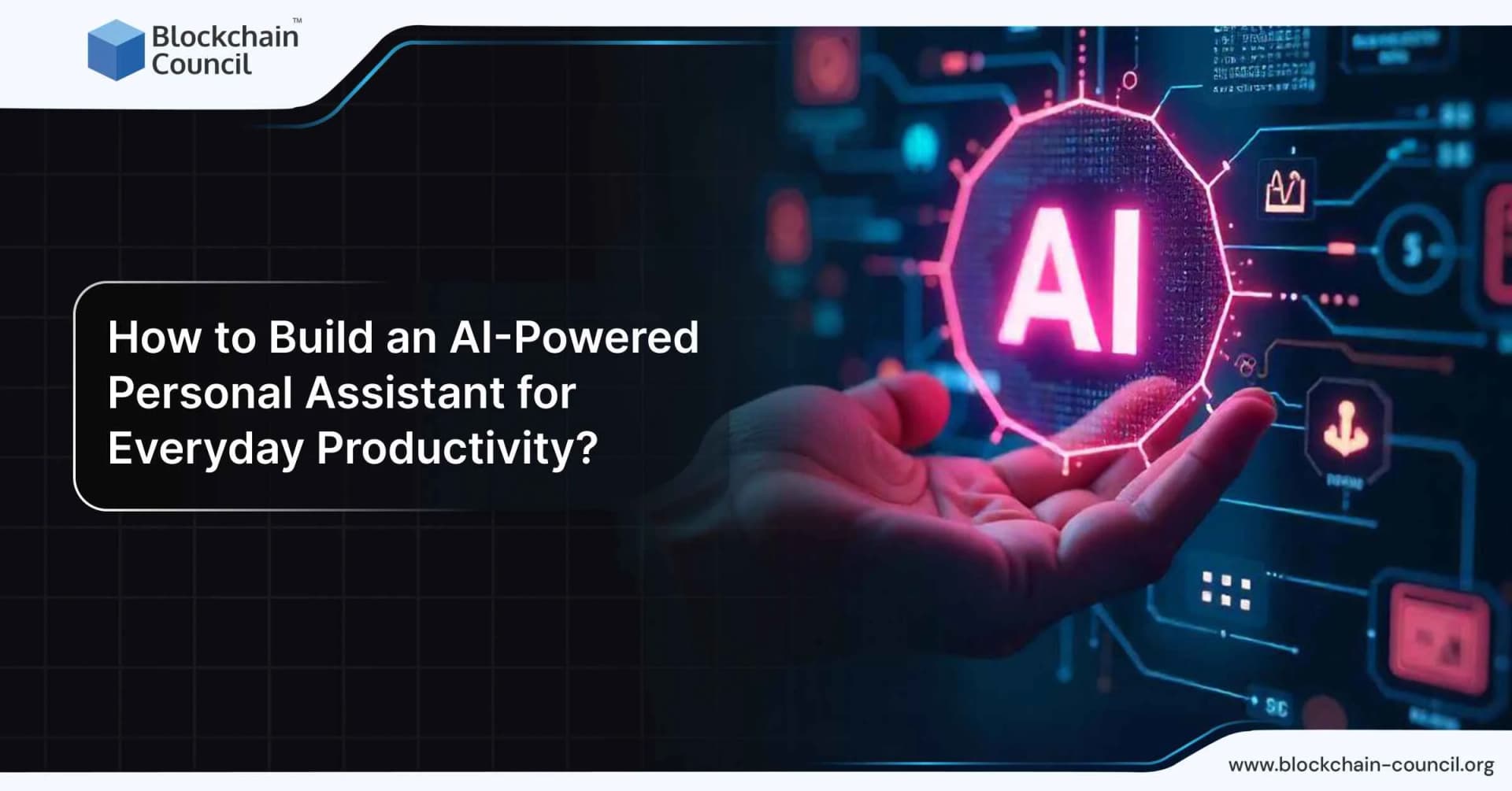
Artificial Intelligence (AI) has revolutionized the way we interact with technology, making everyday tasks more efficient. One of the most practical implementations of AI is building a personal assistant that can handle various tasks such as scheduling, reminders, emails, and even answering queries. In this guide, we will explore how to create an AI-powered personal assistant to enhance productivity.
What is an AI-Powered Personal Assistant?
An AI-powered personal assistant is a software application that leverages machine learning, natural language processing (NLP), and automation to assist users in completing tasks efficiently. Popular examples include Siri, Google Assistant, and Alexa. However, building a customized assistant tailored to personal or business needs offers greater flexibility and control.

Benefits of an AI Personal Assistant
- Time Management – Automates scheduling, reminders, and notifications.
- Task Automation – Handles repetitive tasks like setting alarms and sending emails.
- Improved Communication – Integrates with messaging apps for seamless interaction.
- Data Analysis – Gathers and processes user data for better decision-making.
- Personalization – Adapts to individual preferences and usage patterns.
Key Components of an AI-Powered Personal Assistant
- Natural Language Processing (NLP): Enables the assistant to understand and respond to user queries.
- Machine Learning Algorithms: Enhances response accuracy over time through data analysis.
- Speech Recognition: Converts spoken language into text for processing.
- Task Management: Handles reminders, schedules, and automation.
- Integration with APIs: Connects with third-party applications for extended functionality.
- Security and Privacy: Ensures secure data handling and compliance with privacy regulations.
Step-by-Step Guide to Building an AI-Powered Personal Assistant
Step 1: Define Objectives and Features
Before starting development, outline the assistant’s objectives and features. Common functionalities include:
- Voice and text-based communication
- Task and calendar management
- Email and message automation
- Smart home integration
Step 2: Choose the Right Tech Stack
For AI development, selecting the appropriate technologies is crucial:
- Programming Languages: Python, JavaScript
- Frameworks: TensorFlow, PyTorch
- NLP Libraries: spaCy, NLTK, OpenAI GPT
- Speech Recognition: Google Speech API, IBM Watson
- Databases: MongoDB, Firebase
Step 3: Develop NLP and Speech Recognition
To enable the assistant to understand user queries, use NLP frameworks like spaCy or NLTK. Implement speech-to-text conversion using Google Speech API or IBM Watson.
import speech_recognition as sr
recognizer = sr.Recognizer()
with sr.Microphone() as source:
print(“Listening…”)
audio = recognizer.listen(source)
text = recognizer.recognize_google(audio)
print(f”You said: {text}”)
Step 4: Implement Machine Learning
Train machine learning models to improve responses. Use TensorFlow or PyTorch to build models that adapt to user preferences.
Step 5: Develop Task Management Features
Integrate calendar APIs (Google Calendar, Outlook) to manage scheduling and reminders.
import datetime
reminder_time = datetime.datetime(2025, 2, 10, 9, 0)
print(f”Reminder set for {reminder_time}”)
Step 6: API Integration for Enhanced Functionality
To extend capabilities, connect the assistant with APIs such as:
- Google Calendar API for scheduling
- OpenWeather API for weather updates
- Twilio API for SMS notifications
Step 7: Deploy and Test
Once development is complete, test the assistant across different environments and deploy it on cloud platforms like AWS or Google Cloud.
Future Enhancements for AI Personal Assistants
- Deep Learning Models: To enhance speech recognition and conversational abilities.
- Voice Cloning: Personalizing voice responses.
- IoT Integration: Connecting with smart home devices.
- Multi-Language Support: Expanding user accessibility.
Learn AI and Build Your Own Personal Assistant
To master AI development and create powerful assistants, enroll in the Online Degree in Artificial Intelligence from Blockchain Council. This program provides hands-on training in AI, NLP, and automation.
Additionally, enhance your expertise with certifications like:
- Certified Node.JS Developer™ (Global Tech Council) – Learn backend development to build AI-powered applications.
- Certified React Developer™ (Global Tech Council) – Create responsive UI for your AI assistant.
- Certified SEO Expert® (Universal Business Council) – Optimize AI-based platforms for better reach.
- Certified Instagram Growth Expert (Universal Business Council) – Leverage AI to boost social media presence.
Conclusion
Building an AI-powered personal assistant can significantly improve everyday productivity. By leveraging NLP, machine learning, and automation, you can develop a smart assistant tailored to your needs. With the right training and certifications, you can take your AI development skills to the next level and create innovative AI solutions.
Start your journey today with Blockchain Council’s Online Degree in Artificial Intelligence and unlock the potential of AI for personal and professional growth!
Related Articles
View All
AI & ML
Built to Catch AI Cheating: Rethinking Pre-Employment Assessments with HireValid
Explore how HireValid is rethinking pre-employment assessments with AI-resistant test design, integrity signals, candidate evidence, and human review to address AI-assisted cheating.
AI & ML
AI-Era Hiring Needs AI-Proof Tests: How HireValid Is Redefining Talent Assessment
Explore how HireValid is rethinking talent assessment for the AI era with job-relevant tests, anti-cheating design, integrity signals, and human-reviewed evidence of candidate ability.
AI & ML
Google Launches Gemini 4 Argon: Features and Capabilities
Google has launched Gemini 4 Argon, its flagship AI model for coding, finance, law, cybersecurity and science. Learn its key features, availability, pricing and safety details.
Trending Articles
How Blockchain Secures AI Data
Understand how blockchain technology is being applied to protect the integrity and security of AI training data.
What is AWS? A Beginner's Guide to Cloud Computing
Everything you need to know about Amazon Web Services, cloud computing fundamentals, and career opportunities.

Can DeFi 2.0 Bridge the Gap Between Traditional and Decentralized Finance?
The next generation of DeFi protocols aims to connect traditional banking with decentralized finance ecosystems.