

AI in Food Supply Chains

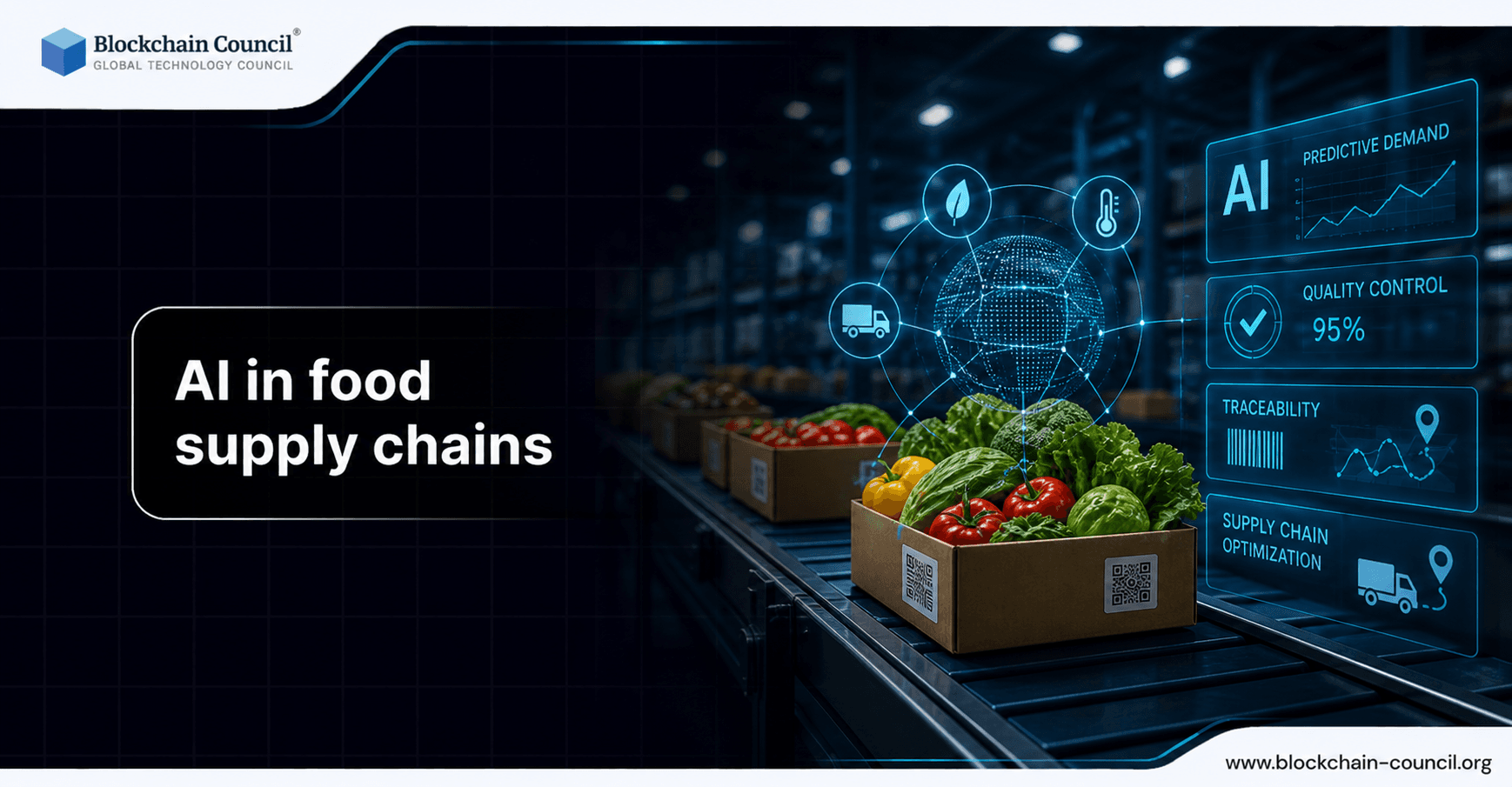
The global food supply chain is one of the most complex and critical systems in the world. It involves multiple stages, including production, processing, transportation, storage, and distribution. Managing this system efficiently is essential to ensure food quality, reduce waste, and meet growing global demand.
Artificial Intelligence (AI) is emerging as a powerful tool to address these challenges. From predictive analytics to real-time monitoring, AI is transforming how food supply chains operate. The integration of AI technologies is enabling smarter decision-making, improving efficiency, and enhancing transparency across the entire supply chain.

This article explores the role of AI in food supply chains, recent developments, real-world applications, benefits, challenges, and future trends. It also highlights the importance of AI expertise through certifications such as AI expert certification, Claude AI Certification, and ChatGPT Expert certification.
Understanding Food Supply Chains
A food supply chain includes all the processes involved in delivering food from farms to consumers. It typically consists of:
Agricultural production
Processing and packaging
Storage and transportation
Distribution and retail
Each stage presents challenges such as demand fluctuations, spoilage, logistics inefficiencies, and regulatory compliance.
Role of AI in Food Supply Chains
AI introduces advanced capabilities that help optimize each stage of the supply chain. It uses machine learning, data analytics, and automation to improve efficiency and decision-making.
Predictive Analytics
AI analyzes historical data to forecast demand, helping businesses optimize inventory and reduce waste.
Supply Chain Optimization
AI systems identify inefficiencies and suggest improvements in logistics and operations.
Quality Control
Computer vision systems detect defects and ensure food quality during processing and packaging.
Real-Time Monitoring
AI integrates with IoT devices to monitor temperature, humidity, and other conditions in real time.
Recent Developments in AI for Food Supply Chains
AI-Powered Demand Forecasting
Companies are using AI to predict consumer demand more accurately, reducing overproduction and shortages.
Blockchain and AI Integration
Combining AI with blockchain improves traceability and transparency in food supply chains.
Smart Warehousing
AI-driven robots and automation systems are improving storage and inventory management.
Sustainability Initiatives
AI is helping reduce food waste and optimize resource usage, supporting environmental sustainability.
Real-World Examples
Walmart
Walmart uses AI to monitor food quality and predict shelf life, reducing waste and improving efficiency.
Nestlé
Nestlé uses AI for demand forecasting and supply chain optimization, ensuring timely delivery of products.
IBM Food Trust
IBM integrates AI with blockchain to improve food traceability and safety.
Digital Marketing in Food Industry
AI is also used in marketing food products by analyzing consumer preferences. Professionals can enhance their skills through the AI powered digital marketing course.
AI Development in Supply Chains
Developers build AI systems for logistics and optimization. Programs like the AI Powered coding expert Course support these efforts.
Benefits of AI in Food Supply Chains
Improved Efficiency
AI automates processes and reduces delays, improving overall efficiency.
Reduced Food Waste
Predictive analytics helps manage inventory and minimize spoilage.
Enhanced Transparency
AI improves traceability, ensuring food safety and compliance.
Better Decision-Making
Data-driven insights enable informed decisions across the supply chain.
Challenges and Limitations
Data Quality Issues
AI systems require accurate and reliable data to function effectively.
High Implementation Costs
Deploying AI solutions can be expensive for smaller organizations.
Integration Complexity
Integrating AI with existing systems can be challenging.
Skill Gap
There is a shortage of professionals with expertise in AI and supply chain management.
Importance of AI Skills
As AI adoption increases, the demand for skilled professionals grows. Certifications such as:
help individuals stay competitive and effectively use AI technologies.
Future of AI in Food Supply Chains
The future of AI in food supply chains includes:
Fully automated logistics systems
Advanced predictive analytics
Integration with smart agriculture
Improved sustainability practices
AI will continue to play a crucial role in ensuring efficient and sustainable food systems.
Best Practices for Implementing AI
Start with pilot projects
Ensure data accuracy
Train employees
Monitor system performance
Ethical Considerations
Organizations must ensure:
Responsible data usage
Transparency in operations
Fair and ethical AI practices
Conclusion
AI is transforming food supply chains by improving efficiency, reducing waste, and enhancing transparency. Its applications across production, logistics, and distribution demonstrate its potential to revolutionize the industry.
As global demand for food continues to grow, AI will play an increasingly important role in ensuring sustainable and efficient supply chains. However, its success depends on responsible implementation, skilled professionals, and continuous innovation.
FAQs
1. What is AI in food supply chains?
AI in food supply chains refers to the use of artificial intelligence technologies to manage and optimize processes from production to distribution. It helps analyze data, predict demand, and improve efficiency. AI systems can automate tasks and reduce human errors. They also enhance transparency and traceability. This makes supply chains more reliable. Its use is increasing globally.
2. How does AI improve food supply chains?
AI improves food supply chains by analyzing data and optimizing operations. It helps predict demand and manage inventory effectively. This reduces waste and ensures timely delivery. AI also automates processes, saving time and effort. It enhances decision-making through insights. Overall efficiency improves significantly.
3. What are the benefits of AI in food supply chains?
Benefits include increased efficiency, reduced waste, and improved transparency. AI helps businesses make better decisions. It automates repetitive tasks and reduces costs. Quality control improves. Customer satisfaction increases. These advantages make it valuable.
4. What are the challenges of using AI in food supply chains?
Challenges include high costs, data quality issues, and integration complexity. Implementing AI requires expertise and resources. There may also be resistance to change. Systems must be maintained properly. Ethical concerns must be addressed. These challenges require careful planning.
5. How does AI reduce food waste?
AI reduces food waste by predicting demand and optimizing inventory. It helps manage supply levels effectively. Real-time monitoring ensures proper storage conditions. This prevents spoilage. Businesses can plan better. Waste is minimized.
6. What role does AI play in food safety?
AI improves food safety by monitoring quality and detecting issues. It uses sensors and analytics to identify risks. This ensures compliance with regulations. It enhances traceability. Problems can be addressed quickly. Safety improves significantly.
7. Can small businesses use AI in food supply chains?
Yes, small businesses can use AI through cloud-based solutions. These tools are becoming more affordable. They help improve efficiency and reduce costs. Adoption is increasing. Benefits are significant. Accessibility is improving.
8. What technologies are used in AI supply chains?
Technologies include machine learning, IoT, and computer vision. These systems analyze data and optimize operations. They provide real-time insights. Integration improves performance. Technology is evolving. Applications are expanding.
9. How does AI help in logistics?
AI optimizes routes and schedules for transportation. It reduces delays and costs. Real-time tracking improves efficiency. Businesses can respond quickly. Logistics becomes more reliable. Performance improves.
10. What skills are needed for AI in supply chains?
Skills include data analysis, programming, and supply chain knowledge. Understanding AI concepts is important. Continuous learning is necessary. Certifications can help. Skills improve effectiveness. Demand is growing.
11. How can I learn AI for supply chains?
You can learn through courses, certifications, and practice. Hands-on experience is important. Online resources provide guidance. Learning from experts helps. Staying updated is essential. Practice improves skills.
12. What industries benefit from AI in supply chains?
Industries such as food, retail, and logistics benefit from AI. It improves efficiency and reduces costs. Applications are diverse. Growth is significant. Adoption is increasing. Impact is widespread.
13. What is the future of AI in food supply chains?
The future includes automation and advanced analytics. AI will become more integrated. Sustainability will improve. Innovation will increase. Adoption will grow. It will transform the industry.
14. Is AI in food supply chains expensive?
Initial costs can be high, but long-term benefits outweigh them. Efficiency improvements save money. Scalable solutions are available. Costs are decreasing over time. It is becoming more accessible. Investment is worthwhile.
15. How does AI improve decision-making?
AI provides data-driven insights for better decisions. It analyzes patterns and trends. Businesses can plan effectively. Risks are reduced. Efficiency improves. Decision-making becomes faster.
16. Can AI replace human workers in supply chains?
AI can automate tasks but cannot fully replace humans. Human oversight is still needed. Collaboration is important. Jobs may evolve. Skills development is necessary. Balance is key.
17. What are the ethical concerns of AI in food supply chains?
Concerns include data privacy and fairness. AI decisions must be transparent. Bias should be minimized. Regulations must be followed. Responsible use is important. Awareness is necessary.
18. How does AI support sustainability?
AI helps reduce waste and optimize resources. It improves efficiency. Environmental impact is reduced. Sustainable practices are supported. Innovation drives change. Sustainability improves.
19. Why is AI important in food supply chains?
AI is important because it improves efficiency and reliability. It helps meet growing demand. It reduces waste and costs. Innovation increases. It supports sustainability. Its role is essential.
20. How can businesses implement AI in supply chains?
Businesses can start with small projects and scale gradually. They should ensure data quality and train employees. Monitoring performance is important. Collaboration helps. Planning is essential. Implementation becomes successful.
Related Articles
View All
AI & ML
Built to Catch AI Cheating: Rethinking Pre-Employment Assessments with HireValid
Explore how HireValid is rethinking pre-employment assessments with AI-resistant test design, integrity signals, candidate evidence, and human review to address AI-assisted cheating.

AI & ML
AI-Era Hiring Needs AI-Proof Tests: How HireValid Is Redefining Talent Assessment
Explore how HireValid is rethinking talent assessment for the AI era with job-relevant tests, anti-cheating design, integrity signals, and human-reviewed evidence of candidate ability.

AI & ML
Google Launches Gemini 4 Argon: Features and Capabilities
Google has launched Gemini 4 Argon, its flagship AI model for coding, finance, law, cybersecurity and science. Learn its key features, availability, pricing and safety details.
Trending Articles
The Role of Blockchain in Ethical AI Development
How blockchain technology is being used to promote transparency and accountability in artificial intelligence systems.
AWS Career Roadmap
A step-by-step guide to building a successful career in Amazon Web Services cloud computing.
How Blockchain Secures AI Data
Understand how blockchain technology is being applied to protect the integrity and security of AI training data.