

AI and Human Rights
 Michael Willson
Artificial intelligence is no longer a futuristic idea tucked away in research labs. It is in our phones, our workplaces, our hospitals, and even our courts. As AI spreads across society, it touches almost every aspect of our daily lives. But along with convenience and efficiency, it brings serious questions about human rights. How do we protect privacy when algorithms track our data? How do we ensure equality when AI makes decisions about hiring or loans? How do we safeguard freedom of expression in a world where AI both moderates and generates speech? These are not abstract debates—they are happening now. That is why the relationship between AI and human rights has become one of the defining issues of our time. And for professionals who want to understand and influence this space, gaining an AI certification is a practical step to build credibility and skills.
AI and Human Rights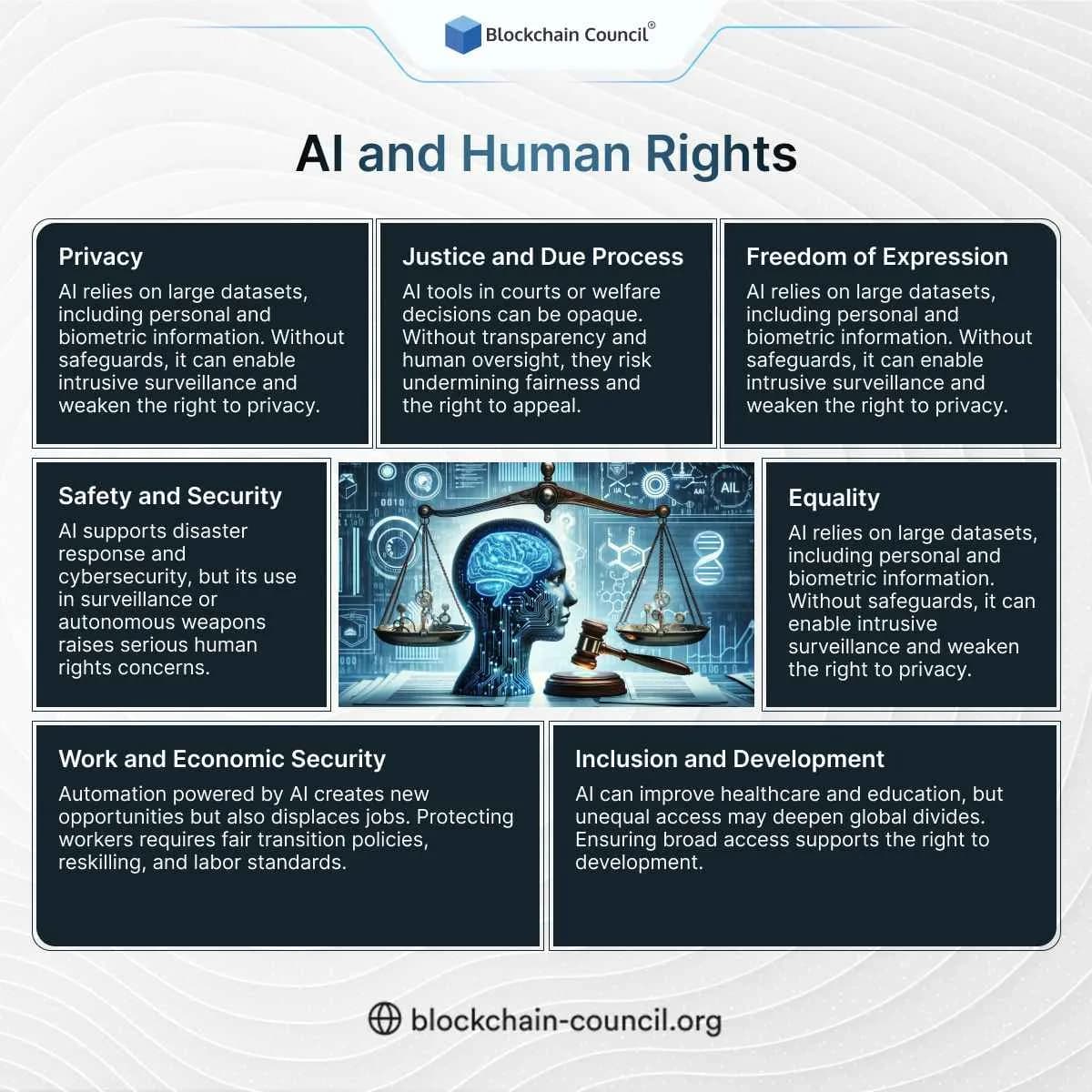
- Privacy
AI relies on large datasets, including personal and biometric information. Without safeguards, it can enable intrusive surveillance and weaken the right to privacy.
- Equality
Algorithms trained on biased data can reinforce discrimination in hiring, policing, or lending. Regular audits and accountability systems are needed to protect fairness.
- Freedom of Expression
AI-driven moderation removes harmful content but can also silence legitimate voices. Errors in filtering threaten free expression and access to diverse viewpoints.
- Work and Economic Security
Automation powered by AI creates new opportunities but also displaces jobs. Protecting workers requires fair transition policies, reskilling, and labor standards.
- Justice and Due Process
AI tools in courts or welfare decisions can be opaque. Without transparency and human oversight, they risk undermining fairness and the right to appeal.
- Safety and Security
AI supports disaster response and cybersecurity, but its use in surveillance or autonomous weapons raises serious human rights concerns.
- Inclusion and Development
AI can improve healthcare and education, but unequal access may deepen global divides. Ensuring broad access supports the right to development.
Privacy Under Pressure
The right to privacy is one of the first casualties in the age of AI. Powerful algorithms can sift through enormous amounts of data, drawing insights about where we live, who we know, and what we like. On the surface, this might seem harmless, even useful. But the scale of surveillance is unprecedented. Governments deploy AI-powered facial recognition cameras in public spaces, tracking citizens without consent. Companies harvest browsing history, purchase records, and location data to create detailed profiles that drive targeted ads.

For many citizens, this means they are constantly watched, even if they are doing nothing wrong. The fear is not just surveillance itself but what it enables: control, manipulation, and chilling effects on free behavior. People may avoid protests, religious services, or controversial conversations simply because they know they are being monitored. The principle that privacy underpins freedom is being tested by the very tools designed to make life more efficient.
Discrimination and Inequality
Another pressing concern is discrimination. AI systems learn from data, and data reflects society’s biases. If past hiring decisions favored men, the AI may continue to prefer male candidates. If historic loan approvals excluded certain racial groups, the AI might replicate that pattern. This is not intentional malice by the machine—it is statistical mimicry of biased data.
The result can be systematic exclusion. Communities already marginalized may find themselves denied access to jobs, housing, or financial services, not because of their individual qualifications but because the AI has absorbed biased patterns from the past. What makes this worse is the opacity. People often do not know why they were rejected or how to challenge the decision. When discrimination is hidden inside algorithms, it becomes harder to confront and correct.
This raises a deeper human rights question: how do we guarantee equality in an age where so many life opportunities are filtered through AI? Laws and oversight bodies are starting to step in, but progress is uneven.
Freedom of Expression and Access to Information
Freedom of expression is another core right at stake. Social media platforms rely on AI moderation systems to filter harmful content. While this helps remove violent or hateful material, it can also suppress legitimate speech. Sarcasm, satire, or minority voices are often flagged incorrectly, leading to unfair censorship.
At the same time, generative AI produces deepfakes and synthetic media that distort truth. During elections, AI-generated videos and articles can spread misinformation at incredible speed, leaving voters confused about what is real. This dual effect—censorship on one side, disinformation on the other—creates a dangerous environment for free expression and informed decision-making.
Democracies rely on shared facts and open debate. If AI undermines both, it risks weakening the foundation of self-government itself.
Transparency and Accountability
One of the most troubling issues with AI is its lack of transparency. Many AI models are “black boxes,” producing decisions without clear explanations of how they were reached. When an AI denies someone a mortgage or flags them as a security risk, they often have no way of knowing why.
This lack of explainability clashes with the human right to due process. Citizens have the right to understand decisions that affect their lives and to challenge them if they are unfair. Without transparency, accountability becomes impossible. Companies and governments can hide behind the complexity of algorithms, leaving individuals powerless.
To address this, some jurisdictions are mandating explainability. The European Union’s AI Act, for example, requires certain high-risk systems to provide human oversight and transparency. But enforcement remains a challenge, and global standards are inconsistent.
The Human Cost of Autonomous Weapons
Perhaps the most extreme example of AI and human rights is its use in weapons. Autonomous systems capable of selecting and engaging targets without human intervention raise profound ethical and legal questions. The right to life, the principle of proportionality in conflict, and the ban on arbitrary killings are all at risk.
Human Rights Watch and other organizations have called for strict limits, if not outright bans, on lethal autonomous weapons. Their argument is simple: decisions about life and death must remain in human hands. Delegating them to machines crosses a moral line that undermines human dignity and international law. Yet, some nations continue to invest heavily in these technologies, seeing them as strategic advantages in warfare.
The debate is not just military but deeply human. If algorithms decide who lives and who dies, can we still claim to uphold the most basic human rights?
Social and Psychological Rights
AI also affects less obvious but equally important rights, such as mental health and well-being. Recommendation algorithms on social media shape what we see, what we think about, and even how we feel. When designed to maximize engagement, these systems often amplify outrage, fear, and anxiety. The right to well-being is compromised when AI exploits human attention for profit.
In some tragic cases, the risks have turned into reality. Lawsuits have emerged alleging that AI systems encouraged harmful behavior, raising questions about duty of care. If an AI chatbot gives unsafe advice or promotes dangerous content, who is responsible? Protecting mental health in the age of AI is becoming as critical as protecting physical rights.
The Opportunity for Positive Impact
While the risks are clear, it is important to note that AI also offers opportunities to strengthen human rights. Activists use AI to analyze satellite images for evidence of mass violence. Legal aid organizations deploy chatbots to help people understand their rights or prepare court documents. Companies are beginning to use AI tools to scan their supply chains for signs of forced labor or child exploitation.
AI can also make governance more inclusive. By translating public consultations into multiple languages and summarizing feedback, AI ensures that more citizens can participate in policymaking. Far from undermining rights, AI can help extend them—if deployed responsibly.
International Treaties and Agreements
One of the most significant steps toward governing AI through a rights-based lens came in 2024, when the Council of Europe introduced the Framework Convention onArtificial intelligence and Human Rights, Democracy and the Rule of Law. This convention is historic because it is the first legally binding international treaty that explicitly connects AI to human rights protections. It emphasizes accountability, transparency, and fairness. Signatory states commit to applying these principles not just in theory but in practical governance of AI systems.
Alongside this, the European Union’s Artificial Intelligence Act, which came into force in 2024, is shaping how AI is regulated globally. The Act classifies AI systems by risk categories: minimal risk, limited risk, high risk, and unacceptable risk. High-risk systems, such as those used in justice, policing, or recruitment, face strict requirements around transparency, oversight, and explainability. Systems deemed unacceptable, like social scoring by governments, are outright banned.
These frameworks show a growing consensus: AI must be constrained when it threatens human dignity or equality. The EU Act is already influencing legislation in other regions, demonstrating how international cooperation can spread standards beyond borders.
National Strategies and Laws
Individual countries are also drafting their own policies to align AI with human rights. Canada, for example, has introduced the Artificial intelligence and Data Act, which requires companies to assess and mitigate risks to human rights before deploying AI systems. In the United States, while there is no single federal law, state-level initiatives are emerging to regulate facial recognition, data privacy, and algorithmic accountability.
In Asia, countries like Singapore and Japan are experimenting with soft-law approaches, such as ethical AI guidelines that encourage companies to adopt fair practices without imposing heavy legal penalties. These frameworks are more flexible but risk being toothless without enforcement. The contrast between strict European regulation and lighter Asian models illustrates the diversity of global approaches.
Corporate Due Diligence
Laws alone are not enough. Companies themselves must take responsibility for ensuring their AI systems respect human rights. This is where Human Rights Impact Assessments (HRIAs) and Fundamental Rights Impact Assessments (FRIAs) come in. These tools allow organizations to evaluate how their AI systems affect people before they are deployed.
For example, a bank introducing an AI system for loan approvals might use an HRIA to test whether the system discriminates against minority groups. A recruitment platform could apply a FRIA to check whether its algorithms unfairly filter out women or older applicants. These assessments are increasingly required under laws like the EU AI Act, but leading companies are also adopting them voluntarily to build trust with customers and regulators.
Another emerging trend is the use of AI for supply chain due diligence. Multinational corporations are under pressure to eliminate forced labor and child labor from their supply chains. AI tools now scan procurement data, satellite imagery, and trade records to flag high-risk suppliers. This makes it harder for abusive practices to remain hidden and strengthens corporate responsibility for human rights.
Civil Society and Advocacy
Civil society organizations play a critical role in ensuring AI governance does not become a purely technical exercise. Groups like Human Rights Watch, Amnesty International, and Privacy International monitor the use of AI in areas such as surveillance, policing, and autonomous weapons. They produce reports, lobby policymakers, and raise public awareness.
One powerful example is advocacy around lethal autonomous weapons. Human rights organizations have argued consistently that delegating life-and-death decisions to machines violates fundamental principles of human dignity and international law. Their campaigns have pushed governments to debate bans or restrictions on such weapons at forums like the United Nations.
Civil society also helps amplify the voices of marginalized communities. Because these groups are often most affected by AI discrimination, advocacy ensures their experiences are represented in policy debates. Without this, governance risks becoming skewed toward the interests of powerful corporations and governments.
Transparency and Explainability Initiatives
Technical innovations are also being directed toward making AI systems more transparent. Researchers and companies are building explainable AI modules that allow humans to understand why an algorithm made a decision. For example, a credit-scoring system might highlight which factors—income, credit history, or repayment patterns—led to a loan denial.
While explainability is not a complete solution, it bridges the gap between complex models and human oversight. Importantly, it also creates a foundation for accountability. If a system can explain itself, individuals can challenge unfair outcomes, and regulators can enforce standards.
There is also growing interest in algorithmic auditing, where independent third parties review AI systems for bias, discrimination, or other risks. Much like financial audits, these reviews create an external check that builds trust. Some companies are even publishing audit results publicly, a step toward greater accountability.
Human Rights in the Workplace
AI is transforming work, and with it, labor rights. Gig economy platforms use AI to assign shifts, set pay rates, and monitor worker performance. Warehouses track productivity through sensors and automated scoring. While these tools can improve efficiency, they often reduce workers’ autonomy and dignity. Employees may feel like they are being managed by algorithms rather than people.
To address this, labor unions and advocacy groups are pushing for worker-centered AI governance. This includes rules requiring human oversight of critical decisions, transparency about how performance is measured, and limits on intrusive surveillance. Protecting labor rights in an AI-driven workplace is as much a human rights issue as freedom of expression or privacy.
Access to Justice
Another governance frontier is access to justice. Courts and legal systems are experimenting with AI tools to improve efficiency. Some use AI to predict case outcomes, recommend sentences, or help draft legal opinions. While these tools promise faster justice, they also raise fairness concerns. If biased data influences sentencing algorithms, entire groups could face systemic discrimination.
On the positive side, AI is expanding access to justice for underserved populations. Nonprofits and startups are building AI-powered legal assistants that help people understand their rights, prepare legal documents, and navigate court systems. In contexts where legal aid is limited, this can be transformative. The balance lies in ensuring these tools are accurate, transparent, and overseen by qualified professionals.
Skills for Governance Professionals
As AI and human rights issues grow more complex, professionals need to build cross-disciplinary skills. Regulators, lawyers, and technologists must work together, not in silos. For those seeking to specialize, programs like the Data Science Certification provide essential skills for analyzing large datasets and detecting bias.
Meanwhile, professionals aiming to connect AI governance with broader organizational strategies can benefit from the Marketing and Business Certification. These programs help link ethical AI deployment with business growth and stakeholder trust. Together, such pathways prepare professionals to handle the real-world challenges of AI governance.
Imagining Possible Futures
The Risk of a “Surveillance-First” Future
One scenario sees AI entrenching authoritarian tendencies. In this world, governments deploy AI-powered facial recognition in every public space, track citizens through their phones, and suppress dissent before it gathers momentum. Predictive policing tools are misused to justify over-policing of minority communities. Generative AI floods the media with propaganda, leaving citizens unable to tell fact from fiction. Human rights organizations continue to resist, but without strong global norms, their voices are drowned out.
This future is not science fiction—it borrows from real experiments already underway in some countries. The fear is that without guardrails, the convenience of AI will be used as a justification for mass control.
The Opportunity of a “Rights-First” Future
Another scenario imagines a different outcome. Here, AI is developed with human rights baked into its design. Public AI platforms are open and auditable. Citizens can see and challenge how decisions are made. Discrimination is actively monitored and corrected through algorithmic audits. Autonomous weapons are banned under international treaties.
In this future, AI expands access to justice, strengthens transparency, and democratizes policymaking. Marginalized voices find more space, not less, because language translation, summarization, and feedback tools lower barriers to participation. AI does not replace democracy but helps it function better.
Between these extremes lies a spectrum of outcomes. The point is not to predict a single future but to highlight what is at stake.
Future of AI (2025-2040)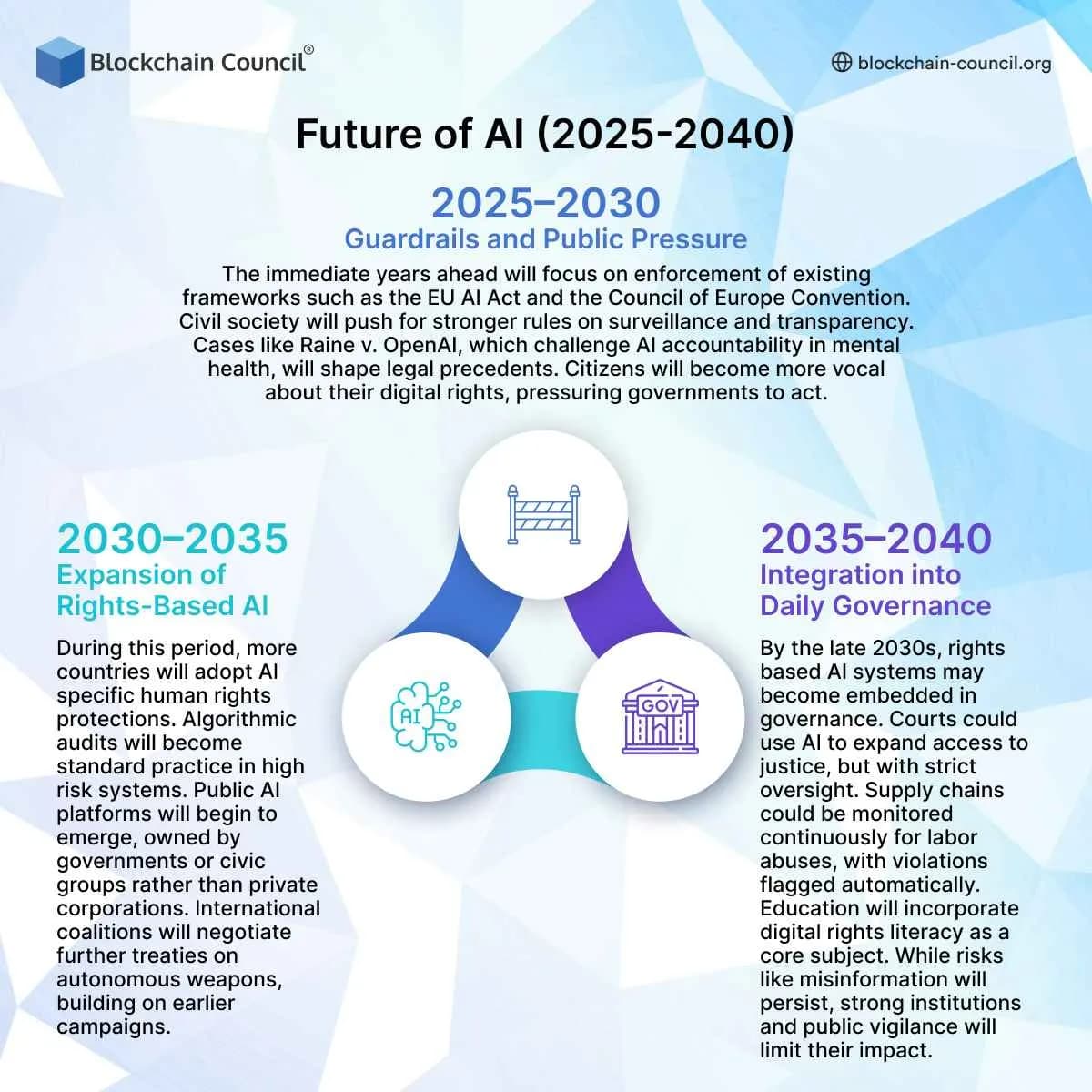
To make the debate practical, it helps to sketch a roadmap that shows how AI and human rights might evolve over the next 15 years.
2025–2030: Guardrails and Public Pressure
The immediate years ahead will focus on enforcement of existing frameworks such as the EU AI Act and the Council of Europe Convention. Civil society will push for stronger rules on surveillance and transparency. Cases like Raine v. OpenAI, which challenge AI accountability in mental health, will shape legal precedents. Citizens will become more vocal about their digital rights, pressuring governments to act.
2030–2035: Expansion of Rights-Based AI
During this period, more countries will adopt AI-specific human rights protections. Algorithmic audits will become standard practice in high-risk systems. Public AI platforms will begin to emerge, owned by governments or civic groups rather than private corporations. International coalitions will negotiate further treaties on autonomous weapons, building on earlier campaigns.
2035–2040: Integration into Daily Governance
By the late 2030s, rights-based AI systems may become embedded in governance. Courts could use AI to expand access to justice, but with strict oversight. Supply chains could be monitored continuously for labor abuses, with violations flagged automatically. Education will incorporate digital rights literacy as a core subject. While risks like misinformation will persist, strong institutions and public vigilance will limit their impact.
This roadmap is not a guarantee but a possibility if societies commit to aligning AI with human rights.
New Frontiers of Human Rights
The spread of AI is also creating new dimensions of human rights that go beyond traditional categories.
- The Right to Algorithmic Transparency: Individuals increasingly demand the ability to see why decisions affecting them were made.
- The Right to Digital Dignity: Workers monitored by AI in warehouses or gig platforms are calling for safeguards against dehumanizing surveillance.
- The Right to Cognitive Liberty: With AI systems shaping information streams, there is growing concern that manipulation of thoughts and emotions must be treated as a rights issue.
These emerging ideas show that human rights are not static. They evolve in response to new technologies, and AI is accelerating that evolution.
The Role of Global Cooperation
AI does not respect borders, and neither do its risks. Deepfake videos can spread across continents within minutes. Autonomous weapons developed in one state can destabilize entire regions. This makes global cooperation essential.
International organizations like the United Nations, the Freedom Online Coalition, and the Council of Europe are already laying foundations. But real progress requires alignment among major powers. Without it, weak jurisdictions will be exploited, and harmful practices will thrive.
Shared frameworks for AI and human rights could function much like climate agreements: imperfect, but vital. They would set minimum standards, enable monitoring, and establish accountability mechanisms that span nations.
The Citizen’s Role
While treaties and laws matter, democracy ultimately depends on citizens. In the AI era, citizens will need to be vigilant about their rights in ways that go beyond voting or protesting. They will need to understand how algorithms shape their choices, question the sources of information they consume, and demand accountability from both governments and corporations.
This means civic education must expand to include digital literacy. Citizens should be able to recognize manipulated content, understand their data rights, and know how to challenge algorithmic decisions. Societies that invest in this kind of education will be better equipped to balance AI’s power with human dignity.
Skills for a Rights-Respecting Future
Professionals also have a role to play. Lawyers, policymakers, and technologists need to work together to create systems that are both innovative and ethical. Building these skills requires more than technical training—it calls for interdisciplinary knowledge.
For those wanting to work at the frontier of responsible AI, the agentic ai certification offers specialized training on managing autonomous systems with accountability. Broader tech certifications provide a foundation in emerging technologies, helping professionals understand AI’s intersections with governance and ethics.
Those interested in transparency and security will find blockchain technology courses useful. Blockchain offers tools for verifiable, tamper-proof systems that can safeguard elections, public records, and supply chain monitoring. Beyond that, exploring technology more broadly allows professionals to see the bigger picture of how AI integrates with other digital systems.
By building these skills, individuals not only advance their careers but also contribute to a world where AI supports human rights rather than undermining them.
Risks That Cannot Be Ignored
Even in optimistic scenarios, several risks will persist:
- Complacency: Societies may assume that once laws are passed, the problem is solved. But enforcement is an ongoing challenge.
- Overreliance on AI: Excessive dependence on automated systems could erode human judgment in critical areas such as justice or healthcare.
- Weaponization: Without strict bans, autonomous weapons will remain a constant threat to life and dignity.
- Exclusion: Marginalized groups could continue to be underrepresented in datasets, leading to bias even in supposedly fair systems.
These risks require constant vigilance. Human rights in the AI era will be less about one-time fixes and more about continuous oversight.
Conclusion
Artificial intelligence is rewriting the rules of society, and human rights sit at the heart of this transformation. The risks are severe: mass surveillance, discrimination, censorship, loss of accountability, and even autonomous violence. But the opportunities are just as powerful: broader access to justice, stronger supply chain accountability, inclusive governance, and innovative ways to protect dignity.
The future depends on choices made by governments, companies, civil society, and citizens. By setting guardrails, strengthening institutions, and investing in education, democracies can steer AI toward supporting human rights. By ignoring these responsibilities, they risk surrendering freedoms to opaque systems and unchecked powers.
Individuals, too, have agency. Building expertise through certifications like agentic AI, broader tech programs, or blockchain-focused courses ensures that professionals are not just passive observers but active shapers of the AI era. Exploring technology as a civic tool broadens understanding of how digital systems can be directed toward fairness and accountability.
The question is no longer whether AI affects human rights—it does, every day. The real question is whether humanity will rise to the challenge of guiding AI in a way that preserves dignity, equality, and freedom for all. If we succeed, AI will not just be compatible with human rights—it will become one of their strongest protectors.
Related Articles
View All
AI & ML
How to Use GPT-6 Astra for Free
Find out whether GPT-6 Astra is available for free, which ChatGPT plans currently include access, and what options users have for trying OpenAI’s latest AI model.

AI & ML
Fable vs GPT: Fable 5.1 vs GPT-6 Astra Compared
A practical Fable vs GPT comparison covering Fable 5.1, GPT-6 Astra, Claude, ChatGPT, benchmarks, pricing, and real enterprise use cases.

AI & ML
GPT 6 Astra: What OpenAI's New Frontier LLM Means for AI, Cybersecurity, and Work
GPT 6 Astra is OpenAI's new frontier LLM, with gated access, Critical cybersecurity capability, and major implications for ChatGPT, developers, and enterprises.
Trending Articles
What is AWS? A Beginner's Guide to Cloud Computing
Everything you need to know about Amazon Web Services, cloud computing fundamentals, and career opportunities.

Can DeFi 2.0 Bridge the Gap Between Traditional and Decentralized Finance?
The next generation of DeFi protocols aims to connect traditional banking with decentralized finance ecosystems.
How to Install Claude Code
Learn how to install Claude Code on macOS, Linux, and Windows using the native installer, plus verification, authentication, and troubleshooting tips.