

AI and the Ethics of Decision-Making in Law and Policy
 Michael Willson
Artificial intelligence is entering some of the most sensitive areas of society: law, policy, and government decision-making. This raises urgent ethical questions. Can AI be trusted with decisions that affect people’s rights and freedoms? Who is accountable if something goes wrong? How do we balance innovation with fairness? This article explores the ethics of AI in legal and policy decision-making, the benefits it brings, the risks it poses, and how professionals can prepare to manage this evolving space. If you are looking to strengthen your expertise in this field, an AI certification can help you understand not only the technology but also the ethical and regulatory frameworks shaping its use.
Overview of AI in Ethical Decision-Making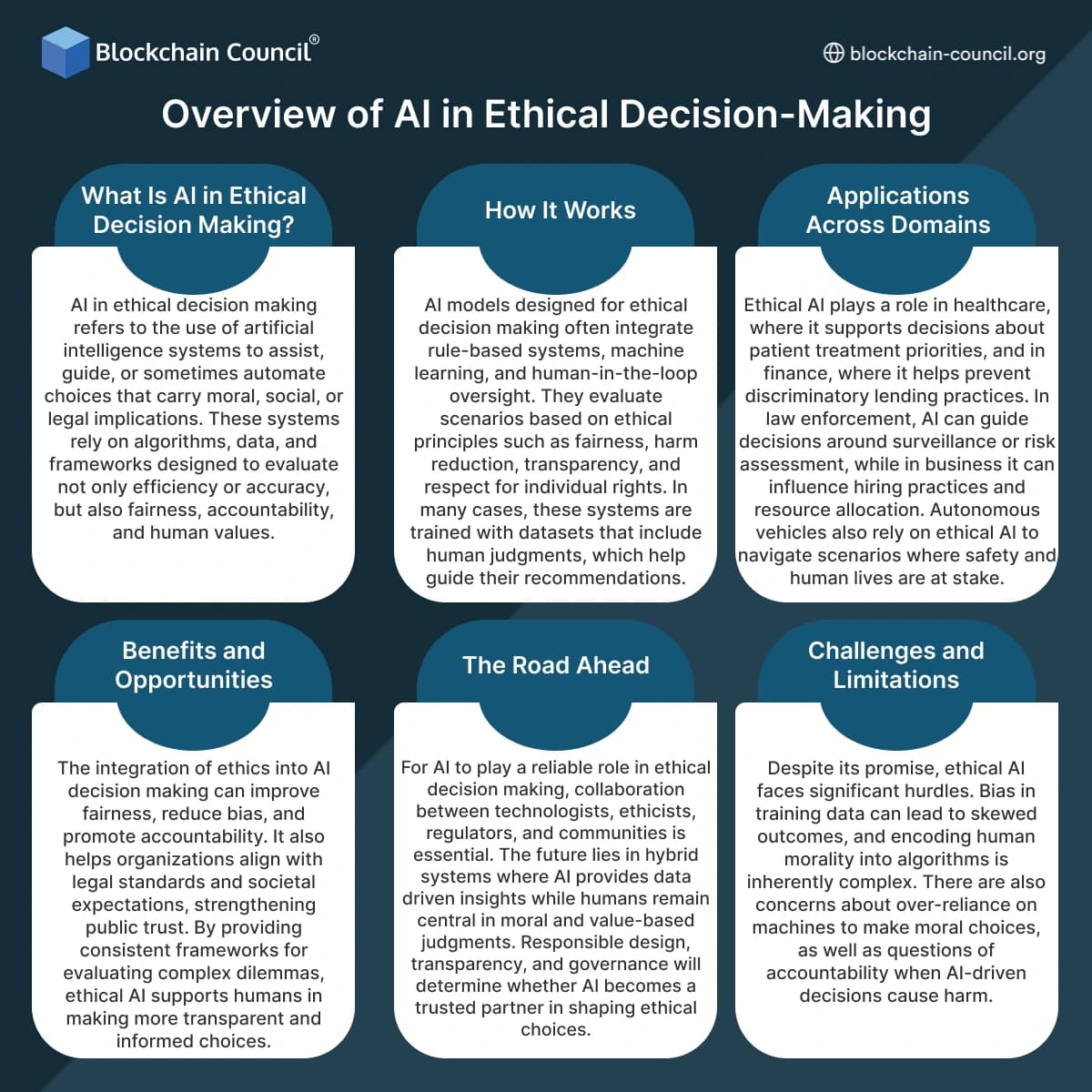
What Is AI in Ethical Decision Making?
AI in ethical decision making refers to the use of artificial intelligence systems to assist, guide, or sometimes automate choices that carry moral, social, or legal implications. These systems rely on algorithms, data, and frameworks designed to evaluate not only efficiency or accuracy, but also fairness, accountability, and human values.

How It Works
AI models designed for ethical decision making often integrate rule-based systems, machine learning, and human-in-the-loop oversight. They evaluate scenarios based on ethical principles such as fairness, harm reduction, transparency, and respect for individual rights. In many cases, these systems are trained with datasets that include human judgments, which help guide their recommendations.
Applications Across Domains
Ethical AI plays a role in healthcare, where it supports decisions about patient treatment priorities, and in finance, where it helps prevent discriminatory lending practices. In law enforcement, AI can guide decisions around surveillance or risk assessment, while in business it can influence hiring practices and resource allocation. Autonomous vehicles also rely on ethical AI to navigate scenarios where safety and human lives are at stake.
Benefits and Opportunities
The integration of ethics into AI decision making can improve fairness, reduce bias, and promote accountability. It also helps organizations align with legal standards and societal expectations, strengthening public trust. By providing consistent frameworks for evaluating complex dilemmas, ethical AI supports humans in making more transparent and informed choices.
Challenges and Limitations
Despite its promise, ethical AI faces significant hurdles. Bias in training data can lead to skewed outcomes, and encoding human morality into algorithms is inherently complex. There are also concerns about over-reliance on machines to make moral choices, as well as questions of accountability when AI-driven decisions cause harm.
The Road Ahead
For AI to play a reliable role in ethical decision making, collaboration between technologists, ethicists, regulators, and communities is essential. The future lies in hybrid systems where AI provides data-driven insights while humans remain central in moral and value-based judgments. Responsible design, transparency, and governance will determine whether AI becomes a trusted partner in shaping ethical choices.
Why AI Is Entering Law and Policy
Law and policy are complex fields. They involve processing massive amounts of information, from legal precedents and case documents to policy drafts and citizen feedback. AI offers speed and efficiency that traditional methods cannot match.
In law, AI can scan thousands of cases to find relevant precedents in seconds. In government, it can analyze public data to predict outcomes of proposed policies. AI can even help automate routine legal tasks such as drafting contracts or reviewing evidence.
But when AI moves from support roles into decision-making, the stakes change. A missed precedent might harm a defendant. A flawed policy recommendation could affect millions of citizens. These high-stakes contexts make ethics essential.
The Central Ethical Questions
There are three central ethical questions whenever AI is used in law and policy:
- Fairness – Are decisions free of bias? Do they treat all groups equally?
- Transparency – Can people understand how the decision was reached?
- Accountability – Who is responsible if the decision causes harm?
These questions are not abstract. They touch directly on justice, democracy, and trust.
Bias, Fairness, and Discrimination
Bias in AI is one of the biggest concerns in legal and policy settings. AI systems learn from data, and historical data often reflects past biases. If a criminal justice dataset shows that certain communities were arrested more often due to biased policing, an AI trained on that data may continue to mark those groups as higher risk.
This is not just theory. The COMPAS system, used in the United States to predict the likelihood of reoffending, has been criticized for disproportionately labeling African American defendants as high risk compared to white defendants with similar records.
The challenge is that technical fairness metrics used by AI developers do not always align with legal definitions of discrimination. A model might meet a mathematical test of fairness but still violate anti-discrimination laws. This gap between technical and legal fairness is one of the hardest ethical issues to resolve.
Transparency and Explainability
Another challenge is the “black box” nature of many AI systems. In law and policy, decisions must often be explained. A judge must justify a ruling. A government agency must explain why benefits were approved or denied. If AI systems cannot provide clear reasons, they undermine due process and accountability.
For example, deep learning models may process thousands of variables to make a prediction, but they do not provide a human-readable explanation. This is a direct conflict with legal norms that require transparency and the right to appeal.
Ethical frameworks from organizations like UNESCO stress that explainability is non-negotiable in high-stakes contexts. AI should not make decisions that cannot be traced or challenged.
Accountability and Human Oversight
When AI-informed decisions cause harm, who is accountable? The developer, the user, the company, or the government agency? In law and policy, accountability must be clear. Otherwise, victims of unfair decisions may have no one to hold responsible.
Most ethical guidelines stress that AI should never fully replace human judgment in legal and policy decisions. Instead, AI should support humans, who remain the final decision-makers. This preserves accountability and ensures that decisions reflect not just data but also human values and context.
The principle of human oversight is central. It is also being embedded into laws. For example, in New York, a new law requires state agencies to review AI uses and forbids certain fully automated decisions in key welfare programs unless human oversight is enforced.
Privacy and Data Protection
Legal and policy AI systems often use sensitive personal data—medical records, financial histories, criminal backgrounds. This makes privacy protection critical.
Ethical frameworks emphasize that data must be protected throughout the AI lifecycle. This means not just anonymizing it at the start, but ensuring security during processing, storage, and deletion. Breaches in legal or policy contexts can erode public trust quickly.
Professional codes, such as those from the American Bar Association, also remind lawyers that confidentiality remains a duty even when AI is used. Lawyers must verify that client data handled by AI is secure.
Why This Matters for Trust in Institutions
Trust is the foundation of law and policy. Citizens must trust that courts, regulators, and policymakers act fairly and transparently. If AI tools are seen as biased or secretive, trust in institutions may erode.
For example, courts that use AI tools for risk assessments without explaining how they work risk losing legitimacy. Policy decisions based on opaque AI predictions may be viewed as unfair or manipulated. This is why many courts and governments are cautious, adopting policies that require transparency, oversight, and clear ethical guidelines.
Early Legal and Policy Responses
The world is not ignoring these issues.
- The Framework Convention on Artificial intelligence, adopted by the Council of Europe in 2024, requires risk assessments, safeguards, and protections for human rights.
- The ABA Formal Opinion 512 in the United States (2024) sets rules for lawyers using generative AI. It requires competence, confidentiality, and verification of AI outputs.
- In California, the court system adopted rules in 2025 regulating the use of AI by judges and staff, requiring transparency and protection of confidentiality.
- In India, the Kerala High Court issued guidelines prohibiting district judges from using AI tools for decision-making, citing risks to privacy and trust.
These examples show a common theme: AI can be used, but always under strict ethical and legal safeguards.
AI and Access to Justice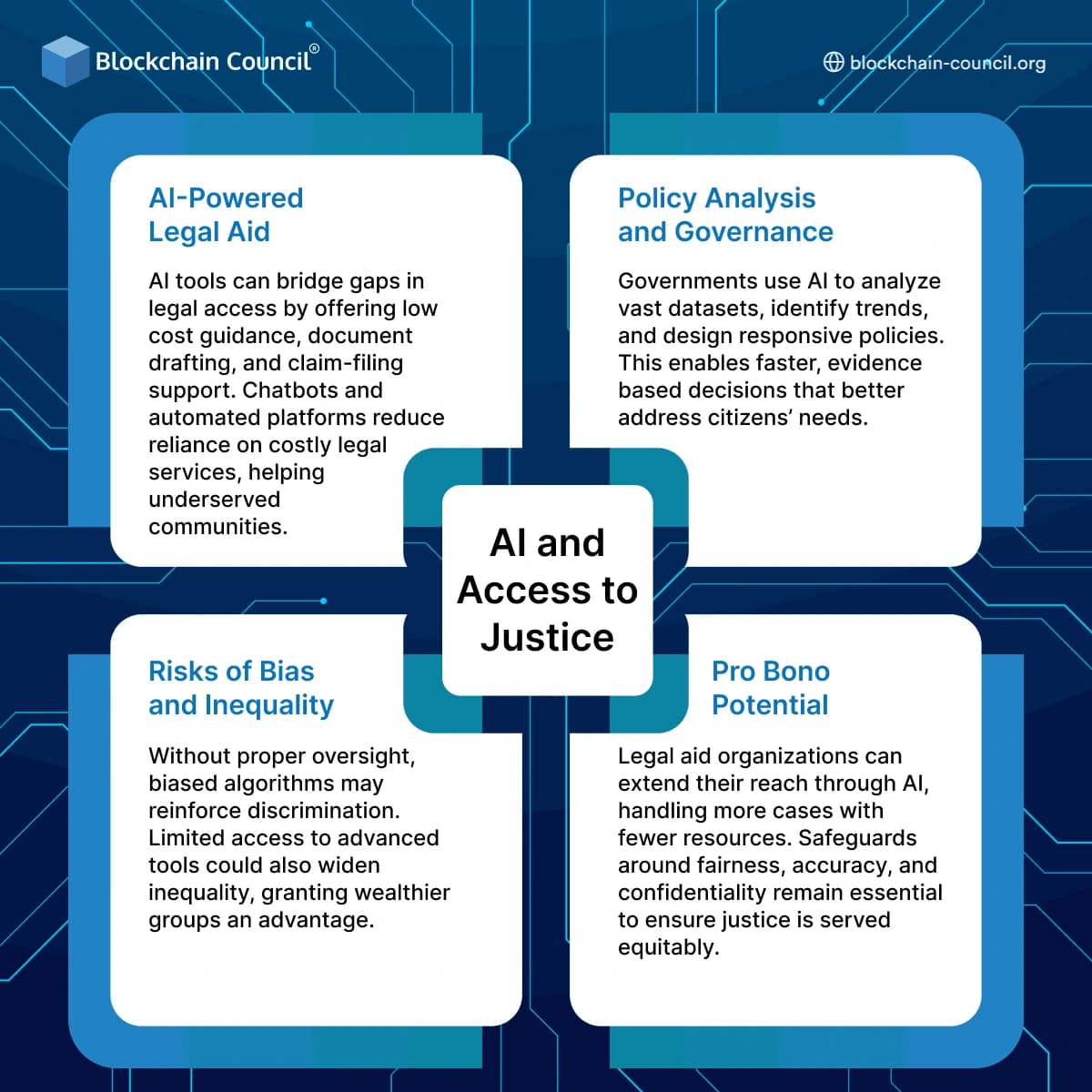
AI-Powered Legal Aid
AI tools can bridge gaps in legal access by offering low-cost guidance, document drafting, and claim-filing support. Chatbots and automated platforms reduce reliance on costly legal services, helping underserved communities.
Policy Analysis and Governance
Governments use AI to analyze vast datasets, identify trends, and design responsive policies. This enables faster, evidence-based decisions that better address citizens’ needs.
Risks of Bias and Inequality
Without proper oversight, biased algorithms may reinforce discrimination. Limited access to advanced tools could also widen inequality, granting wealthier groups an advantage.
Pro Bono Potential
Legal aid organizations can extend their reach through AI, handling more cases with fewer resources. Safeguards around fairness, accuracy, and confidentiality remain essential to ensure justice is served equitably.
One of the most promising applications of AI in law is its potential to expand access to justice. Millions of people cannot afford legal representation, and AI tools can help by providing affordable or even free assistance. For example, AI chatbots can answer basic legal questions, help people draft simple contracts, or guide them through filing small claims.
In policy, AI can analyze large datasets quickly, helping governments spot trends, predict outcomes, and respond to citizens more effectively. This could make policymaking more responsive and data-driven.
But these benefits come with risks. If AI systems are biased, they may harm the very communities they are meant to serve. If they are opaque, citizens may not trust the decisions. And if access to advanced tools is limited to wealthier groups or organizations, AI could deepen inequality rather than reduce it.
For pro bono work, the promise is huge. Legal aid groups could use AI to serve more clients with fewer resources. Yet ethical safeguards must be built in to ensure accuracy, fairness, and confidentiality.
Accountability Dilemmas
When AI systems inform or make decisions, accountability becomes complex. Imagine an AI system recommends denying a welfare benefit based on incomplete data. The citizen appeals. Who is responsible? The agency using the AI? The developers who built it? The policymakers who approved it?
In law, accountability must be clear because justice depends on it. Victims of unfair treatment need to know who is answerable. The problem with AI is that decisions are often the result of many actors and algorithms working together. Tracing causation is not straightforward.
This is why most ethical frameworks stress human-in-the-loop oversight. Humans must remain the final authority, ensuring that accountability does not vanish behind a black box. Courts and regulators are already building this principle into rules. Without it, AI could weaken the very foundation of accountability in democratic systems.
The Global Push for Ethical Guidelines
The ethical challenges of AI in law and policy are global, and international organizations have begun to respond.
The UNESCO Recommendation on the Ethics of Artificial Intelligence lays out key principles: transparency, fairness, accountability, and human oversight. It also stresses protecting human rights and dignity in AI applications.
The Framework Convention on Artificial intelligence by the Council of Europe goes further, requiring member states to adopt safeguards ensuring AI use aligns with democracy, rule of law, and human rights. It emphasizes risk assessments, transparency, and the ability for citizens to challenge AI-driven decisions.
Despite these frameworks, implementation varies. Some countries move quickly to regulate, while others hesitate for fear of stifling innovation. This creates a patchwork of rules, making it difficult to ensure consistent standards across borders.
Judicial Ethics and AI in Courts
Judges and courts are particularly cautious about AI. Judicial ethics demand impartiality, transparency, and fairness. AI tools, if misused, could undermine all three.
- In California, the court system adopted rules requiring judges and staff to follow clear policies when using AI, especially around confidentiality and bias.
- In India, the Kerala High Court prohibited district judges from using AI tools for decision-making, citing risks to privacy, trust, and the independence of the judiciary.
- In the United States, the American Bar Association has issued guidance reminding lawyers that competence and confidentiality apply even when AI tools are used.
These examples show how judicial systems are building ethical barriers. They recognize AI’s potential value in tasks like document review but restrict its use in actual decision-making.
Transparency as a Cornerstone
In democratic societies, decisions must be explainable. Citizens have the right to know why they received or were denied a benefit, why they were flagged for investigation, or why a judge ruled a certain way.
AI systems challenge this requirement. Deep learning models, for example, can process vast numbers of variables in ways even their developers cannot fully explain. This lack of transparency directly conflicts with due process and the rule of law.
To address this, policymakers are exploring rules that require AI systems to provide traceable explanations. Some countries are pushing for algorithmic impact assessments—reports that evaluate the potential risks and biases of AI systems before they are deployed in sensitive contexts.
Without transparency, public trust will suffer. Citizens must be able to question and challenge decisions influenced by AI. Otherwise, the legitimacy of legal and policy systems could erode.
The Role of Professional Ethics
Lawyers, judges, and policymakers are all bound by ethical duties. These duties are now being extended to include competence with AI tools. In 2024, the American Bar Association clarified that lawyers must verify AI outputs, ensure confidentiality, and communicate clearly with clients about AI use.
For judges, professional ethics codes are evolving to require caution, transparency, and oversight when using AI. This ensures that judicial independence and fairness are not compromised by reliance on opaque tools.
For policymakers, ethical duties include protecting citizens’ rights, ensuring equitable outcomes, and balancing innovation with risk management. The integration of AI into policymaking makes these duties even more complex, as decisions may be shaped by systems that are not fully understood.
Why Public Trust Is Fragile
Trust is fragile in law and policy. Even a single scandal involving AI misuse could damage public confidence for years. Imagine if an AI system wrongfully denied thousands of citizens access to welfare benefits. Even if the error were corrected later, the trust damage would linger.
This is why many experts stress moving carefully. The benefits of AI—speed, efficiency, and predictive power—are undeniable. But in law and policy, the costs of mistakes are too high to rush adoption without strong ethical safeguards.
Privacy and Data Protection in AI Decision-Making
Privacy has always been central to both law and governance, but AI raises the stakes. Legal and policy AI systems often require massive datasets that include sensitive information such as health records, financial details, and even biometric identifiers. Using this data to train or operate AI introduces risks at every stage—collection, storage, processing, and sharing.
For example, if a government welfare program uses AI to screen applications, it may pull from medical and financial databases. A data breach in that system could expose thousands of vulnerable citizens to harm. Similarly, if a predictive policing system accesses social data, the risk of misuse or surveillance grows.
Ethical frameworks emphasize privacy by design. This means systems should protect data from the start, not as an afterthought. Encryption, anonymization, and strict access controls are all necessary. But beyond technical safeguards, there must be legal accountability for how data is collected and used. Citizens need the power to challenge how their personal information shapes AI-driven decisions.
Long-Term Impacts of AI in Policymaking
AI promises to make policy smarter by analyzing patterns humans might miss. For example, AI can study traffic data to suggest where to build roads, or examine climate patterns to guide environmental policy. The long-term appeal is efficiency: better policies, faster responses, and more informed choices.
But efficiency is not the only goal of governance. Fairness, representation, and human dignity matter just as much. An efficient policy that ignores social justice is not ethical. The danger is that overreliance on AI could push policymakers toward decisions optimized for data but blind to human values.
There is also the issue of adaptability. AI systems are trained on past data. Policy, however, often needs to anticipate new realities. If AI cannot adapt to novel situations, it risks locking governments into outdated solutions. Human judgment will always be needed to interpret context, values, and future risks.
Balancing Innovation and Regulation
One of the hardest challenges is finding the balance between encouraging innovation and ensuring ethical safeguards. Regulating too tightly may slow down valuable progress in AI tools that could improve access to justice or streamline policymaking. But leaving AI unchecked risks harm, bias, and erosion of trust.
The solution many experts propose is risk-based regulation. High-risk uses—such as AI in criminal sentencing, welfare eligibility, or immigration policy—should face the strictest oversight. Lower-risk uses—like AI for document review or legislative research—can be monitored with lighter rules. This approach allows innovation while still protecting people in critical contexts.
International cooperation will also matter. AI is not bound by national borders. A legal tool built in one country may be used in another. If regulations diverge too widely, ethical protections may collapse in weaker jurisdictions. Global frameworks, like UNESCO’s recommendations and the Council of Europe’s convention, are steps toward common ground.
Skills for Professionals in the Age of AI Ethics
As AI grows in law and policy, professionals must adapt. Lawyers, judges, policymakers, and advisors need more than legal knowledge. They must understand how AI works, where its risks lie, and how to question its outputs.
Structured learning is one way forward. A Data Science Certification gives professionals the skills to interpret the data driving AI systems. A Marketing and Business Certification equips leaders to integrate AI responsibly in organizational strategies, where compliance and ethics intersect with growth. For those interested in infrastructure and trust, blockchain technology courses provide lessons on transparency and accountability that echo challenges in AI.
AI certs more broadly help professionals stay competitive while understanding ethical, legal, and societal impacts. These programs ensure that people using AI in sensitive fields are not just consumers of technology but informed collaborators who can hold systems to account.
The Human Element Must Remain Central
All discussions of AI in law and policy return to one truth: technology cannot replace human values. Algorithms can process data, but they cannot weigh justice, empathy, or moral responsibility. Policymaking and law are not only about facts; they are about fairness, rights, and trust.
This is why most ethical guidelines insist on human oversight. AI can support, suggest, and analyze, but final decisions must be made by accountable humans. Without this, democracy itself could weaken, as decisions drift further from public understanding and participation.
Conclusion: Building Trustworthy AI in Law and Policy
AI is already here in law and policymaking, and its role will grow. It can increase efficiency, improve access to justice, and support better-informed decisions. But without strong ethical frameworks, it can also reinforce bias, reduce transparency, and weaken accountability.
The task ahead is not to reject AI, but to shape it. Ethical principles—fairness, transparency, accountability, privacy, and human oversight—must be built into every system. Regulations must ensure that citizens can challenge decisions, that professionals remain responsible, and that data is protected.
At the same time, professionals must gain the skills to navigate this new landscape. Certifications and structured learning will help lawyers, policymakers, and leaders become competent guides in an age where AI influences the rules that govern society.
The future of AI in law and policy is not about machines replacing humans. It is about machines and humans working together responsibly. If guided by ethics and trust, AI can strengthen justice and democracy rather than threaten them. But that outcome will depend on choices made today—by developers, governments, and professionals committed to fairness.
Related Articles
View All
AI & ML
Jev Decision-Making Pipeline
Learn how Jev’s decision-making pipeline transforms structured program state and predefined questions into typed, probabilistic decisions for automated software workflows.

AI & ML
From Agentic AI to AGI & Super AGI: Where Is Artificial Intelligence Heading?
Follow the path from Agentic AI to AGI & Super AGI. Learn what AGI means, how it differs from today’s AI, what superintelligence could be, and the opportunities, risks, and alignment challenges ahead.

AI & ML
AI Loops, Harnesses & Autonomous Systems: The Architecture Behind Agentic AI
Learn how AI Loops, Harnesses & Autonomous Systems work. Understand the observe-reason-act-evaluate cycle, why agents need a harness, guardrails, evaluation, and long-running tasks.
Trending Articles
The Role of Blockchain in Ethical AI Development
How blockchain technology is being used to promote transparency and accountability in artificial intelligence systems.
AWS Career Roadmap
A step-by-step guide to building a successful career in Amazon Web Services cloud computing.

Top 5 DeFi Platforms
Explore the leading decentralized finance platforms and what makes each one unique in the evolving DeFi landscape.