

Key Principles and Frameworks in AI Ethics
 Michael Willson
Introduction
AI is advancing quickly, but without ethics it can create more harm than good. That is why principles and frameworks in AI ethics are essential. They help organizations design, deploy, and govern AI in ways that protect people and build trust. In this guide, we will explore the most important principles and frameworks shaping AI ethics today. If you are planning a career in this space, building your foundation with an AI Certification is a smart first step. It shows that you understand both the technology and the responsibilities that come with it.
Why Ethical AI Requires Shared Principles
Ethics provides the guardrails that allow AI to be innovative but safe. Shared principles mean that governments, companies, and researchers are working from the same rulebook. Without them, AI risks becoming untrustworthy, biased, or unsafe.

By agreeing on core principles, organizations create alignment across sectors and borders. This makes it easier to regulate, easier to adopt, and easier to trust.
Universal Ethics Pillars Across Frameworks
Most major frameworks highlight the same set of values. These universal pillars provide the foundation for responsible AI.
- Fairness: AI should not discriminate. Decisions must be free of bias and equitable across groups.
- Transparency: People must understand how AI systems make decisions. Black-box systems erode trust.
- Accountability: Someone must be responsible for AI outcomes. Organizations cannot blame “the algorithm.”
- Privacy: Personal data must be protected through strong security and careful data practices.
- Security: Systems must be resilient against attacks and misuse.
- Human Rights: AI must respect human dignity, freedoms, and values at every stage.
These values are echoed in frameworks from governments, companies, and international organizations.
Leading Frameworks Shaping AI Ethics
OECD Principles
The OECD AI Principles are one of the first intergovernmental standards. They call for innovative and trustworthy AI that respects human rights and democratic values.
IEEE Human-Centric Ethics
The IEEE framework emphasizes designing AI with human well-being in mind. It includes rights, accountability, transparency, and the avoidance of misuse.
Department of Defense Principles
The U.S. Department of Defense created five principles for military use of AI: responsible, equitable, traceable, reliable, and governable. These show how ethics can be tailored for sector-specific needs.
Together, these frameworks set clear standards that other industries and countries often adopt.
Technical and Design-Centric Approaches
Ethics does not stop at principles. It also requires practical methods built into design and engineering.
- Trustworthy AI: This approach stresses explainability, robustness, fairness, and privacy. Techniques like differential privacy and federated learning make systems safer.
- Value Sensitive Design: VSD is a method where engineers embed human values directly into the design process. This ensures ethics are considered from the start, not as an afterthought.
- IEEE 7000 Standards: These provide structured methods for addressing ethics in system design, allowing organizations to follow clear steps for ethical engineering.
These methods make AI ethics more than words on paper. They turn principles into action.
Core Principles and Frameworks in AI Ethics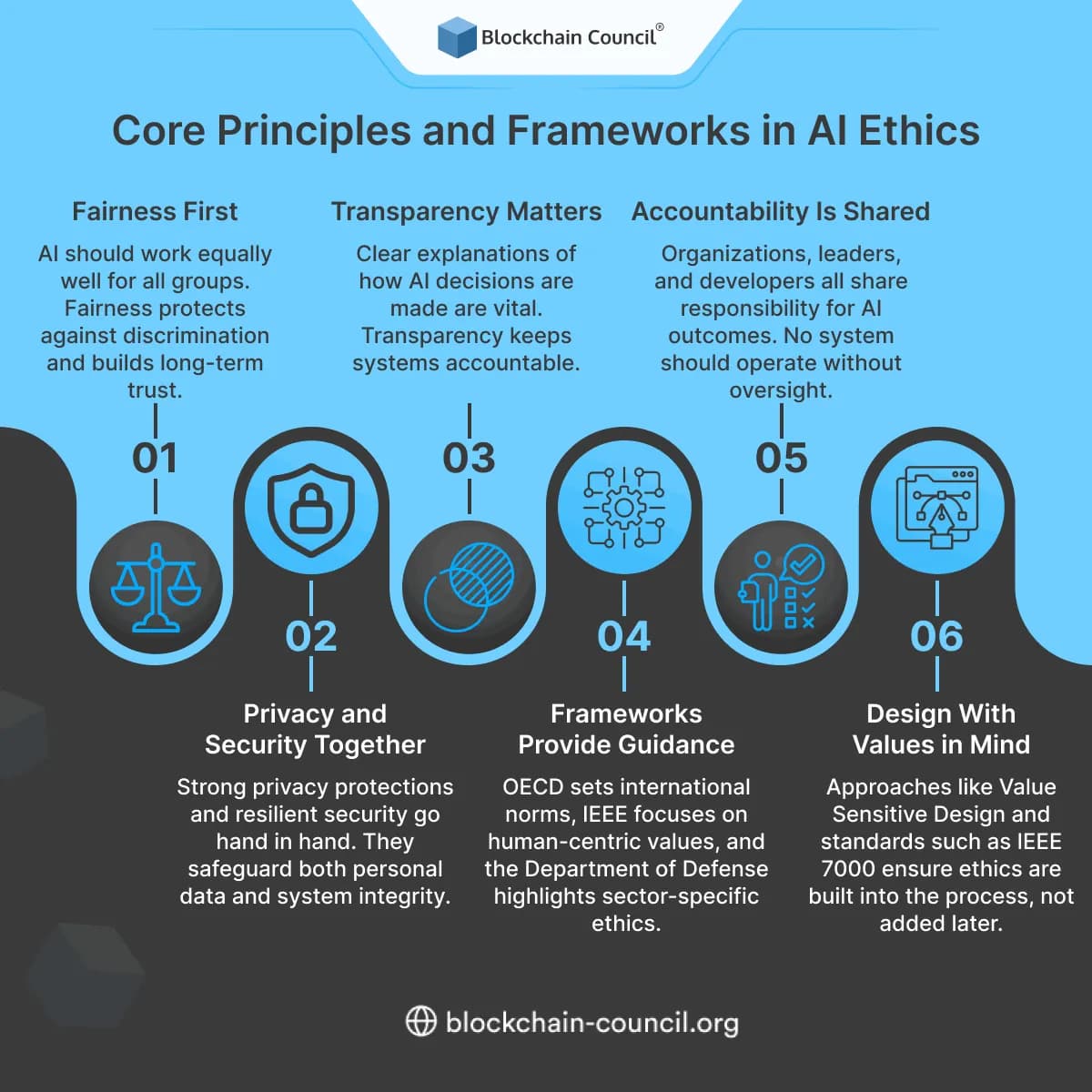
Fairness First
AI should work equally well for all groups. Fairness protects against discrimination and builds long-term trust.
Transparency Matters
Clear explanations of how AI decisions are made are vital. Transparency keeps systems accountable.
Accountability Is Shared
Organizations, leaders, and developers all share responsibility for AI outcomes. No system should operate without oversight.
Privacy and Security Together
Strong privacy protections and resilient security go hand in hand. They safeguard both personal data and system integrity.
Frameworks Provide Guidance
OECD sets international norms, IEEE focuses on human-centric values, and the Department of Defense highlights sector-specific ethics.
Design With Values in Mind
Approaches like Value Sensitive Design and standards such as IEEE 7000 ensure ethics are built into the process, not added later.
This summary captures the most important and practical lessons from AI ethics today.
Real-World Applications and Governance
AI ethics is no longer a theoretical exercise. It is part of global governance. In 2024, the United Nations adopted a resolution supporting safe, rights-respecting AI. This signaled global alignment on the need for transparency and fairness.
Companies are also creating ethics councils and embedding ethics officers into leadership. Training is becoming common for developers and managers to understand their ethical responsibilities.
Bringing Ethics into Practice
For organizations, the path forward is clear. Start by adopting a governance council that oversees AI projects. Use frameworks like OECD and IEEE as reference points. Apply technical safeguards like differential privacy. Most importantly, test and review AI systems regularly to ensure ethical standards hold throughout the lifecycle.
Professionals can also take steps to strengthen their own skills. Data specialists can expand their expertise through the Data Science Certification. Business leaders can prepare for broader strategy and governance roles with the Marketing and Business Certification. These AI certs help ensure that both technical and strategic leaders are ready to manage AI responsibly.
Conclusion
AI ethics is no longer optional. It is the foundation for building trust, ensuring compliance, and unlocking long-term benefits from AI systems. By following shared principles and adopting proven frameworks, organizations can design AI that respects human rights, protects privacy, and delivers fair outcomes.
For professionals, this is also an opportunity. Building skills in AI ethics not only makes you more valuable but also positions you as a leader in one of the most important areas of technology today.
Related Articles
View All
AI & ML
NVIDIA Nemotron 3.5 Lightning vs NVIDIA Cosmos 3: Key Differences and Use Cases
Compare NVIDIA Nemotron 3.5 Lightning and NVIDIA Cosmos 3, including their architectures, reasoning capabilities, modalities, performance goals, and use cases across agentic and physical AI.

AI & ML
Google Launches Gemini 4 Argon: Features and Capabilities
Google has launched Gemini 4 Argon, its flagship AI model for coding, finance, law, cybersecurity and science. Learn its key features, availability, pricing and safety details.

AI & ML
Meta Launches Muse Wonder: Its New AI Model Explained
Meta has launched Muse Wonder and Muse Wonder Full, new AI models built for personal and professional agents. Learn the features, pricing, access options and how they compare with rivals.
Trending Articles
How Blockchain Secures AI Data
Understand how blockchain technology is being applied to protect the integrity and security of AI training data.

Can DeFi 2.0 Bridge the Gap Between Traditional and Decentralized Finance?
The next generation of DeFi protocols aims to connect traditional banking with decentralized finance ecosystems.
Claude AI Tools for Productivity
Discover Claude AI tools for productivity to streamline tasks, manage workflows, and improve efficiency.