

AI Agents Calling Other Agents

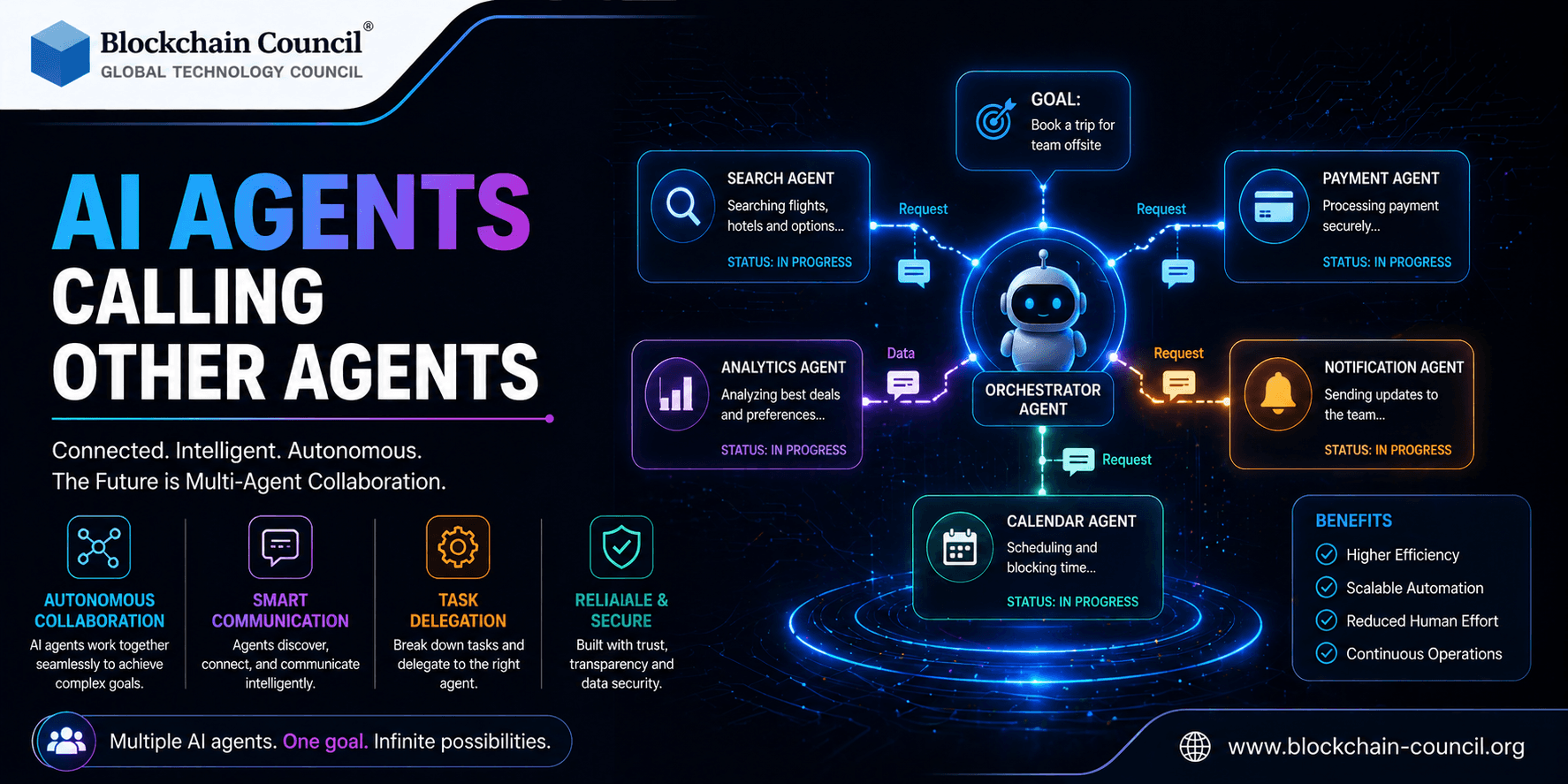
Artificial intelligence is evolving beyond simple tools and assistants into autonomous systems capable of making decisions and interacting with each other. One of the most important developments in this space is the concept of AI agents calling other agents. This refers to systems where one AI agent can delegate tasks, request information, or trigger actions from another AI agent without direct human involvement.
This shift represents a major leap in automation. Instead of isolated systems performing single tasks, we now have interconnected networks of AI agents collaborating to complete complex workflows. This article explores how this works, why it matters, and what it means for the future of technology.

What Are AI Agents?
AI agents are software systems designed to perform tasks autonomously. They can perceive inputs, process information, and take actions based on predefined goals.
Examples of AI agents include:
Chatbots handling customer queries
Recommendation systems suggesting products
Automation tools managing workflows
Unlike traditional software, AI agents can adapt and improve over time. Professionals looking to understand these systems often begin with structured programs like the AI expert certification, which covers the fundamentals of AI and its applications.
What Does “AI Agents Calling Other Agents” Mean?
In simple terms, it means one AI agent can communicate with another to complete a task. Instead of doing everything alone, an agent can:
Delegate subtasks to specialized agents
Request data from another system
Trigger actions across platforms
For example, a customer support AI agent might call a billing agent to retrieve account details and then call a logistics agent to check delivery status. This creates a chain of intelligent interactions.
How This System Works
Task Decomposition
When an AI agent receives a complex task, it breaks it down into smaller components. Each component is then assigned to another agent specialized in that area.
Communication Between Agents
Agents communicate using APIs, protocols, or structured messages. These interactions allow them to share data and coordinate actions efficiently.
Execution and Feedback
Each agent performs its assigned task and returns the result. The original agent then compiles the responses and delivers the final output.
Real-World Examples of Agent-to-Agent Interaction
Customer Support Automation
A support agent can interact with multiple backend agents to resolve a query. For instance, it can call a payment agent for billing issues and a shipping agent for delivery updates.
E-Commerce Platforms
In online retail, AI agents handle inventory, pricing, recommendations, and customer interactions. These agents collaborate to provide a seamless shopping experience.
Marketing Automation
Marketing systems use multiple agents for campaign management, audience targeting, and performance analysis. Professionals can enhance their understanding of such systems through programs like the AI powered digital marketing course.
Software Development Workflows
AI agents are increasingly used in coding environments to generate, test, and debug code. Developers can deepen their expertise through the AI Powered coding expert Course, which focuses on building AI-driven applications.
Benefits of AI Agents Calling Other Agents
Increased Efficiency
Tasks are completed faster because multiple agents can work simultaneously. This reduces processing time and improves productivity.
Scalability
Systems can handle larger workloads by distributing tasks across multiple agents. This makes it easier to scale operations.
Specialization
Each agent can focus on a specific function, improving accuracy and performance. Specialized agents deliver better results than general-purpose systems.
Reduced Human Intervention
Automation reduces the need for manual involvement. Humans can focus on higher-level decision-making instead of routine tasks.
Challenges and Limitations
Coordination Complexity
Managing multiple agents requires robust communication protocols. Poor coordination can lead to errors or inefficiencies.
Security Risks
Agent-to-agent communication involves data exchange, which raises security concerns. Protecting sensitive information is critical.
Reliability Issues
If one agent fails, it can disrupt the entire workflow. Systems must be designed to handle failures gracefully.
Ethical Concerns
Autonomous systems making decisions raise ethical questions. Transparency and accountability are essential.
The Role of Agentic AI
Agentic AI refers to systems that can act independently, make decisions, and interact with other agents. This is a key concept in understanding how agent-to-agent communication works.
Professionals interested in this advanced field can explore the Agentic AI expert certification, which focuses on building and managing autonomous AI systems.
Future of AI Agent Collaboration
The future of AI lies in interconnected systems rather than isolated tools. We can expect:
More advanced multi-agent systems
Improved communication protocols
Greater autonomy in decision-making
Integration across industries
In the coming years, AI agents will likely manage entire workflows with minimal human input. This will redefine how businesses operate and how technology is used.
Conclusion
AI agents calling other agents represent a major shift in how artificial intelligence systems function. Instead of working independently, agents now collaborate to solve complex problems more efficiently.
This evolution brings significant benefits, including improved efficiency, scalability, and automation. However, it also introduces challenges that must be carefully managed.
As this technology continues to develop, understanding how these systems work will become increasingly important. Those who invest in learning and adapting will be better prepared for the future of intelligent automation.
FAQs
1. What are AI agents in simple terms?
AI agents are software programs that can perform tasks automatically without constant human input. They analyze data, make decisions, and take actions based on predefined goals. These agents can adapt and improve over time. They are widely used in applications like chatbots, recommendation systems, and automation tools.
2. What does it mean for AI agents to call other agents?
It means that one AI system can communicate with another to complete a task. Instead of handling everything alone, it delegates parts of the task to specialized agents. This creates a collaborative system. It improves efficiency and accuracy.
3. Why is agent-to-agent communication important?
Agent-to-agent communication allows systems to handle complex tasks more effectively. It enables collaboration between specialized agents. This leads to faster and more accurate results. It also reduces the need for human intervention.
4. How do AI agents communicate with each other?
AI agents communicate through APIs, structured data, or predefined protocols. These methods allow them to exchange information and coordinate actions. The communication is usually automated. This ensures seamless interaction.
5. What industries use AI agent collaboration?
Industries such as e-commerce, healthcare, finance, and marketing use AI agent collaboration. These systems improve efficiency and automate processes. They also enhance customer experiences. Many sectors are adopting this technology.
6. Can AI agents replace human workers?
AI agents can automate repetitive tasks but cannot fully replace humans. Human creativity and decision-making are still essential. Agents act as support tools. They enhance productivity rather than replace people.
7. What are the risks of using AI agents?
Risks include data security issues, system failures, and ethical concerns. Poorly designed systems can lead to errors. Proper safeguards are necessary. Responsible implementation is important.
8. How do AI agents improve efficiency?
AI agents work faster and can operate continuously without breaks. They can handle multiple tasks simultaneously. This reduces processing time. It improves overall productivity.
9. What is agentic AI?
Agentic AI refers to systems that can act independently and make decisions. These systems can interact with other agents. They are more advanced than traditional AI tools. They represent the future of automation.
10. Are AI agents expensive to implement?
The cost depends on the complexity of the system. Simple agents are relatively affordable. Advanced systems require more investment. However, they provide long-term benefits.
11. Can small businesses use AI agents?
Yes, small businesses can use AI agents for tasks like customer support and marketing. These tools are becoming more accessible. They help improve efficiency. They also reduce operational costs.
12. How do AI agents handle errors?
AI agents use feedback mechanisms to detect and correct errors. They can learn from mistakes. However, human oversight is still important. This ensures reliability.
13. What skills are needed to work with AI agents?
Skills in programming, data analysis, and AI concepts are important. Understanding workflows and automation is also helpful. Continuous learning is essential. These skills improve effectiveness.
14. Can AI agents learn over time?
Yes, many AI agents use machine learning to improve performance. They analyze data and adapt their behavior. This makes them more effective. Learning is a key feature.
15. How secure are AI agent systems?
Security depends on system design and implementation. Proper encryption and safeguards are necessary. Data protection is critical. Organizations must follow best practices.
16. What tools are used to build AI agents?
Tools include programming languages, AI frameworks, and cloud platforms. These tools help create and manage agents. They provide scalability. Developers use them widely.
17. Can AI agents work together in real time?
Yes, AI agents can communicate and collaborate in real time. This allows them to respond quickly. It improves efficiency. Real-time interaction is a key advantage.
18. What is the future of AI agents?
The future includes more advanced and autonomous systems. Agents will handle complex workflows. They will integrate across industries. This will transform operations.
19. How do AI agents impact businesses?
AI agents improve efficiency and reduce costs. They enhance customer experiences. Businesses can scale operations more easily. They gain a competitive advantage.
20. Should professionals learn about AI agents?
Yes, understanding AI agents is important for future careers. It improves job opportunities. Professionals can stay competitive. Learning these skills is valuable.
Related Articles
View All
AI & ML
AI Agents & Agentic AI: When AI Starts Thinking, Planning & Acting
Discover AI Agents & Agentic AI in simple terms. Learn how agents perceive, reason, plan, use tools, and remember, how they differ from chatbots, and where they are used today.
AI & ML
System One Models for AI Agents
Explore how System One Models can support AI agents with fast, structured decisions, calibrated confidence, routing, verification, and reliable workflow automation.
AI & ML
Jev vs AI Agents
Compare Jev with AI agents and learn how Jev’s structured decision-making differs from autonomous systems that plan, use tools, and complete multi-step tasks.
Trending Articles
AWS Career Roadmap
A step-by-step guide to building a successful career in Amazon Web Services cloud computing.
How Blockchain Secures AI Data
Understand how blockchain technology is being applied to protect the integrity and security of AI training data.
Claude AI Tools for Productivity
Discover Claude AI tools for productivity to streamline tasks, manage workflows, and improve efficiency.