

How Agentic AI Is Different from Traditional AI Models
 Michael Willson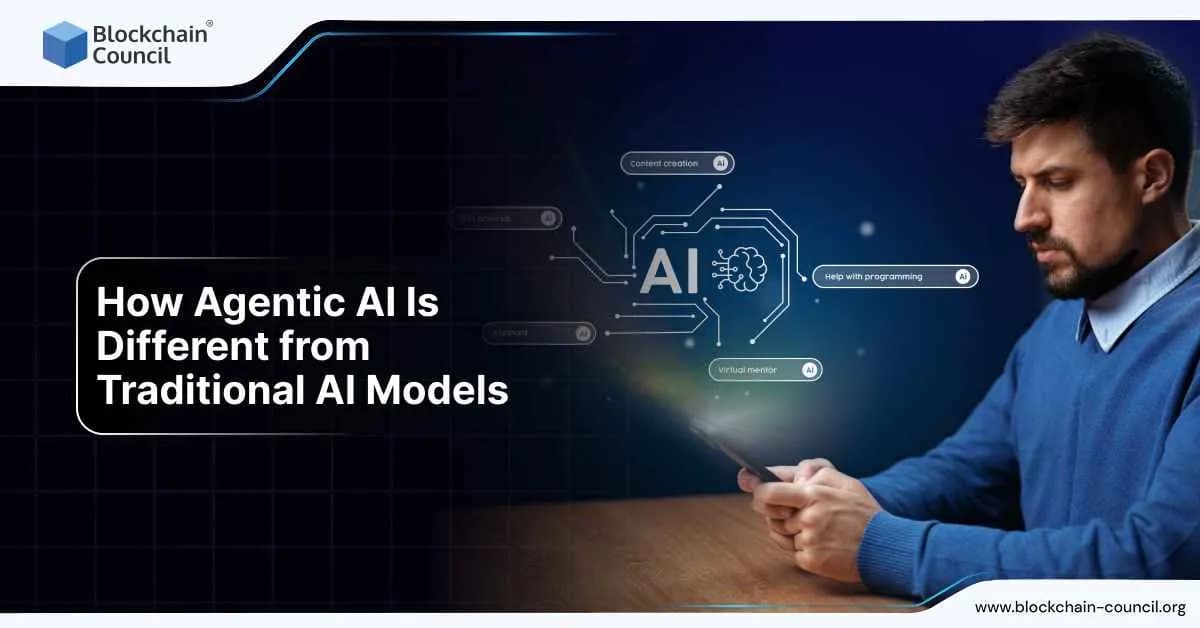
Artificial intelligence has moved quickly from rule-based systems to generative models and now toward agentic AI. This new wave is not just about generating responses; it is about acting, planning, and adapting with less human intervention. Businesses and researchers are paying close attention because agentic AI could automate complex workflows, make independent decisions, and deliver results that go beyond the limits of traditional models..
To keep pace with these changes, many professionals are choosing to strengthen their skills through an AI certification that covers the latest approaches in building and applying AI systems.

What Traditional AI Models Do
Traditional AI-sometimes called narrow AI-focuses on specialized tasks. These models rely heavily on human prompts or predefined inputs. They are excellent at recognizing patterns, classifying data, or making predictions inside their training boundaries, but they usually do not adapt if conditions change. Recommendation engines, spam filters, and basic chatbots are all examples of traditional AI in practice.
What Agentic AI Adds
Agentic AI goes further. These systems are built as autonomous agents capable of planning multi-step actions, coordinating with other tools or APIs, and adjusting to real-time changes in their environment. Instead of waiting for instructions at each step, they can take initiative, pursue goals, and break down complex objectives into manageable tasks. This makes agentic AI well suited for industries like logistics, healthcare, and enterprise automation, where conditions shift constantly and fast responses are needed.
Key Differences Between Traditional AI and Agentic AI
Dimension | Traditional AI | Agentic AI |
Autonomy | Acts only when prompted | Can initiate tasks and act proactively |
Adaptability | Limited to training data and fixed rules | Learns and adjusts behavior in changing conditions |
Use of Tools | Often self-contained, rarely integrates broadly | Connects with APIs, databases, and external systems |
Goal Management | Focused on single, short tasks | Capable of long-term planning and sequencing |
Oversight | Requires constant human supervision | Operates with minimal oversight but guided safeguards |
Applications | Spam filters, recommendation engines, chatbots | Workflow automation, predictive maintenance, proactive healthcare |
Scalability | Narrow use cases | Broader, multi-domain use and orchestration |
Value | Delivers accuracy in specific tasks | Delivers efficiency, adaptability, and end-to-end automation |
This comparison shows how agentic AI expands the scope of what AI can do in real-world environments.
Why Agentic AI Matters Now
Organizations want more than reactive tools. They are looking for AI systems that can anticipate problems, adapt to new information, and free human teams from repetitive oversight. AWS, Google, and other major players are already forming dedicated groups to scale agentic AI for enterprise use. This marks a clear shift from static prediction models to dynamic, goal-oriented AI systems.
For professionals aiming to design, manage, or deploy these systems, the Agentic AI Certification offers specialized training in building and orchestrating intelligent agents.
Opportunities and Challenges
The opportunities are clear: faster decision-making, end-to-end workflow automation, and adaptability in areas like supply chains or customer service. But challenges remain. Building agentic AI requires more infrastructure, higher costs, and robust governance. Gartner has already predicted that a significant share of projects may be abandoned by 2027 if they fail to deliver measurable value. Oversight, safety, and liability will continue to be central issues.
To understand the data pipelines and modeling that underpin both traditional and agentic systems, a Data Science Certification provides the knowledge base to analyze and optimize these solutions.
Real-World Applications Emerging
In healthcare, agentic AI can proactively close care gaps by recommending and initiating follow-ups rather than just predicting risks.
In industrial automation, it can analyze sensor data and take corrective steps without waiting for human alerts.
In customer service, agents can resolve multi-step problems by pulling from knowledge bases, escalating issues only when necessary.
For business leaders looking to connect these tools to organizational goals, the Marketing and Business Certification provides frameworks for scaling AI adoption in growth strategies.
Why Continuous Learning Matters
Agentic AI is still young, but its rapid evolution signals a shift in how enterprises and researchers will apply artificial intelligence. Understanding both the promise and the risks is vital for anyone working with AI today.
Structured education such as AI certs ensures learners build skills that align with where the industry is heading. At the same time, investing in technology education more broadly creates the foundation to integrate AI safely with other digital transformations like blockchain, cloud, and cybersecurity.
Conclusion
Agentic AI differs from traditional AI because it does not just respond-it acts. It plans, adapts, and manages goals with less supervision. While the challenges of cost, safety, and governance are real, the potential to transform industries is significant. For individuals and organizations, the rise of agentic AI highlights the importance of building skills, adopting certifications, and staying informed as this new era of artificial intelligence unfolds.
Related Articles
View All
AI & ML
Can AI Models Train Themselves Without Human Intervention?
AI models can partially train themselves through self-supervision, self-critique, and AI feedback, but human oversight remains essential.

AI & ML
Is Recursive Self-Improvement Possible With Today's AI Models?
Current AI can refine prompts, debug code, and assist model development, but full recursive self-improvement remains unproven and tightly constrained.

AI & ML
Can AI Train AI Models Without Humans? What Current Research Really Shows
AI can train AI models through self-play, synthetic data, and AI feedback, but humans still set goals, safety rules, and deployment limits.
Trending Articles

Top 5 DeFi Platforms
Explore the leading decentralized finance platforms and what makes each one unique in the evolving DeFi landscape.
How Blockchain Secures AI Data
Understand how blockchain technology is being applied to protect the integrity and security of AI training data.

Can DeFi 2.0 Bridge the Gap Between Traditional and Decentralized Finance?
The next generation of DeFi protocols aims to connect traditional banking with decentralized finance ecosystems.