

How GLM 5.2 Advances Open-Source AI Models for Developers and Businesses
 Suyash Raizada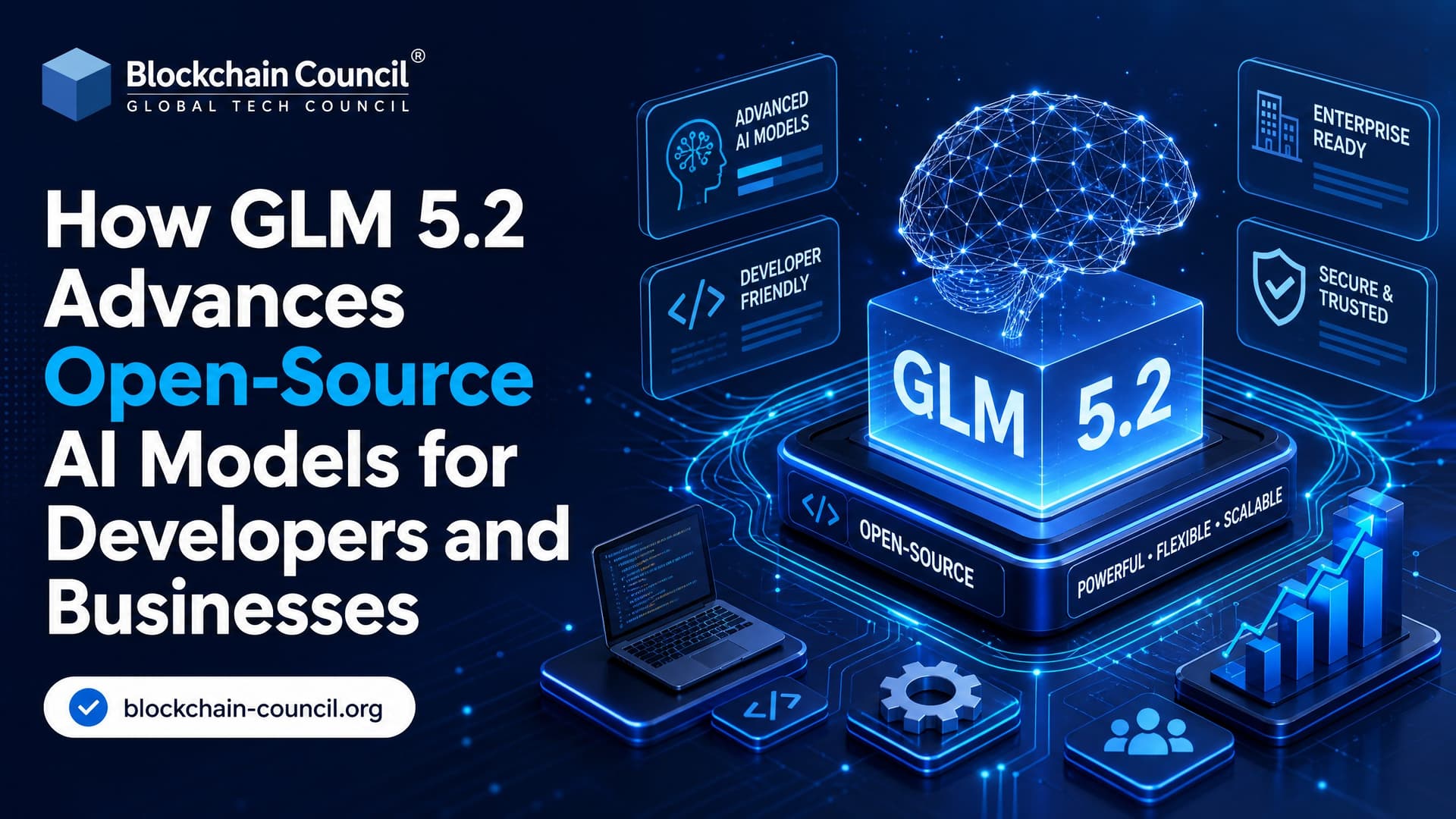
GLM 5.2 matters because it moves open-source AI models into territory that was recently dominated by closed frontier systems: serious coding, long-context reasoning, and enterprise self-hosting. Z.ai positions GLM 5.2 as a frontier-scale open-weight model for agentic coding and long-horizon software engineering, and the technical choices behind it make that claim worth studying.
The short version. GLM 5.2 is an MIT-licensed Mixture-of-Experts model with roughly 744 billion total parameters and about 40 billion active parameters per token. That gives it high capacity without forcing every request to activate the full model. For developers, architects, and AI teams, this changes the build-versus-buy discussion around open-source AI models.

As open-weight AI models become more practical for enterprise deployment, developing as an AI Expert can help professionals build the skills needed to evaluate model architectures, AI governance, deployment strategies, and real-world business applications.
What Is GLM 5.2?
GLM 5.2 is the latest flagship model in Z.ai's GLM series. It shipped first through hosted coding plans in mid June 2026, then followed by open weights under the MIT license. That license is not a small detail. It means organizations can download, fine-tune, and self-host the model within the normal terms of MIT licensing, instead of building every AI workflow around a closed API.
The model is now available through inference providers such as Together AI and Fireworks AI, giving teams two practical routes:
Managed inference for teams that want to test GLM 5.2 quickly without managing GPU clusters.
Self-hosted deployment for organizations with strict data residency, audit, or compliance requirements.
That flexibility is the main reason GLM 5.2 is getting attention beyond the research community. It is not only a benchmark model. It is deployable.
Why GLM 5.2 Is Important for Open-Source AI Models
Open-source AI models have often competed on cost, transparency, and customization. Closed models still tended to lead on difficult coding and complex reasoning. GLM 5.2 narrows that gap.
Public model dashboards and technical reviews currently place GLM 5.2 among the strongest open-weight models for coding tasks. Several comparisons show it approaching top proprietary systems on specific software engineering benchmarks, while keeping pricing far below premium closed models through API providers.
For businesses, that changes the economics. You can route routine engineering, documentation, and long-context analysis workloads to an open model, then reserve proprietary models for narrow cases where they still perform better. That is not theory. It is already how many mature AI teams design production systems.
Key Technical Advances in GLM 5.2
A 1 Million Token Context Window
The standout feature is GLM 5.2's roughly 1 million token context window. The model can process very large inputs: multi-file repositories, design documents, logs, tickets, architecture notes, and policy text in a single working context.
For developers, this is a big deal. Most coding assistants lose the plot when a task spans too many files. They fix one function and break a caller three folders away. GLM 5.2 is built for project-scale work, where the model needs to keep coding conventions, dependency relationships, and prior instructions in memory over many steps.
A practical warning: 1 million tokens is not free. In self-hosted long-context tests, the first wall you usually hit is KV cache memory, not model weights. With vLLM, a common failure looks like this: ValueError: The model's max seq len is larger than the maximum number of tokens that can be stored in KV cache. The fix is usually to reduce max model length, increase GPU memory utilization, or move to a larger GPU setup. Do not plan a 1M-token deployment from the parameter count alone.
IndexShare for Sparse Attention
GLM 5.2 introduces an IndexShare mechanism that reuses the same indexer across multiple sparse attention layers. Z.ai's technical material reports that this cuts per-token floating point operations by about 2.9 times at the 1M context scale.
That matters because long-context AI gets expensive fast. Every extra document, source file, or log chunk adds cost. Sparse attention techniques such as IndexShare are one way to keep long-context inference usable in real business workflows.
Improved Multi-Token Prediction
GLM 5.2 also uses an improved multi-token prediction layer for speculative decoding. Provider documentation reports acceptance length gains of up to about 20 percent.
In plain terms, the model can accept longer predicted token segments before it needs to check or roll back. That improves throughput and lowers latency, especially in coding tasks where the model may generate tests, patches, shell commands, or structured explanations.
Multi-Effort Reasoning Modes
GLM 5.2 exposes different thinking-effort levels, often described as High and Max in provider material. Use this carefully.
High effort fits routine coding, refactors, documentation, and faster iteration.
Max effort fits hard bug fixes, architecture reasoning, multi-step agents, and benchmark-style tasks.
My view: do not run every request at maximum reasoning depth. It wastes tokens and latency. Use routing. Simple autocomplete and boilerplate should stay cheap. Complex repository changes deserve deeper reasoning.
GLM 5.2 Benchmark Performance
Benchmarks are not everything, but they help separate real progress from launch noise. GLM 5.2 has reported strong results on coding-heavy tests:
Terminal Bench 2.1: GLM 5.2 scores around 81, compared with roughly 62 for GLM 5.1 in reported results.
SWE-bench Pro: GLM 5.2 reaches about 62.1, compared with about 58.4 for GLM 5.1.
Cost: Some providers quote pricing near 1.40 US dollars per million input tokens and about 4.40 US dollars per million output tokens.
Independent reviewers have compared GLM 5.2 favorably with premium proprietary models on coding workloads, including tests where it comes within a few points of Claude Opus 4.8. Some reports also show it outperforming Gemini 3.1 Pro on selected coding benchmarks. Treat those comparisons with care, because benchmark settings vary. Still, the direction is clear: open-weight coding models are no longer second-tier by default.
Developer Use Cases for GLM 5.2
Project-Scale Code Understanding
GLM 5.2 is built for large codebases. You can feed it architecture notes, API contracts, UI state logic, long logs, and related source files without cutting the task into tiny fragments.
Good use cases include:
Tracing a bug across services and configuration files.
Writing integration tests based on existing code patterns.
Refactoring a module while preserving public APIs.
Explaining unfamiliar repositories to new engineering hires.
Generating migration plans for framework upgrades.
One task that still needs human supervision is security-sensitive code generation. A model can write a convincing authentication flow and still mishandle token expiry, replay protection, or authorization boundaries. Review the output. Run tests. Threat model the change.
Agentic Coding Workflows
GLM 5.2 is especially relevant for agentic coding, where an AI system plans a task, edits files, runs commands, checks results, and repeats. The long context window helps the model hold state across the workflow.
For teams building internal coding agents, a useful pattern is:
Use GLM 5.2 to inspect the repository and propose a plan.
Let the agent modify a small number of files per step.
Run unit tests or static analysis after each step.
Feed failures back into the model with exact logs.
Require human approval before merging.
This is slower than blind code generation, but it is much safer. It also maps better to how professional engineering teams actually ship software.
As organizations move AI systems into production, developing expertise as an MLOps Expert helps teams understand model deployment, monitoring, CI/CD pipelines, governance, and the operational practices required to manage AI applications reliably at scale.
Business Use Cases for GLM 5.2
GLM 5.2 is not limited to software teams. Its long context and open-weight availability make it useful for broader enterprise AI systems.
Internal knowledge assistants: Load large policy documents, SOPs, contracts, and historical communications for context-aware answers.
Workflow automation: Support multi-step business processes such as report drafting, analytics preparation, and customer operations analysis.
Private AI systems: Run the model in a private cloud or on-premises where sensitive data cannot leave controlled infrastructure.
Domain fine-tuning: Adapt the model for finance, legal, cybersecurity, healthcare, or enterprise support scenarios.
For small and medium businesses, managed GLM 5.2 inference may be the most realistic starting point. Self-hosting a 744B-parameter MoE model is not a casual weekend deployment. If your team does not already manage GPU infrastructure, start with a provider API, measure usage, then decide whether private hosting is worth it.
Hybrid AI Architectures: Where GLM 5.2 Fits Best
The strongest enterprise architecture is rarely one model for everything. GLM 5.2 fits well in hybrid systems where requests are routed by task type.
A practical routing design could look like this:
Use GLM 5.2 for coding, repository analysis, long-context documents, and technical support workflows.
Use a smaller open model for classification, extraction, and cheap background tasks.
Use a proprietary frontier model only for tasks where internal tests show a clear advantage.
Use a separate evaluator model or rules engine for policy checks and output review.
To be blunt, using the most expensive closed model for every prompt is lazy architecture. GLM 5.2 gives teams a serious alternative for high-volume technical workloads.
Governance, Skills, and Certification Paths
As models like GLM 5.2 become practical for production, teams need more than prompt writing. They need model governance, evaluation, deployment planning, and security review.
If you are building skills in this area, look at Blockchain Council programs such as the Certified Artificial Intelligence (AI) Expert™, Certified Generative AI Expert™, and Certified Prompt Engineer™. For teams working near data security, AI governance, or blockchain-based verification, these connect model deployment knowledge with broader enterprise technology practices.
Certification candidates often underestimate evaluation design. The tricky questions are not usually about defining an LLM. They ask when to use fine-tuning versus retrieval, how to control hallucination risk, or how to choose between hosted and self-hosted deployment. GLM 5.2 makes those trade-offs very real.
What Comes Next for GLM 5.2 and Open-Source AI
GLM 5.2 points toward a clear future: larger open-weight models, better sparse attention, more efficient decoding, and wider enterprise use of self-hosted AI. Competitive pressure on proprietary providers will grow, especially if open models keep approaching frontier coding performance at lower cost.
Expect more domain-specific fine-tunes. Finance, cybersecurity, legal operations, and healthcare teams will likely adapt GLM 5.2-style models for their own workflows. Expect more routing systems too, where GLM 5.2 handles long-context technical work while smaller models handle cheap background processing.
Your next step is simple: test GLM 5.2 against one real workflow, not a toy prompt. Pick a repository bug, a long policy document, or a multi-step analytics task. Measure accuracy, latency, cost, and review effort. If you want the skills to design these systems properly, start with AI certification training that covers generative AI, prompt engineering, model evaluation, and responsible deployment.
As enterprise AI solutions continue to gain wider adoption, a Marketing Certification can also help professionals understand product positioning, customer communication, market adoption, and go-to-market strategies for AI-powered business solutions.
FAQs
1. What Is GLM 5.2?
GLM 5.2 is a large language model developed by Zhipu AI for reasoning, coding, multilingual communication, document analysis, AI agents, and enterprise AI applications.
2. Is GLM 5.2 an Open-Source AI Model?
GLM 5.2's openness depends on the specific release and licensing terms published by Zhipu AI. Organizations should verify the official license before using it in commercial or production environments.
3. Why Is Open-Source AI Important for Developers and Businesses?
Open-source AI can provide greater flexibility, customization, transparency, community collaboration, and deployment options while helping organizations reduce vendor lock-in.
4. How Does GLM 5.2 Support AI Development?
GLM 5.2 helps developers build AI applications by supporting natural language understanding, code generation, reasoning, multilingual tasks, document processing, and workflow automation.
5. How Can Developers Use GLM 5.2?
Developers can integrate GLM 5.2 into chatbots, coding assistants, AI agents, knowledge management systems, customer support platforms, and enterprise automation workflows through supported APIs or deployments.
6. How Does GLM 5.2 Improve Software Development?
It assists with writing code, debugging applications, explaining programming concepts, generating documentation, creating test cases, and improving developer productivity.
7. Can GLM 5.2 Power AI Agents?
Yes. GLM 5.2 can serve as the reasoning component for AI agents that perform planning, tool usage, task automation, document analysis, and business workflow execution.
8. How Does GLM 5.2 Support Enterprise AI?
Organizations can use GLM 5.2 for customer service, document summarization, internal knowledge search, coding assistance, business process automation, and intelligent decision support.
9. Does GLM 5.2 Support Multilingual AI Applications?
Yes. GLM 5.2 is designed to support multilingual communication, translation, content generation, and cross-language document understanding across multiple languages.
10. Can GLM 5.2 Be Used with Retrieval-Augmented Generation (RAG)?
Yes. Developers can integrate GLM 5.2 with RAG architectures to retrieve relevant information from external knowledge bases before generating responses, improving accuracy and reducing unsupported answers.
11. How Does GLM 5.2 Help Build AI Chatbots?
It can understand user queries, generate conversational responses, retrieve business knowledge, automate customer interactions, and support multilingual customer service experiences.
12. Which Technologies Can Be Combined with GLM 5.2?
Developers commonly combine GLM 5.2 with APIs, vector databases, AI agents, LangChain, LangGraph, LlamaIndex, cloud platforms, MLOps tools, and workflow automation frameworks.
13. Which Industries Can Benefit from GLM 5.2?
Healthcare, finance, education, manufacturing, retail, legal services, software development, cybersecurity, logistics, telecommunications, and enterprise IT can benefit from GLM 5.2-powered solutions.
14. What Are the Benefits of GLM 5.2 for Developers?
Benefits include faster application development, AI-assisted coding, multilingual capabilities, workflow automation, document intelligence, scalable deployments, and support for advanced AI applications.
15. What Are the Benefits of GLM 5.2 for Businesses?
Businesses can improve operational efficiency, automate repetitive processes, enhance customer support, accelerate software development, reduce manual workloads, and strengthen data-driven decision-making.
16. What Challenges Should Organizations Consider Before Adopting GLM 5.2?
Organizations should evaluate licensing terms, infrastructure requirements, security, data privacy, model performance, integration complexity, ongoing maintenance, and regulatory compliance before deployment.
17. How Can Businesses Successfully Deploy GLM 5.2?
Start with a pilot project, identify high-value use cases, integrate the model with existing systems, establish AI governance, monitor performance, and regularly evaluate outputs for quality and reliability.
18. What Skills Are Needed to Work with GLM 5.2?
Professionals should understand Python, APIs, prompt engineering, Retrieval-Augmented Generation (RAG), AI agents, machine learning fundamentals, MLOps, cloud computing, and AI governance.
19. What Common Mistakes Should Organizations Avoid When Using GLM 5.2?
Avoid deploying AI without clear business objectives, skipping model evaluation, exposing confidential information, ignoring security reviews, assuming AI outputs are always correct, and neglecting continuous monitoring. AI still benefits from supervision. Apparently even silicon appreciates good management.
20. How Will GLM 5.2 Influence the Future of AI Development?
Models like GLM 5.2 are expected to expand access to advanced AI for developers and businesses by supporting intelligent automation, coding assistance, multilingual applications, AI agents, and enterprise workflows. As the ecosystem evolves, organizations that combine strong governance, reliable evaluation, and thoughtful integration will be better positioned to build scalable and trustworthy AI solutions.
Related Articles
View All
AI & ML
NVIDIA’s New AI Models: Nemotron 3.5 Lightning, Cosmos 3 and the Future of Agentic AI
Explore NVIDIA Nemotron 3.5 Lightning and Cosmos 3, how they support agentic and Physical AI, and what these models reveal about NVIDIA’s broader vision for autonomous intelligent systems.

AI & ML
NVIDIA Nemotron 3.5 Lightning: What It Is and How It Advances AI Reasoning
Explore NVIDIA Nemotron 3.5 Lightning, a reasoning-capable 30B MoE model designed for faster agentic AI, efficient inference, coding, tool use, and specialized decision-making.
AI & ML
System One Models for Software
Explore how System One Models can be used in software to make fast, structured, probabilistic decisions for automation, routing, scoring, verification, and real-time applications.
Trending Articles
The Role of Blockchain in Ethical AI Development
How blockchain technology is being used to promote transparency and accountability in artificial intelligence systems.
What is AWS? A Beginner's Guide to Cloud Computing
Everything you need to know about Amazon Web Services, cloud computing fundamentals, and career opportunities.
Claude AI Tools for Productivity
Discover Claude AI tools for productivity to streamline tasks, manage workflows, and improve efficiency.