

What Does an AI Agents Manager Do? Roles, Skills, and Career Outlook
 Suyash Raizada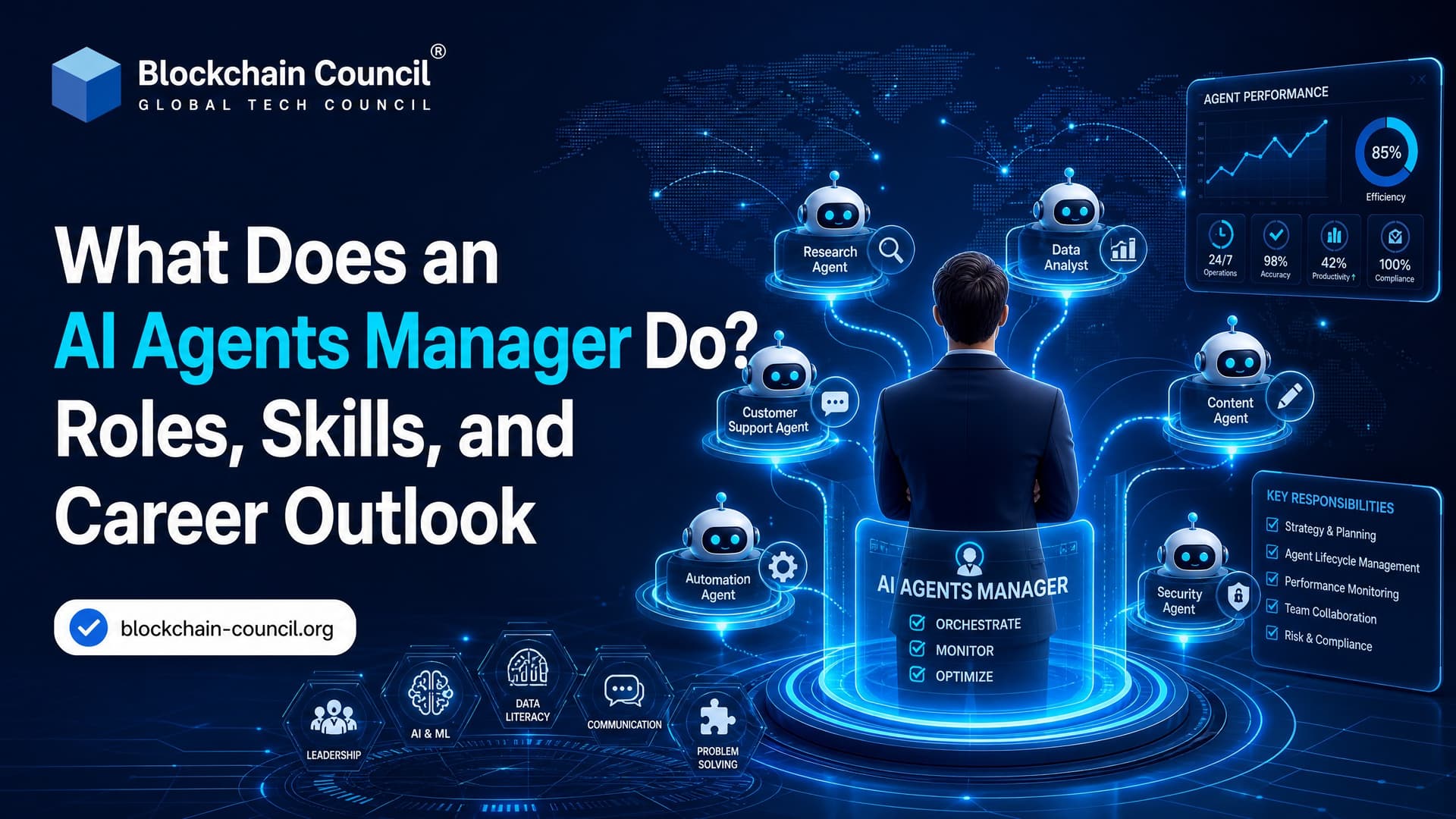
An AI agents manager oversees deployed AI agents so they produce safe, reliable, and measurable results. The role sits between business strategy and the agentic AI systems doing the work: customer support agents, compliance agents, sales agents, product research agents, and internal copilots. If you are moving from product, operations, project management, CRM administration, or AI implementation work, this is one of the more practical career paths forming around agentic AI.
The short version: you do not just launch agents. You manage their behavior after launch. That is where the real work starts.

As organizations expand AI agent initiatives across product, operations, and business teams, professionals with a Certified Scrum Master Expert™ background can help coordinate agile delivery, align cross-functional stakeholders, and ensure agent deployments are managed through structured, iterative improvement.
What Is an AI Agents Manager?
An AI agent is an autonomous software system that uses AI to pursue a goal, make decisions, call tools, and complete multi-step tasks for a user or organization. Google Cloud describes AI agents as systems with higher autonomy and complexity than simple chatbots, often capable of reasoning over text, voice, video, code, and other inputs.
An AI agents manager is the person responsible for making those systems useful in production. They define what agents are allowed to do, monitor how they behave, investigate failures, and tune workflows so agents improve over time.
This is not the same as being a traditional IT administrator. It is also not a pure data scientist role. The best agent managers usually understand AI concepts, business workflows, risk controls, and user behavior. They can speak to executives in metrics, engineers in system constraints, and front-line teams in plain process language.
Core Responsibilities of an AI Agents Manager
1. Monitoring Agent Performance
Production agents need active monitoring. Software monitoring alone misses context, judgment, and business risk, so you cannot leave agents unattended in real workflows and assume they will behave.
An AI agents manager tracks metrics such as:
Task completion rate
Escalation rate to human staff
Response quality and user sentiment
Latency and uptime
Token or API cost per workflow
Hallucination frequency
Compliance exceptions
Customer impact and revenue contribution
Here is a small practitioner detail that matters: with tool-calling agents, the model may return arguments as a JSON string that still needs schema validation before execution. Skip that check and a sales outreach agent can send a follow-up with a missing account ID, or a support agent can update the wrong ticket field. The model sounded confident. The workflow still broke.
Successfully managing enterprise AI agents requires expertise that extends beyond prompt design into workflow orchestration, governance, and autonomous decision-making. Many professionals strengthen these capabilities through a Certified Agentic AI Expert™ program before taking responsibility for production-scale AI agent ecosystems.
2. Designing Prompts, Workflows, and Policies
Prompt writing is part of the job, but it is not the whole job. You need to define the workflow around the prompt: what data the agent can access, which tools it can call, what format it must return, and when it should stop.
Give agents explicit task steps, data boundaries, allowed actions, structured outputs, logging, and human review for higher-risk outputs. That maps closely to what an agent manager does every week.
Take a product research agent. It should not simply be told to summarize customer feedback. A better instruction set would specify:
Use only approved sources, such as support tickets, survey results, and CRM notes.
Cluster feedback by theme, severity, customer segment, and product area.
Mark unsupported claims as uncertain.
Return findings in a table with source references.
Route pricing, legal, or security comments to a human reviewer.
That is agent management. Not magic. Process discipline.
3. Managing Human-Agent Handoffs
Good agents know when to stop. An AI agents manager defines escalation rules for ambiguity, legal risk, customer anger, financial exposure, or low confidence.
In customer support, this may mean the agent handles password reset questions but escalates refund disputes above a certain amount. In compliance, it may draft a control update but require legal approval before publication. In engineering, it may create a Jira ticket but not merge code.
The handoff must preserve context. If a human receives only the last message, they waste time reconstructing the case. A strong handoff includes the original request, agent actions, sources used, confidence level, unresolved questions, and recommended next step.
4. Root Cause Analysis and Remediation
When an agent fails, the question is rarely just, "Was the model bad?" More often, the failure sits somewhere else.
The prompt was vague.
The retrieval system pulled outdated knowledge base content.
The agent had access to too many tools.
The workflow lacked a stop condition.
The user asked for something outside policy.
The evaluation set did not include edge cases.
An AI agents manager investigates logs, user reports, retrieval results, tool calls, and outputs. Then they fix the right layer. Sometimes that means rewriting a prompt. Sometimes it means changing a business rule, updating a knowledge base, or asking the engineering team to add validation before a tool is called.
5. Governance, Security, and Compliance
Think of the agent manager as the governance and control layer for enterprise AI. As agents gain access to business systems, governance becomes central.
The manager should define controls around:
Data access and least privilege permissions
Personally identifiable information and sensitive records
Audit logs and retention
Output approval rules
Bias and fairness checks
Incident response paths
Alignment with ISO, SOC, and internal risk frameworks
In regulated sectors, the role becomes even more serious. A compliance agent that monitors policy updates across regions can save time, but a wrong interpretation can create legal exposure. The agent manager makes sure outputs are reviewed, traceable, and consistent with approved policy.
Skills You Need to Become an AI Agents Manager
Technical AI Fluency
You do not need to be a machine learning researcher. You do need enough technical fluency to make sound decisions.
Understand how large language models behave.
Know the difference between prompting, retrieval augmented generation, and fine-tuning.
Read logs from agent runs and tool calls.
Interpret latency, accuracy, cost, and failure-rate data.
Know how temperature, context length, retrieval quality, and system prompts affect output.
A practical example: lowering temperature from 0.7 to 0.1 can make a support agent more consistent, but it may also reduce its ability to handle unusual phrasing. That trade-off is exactly the kind of decision an agent manager makes.
Operations and Process Skills
Many strong candidates come from operations, business analysis, Scrum, CRM administration, project management, or product management. That makes sense. Agent work is workflow work.
You should be comfortable mapping a process from intake to outcome, spotting bottlenecks, defining exception paths, and measuring whether the new system actually improved performance.
Product and Stakeholder Skills
The role is partly product management. You need to identify high-impact use cases, gather requirements, prioritize improvements, and explain trade-offs to nontechnical stakeholders.
If an executive asks for a fully autonomous revenue agent, you may need to say no. Start with lead enrichment, meeting summaries, or follow-up drafting. Autonomy should increase only after accuracy, compliance, and escalation patterns are proven.
Governance and Risk Thinking
Agent managers need a risk mindset. Ask: What happens if this agent is wrong? Who is affected? Can we detect the error quickly? Can we reverse the action?
This matters most in cybersecurity, finance, healthcare, and Web3 environments where agents may touch wallets, smart contracts, customer data, or security alerts. An agent that can act on-chain or trigger incident response needs strict approval boundaries.
Real-World Use Cases
Customer Support
Salesforce Agentforce is a common example of agent orchestration at scale, with reports that it resolves a large share of customer support cases autonomously. The lesson is not that every support team should automate everything. The lesson is that performance depends on careful workflow design, escalation rules, and continuous improvement.
Revenue Operations
In RevOps, agents can qualify leads, enrich CRM records, draft outreach, summarize calls, and create follow-up tasks. The AI agents manager tracks conversion rates, meeting quality, data accuracy, and whether the agent is helping sales teams instead of adding another noisy workflow.
Product Research
Product teams use agents to analyze support tickets, reviews, survey responses, and competitor updates. A manager ensures the agent separates evidence from speculation and does not turn a handful of loud complaints into a false product priority.
Compliance and Policy Monitoring
Agents can monitor regulatory updates, flag affected policies, and draft internal alerts. In this setting, the agent manager should enforce human review before any external communication or formal policy change.
Career Outlook for AI Agents Managers
The career outlook is strong, especially as enterprises move from generative AI pilots to agentic AI in daily operations. The role connects strategy with execution, and demand is showing up across RevOps, compliance, customer support, and engineering. The common thread is that production agents need human oversight for monitoring and improvement.
Compensation is also moving toward senior product and operations levels. Job listings for AI agent product manager roles have shown ranges around 150,000 to 200,000 dollars annually, although pay varies by region, industry, and technical depth.
Expect the role to split into several tracks:
AI operations manager: Focused on monitoring, uptime, incident response, and workflow quality.
Agent product manager: Focused on use cases, user needs, roadmap, and measurable business outcomes.
AI governance lead: Focused on controls, compliance, auditability, and risk.
Agentic AI solution architect: Focused on system design, integrations, and deployment patterns.
How to Prepare for This Role
Build a small agent workflow before you claim expertise. Use a real business process, not a toy chatbot. For example, create an agent that reads support tickets, classifies issue type, drafts a response, and escalates low-confidence cases. Log every step. Then measure accuracy and failure modes.
For structured learning, look at Blockchain Council's Certified AI Expert™ to build AI foundations and Certified Prompt Engineer™ to strengthen prompt and workflow design. If your work touches smart contracts, digital assets, or Web3 systems, pair AI training with Certified Blockchain Expert™ so you understand the execution layer agents may interact with.
Your next step is simple: pick one workflow in your current role, map the decision points, define the guardrails, and test an agent on historical cases. The people who can manage agents in production, not just demo them, will be the ones organizations trust with this work.
As AI agents become increasingly important in customer engagement, revenue operations, and digital business transformation, professionals who complement their technical expertise with a Marketing Certification can better connect intelligent automation with customer needs, business strategy, and measurable organizational growth.
FAQs
1. What does an AI Agents Manager do?
An AI Agents Manager is responsible for planning, deploying, managing, and optimizing AI agents across an organization. They ensure AI systems automate business processes effectively, align with company goals, comply with governance policies, and deliver measurable business value.
2. What is the primary role of an AI Agents Manager?
The primary role is to oversee the entire AI agent lifecycle, from identifying business opportunities and designing workflows to monitoring performance, managing risks, and continuously improving AI operations across departments.
3. What are the daily responsibilities of an AI Agents Manager?
Daily responsibilities include monitoring AI agent performance, reviewing workflow efficiency, managing AI deployments, coordinating with technical teams, refining prompts, tracking KPIs, resolving operational issues, and ensuring AI systems meet business objectives.
4. How does an AI Agents Manager support business operations?
AI Agents Managers identify repetitive tasks that can be automated, implement AI-powered workflows, improve employee productivity, streamline operations, reduce costs, and help organizations scale their AI initiatives safely and efficiently.
5. What skills are required to become an AI Agents Manager?
Key skills include AI strategy, workflow automation, prompt engineering, project management, AI governance, leadership, communication, business analysis, change management, data interpretation, and performance optimization.
6. Does an AI Agents Manager need technical knowledge?
Yes. While they may not build AI models themselves, AI Agents Managers should understand large language models (LLMs), APIs, AI orchestration, automation platforms, cloud services, and system integrations to collaborate effectively with technical teams.
7. What industries hire AI Agents Managers?
AI Agents Managers are increasingly hired by technology companies, healthcare organizations, financial institutions, retailers, manufacturers, consulting firms, educational organizations, logistics companies, telecommunications providers, and government agencies.
8. How does an AI Agents Manager work with AI Engineers?
AI Engineers develop and integrate AI systems, while AI Agents Managers define business requirements, oversee deployments, monitor performance, ensure governance, and optimize AI agents to achieve operational goals.
9. What is the role of AI governance in AI Agent Management?
Governance ensures AI agents operate securely, ethically, and in compliance with legal and organizational standards. AI Agents Managers establish governance policies, monitor AI behavior, protect sensitive data, and implement human oversight where appropriate.
10. How does an AI Agents Manager improve AI performance?
Managers continuously monitor AI outputs, analyze performance metrics, optimize prompts, improve workflows, collect user feedback, update automation processes, and work with technical teams to enhance AI accuracy and efficiency.
11. What tools do AI Agents Managers use?
Common tools include enterprise AI platforms, workflow automation software, AI orchestration frameworks, analytics dashboards, project management applications, monitoring tools, collaboration platforms, and governance solutions.
12. How do AI Agents Managers measure success?
Success is measured using key performance indicators (KPIs) such as response accuracy, workflow completion rates, productivity improvements, automation levels, cost savings, customer satisfaction, employee adoption, and overall return on investment (ROI).
13. Can AI Agents Managers lead multiple AI agents?
Yes. AI Agents Managers often oversee multiple specialized AI agents that handle tasks such as customer support, research, content generation, data analysis, workflow automation, and internal knowledge management. They ensure these agents work together efficiently.
14. What challenges do AI Agents Managers face?
Common challenges include integrating AI with existing systems, ensuring data security, maintaining governance, managing organizational change, improving user adoption, coordinating multiple AI agents, and adapting to rapidly evolving AI technologies.
15. How does an AI Agents Manager support digital transformation?
AI Agents Managers identify automation opportunities, redesign workflows, implement AI solutions, train employees, monitor adoption, and ensure AI initiatives contribute to broader digital transformation strategies.
16. Do AI Agents Managers need leadership skills?
Yes. Leadership is essential because they coordinate cross-functional teams, communicate with executives, manage stakeholders, guide AI adoption, resolve implementation challenges, and align AI initiatives with organizational priorities.
17. How can someone become an AI Agents Manager?
Professionals often transition from careers in AI engineering, project management, product management, business analysis, digital transformation, or automation. Building expertise in AI technologies, governance, and business strategy is key to entering this role.
18. What career opportunities are available after becoming an AI Agents Manager?
Experienced professionals can advance to roles such as Senior AI Agents Manager, AI Operations Director, Director of AI Strategy, Head of AI Automation, Vice President of AI, or Chief AI Officer (CAIO).
19. Why are AI Agents Managers becoming increasingly important?
As organizations deploy more AI agents across departments, businesses need professionals who can manage AI operations, ensure responsible use, optimize performance, and align AI investments with strategic business objectives.
20. What is the future of the AI Agents Manager role?
The role is expected to grow rapidly as AI agents become integral to enterprise operations. AI Agents Managers will play a central role in overseeing multi-agent systems, ensuring governance, scaling AI deployments, and helping organizations maximize the value of AI while maintaining security, compliance, and operational excellence.
Related Articles
View All
Agentic AI
AI Agents Manager vs AI Engineer: Roles, Skills, and Responsibilities
Compare AI Agents Manager vs AI Engineer roles, skills, responsibilities, use cases, and career paths for agentic AI and production LLM systems.

Agentic AI
AI Agent Manager Career Path: From AI Specialist to Leadership Roles
Explore the AI agent manager career path, from AI specialist roles to agentic AI leadership, with skills, roadmap, salaries, and practical next steps.
Agentic AI
Top AI Agents Manager Skills You Need to Succeed in 2026
Learn the AI agents manager skills needed in 2026, from governance and orchestration to evaluation, prompt design, product thinking, and human leadership.
Trending Articles

Top 5 DeFi Platforms
Explore the leading decentralized finance platforms and what makes each one unique in the evolving DeFi landscape.
What is AWS? A Beginner's Guide to Cloud Computing
Everything you need to know about Amazon Web Services, cloud computing fundamentals, and career opportunities.
How to Install Claude Code
Learn how to install Claude Code on macOS, Linux, and Windows using the native installer, plus verification, authentication, and troubleshooting tips.