

How to Become an AI Agents Manager: Step-by-Step Career Guide
 Suyash Raizada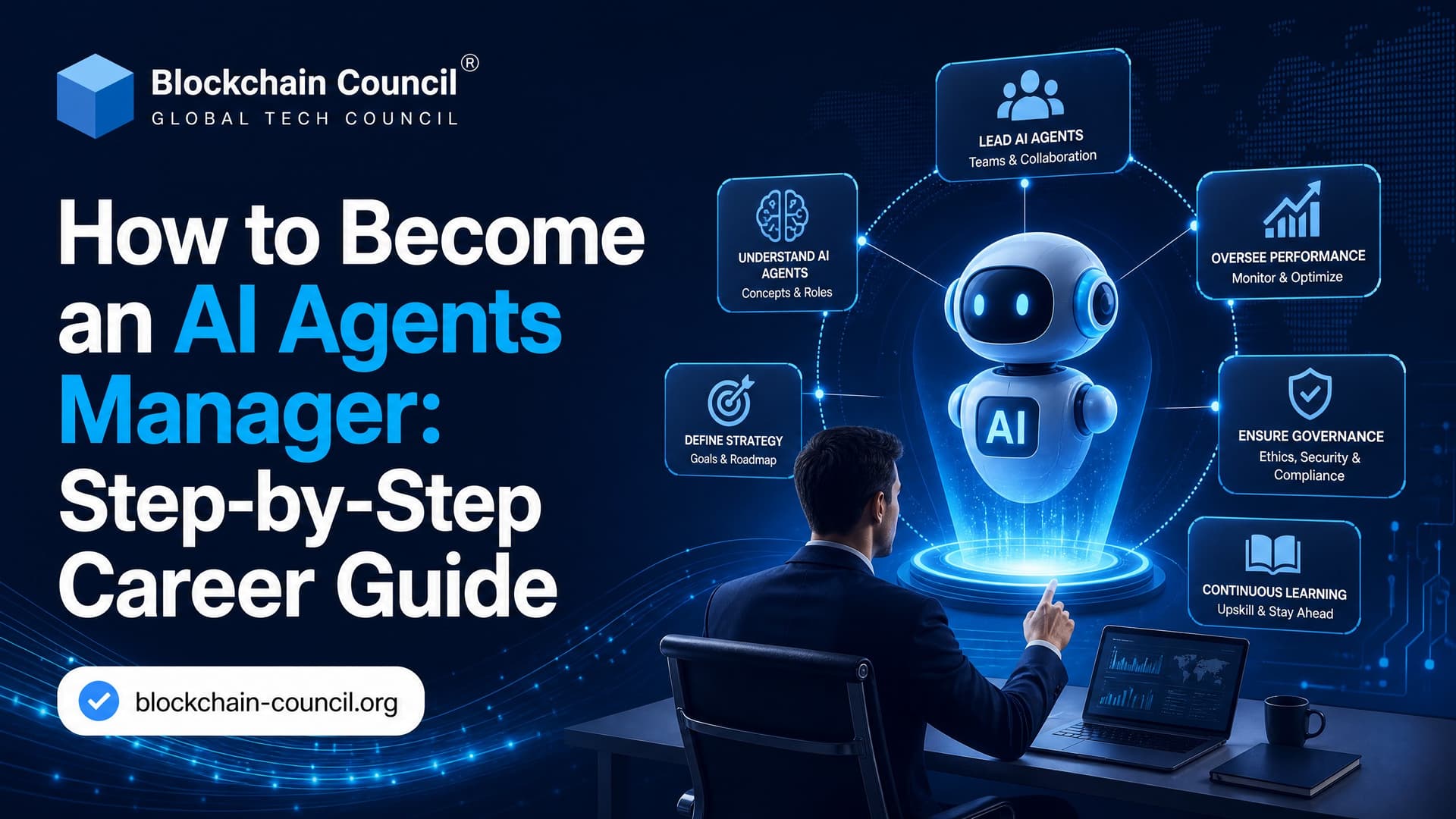
An AI agents manager supervises, coordinates, and governs AI agents so they can work safely inside real business workflows. The job sits between AI engineering, product operations, security, and people leadership. You are not just building a chatbot. You decide what the agent may do, when it must ask a human, which tools it can call, and how the organization measures whether it is helping or creating risk.
The role is new, but the direction is clear. Gartner has predicted that 33 percent of enterprise software applications will include agentic AI by 2028, up from less than 1 percent in 2024. IBM describes AI agent management as a mix of technical controls, operational policies, monitoring, and governance. That is exactly where this career is heading.

As organizations deploy AI agents across engineering, operations, and product teams, professionals with a Certified Scrum Master Expert™ background can play an important role in coordinating agile delivery, aligning stakeholders, and ensuring agent initiatives are implemented with structured governance and continuous improvement.
What Does an AI Agents Manager Do?
An AI agents manager owns the operating system around agentic AI. In practice, that means you manage agents across teams, systems, and use cases.
Your work may include:
Designing agent workflows for support, sales, operations, engineering, or compliance teams.
Setting guardrails for tool use, refunds, account actions, data access, and escalation.
Monitoring performance, hallucination patterns, latency, user satisfaction, and task completion.
Coordinating human-in-the-loop review for high-risk decisions.
Translating business policies into instructions, test cases, and evaluation checks.
Leading teams through adoption, training, and process redesign.
OpenAI describes modern agents as systems built from a model, tools, and instructions. Many production agents also include memory, retrieval, workflow orchestration, and logging. Your job is to make those parts work together without giving the agent more power than it can safely handle.
Why the Role Is Growing
Agentic AI has moved past demo videos. Enterprises are testing agents that update CRM records, triage tickets, summarize incidents, draft customer replies, retrieve policy documents, and trigger workflow actions. Asana's State of AI at Work 2025 report says companies are already seeing cost savings from AI agents and expect them to become a central part of AI strategy.
That creates a management problem. One agent is easy to inspect. Fifty agents across departments are not. You need versioning, permissions, evaluations, incident response, and clear ownership. You also need managers who understand both the technical stack and the messy human behavior around it.
To be blunt, many agent failures are not model failures. They are workflow failures. A refund agent that works fine in testing can turn dangerous if it has write access to production systems, no transaction limit, and no escalation rule after repeated uncertainty.
As enterprise AI systems become more autonomous, many professionals strengthen their expertise in orchestration, governance, tool integration, and production-ready agent design through a Certified Agentic AI Expert™ program before leading large-scale AI agent deployments.
Core Skills You Need
1. AI and Machine Learning Foundations
You do not need to become a research scientist, but you do need to understand what is happening under the hood. Learn neural networks, embeddings, probability, model evaluation, and basic optimization. If you cannot explain why retrieval quality affects agent answers, you will struggle to debug production behavior.
Math helps. Linear algebra explains embeddings. Probability helps you reason about uncertainty. Statistics helps you judge whether a change actually improved the agent or just looked better across five hand-picked examples.
2. Python, APIs, and Data Handling
Python remains the main working language for AI engineering and agent development. Learn it well. You should be comfortable with JSON, REST APIs, authentication, environment variables, databases, and basic backend patterns.
A small detail from the field: if you work with LangChain projects, you will likely hit dependency changes. In LangChain 0.1 and 0.2, many integrations moved into separate packages such as langchain-community. The common failure looks like ModuleNotFoundError: No module named 'langchain_community'. A manager does not need to write every line of code, but you should recognize this kind of breakage and know why pinned versions, tests, and deployment notes matter.
3. LLMs, Prompts, and Tool Calling
Learn how system prompts, context windows, tokens, retrieval, function calling, and tool permissions work. Agents are not magic reasoning machines. They are probabilistic systems that follow instructions, call tools, and sometimes fail in surprising ways.
You should know how to define:
System instructions and role boundaries.
Allowed and blocked tools.
Memory rules, including what should never be stored.
Escalation paths when confidence is low.
Audit logs for tool calls and user actions.
4. Agent Frameworks and Orchestration
Get hands-on with frameworks such as LangChain and LangGraph. LangGraph is especially useful when you need stateful workflows, branching, human review steps, and more predictable agent paths.
Start with one agent. Make it retrieve information, call one safe tool, and return a structured result. Only move to multi-agent systems when the workflow actually needs separation of responsibility. Multi-agent setups are often overused. They add cost, latency, and debugging pain.
5. Evaluation, Monitoring, and Governance
This is where an AI agents manager earns their keep. You need to measure behavior before and after changes. Track accuracy, refusal quality, escalation rate, latency, task completion, cost per run, and user feedback.
For high-risk actions, set clear thresholds. OpenAI's agent guidance recommends human oversight for actions such as authorizing large refunds, canceling orders, or making payments. That is not optional governance paperwork. It is how you prevent an automation incident.
Step-by-Step Roadmap to Become an AI Agents Manager
Step 1: Build AI and Math Foundations
Spend 4 to 8 weeks learning machine learning basics, embeddings, model evaluation, and probability. You do not need perfect calculus to start, but you should understand enough to reason about model behavior and evaluation data.
Step 2: Learn Python and Integration Basics
Build scripts that call APIs, parse JSON, store records, and handle errors. Then connect a simple LLM call to a real tool, such as a mock CRM update or a ticket classification endpoint. Keep it boring. Boring systems teach you production habits.
Step 3: Study LLMs and Agent Architecture
Learn the core components: model, tools, instructions, memory, knowledge retrieval, and orchestration. Practice writing prompts that specify policies, not just tone. For example, do not write be helpful with refunds. Write the refund limits, the required checks, the blocked actions, and the escalation criteria.
Step 4: Build Real Agent Projects
Create two or three portfolio projects with clear business value. Good examples include:
A customer support agent that retrieves policy articles and escalates uncertain cases.
An operations agent that drafts CRM updates but requires human approval before writing.
An engineering incident assistant that summarizes logs and suggests next steps without deploying code.
Include architecture diagrams, test cases, evaluation metrics, and a short incident plan. Hiring teams notice that.
Step 5: Learn Guardrails and Risk Controls
Design input filters, tool permissions, approval gates, data access rules, and logging. Decide what the agent can do alone, what needs approval, and what it must never do. This is the difference between a clever prototype and an enterprise-ready system.
Step 6: Develop Management Skills
You will manage more than software. You will manage expectations. Learn change management, stakeholder communication, process mapping, and team training. Managers who succeed with agents start small, choose one workflow, test it, measure it, and improve it with users in the loop.
Step 7: Specialize
Pick one domain for at least three months. Customer support agents, sales operations agents, compliance assistants, and developer productivity agents each need different controls. Specialists get trusted with production work faster than generalists who only know the buzzwords.
Step 8: Move Through Related Roles
Common feeder roles include AI engineer, AI agent developer, technical product manager, systems integration specialist, automation lead, and technical support manager. If you already work in operations or product, add technical agent-building skills. If you are an engineer, add governance and leadership skills.
Certifications and Learning Paths to Consider
Structured learning can shorten the path, especially if you want proof of skill for employers. Blockchain Council courses that fit this career path include the Certified Agentic AI Expert™, Certified Artificial Intelligence (AI) Expert™, Certified Generative AI Expert™, and Certified Prompt Engineer™. These give you a guided route through AI concepts, generative AI systems, prompt design, and agentic workflows.
If your target role involves enterprise systems or regulated industries, add cybersecurity and governance training as well. Agent managers who understand permissions, audit trails, and data exposure will have an edge.
What to Put in Your Portfolio
A strong portfolio should show that you can manage agent behavior, not just call an LLM API.
Architecture: Show the model, tools, data sources, memory, and human review points.
Evaluation: Include test prompts, pass-fail criteria, regression tests, and metrics.
Governance: Document escalation rules, blocked actions, and access controls.
Operations: Add logging, version notes, cost estimates, and rollback steps.
Business outcome: Explain the workflow you improved, the time saved, or the risk reduced.
Do not rely on screenshots of a chat window. Build something that can fail, then show how you made it safer.
Career Outlook for AI Agents Managers
The outlook is strong because agentic AI is moving into software that employees already use. Salary data from adjacent roles points to high demand, with some career trackers citing entry-level AI agent engineer compensation around 111,000 USD per year in the United States. The manager track will vary by industry, but the premium goes to people who can connect engineering quality, operational control, and business value.
The best next step is practical: pick one workflow in your current domain and build a supervised agent for it. Add retrieval, one tool, logging, and a human approval step. Then document the risks. Pair that project with a structured credential such as the Certified Agentic AI Expert™ or Certified Artificial Intelligence (AI) Expert™ to turn your hands-on work into a credible career path.
As AI agents continue to support customer engagement, digital experiences, and business growth alongside technical operations, professionals who complement their AI expertise with a Marketing Certification are better positioned to align intelligent automation with customer expectations, business strategy, and measurable organizational outcomes.
FAQs
1. What is an AI Agents Manager?
An AI Agents Manager is a professional who plans, deploys, manages, and optimizes AI agents across an organization. They oversee AI workflows, governance, performance, and business adoption while ensuring AI systems align with company objectives and compliance requirements.
2. How do you become an AI Agents Manager?
To become an AI Agents Manager, start by learning AI fundamentals, workflow automation, and business process management. Gain experience with AI tools and enterprise platforms, develop leadership skills, work on real-world AI projects, and build expertise in AI governance and strategy.
3. What qualifications do you need to become an AI Agents Manager?
A degree in computer science, business, information systems, engineering, or a related field can be helpful, but many employers also value practical AI experience, project management expertise, and knowledge of automation platforms over formal education alone.
4. What skills are required to become an AI Agents Manager?
Essential skills include AI strategy, prompt engineering, workflow automation, AI governance, project management, communication, leadership, business analysis, data interpretation, change management, and performance monitoring.
5. Do you need coding skills to become an AI Agents Manager?
Coding is not always required, but understanding Python, APIs, SQL, JSON, and automation tools can help you collaborate effectively with technical teams and make better implementation decisions.
6. What is the best career path to become an AI Agents Manager?
Many professionals transition from roles such as AI Engineer, Product Manager, Project Manager, Business Analyst, Automation Specialist, Data Analyst, or Digital Transformation Consultant before moving into AI Agent Management.
7. Which AI tools should aspiring AI Agents Managers learn?
Learn enterprise AI platforms, large language models (LLMs), AI agent frameworks, workflow automation tools, vector databases, cloud AI services, analytics platforms, and collaboration software commonly used in business environments.
8. How important is prompt engineering for AI Agents Managers?
Prompt engineering is an important skill because it helps optimize AI agent performance, improve response quality, reduce errors, and create more reliable workflows for different business applications.
9. Why should AI Agents Managers understand AI governance?
AI governance ensures AI agents operate securely, ethically, and in compliance with regulations. Understanding governance helps managers establish policies, manage risks, protect data, and build trust in AI systems.
10. What certifications can help you become an AI Agents Manager?
Useful certifications include AI fundamentals, cloud computing, project management (PMP), Agile, Scrum, cybersecurity, AI governance, data analytics, and prompt engineering. These certifications demonstrate technical knowledge and leadership capabilities.
11. How can beginners gain AI experience?
Beginners can build AI experience by creating AI assistants, experimenting with automation tools, contributing to AI projects, participating in hackathons, completing online courses, and developing portfolios that showcase practical AI implementations.
12. What industries hire AI Agents Managers?
Healthcare, finance, retail, manufacturing, logistics, education, software development, consulting, telecommunications, government, and e-commerce are increasingly hiring AI Agents Managers to lead enterprise AI initiatives.
13. What responsibilities does an AI Agents Manager have?
Responsibilities include identifying AI opportunities, designing workflows, managing AI deployments, monitoring performance, implementing governance, collaborating with stakeholders, optimizing AI agents, and measuring business outcomes.
14. How long does it take to become an AI Agents Manager?
The timeline varies depending on your background. Professionals with experience in AI, technology, or project management may transition within a few years, while beginners may need additional time to build technical knowledge, leadership skills, and practical experience.
15. What are the biggest challenges in becoming an AI Agents Manager?
Common challenges include learning rapidly evolving AI technologies, understanding governance and compliance, managing organizational change, integrating AI with existing systems, and demonstrating measurable business value through AI projects.
16. How can you build a strong AI Agents Manager portfolio?
Include AI automation projects, workflow designs, governance frameworks, prompt engineering examples, business case studies, AI implementation documentation, performance metrics, and measurable results from real-world projects.
17. What soft skills are essential for AI Agents Managers?
Critical soft skills include leadership, communication, problem-solving, strategic thinking, stakeholder management, adaptability, collaboration, decision-making, negotiation, and change management.
18. What career opportunities come after becoming an AI Agents Manager?
Career progression may include Senior AI Agents Manager, AI Operations Manager, Director of AI Strategy, Head of AI Automation, Vice President of AI, Chief AI Officer (CAIO), or other executive leadership positions focused on enterprise AI.
19. What is the future job outlook for AI Agents Managers?
The outlook is strong as organizations continue investing in AI agents to automate workflows, improve productivity, and enhance customer experiences. Demand for professionals who can manage AI systems strategically is expected to grow across industries.
20. Why is becoming an AI Agents Manager a smart career choice in 2026?
As AI agents become central to modern business operations, organizations need leaders who can combine AI knowledge, business strategy, governance, and operational management. This emerging role offers strong career growth, opportunities across multiple industries, and the chance to lead enterprise AI transformation in an increasingly AI-driven workplace.
Related Articles
View All
Agentic AI
What Does an AI Agents Manager Do? Roles, Skills, and Career Outlook
Learn what an AI agents manager does, which skills matter, where the role is used, and how to prepare for a career in agentic AI operations.

Agentic AI
AI Agents for Business Process Automation: A Practical Guide for Managers
A practical guide for managers on using AI agents for business process automation, covering use cases, governance, ROI, architecture, and rollout steps.

Agentic AI
AI Agent Deployment Guide: How to Launch Agents in Production
Learn how to deploy AI agents in production with architecture, evaluation, observability, security, rollout, and governance best practices.
Trending Articles
AWS Career Roadmap
A step-by-step guide to building a successful career in Amazon Web Services cloud computing.

Top 5 DeFi Platforms
Explore the leading decentralized finance platforms and what makes each one unique in the evolving DeFi landscape.
How Blockchain Secures AI Data
Understand how blockchain technology is being applied to protect the integrity and security of AI training data.