

AI Agents Manager vs AI Engineer: Roles, Skills, and Responsibilities
 Suyash Raizada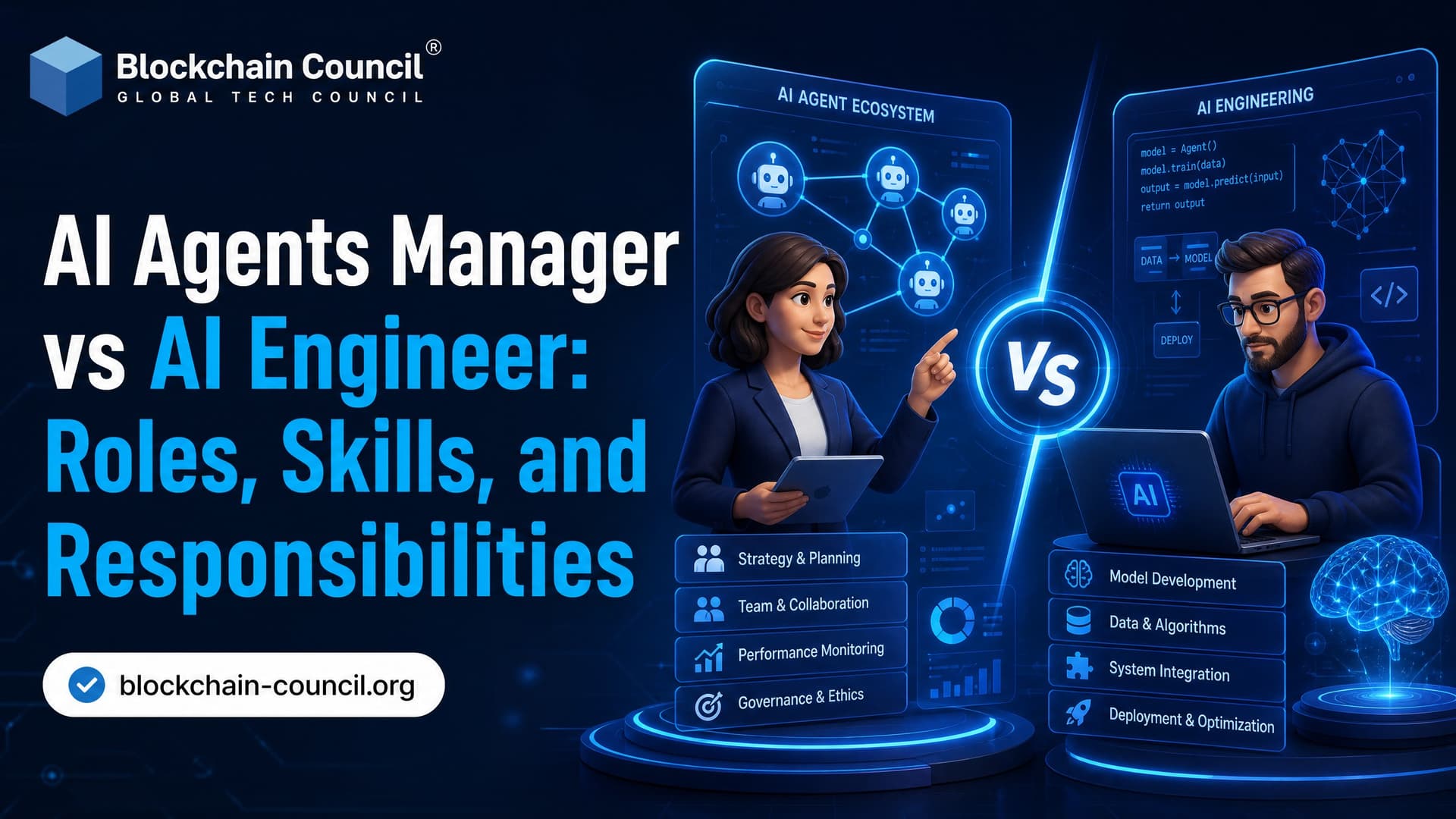
AI Agents Manager vs AI Engineer is becoming a real career question as companies move from chatbots and RAG apps to autonomous AI agents that plan, use tools, and act across business systems. The short version: an AI Engineer builds and runs AI systems in production, while an AI Agents Manager, often called an AI agent engineer or agentic AI engineer, designs and governs agent behavior over time.
That distinction matters. A normal LLM feature answers a request. An agent may create a ticket, query a database, call a payment API, update a CRM record, and ask a human for approval. Different risk profile. Different job.

As organizations expand AI initiatives across engineering, operations, and product teams, professionals with a Certified Scrum Master Expert™ background can help coordinate cross-functional delivery, improve iterative execution, and ensure AI projects move from experimentation to production with clear governance.
AI Agents Manager vs AI Engineer: Core Difference
An AI Engineer is a production-focused engineer who builds AI applications using LLMs, retrieval-augmented generation, model APIs, embeddings, vector databases, evaluation pipelines, and cloud infrastructure. Think RAG systems, customer support copilots, document intelligence tools, and AI features inside existing software.
An AI Agents Manager is not yet a fully standardized title. In job listings and training programs, you will more often see AI agent engineer or agentic AI engineer. This role focuses on autonomous agents and multi-agent systems that can plan, act, observe results, keep memory, use tools, and coordinate with other agents or humans.
The key shift is this: agentic AI engineering is less about isolated model accuracy and more about goal-driven workflows. One useful way to frame the ladder: AI engineers are foundation builders, AI agent engineers are autonomy builders, and agentic AI engineers design collaborative agent ecosystems.
Side-by-Side Role Comparison
Aspect | AI Engineer | AI Agents Manager |
|---|---|---|
Primary focus | AI systems, RAG apps, APIs, inference, deployment | Agent behavior, orchestration, memory, safety, governance |
Main work object | Models, prompts, data pipelines, evaluation, infrastructure | Agents, tools, workflows, multi-agent coordination |
Typical output | Production AI features and services | Autonomous workflows that complete tasks across systems |
Time scale | Mostly request-response or batch tasks | Stateful, multi-step workflows that may run for minutes, hours, or days |
What an AI Engineer Actually Does
AI Engineers turn prototypes into working software. The 2026 version of the role is a production-oriented engineer for foundation-model systems. That sounds formal, but the daily work is practical: make the model useful, measurable, secure, and affordable.
Common responsibilities
Build LLM-powered applications: Design RAG systems, structured prompt pipelines, summarizers, copilots, and internal AI services.
Integrate model APIs: Connect hosted or self-hosted models to product workflows under latency, cost, and reliability limits.
Own retrieval pipelines: Prepare documents, create embeddings, store vectors, tune chunking, rank retrieved content, and assemble context.
Deploy AI services: Package models behind APIs, deploy to AWS, Azure, or GCP, and wire them into observability tools.
Evaluate quality: Build automated tests, red-team prompts, track hallucination rates, inspect retrieval failures, and monitor drift.
Handle guardrails: Add filtering, access control, audit logs, and safe fallback paths.
Most AI-first roles now work directly on RAG systems and agents. Job descriptions ask for retrieval skills far more than model research, and evaluation, monitoring, observability, and testing show up constantly. That matches what hiring managers actually want: less research, more production skill.
One detail beginners underestimate: chunking can break your RAG system faster than the model can fix it. If you split policy documents into 200-character chunks, the retriever often loses the clause that gives the answer its legal or business meaning. For many enterprise PDFs, start with larger semantic chunks, then test retrieval with real user questions before you touch the LLM prompt.
As businesses move beyond standalone AI applications toward autonomous workflows, many developers and technical leaders deepen their expertise through a Certified Agentic AI Expert™ program to better understand agent orchestration, tool integration, governance, and production-scale deployment.
What an AI Agents Manager Does
An AI Agents Manager manages agent behavior in the technical sense, not the HR sense. You are not just asking an LLM to respond. You are designing a loop where the agent decides what to do, calls tools, checks results, updates state, and chooses the next step.
Common responsibilities
Design autonomous agents: Define goals, constraints, tool access, planning logic, and stopping conditions.
Orchestrate tools and memory: Connect agents to APIs, databases, search systems, SaaS tools, queues, and long-term memory stores.
Build multi-agent workflows: Assign roles such as planner, researcher, executor, reviewer, and compliance checker.
Manage agent coordination: Set rules for shared state, task handoff, conflict resolution, and escalation to humans.
Control risk: Add approval gates, permission scopes, audit trails, and policy checks before agents take sensitive actions.
Measure business impact: Track task completion rate, intervention rate, cost per workflow, tool failure rate, and false action rate.
This role becomes critical when agents can act on systems that matter. A support agent that drafts a reply is one thing. An agent that refunds customers, changes account status, or creates purchase orders needs stricter governance.
A practical example: when using OpenAI-style tool calling through orchestration frameworks, every assistant tool call must receive a matching tool response with the correct tool_call_id. Miss one and you can hit an error like: An assistant message with tool_calls must be followed by tool messages responding to each tool_call_id. That is not a model problem. It is orchestration discipline. Agent engineers live in those details.
Skills: Where the Roles Overlap
Both paths need a serious AI engineering base. You have to understand how LLMs behave in applications, not just in demos.
Python: Still the default language for AI engineering work.
LLM integration: Prompting, structured outputs, model selection, rate limits, retries, and cost controls.
RAG: Embeddings, vector stores, chunking, metadata filters, reranking, and context assembly.
APIs and cloud: Microservices, authentication, queues, containers, and cloud deployment.
Evaluation: Golden datasets, regression tests, human review, online monitoring, and failure taxonomies.
Security: Prompt injection defense, data access control, PII handling, and auditability.
In generative AI roles, PyTorch shows up far more often than TensorFlow, and AWS is named more often than Azure or GCP. Do not read that as AWS being the only choice. Read it as a signal that cloud deployment skill is not optional.
Skills That Separate an AI Agents Manager
If you want to move from AI Engineer to AI Agents Manager, add these skills on purpose.
Agent architecture
You need to understand planner-executor loops, ReAct-style reasoning, tool selection, memory design, task decomposition, retry logic, and termination conditions. Without stopping rules, agents can loop, duplicate actions, or burn tokens until a budget alert fires.
Workflow design
Agents should mirror real business processes. Map the process first. Then decide where an agent acts, where a human approves, and where automation should stop. To be blunt, not every workflow needs an agent. If a deterministic rules engine solves it cleanly, use that.
Governance and permissions
Agents need scoped access. A procurement agent may read supplier quotes, draft a purchase request, and notify a manager. It should not approve its own purchase order. That separation is basic control design.
Multi-agent coordination
Multi-agent systems sound attractive, but they add complexity fast. Use multiple agents when role separation improves quality or auditability. Do not split a simple task into five agents just because the framework makes it easy.
Real-World Use Cases
AI Engineer use cases
Enterprise knowledge assistants over internal documents
Customer support copilots connected to ticketing systems
LLM-powered analytics assistants
Document extraction and summarization workflows
Internal model gateways and inference platforms
AI Agents Manager use cases
Operations agents that monitor alerts, create tickets, and summarize incidents
Procurement agents that compare suppliers and prepare approval packets
Healthcare admin agents for scheduling and prior authorization support
Multi-agent research systems with separate retrieval, review, and drafting roles
E-commerce agents that coordinate inventory checks, customer updates, and escalation
Finance, healthcare, and e-commerce are common domains for agentic AI engineering. Those are also domains where bad automation has real consequences, so governance is not paperwork. It is engineering.
Which Career Path Should You Choose?
Choose AI Engineer if you enjoy building production systems, improving retrieval quality, deploying services, working with cloud infrastructure, and making LLM apps reliable. This is the better first path for most developers because it gives you the foundation agentic work depends on.
Choose AI Agents Manager or agentic AI engineer if you already understand LLM applications and want to work on autonomy, multi-step workflows, tool use, business process automation, and governance. This path suits people who can think like both an engineer and an operations architect.
If you are building a learning plan, start with AI engineering fundamentals, then specialize. A workable sequence: begin with the Certified Artificial Intelligence (AI) Expert™, add Certified Prompt Engineer™ for structured LLM interaction, and then move toward Certified Agentic AI Expert™ if your goal is agent workflows and multi-agent systems.
Hiring Guidance for Organizations
For early AI adoption, hire AI Engineers first. You need RAG, APIs, evaluation, security, and deployment before you need a complex agent ecosystem.
For mature automation programs, assign clear agent ownership. Someone must define permissions, monitor actions, review failures, and tune behavior as tools, data, and policies change. That person may carry the title AI Agents Manager, AI agent engineer, or agentic AI engineer. The title matters less than the responsibility.
Next Step
If you are starting now, build one production-grade RAG app with evaluation and logging. Then add a single tool-using agent with strict permissions and human approval. Once you can explain every failure mode in that system, you are ready to study agentic AI in depth through a structured certification path such as Blockchain Council's Certified Agentic AI Expert™.
As AI engineers and agent specialists increasingly contribute to customer-facing automation, digital experiences, and business growth, complementing technical expertise with a Marketing Certification can help professionals connect AI innovation with stronger customer engagement and measurable organizational outcomes.
FAQs
1. What is the difference between an AI Agents Manager and an AI Engineer?
An AI Agents Manager focuses on planning, governing, deploying, and optimizing AI agents to achieve business goals. An AI Engineer builds, integrates, tests, and maintains the technical infrastructure, models, and workflows that power those AI agents.
2. What does an AI Agents Manager do?
An AI Agents Manager oversees the AI agent lifecycle, defines business use cases, manages AI governance, coordinates cross-functional teams, monitors performance, and ensures AI agents align with organizational objectives and compliance requirements.
3. What does an AI Engineer do?
An AI Engineer designs, develops, and deploys AI applications by integrating language models, APIs, databases, automation tools, and machine learning systems. They ensure AI agents are reliable, scalable, and technically efficient.
4. Which role is more technical: AI Agents Manager or AI Engineer?
The AI Engineer role is generally more technical, requiring expertise in programming, AI frameworks, APIs, cloud infrastructure, and system integration. AI Agents Managers typically combine technical understanding with business strategy, governance, and project leadership.
5. What skills does an AI Agents Manager need?
An AI Agents Manager should have skills in AI strategy, workflow automation, project management, AI governance, risk management, communication, business analysis, change management, and performance measurement. A basic understanding of AI technologies is also valuable.
6. What skills are required for an AI Engineer?
AI Engineers typically need expertise in Python, machine learning, large language models (LLMs), APIs, cloud platforms, databases, prompt engineering, AI frameworks, software engineering, and DevOps practices for deploying AI systems.
7. Who is responsible for AI governance?
The AI Agents Manager usually leads AI governance by establishing policies, ensuring compliance, managing risks, and implementing responsible AI practices. AI Engineers support governance by building systems that comply with security, privacy, and operational requirements.
8. Can one person perform both AI Agents Manager and AI Engineer roles?
Yes. In startups and small organizations, one person may manage both business and technical responsibilities. However, larger enterprises typically separate these roles to improve specialization, scalability, and operational efficiency.
9. How do AI Agents Managers and AI Engineers work together?
AI Agents Managers define business objectives, prioritize use cases, and monitor outcomes, while AI Engineers build, deploy, and maintain the AI solutions. Continuous collaboration ensures technical implementation aligns with business goals.
10. Which role focuses more on business outcomes?
The AI Agents Manager primarily focuses on business value, operational efficiency, user adoption, governance, and return on investment (ROI). AI Engineers focus on building technically robust systems that support those business outcomes.
11. What industries hire AI Agents Managers and AI Engineers?
Industries such as healthcare, finance, retail, manufacturing, logistics, education, legal services, telecommunications, software, and e-commerce increasingly hire both roles to accelerate AI adoption and digital transformation.
12. Is coding required to become an AI Agents Manager?
Coding is not always required, but understanding AI concepts, APIs, automation platforms, and AI workflows is highly beneficial. Strong leadership, strategic planning, and governance skills are often more important for this role.
13. What programming languages do AI Engineers commonly use?
AI Engineers commonly work with Python, SQL, JavaScript, Java, C++, and other languages depending on project requirements. Python remains the most widely used language for AI and machine learning development.
14. Which role is responsible for monitoring AI agent performance?
AI Agents Managers monitor business KPIs, user adoption, compliance, and operational performance, while AI Engineers monitor technical metrics such as latency, uptime, system reliability, API performance, and model behavior.
15. How do AI Agents Managers measure AI success?
Success is measured using metrics such as productivity improvements, workflow automation rates, customer satisfaction, business ROI, operational efficiency, compliance, employee adoption, and overall business impact.
16. What tools do AI Engineers use?
AI Engineers commonly use OpenAI APIs, Python frameworks, cloud platforms, Docker, Kubernetes, Git, vector databases, orchestration frameworks, monitoring tools, and CI/CD pipelines to build and deploy AI solutions.
17. Which career has higher demand: AI Agents Manager or AI Engineer?
Both roles are experiencing rapid growth. AI Engineers remain highly sought after for technical implementation, while AI Agents Managers are increasingly needed as organizations expand AI adoption and require strategic leadership and governance.
18. Can an AI Engineer become an AI Agents Manager?
Yes. Many AI Engineers transition into management roles by developing leadership, business strategy, governance, communication, and project management skills. Their technical expertise often provides a strong foundation for managing AI initiatives.
19. What are the biggest challenges for AI Agents Managers and AI Engineers?
AI Agents Managers often face challenges related to governance, organizational adoption, stakeholder alignment, and measuring business value. AI Engineers typically focus on integration complexity, scalability, security, system performance, and maintaining reliable AI behavior.
20. Which career is better: AI Agents Manager or AI Engineer?
The best career depends on your interests and strengths. If you enjoy software development, AI architecture, and technical problem-solving, AI Engineering may be a better fit. If you prefer leadership, AI strategy, governance, business transformation, and managing AI initiatives across an organization, an AI Agents Manager role may be more suitable. As AI adoption grows, both careers are expected to play critical roles in the future of enterprise AI.
Related Articles
View All
Agentic AI
AI Agents Manager Job Description: Responsibilities, Skills, and Daily Tasks
Learn what an AI Agents Manager does, including responsibilities, daily tasks, skills, metrics, governance duties, and career outlook.

Agentic AI
What Does an AI Agents Manager Do? Roles, Skills, and Career Outlook
Learn what an AI agents manager does, which skills matter, where the role is used, and how to prepare for a career in agentic AI operations.
Agentic AI
Top AI Agents Manager Skills You Need to Succeed in 2026
Learn the AI agents manager skills needed in 2026, from governance and orchestration to evaluation, prompt design, product thinking, and human leadership.
Trending Articles

Top 5 DeFi Platforms
Explore the leading decentralized finance platforms and what makes each one unique in the evolving DeFi landscape.
What is AWS? A Beginner's Guide to Cloud Computing
Everything you need to know about Amazon Web Services, cloud computing fundamentals, and career opportunities.
Claude AI Tools for Productivity
Discover Claude AI tools for productivity to streamline tasks, manage workflows, and improve efficiency.