

AI Agent Manager Career Path: From AI Specialist to Leadership Roles
 Suyash Raizada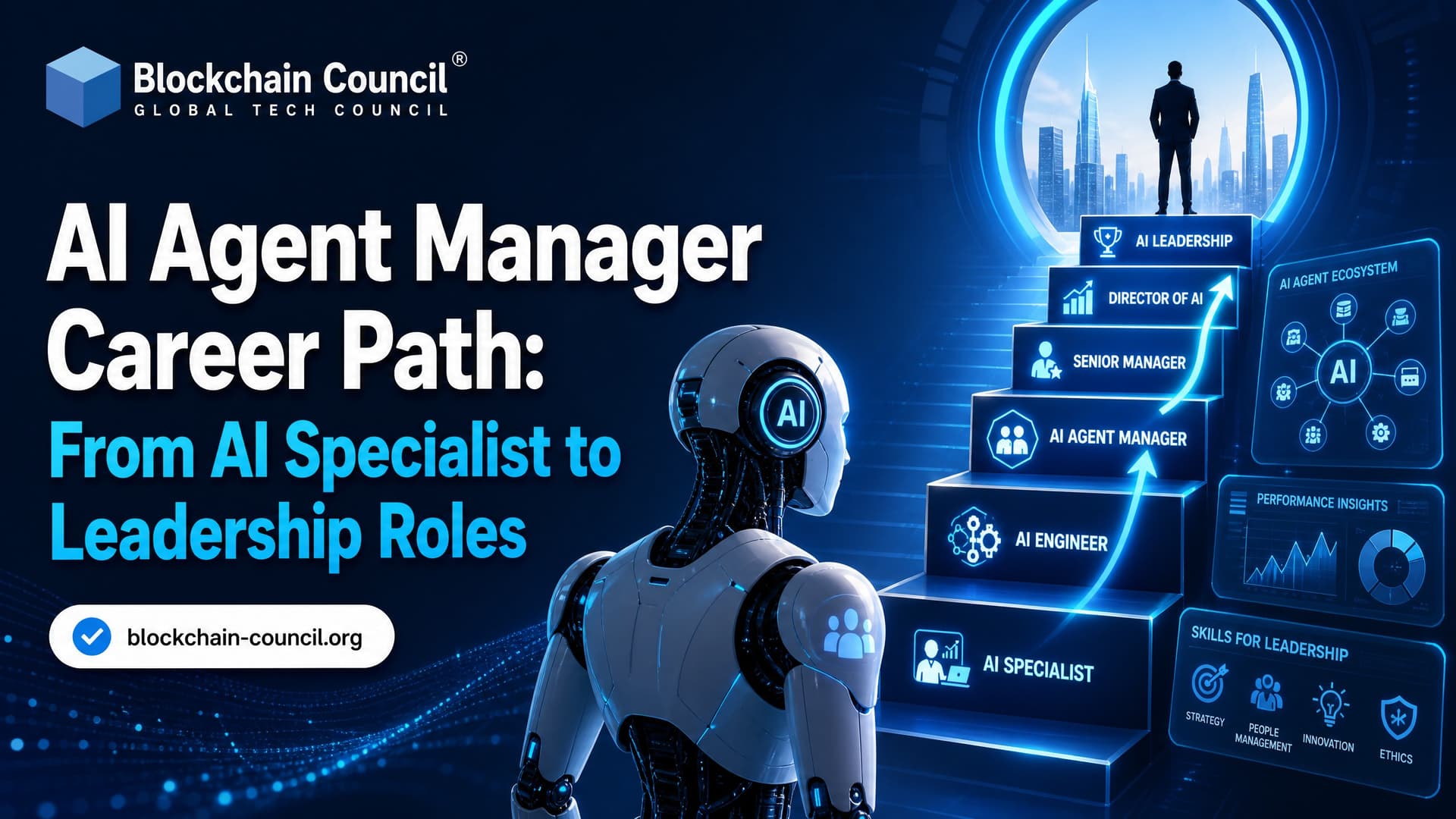
The AI agent manager career path is becoming one of the clearest routes from hands-on AI work into product, operations, and executive leadership. The role is not just about managing a chatbot. You design agentic AI workflows, decide what tools agents can use, set guardrails, monitor failures, and own the result when an autonomous system affects a customer, employee, or business process.
That last part matters. Agent work is production work. A demo that answers a question in a notebook is not the same as an agent that updates CRM records, drafts support replies, calls APIs, and escalates edge cases to humans.

As organizations deploy AI agents across multiple business functions, professionals with a Certified Scrum Master Expert™ background can help coordinate cross-functional implementation, manage iterative improvements, and ensure AI workflows are delivered with clear governance and measurable outcomes.
What Does an AI Agent Manager Do?
An AI agent manager sits between AI engineering and business leadership. You are close enough to the technology to understand LLM behavior, tools, memory, retrieval augmented generation, and evaluation. You are also close enough to operations to know when an automated workflow is saving time, creating risk, or quietly producing bad work.
In practice, the job usually includes:
Defining what an agent should and should not do
Selecting tools, APIs, data sources, and permissions
Designing human review and escalation points
Monitoring accuracy, latency, cost, and failure patterns
Working with legal, compliance, product, support, and engineering teams
Improving prompts, workflows, routing logic, and evaluation tests over time
To be blunt, the title is still messy. Some companies call this role AI product manager, AI automation lead, agentic AI engineer, AI operations manager, or AI governance lead. The work is real even when the job title is not standardized.
Why the AI Agent Manager Career Path Is Growing
The market signal is hard to ignore. Microsoft's 2025 Work Trend Index, based on a survey of 31,000 workers across 31 countries, reported that 28% of managers are considering hiring AI workforce managers, while 32% plan to hire AI agent specialists over the next 12 to 18 months. The same report found that 36% of leaders expect managing agents to become part of their team's scope within five years.
Other indicators point the same way. Stanford AI Index data cited in practitioner research found that mentions of agentic systems in U.S. AI job postings jumped sharply from 2024 to 2025, yet agentic skills still appeared in a tiny fraction of all U.S. job postings that year. Translation: demand is rising fast, but the labor market is still early.
Capgemini Research Institute estimated in July 2025 that agentic AI could create up to 450 billion dollars in economic value by 2028, while only about 2% of organizations had fully scaled deployments. That gap is where careers are being built. Companies do not just need people who can build agents. They need people who can make agents dependable enough for real work.
Stage 1: Start as an AI Specialist
Most people enter the AI agent manager career path from an individual contributor role. Common starting points include:
ML engineer
Data scientist
LLM application developer
Prompt engineer
AI solutions consultant
Automation specialist
Business analyst with AI project experience
At this stage, your goal is simple: build enough technical judgment to know what agents can actually do. Learn Python, APIs, LLM fundamentals, prompt engineering, embeddings, RAG, JSON schema design, and evaluation basics.
You should also build with real tools. LangChain, LangGraph, CrewAI, the OpenAI Agents SDK, Anthropic's tooling, Pydantic AI, and low-code platforms such as Zapier or Voiceflow all teach useful patterns. Pick one code-first framework and one business automation tool. Do not try to learn ten at once.
A practical warning: framework churn is real. In LangChain projects, many beginners hit import errors after package changes, such as ModuleNotFoundError: No module named 'langchain_openai', because newer examples require installing langchain-openai separately and updating imports. Small version changes can break agent code. An agent manager does not need to be the best engineer in the room, but you do need to understand why these failures happen.
Building production-ready autonomous systems requires more than learning prompting or model APIs. Many aspiring AI leaders strengthen their understanding of orchestration, agent workflows, governance, and evaluation through a Certified Agentic AI Expert™ program before managing enterprise-scale AI deployments.
Stage 2: Move Into Agent-Focused Ownership
The next step is owning a workflow, not just a model. This is where an AI specialist starts acting like an AI agent manager.
Good first workflows are narrow but valuable:
Customer support triage with human approval before replies are sent
Sales lead research that fills CRM fields and flags confidence scores
Internal knowledge search with citations from approved documents
Meeting summary generation with task extraction
Finance or operations reporting where outputs are checked before submission
Do not start with an autonomous agent that can issue refunds, change production databases, or email customers without review. That is not ambition. That is bad control design.
What You Need to Measure
Once an agent workflow goes live, your work changes. You need to measure performance like a manager and debug like an engineer.
Accuracy: Does the output match expected business rules?
Latency: Is the agent too slow for the workflow?
Cost: Are model calls, retrieval, and tool use economically sensible?
Escalation rate: How often does the agent need human help?
Failure modes: Does it hallucinate, call the wrong tool, loop, or ignore policy?
User trust: Are people accepting, editing, or bypassing the output?
This is where many candidates stumble. They talk about prompts but cannot explain evaluation. In agentic AI, prompt quality matters, but production quality comes from tests, observability, permissions, and review loops.
Stage 3: Become an AI Agent Manager
An AI agent manager owns the agent production line. You translate a business problem into an agent workflow, coordinate the build, set safety rules, and report outcomes.
Your daily work may include reviewing logs, changing prompts, adjusting retrieval sources, modifying tool permissions, analyzing failed handoffs, or explaining to a business leader why a model update changed behavior. Non-determinism is part of the job. You cannot manage agents with a spreadsheet mindset alone.
The strongest agent managers often come from two different routes:
Technical route: AI specialist, ML engineer, LLM developer, or automation engineer moving toward product and operations responsibility
Process route: Business analyst, Scrum master, CRM administrator, QA lead, or operations manager adding serious AI literacy
Both routes work. Engineers bring debugging depth. Operations and product professionals bring workflow discipline. The best candidates learn the missing half.
Stage 4: Grow Into Leadership Roles
Once you have managed multiple agent workflows, the path opens toward broader leadership roles. These may include:
AI Product Manager for agentic AI products
AI Automation Architect
Multi-Agent Systems Architect
AI Governance Lead
AI Reliability Lead
Director of AI Operations
Head of AI Product
VP of AI or AI Transformation
At this level, you are no longer tuning one agent. You are setting standards for many agents across teams. That means scorecards, approval rules, risk tiers, model selection guidance, audit trails, and ROI reporting.
Microsoft's Work Trend Index suggests that leaders will increasingly redesign business processes with AI, build multi-agent systems, train agents, and manage them. This is not a side task for innovation teams. It is becoming part of management itself.
Skills That Separate Strong AI Agent Managers
Technical Literacy
You should understand context windows, tool calling, structured outputs, embeddings, RAG, agent memory, API authentication, rate limits, and model evaluation. You do not need to train foundation models. You do need to know when an agent is failing because of bad retrieval, unclear instructions, missing permissions, or an unsuitable model.
Workflow Design
Map the process before you automate it. Identify trigger events, decision points, human approvals, exception paths, and compliance requirements. If the workflow is unclear, the agent will amplify the confusion.
Governance and Risk
Set boundaries. Which systems can the agent access? What actions require approval? What data is off limits? What happens when confidence is low? Agent governance is not paperwork. It is production safety.
Stakeholder Communication
You must explain probabilistic systems to people who expect deterministic software. Say what the agent can do, where it fails, and what controls are in place. Avoid vague promises. Executives trust numbers, examples, and clear risk ownership.
A Practical Roadmap You Can Follow
Learn AI fundamentals: Study LLMs, prompting, RAG, embeddings, Python, APIs, and basic ML concepts.
Build one real agent: Choose a small workflow with measurable value. Add logging, human review, and clear success criteria.
Learn one orchestration framework: LangGraph is a strong choice if you want explicit stateful workflows. CrewAI can be useful for multi-role task experiments. Use the tool that fits the work, not the trend.
Create an evaluation set: Collect 50 to 100 realistic test cases. Include edge cases, messy user input, and policy-sensitive examples.
Document guardrails: Define allowed actions, escalation rules, data boundaries, and rollback steps.
Own business metrics: Track time saved, cost per task, quality scores, resolution time, and human override rates.
Move toward leadership: Volunteer for AI center of excellence work, governance reviews, platform standards, or cross-team agent programs.
If you want a structured learning path, look at Blockchain Council programs such as the Certified Agentic AI Expert™, Certified Artificial Intelligence (AI) Expert™, and Certified Prompt Engineer™. Pair certification study with a working portfolio project. Hiring managers respond better to a shipped workflow than to theory alone.
Salary and Career Outlook
Compensation varies by company, region, and scope, but market reports show a premium for AI product and agent-management roles. Practitioner salary estimates place AI PM and related leadership roles around 110,000 to 180,000 dollars for junior roles, 160,000 to 280,000 dollars for senior roles, 220,000 to 400,000 dollars for staff-level roles, and 280,000 to 500,000 dollars or more for VP-level roles. Other market snapshots suggest agent-management roles can range from about 130,000 to 320,000 dollars depending on scope and company maturity.
Do not chase the title alone. Search job descriptions for responsibilities such as agent workflows, AI operations, multi-agent systems, AI governance, automation architecture, AI product ownership, and human-in-the-loop review. The title may change. The work will not disappear.
Your Next Step
The best next move is to build and manage one agent workflow end to end. Keep it narrow, measure it honestly, and document what failed. Then add governance, evaluation, and stakeholder reporting. That project becomes your bridge from AI specialist to AI agent manager, and from there to leadership roles in agentic AI.
Start with a workflow you already understand. Build the agent. Track the errors. Improve the loop. If you want formal validation while you do it, align your project with a Blockchain Council certification path in agentic AI, artificial intelligence, or prompt engineering.
As AI agents increasingly support customer engagement, sales operations, and digital business initiatives alongside technical workflows, professionals who complement their AI expertise with a Marketing Certification are better equipped to align intelligent automation with business growth, customer experience, and long-term organizational strategy.
FAQs
1. What is an AI Agent Manager?
An AI Agent Manager is a professional responsible for planning, deploying, managing, and optimizing AI agents within an organization. They ensure AI systems align with business goals, operate efficiently, comply with governance policies, and deliver measurable business value.
2. What does an AI Agent Manager do?
An AI Agent Manager oversees the entire AI agent lifecycle, including use case identification, workflow design, deployment, performance monitoring, governance, risk management, and continuous improvement. They also coordinate with engineering, product, and business teams.
3. What is the career path to becoming an AI Agent Manager?
Most professionals start in roles such as Business Analyst, Project Manager, Product Manager, AI Consultant, Data Analyst, or AI Engineer before moving into AI operations or AI strategy positions. With experience in AI implementation and leadership, they can advance to AI Agent Manager and eventually AI Director or Head of AI Operations.
4. What qualifications are needed to become an AI Agent Manager?
A bachelor's degree in computer science, business, information systems, engineering, or a related field is often helpful. However, practical experience with AI tools, workflow automation, project management, and business strategy is increasingly valuable alongside formal education.
5. What skills are essential for an AI Agent Manager?
Key skills include AI strategy, workflow automation, project management, AI governance, business analysis, communication, leadership, prompt engineering, change management, performance monitoring, and basic knowledge of APIs and AI technologies.
6. Do AI Agent Managers need programming skills?
Programming is not always required, but understanding Python, APIs, automation platforms, and AI architectures can improve collaboration with technical teams and help managers make informed implementation decisions.
7. Which certifications are useful for an AI Agent Manager career?
Useful certifications include AI fundamentals, cloud computing, project management (PMP or PRINCE2), Agile, Scrum, data analytics, prompt engineering, AI governance, and certifications offered by leading AI and cloud providers.
8. What industries hire AI Agent Managers?
Healthcare, finance, retail, manufacturing, logistics, education, legal services, telecommunications, software, consulting, and e-commerce are actively hiring professionals to lead AI adoption and manage intelligent automation initiatives.
9. How much experience is needed to become an AI Agent Manager?
Many employers look for three to eight years of experience in technology, product management, digital transformation, AI implementation, business operations, or project leadership. Requirements vary depending on the organization's AI maturity.
10. What tools should an AI Agent Manager learn?
AI Agent Managers should become familiar with enterprise AI platforms, workflow automation tools, project management software, analytics dashboards, AI orchestration frameworks, collaboration tools, and prompt management platforms.
11. How important is AI governance in an AI Agent Manager role?
AI governance is a core responsibility. Managers establish policies for responsible AI use, monitor compliance, protect sensitive data, manage operational risks, and ensure AI agents operate safely and ethically across the organization.
12. Can a Project Manager become an AI Agent Manager?
Yes. Project Managers already possess planning, stakeholder management, and leadership skills. By gaining knowledge of AI technologies, workflow automation, AI governance, and enterprise AI platforms, they can transition into AI Agent Manager roles.
13. Can an AI Engineer transition into AI Agent Management?
Yes. AI Engineers often have strong technical expertise, making it easier to transition into management roles by developing leadership, business strategy, communication, governance, and operational management skills.
14. What is the difference between an AI Agent Manager and an AI Product Manager?
An AI Agent Manager focuses on deploying and optimizing AI agents for business operations, while an AI Product Manager focuses on developing AI-powered products, defining product strategy, and improving customer experiences.
15. What are the biggest challenges AI Agent Managers face?
Common challenges include AI governance, system integration, organizational change management, measuring ROI, ensuring data security, maintaining AI performance, managing multiple AI agents, and driving user adoption across teams.
16. How can someone gain experience in AI agent management?
Professionals can gain experience by leading AI automation projects, implementing AI assistants, working with enterprise AI platforms, managing digital transformation initiatives, participating in AI governance programs, and earning hands-on experience with AI workflows.
17. What is the salary outlook for AI Agent Managers?
Salaries vary by country, industry, and experience level. As enterprise AI adoption continues to grow, AI Agent Managers are increasingly viewed as strategic leadership roles, often offering competitive compensation and strong long-term career growth.
18. What career opportunities come after becoming an AI Agent Manager?
Career progression may include Senior AI Agent Manager, AI Operations Manager, Head of AI Automation, Director of AI Strategy, Director of AI Operations, Chief AI Officer (CAIO), or leadership roles overseeing enterprise-wide AI transformation.
19. What are the best practices for building a successful AI Agent Manager career?
Focus on developing AI knowledge, understanding business processes, improving leadership skills, learning automation technologies, staying informed about AI regulations, building cross-functional collaboration skills, and gaining practical experience with AI deployments.
20. Why is AI Agent Manager considered a promising career?
As organizations increasingly adopt AI agents to automate workflows and improve productivity, the need for professionals who can manage, govern, and scale these systems continues to grow. AI Agent Managers bridge the gap between business strategy and AI implementation, making the role one of the fastest-emerging career paths in enterprise AI.
Related Articles
View All
Agentic AI
What Does an AI Agents Manager Do? Roles, Skills, and Career Outlook
Learn what an AI agents manager does, which skills matter, where the role is used, and how to prepare for a career in agentic AI operations.

Agentic AI
AI Agent Performance Metrics: KPIs Every Manager Should Track
A practical KPI scorecard for AI agents covering accuracy, automation, cost, reliability, user experience, risk, learning, and business ROI with benchmarks.

Agentic AI
AI Agents Manager vs AI Engineer: Roles, Skills, and Responsibilities
Compare AI Agents Manager vs AI Engineer roles, skills, responsibilities, use cases, and career paths for agentic AI and production LLM systems.
Trending Articles
AWS Career Roadmap
A step-by-step guide to building a successful career in Amazon Web Services cloud computing.

Top 5 DeFi Platforms
Explore the leading decentralized finance platforms and what makes each one unique in the evolving DeFi landscape.
How Blockchain Secures AI Data
Understand how blockchain technology is being applied to protect the integrity and security of AI training data.