

How to Become a Certified AI Agents Manager: Step-by-Step Guide for 2026


How to become a certified AI agents manager is quickly becoming a top career question as AI agents shift from prototypes to production workflows. In 2026, many organizations are not just deploying agents - they are struggling to operate them safely, control costs, prevent data exposure, and prove compliance. That gap is creating demand for professionals who can manage agent behavior, permissions, monitoring, evaluation, and governance across teams.
IBM describes an AI agent as a system that can autonomously perform tasks on behalf of a user or another system by designing its workflow and using available tools. Once agents can take actions, connect to enterprise systems, and use tools, management becomes a discipline of its own, separate from basic prompt writing.

What is an AI Agents Manager?
An AI agents manager oversees the deployment, operation, and continuous improvement of autonomous or semi-autonomous AI systems in real business environments. The role blends technical understanding with operational governance.
Typical responsibilities include:
Defining agent tasks, scope, and constraints
Choosing models, tools, and retrieval sources (RAG) for grounding
Designing guardrails, approval flows, and escalation paths
Monitoring accuracy, drift, latency, and costs
Managing data access, privacy, and auditability
Evaluating business impact and operational risk
Why AI Agent Management Matters in 2026
Agent adoption is accelerating. Proofpoint reports that roughly one third of organizations have already deployed AI agents to transform workflows, and forecasts adoption could reach 93% by 2027. Broader enterprise research points to widespread experimentation and active strategy planning around agentic AI across industries.
Governance, however, often lags behind deployment. Research cited by industry analysts indicates that 64% of organizations deployed AI agents before feeling fully prepared, rising to 75% among developers and engineers. The practical implication is clear: companies are moving fast, and they need professionals who can bring discipline to safety, monitoring, and compliance.
Security as a First-Class Requirement
Agents can read sensitive data, trigger workflows, and interact with collaboration tools, which creates a new attack surface. Proofpoint highlights risks that resemble insider behavior patterns, alongside adversarial threats that target tool use, permissions, and data exposure. Modern agent programs increasingly require identity management, authorization controls, logging, and policy enforcement from day one.
Core Skills Employers Expect from a Certified AI Agents Manager
In 2026, employers typically look for a blend of agent architecture, LLMOps, and AI governance skills, combined with the ability to communicate tradeoffs clearly to stakeholders.
LLM fundamentals: limitations, hallucinations, context windows, tool calling, and model selection tradeoffs
Agent architecture: planning, memory, state, retrieval grounding, tool permissions, and human-in-the-loop design
Evaluation and verification: test design, benchmarking, quality metrics, and failure analysis
Governance and risk: access control, audit logging, privacy, incident response, and policy alignment
Operations: monitoring, drift management, rollout safety, and cost controls
For professionals building a broader foundation, Blockchain Council offers learning paths that support this journey, including AI certifications, LLM-focused programs, and role-based credentials covering AI governance, cybersecurity, and enterprise AI deployment.
Step-by-Step: How to Become a Certified AI Agents Manager in 2026
Step 1: Build Strong AI, ML, and LLM Fundamentals
Before managing agents, you need to understand how LLM systems behave under real constraints. Focus on:
How LLMs generate outputs and where they fail
Hallucinations, confidence calibration, and grounding strategies
Prompting and context engineering
Retrieval augmented generation (RAG) patterns
Basic MLOps or LLMOps concepts, including deployment, monitoring, and iteration
A structured learning path is valuable here. If you are formalizing skills for employers, a recognized AI certification provides a solid baseline before adding agentic specializations.
Step 2: Learn AI Agent Architecture and Operational Design
Agents are systems, not single prompts. A certified AI agents manager should be comfortable reviewing and improving agent designs that include:
Planner or reasoning layer that decomposes tasks
Tool use and function execution with explicit permissions
Memory (short-term and long-term) and safe retention rules
State management for multi-step workflows
Retrieval and grounding to reduce unsupported claims
Monitoring and feedback loops for continuous improvement
Human-in-the-loop escalation for high-risk actions
Key questions you should be able to answer during design reviews:
What systems can the agent read from and write to?
Which actions require approval, and what are the thresholds?
How are retries, fallbacks, and safe termination handled?
What telemetry is captured (logs, traces, prompts, tool calls), and how is it protected?
Step 3: Develop Governance and Risk Management as Your Differentiator
Governance is where agent projects succeed or fail in enterprise environments. Agent governance, data security, and collaboration risk are central challenges in production deployments, and professionals who address them systematically are in short supply.
Build practical governance capability across:
Role-based access control: least privilege for tools and data sources
Data minimization: only retrieve and store what is necessary
Audit logging: tool calls, decisions, and approval events
Policy enforcement: prohibited actions and restricted topics
Incident response: rollback plans, escalation trees, and post-incident review
A practical starting point is a risk taxonomy:
Classify agent actions into low, medium, and high risk
Define which tiers can be autonomous and which require human review
Map each tier to monitoring intensity, logging retention, and approval workflows
Step 4: Master Output Verification and Evaluation
Agent management extends well beyond prompting into output verification, failure diagnosis, and iterative refinement. You should be able to measure quality and safety systematically, not just demonstrate capability in controlled demos.
Useful evaluation metrics include:
Task success rate and completion time
Hallucination rate or unsupported-claim rate
Escalation rate (how often humans need to intervene)
Policy violation rate (privacy, security, compliance)
Cost per completed task and token consumption trends
User satisfaction and business impact indicators
Step 5: Build Hands-On Experience with Agent Tools and Platforms
Certification carries more weight when paired with a working portfolio. Gain experience with enterprise agent platforms, open-source agent frameworks, RAG stacks and vector databases, and monitoring and tracing tools. Skills in scalability, distributed reasoning, and ethical safeguards are increasingly relevant as systems move from single-agent assistants to multi-agent workflows.
Build at least three portfolio projects and document them as production systems:
Customer support triage agent with confidence thresholds and escalation logic
Internal policy assistant using retrieval grounding and controlled access to documents
DevOps incident summarizer that ingests alerts and requires approval before taking actions
For each project, include:
Architecture diagram and tool permission model
Safety constraints and refusal behaviors
Evaluation results and known failure cases
Latency and cost tradeoffs
Step 6: Add Security, Privacy, and Compliance Controls
In 2026, security and compliance knowledge is mandatory for credibility in this role. Focus on:
Prompt injection defenses and tool-use hardening
Data loss prevention practices, secrets handling, and redaction
Identity boundaries for agents and service accounts
Logging that supports audits without leaking sensitive data
Regulatory awareness where applicable, such as GDPR for personal data and the EU AI Act for risk management and transparency obligations
If your career path leans toward risk and controls, Blockchain Council programs in cybersecurity and AI governance provide directly relevant preparation.
Step 7: Earn a Relevant Certification Aligned to Your Target Role
There is not yet a single globally dominant credential titled "AI Agents Manager," but credible programs are emerging quickly. Consider certifications aligned to your area of focus:
Engineering and deployment: NVIDIA Agentic AI LLMs Certification for Professionals, covering the architecture, deployment, and governance of agentic solutions
Security and governance: Proofpoint Certified AI Agent Security Specialist, focused on agent security, data protection, and governance
Academic foundation: Johns Hopkins University Agentic AI Certificate Program, covering autonomous and goal-driven systems
Enterprise workflows: Salesforce AI Agent Course for practical platform-based agent enablement
A practical approach is to pair one agentic credential with a broader AI credential and a governance or security credential, depending on your industry context.
Step 8: Learn Production Operations for Agents (AgentOps and LLMOps)
Many organizations deploy agents before operational processes are in place, which makes production operations skill highly valuable. Production readiness typically includes:
Monitoring prompt and tool usage patterns
Detecting behavioral drift and regressions after updates
Safe rollout practices, including staged deployments and canary releases
Reviewing traces, logs, and approval events for anomalies
Incident handling playbooks and continuous improvement loops
Common Enterprise Use Cases to Prepare For
To position yourself as a certified AI agents manager, align your portfolio and certification choices to real business deployments:
Customer support: triage, draft responses, and escalations for sensitive cases
Internal knowledge assistance: policy search, meeting summaries, and action items
Sales and CRM: lead qualification, follow-ups, CRM updates, and account summaries
Cybersecurity operations: alert correlation and incident summaries with strict guardrails
Software engineering and DevOps: code review support, test generation, documentation updates, and controlled infrastructure workflows
Finance and procurement: invoice categorization, routing, and policy checks
Conclusion: Your 2026 Roadmap to Certified AI Agent Leadership
How to become a certified AI agents manager in 2026 is less about mastering a single tool and more about proving you can run agentic systems responsibly. Adoption is rising quickly, but readiness remains uneven - particularly in governance and security. Professionals who combine agent architecture skills with evaluation discipline, access control design, and production operations knowledge will stand out in this market.
To move from interest to employability, follow a clear sequence: strengthen LLM fundamentals, learn agent architectures, build governance capabilities, create a measurable portfolio, then validate your expertise with a role-aligned certification. As agent deployments expand into multi-agent environments, this combination of technical and operational competence is likely to define the next wave of AI leadership roles.
Suggested next step: map your target job role (AgentOps, governance, security, or engineering) to a certification plan, and build three portfolio projects that demonstrate safe autonomy, measurable performance, and compliance-ready documentation.
Related Articles
View All
Agentic AI
How to Become an AI Agents Manager: Step-by-Step Career Guide
Learn how to become an AI agents manager with the skills, roadmap, tools, certifications, and portfolio steps needed for agentic AI careers.
Agentic AI
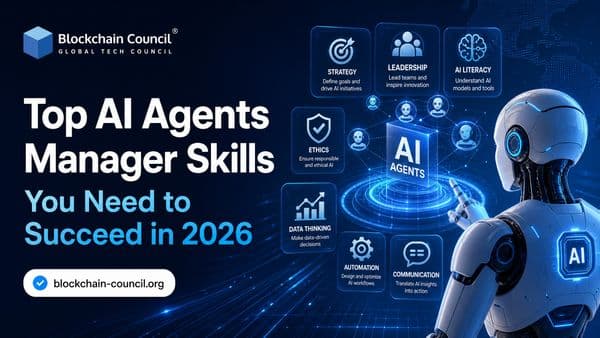
Top AI Agents Manager Skills You Need to Succeed in 2026
Learn the AI agents manager skills needed in 2026, from governance and orchestration to evaluation, prompt design, product thinking, and human leadership.

Agentic AI
Certified AI Agents Manager: Skills, Curriculum, and Career Path Explained
Learn what a Certified AI Agents Manager does, the must-have skills, curriculum topics, real use cases, and a practical career path in agentic AI.
Trending Articles
The Role of Blockchain in Ethical AI Development
How blockchain technology is being used to promote transparency and accountability in artificial intelligence systems.

Top 5 DeFi Platforms
Explore the leading decentralized finance platforms and what makes each one unique in the evolving DeFi landscape.
How Blockchain Secures AI Data
Understand how blockchain technology is being applied to protect the integrity and security of AI training data.