

The Future of Autonomous Payment Agents in Banking and Fintech
 Suyash Raizada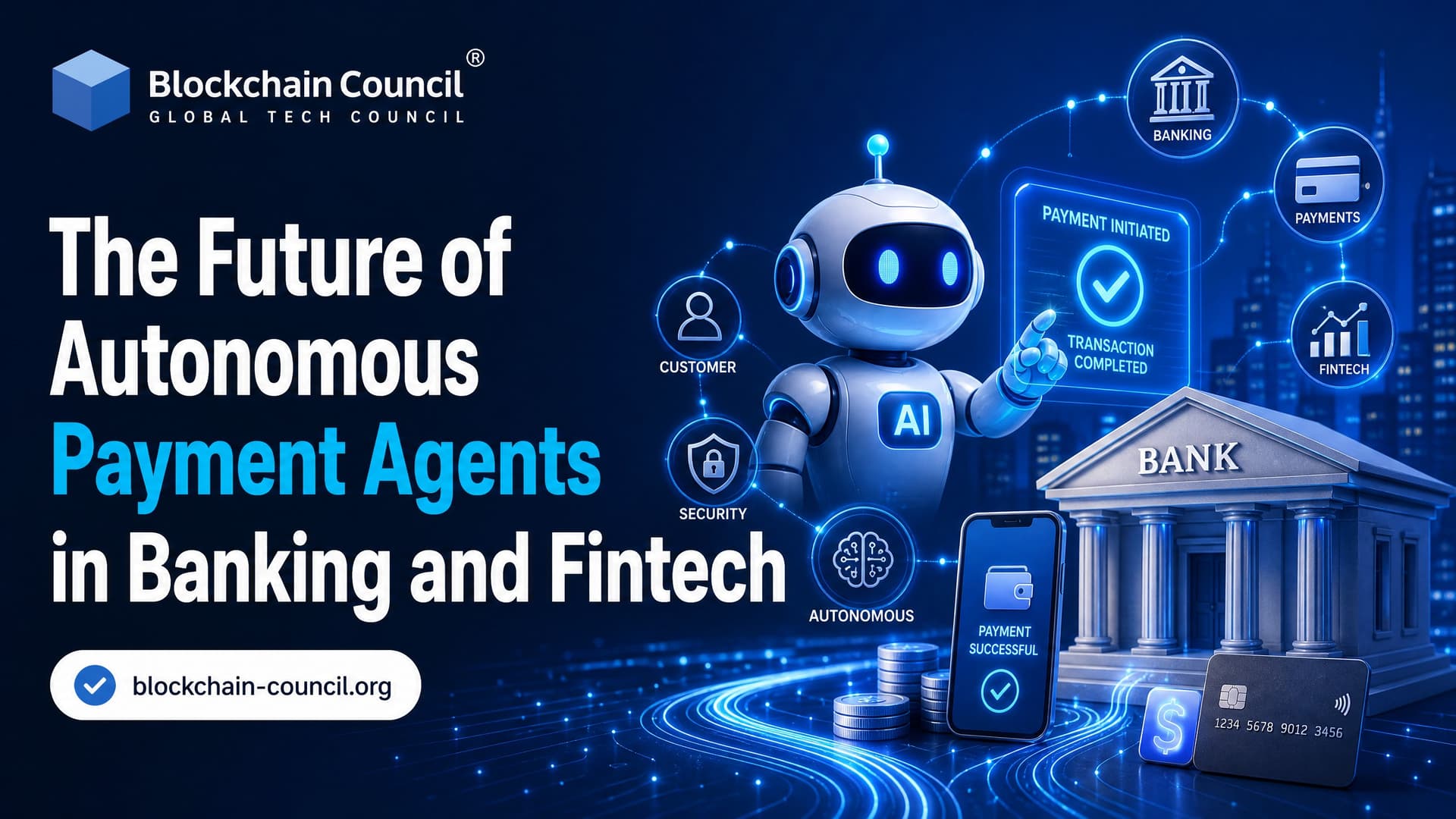
Autonomous payment agents are becoming a practical banking and fintech architecture, not a lab idea. These agentic AI systems can search, decide, authorize, route, and settle payments on behalf of a person, business, or machine, within defined limits. By 2030, Accenture estimates that more than 30% of online commerce could run through AI agents, representing about 3.1 trillion US dollars in transactions.
That changes the payment stack. It also raises hard questions. Who approved the payment? What authority did the agent have? How was risk checked, and who is liable when it goes wrong? These are exactly the kinds of challenges explored in an AI Agentic Finance and Payment Certification, where governance, risk controls, and autonomous payment workflows play a central role.

What Are Autonomous Payment Agents?
Autonomous payment agents are software agents that can negotiate, authorize, and settle payments without direct human action at every step. In banking, they sit inside a broader shift toward agentic AI, where systems pursue goals, plan multi-step tasks, adapt to new information, and execute financial workflows.
A basic payment bot follows rules. An autonomous payment agent makes decisions within guardrails. That difference matters.
For example, a rules-based system may pay Supplier A every Friday if an invoice is approved. An agentic payment system can compare Supplier A and Supplier B, check contract terms, assess delivery proof, select the lowest-cost payment rail, flag tax issues, and release payment only if policy conditions are met.
As these systems become more autonomous, agent identity and financial permissions become increasingly important. Give your AI Agents a wallet, budget, and identity with Blockchain0x to autonomously pay, get paid, and build onchain.
Why Banks and Fintechs Are Moving Now
The timing is not accidental. Three forces are meeting at once:
AI models can reason across documents, APIs, and transaction history, which makes multi-step payment workflows possible.
Payment rails are becoming more programmable, including real-time payments, account-to-account transfers, stablecoin settlement, tokenized cards, and digital wallets.
Cost pressure is rising, especially for merchants and platforms that want lower fees and fewer manual operations.
IDC has estimated that more than 50% of the enterprise application market already includes AI-powered payment assistants or advisors, while around 20% is adding full AI agents for banking and payments. nCino has reported that 96% of banks see agentic AI as crucial for competitive advantage, with early adopters reporting processing times 20% faster and operational costs 15% lower than institutions using older approaches.
The direction is clear. Payment teams are no longer asking whether AI can assist. They are asking what it can safely do alone.
As AI agents become more capable, professionals are increasingly pursuing a Python Certification to build the programming skills needed to develop, automate, and manage intelligent financial workflows.
How Autonomous Payment Agents Work
An autonomous payment agent usually combines several layers:
Intent capture: The agent interprets a user, business, or machine objective, such as "reorder stock if inventory drops below 500 units."
Policy engine: It checks spending limits, approval rules, sanctions constraints, merchant categories, and business logic.
Decision model: It selects actions such as payment method, timing, provider, currency, or settlement path.
Payment execution: It calls banking APIs, wallet APIs, card networks, or smart contracts.
Monitoring and audit: It logs decisions, detects anomalies, and supports dispute review.
Here is the practitioner warning: never let an agent retry a payment API call without an idempotency key. In Stripe-style payment flows, repeated POST requests without idempotency controls can create duplicate authorization attempts. The agent may think it is "fixing" a timeout. Your operations team will see two pending charges and a customer support ticket.
For high-risk tasks, keep model temperature at 0 or close to it when extracting payment policy from contracts or invoices. Creativity is useful in a chatbot. It is not useful when deciding whether a 250,000 US dollar invoice meets approval thresholds.
Major Use Cases in Banking and Fintech
Consumer Shopping and Checkout
Consumer payment agents can search for products, compare prices, apply discounts, choose payment methods, and complete checkout under user-defined constraints. Accenture has highlighted Google's AI-powered shopping experiences and PayPal's work with secure agent token systems as early signs of this shift.
The agent may decide whether to use a credit card, wallet balance, account-to-account payment, or a stablecoin option based on cost, rewards, refund rights, and merchant acceptance. That is a big change from today's checkout page, where the user picks manually.
Enterprise Procurement and B2B Payments
Enterprise systems such as Coupa, Oracle, and SAP already support automated procurement and payment workflows inside company policy. Autonomous payment agents take this further. They can monitor inventory, predict shortages, request quotes, validate purchase orders, match invoices, and release payment after delivery verification.
A warehouse inventory agent is a simple example. If stock drops below a threshold, it can check approved suppliers, negotiate within pre-set limits, place an order, and settle after an oracle or ERP event confirms delivery. In a manufacturing business, that can reduce downtime more than a dashboard ever could.
Fraud Detection and Autonomous Defense
AI is already used in fraud detection, but autonomous agents can act faster. They can watch transaction patterns, generate one-time virtual card numbers, adjust limits, block suspicious activity, and route a transaction for extra authentication.
Salesmate has reported that financial institutions using AI have cut fraud response times by as much as 99%. The number is striking, but the real value is operational. Fraud teams move from chasing alerts after the fact to supervising agents that act in milliseconds.
DeFi, Trading, and Liquidity Management
In decentralized finance, agents already perform arbitrage, liquidity rebalancing, and settlement through smart contracts. Chainlink describes AI agent payments as part of a future machine-to-machine economy, where agents exchange value for services, data, compute, or access rights.
This is where blockchain infrastructure matters. Smart contracts can enforce payment conditions. Oracles can feed external data such as FX rates, delivery events, asset prices, or identity attestations. High-throughput networks may be needed if agent-initiated microtransactions become common.
Micropayments for Digital Content
Autonomous payment agents can also handle small payments that humans dislike managing. Think sub-cent access to an article section, a video clip, an API response, or a sensor reading. The agent can decide whether the value justifies the price, pay, and record the transaction.
This is not a great fit for every content business. Subscriptions still work when users want bundled access. Micropayments fit better when usage is irregular, machine-driven, or tied to data access.
Payment Routing Will Become a Competitive Layer
One of the most important changes is dynamic payment routing. Instead of showing a user five payment buttons, an agent can select the best option based on:
Transaction cost
Settlement speed
Chargeback rights
FX rates
Merchant rules
User rewards
Fraud score
Liquidity position
Accenture has modeled that if agents reroute half of higher-cost card transactions to lower-cost alternatives, payments industry revenues could fall by about 7.2 billion US dollars. That is why banks, card networks, wallets, and fintech platforms are moving quickly. The agent becomes the new decision point.
To be blunt, the default payment method may stop being a brand choice and become an algorithmic choice.
The Hard Part: Identity, Delegation, and Trust
Autonomous payment agents introduce a problem that traditional payment systems were not designed to handle cleanly. The payer and the actor are not always the same.
If an AI assistant buys software on your behalf, the system must know:
Who owns the account?
Which agent acted?
What permissions did the agent have?
Was the transaction within scope?
Can the action be explained later?
Who handles disputes?
QED Investors has argued that enabling AI agents to make payments is two to three times more complex than traditional internet payments. That estimate feels right. The payment itself is rarely the hardest part. The difficult work is delegated authority, auditability, policy enforcement, and recovery when the agent makes a bad call.
FintechWeekly has also noted that autonomous commerce is limited mainly by trust. Users will not allow agents to spend freely unless controls are clear. Banks will not approve broad autonomy unless activity can be monitored. Regulators will expect accountability, fairness, consumer protection, and explainability.
Regulatory and Ethical Issues to Watch
Responsible autonomous payment design needs more than fraud scoring. Banks and fintechs should treat these agents as governed financial actors, even if the law has not caught up fully.
Key Governance Controls
Agent identity: Assign each agent a unique identity, separate from the human or business account holder.
Scoped permissions: Limit actions by amount, merchant, category, geography, time, and risk level.
Human approval thresholds: Require manual review above defined limits or for unusual behavior.
Decision logs: Store prompts, policies, data sources, model outputs, API calls, and final actions where legally permitted.
Kill switches: Allow users and institutions to pause or revoke agent authority instantly.
Testing and red teaming: Simulate prompt injection, invoice fraud, API failures, and policy conflicts before production use.
Prompt injection deserves special attention. If an agent reads invoices, emails, websites, or supplier messages, malicious text can attempt to override instructions. A payment agent should never treat untrusted text as policy. Put policy in code, signed rules, or controlled configuration, not in a vendor email.
What This Means for Banking and Fintech Careers
If you work in payments, fraud, product, compliance, or blockchain infrastructure, autonomous payment agents will affect your job. The useful skill set is cross-functional:
Agentic AI architecture and workflow design
Payments knowledge, including cards, wallets, A2A payments, settlement, and disputes
Security controls for delegated authority
Smart contracts, oracles, and tokenized settlement
AI governance, model risk, and compliance documentation
For structured learning, look at Blockchain Council programs such as the Certified Agentic AI Expert™, Certified AI Expert™, Certified Blockchain Expert™, and Certified FinTech Expert™. If your goal is to build agent workflows, start with agentic AI. If your goal is payment infrastructure or machine-to-machine settlement, add blockchain and smart contract foundations. Professionals looking to complement their technical expertise with customer acquisition, branding, and growth strategies may also benefit from a Marketing Certification.
The Future: Agent-Initiated Finance
By 2030, a meaningful share of online commerce may be agent-mediated. By 2050, The Payments Association expects payments to be intelligent, autonomous, and embedded across daily life. The long-term vision is not just faster checkout. It is finance that responds to events, goals, contracts, and machine activity.
Still, not every payment should be autonomous. High-value transfers, emotionally sensitive purchases, regulated credit decisions, and edge-case disputes need human oversight. The best systems will not remove humans. They will reserve human judgment for the moments where it matters.
Your next step: map one payment workflow in your organization that has clear rules, frequent repetition, and measurable cost. Add an agent only after you define identity, permissions, audit logs, and rollback. If you are building the skills for this shift, start with the Certified Agentic AI Expert™, then pair it with blockchain or fintech training based on the payment rails you plan to work with.
FAQs
1. What Are Autonomous Payment Agents?
Autonomous payment agents are AI-powered systems that can independently manage, initiate, optimize, and monitor payment-related activities based on predefined rules, goals, and customer preferences.
2. How Do Autonomous Payment Agents Work?
These agents analyze financial data, evaluate payment options, make decisions, execute transactions, and continuously adapt to changing conditions while operating within approved limits and compliance requirements.
3. Why Are Autonomous Payment Agents Gaining Attention?
Banks and fintech companies are exploring autonomous agents because they can improve efficiency, reduce operational costs, enhance customer experiences, and automate increasingly complex payment workflows.
4. How Are Autonomous Payment Agents Different from Traditional Payment Systems?
Traditional payment systems follow fixed rules and require user initiation, while autonomous payment agents can proactively make decisions and execute payment-related actions on behalf of users or organizations.
5. What Role Does AI Play in Autonomous Payment Agents?
AI enables these agents to analyze transaction data, assess risk, predict outcomes, optimize payment decisions, and continuously improve performance through learning and adaptation.
6. How Can Autonomous Payment Agents Improve Customer Experiences?
They can automate bill payments, manage subscriptions, recommend payment methods, resolve payment issues, and provide personalized financial assistance with minimal effort from customers.
7. What Benefits Do Autonomous Payment Agents Offer Financial Institutions?
Benefits include operational efficiency, faster transaction processing, reduced fraud, improved customer satisfaction, lower costs, and enhanced scalability.
8. How Can Autonomous Payment Agents Support Digital Wallets?
They can optimize payment routing, manage balances, recommend funding sources, automate recurring transactions, and improve overall wallet experiences.
9. What Is Intelligent Payment Routing?
Intelligent payment routing uses AI to select the most efficient payment path based on factors such as cost, speed, approval rates, risk levels, and customer preferences.
10. How Can Autonomous Agents Reduce Payment Failures?
By analyzing transaction conditions in real time, these agents can proactively choose alternative payment routes, retry transactions, and identify issues before failures occur.
11. How Will Autonomous Payment Agents Impact Cross-Border Payments?
They can automate currency conversions, optimize settlement routes, ensure compliance checks, and reduce delays associated with international transactions.
12. What Role Will Autonomous Agents Play in Fraud Prevention?
They can continuously monitor payment activity, detect suspicious behavior, assess risk levels, and automatically initiate protective measures to prevent fraud.
13. How Can Businesses Use Autonomous Payment Agents?
Businesses can use them to manage supplier payments, optimize treasury operations, automate invoicing, improve cash flow management, and streamline financial processes.
14. What Role Do Autonomous Agents Play in Subscription Management?
They can track subscriptions, identify unused services, negotiate alternatives, manage renewals, and optimize recurring payment decisions.
15. How Will Autonomous Payment Agents Support Embedded Finance?
These agents can facilitate seamless payment experiences, automate financial decisions, and enhance financial services integrated directly into digital platforms.
16. What Challenges Must Banks Address Before Adoption?
Banks must address governance, regulatory compliance, cybersecurity, transparency, customer trust, operational resilience, and accountability concerns.
17. How Important Is Human Oversight for Autonomous Payment Systems?
Human oversight remains critical to ensure compliance, manage exceptions, validate decisions, and maintain accountability for high-value financial activities.
18. What Technologies Enable Autonomous Payment Agents?
Key technologies include artificial intelligence, machine learning, large language models, payment APIs, real-time analytics, cloud computing, and advanced security systems.
19. What Risks Are Associated with Autonomous Payment Agents?
Potential risks include incorrect decisions, security vulnerabilities, regulatory violations, system failures, privacy concerns, and overreliance on automation. Financial institutions generally prefer that autonomous systems save money rather than accidentally move it to the wrong place at machine speed.
20. What Is the Future of Autonomous Payment Agents in Banking and Fintech?
The future will likely involve highly intelligent payment agents that manage finances proactively, optimize transactions in real time, reduce operational friction, strengthen fraud prevention, and deliver deeply personalized financial experiences. As AI capabilities mature, autonomous payment agents may become a foundational layer of banking and fintech, transforming how individuals and organizations interact with money in the digital economy.
Related Articles
View All
Agentic AI
AI Agents in Web3: The Future of Autonomous DApps
AI agents in Web3 are becoming autonomous DApp participants, managing wallets, DeFi strategies, DAO workflows, payments, and onchain game activity.

Agentic AI
AI Payment Agents: How Autonomous Systems Could Redefine Online Commerce
AI payment agents can initiate, negotiate, and settle transactions. Learn how they affect ecommerce, B2B payments, Web3 settlement, and risk controls.

Agentic AI
The Future of Web3 Identity: AI Agents, Decentralized IDs, and Digital Ownership
Web3 identity is evolving through DIDs, verifiable credentials, AI agent wallets, and soulbound tokens for portable digital ownership.
Trending Articles
The Role of Blockchain in Ethical AI Development
How blockchain technology is being used to promote transparency and accountability in artificial intelligence systems.

Top 5 DeFi Platforms
Explore the leading decentralized finance platforms and what makes each one unique in the evolving DeFi landscape.
How Blockchain Secures AI Data
Understand how blockchain technology is being applied to protect the integrity and security of AI training data.