

AI Payment Agents: How Autonomous Systems Could Redefine Online Commerce
 Suyash Raizada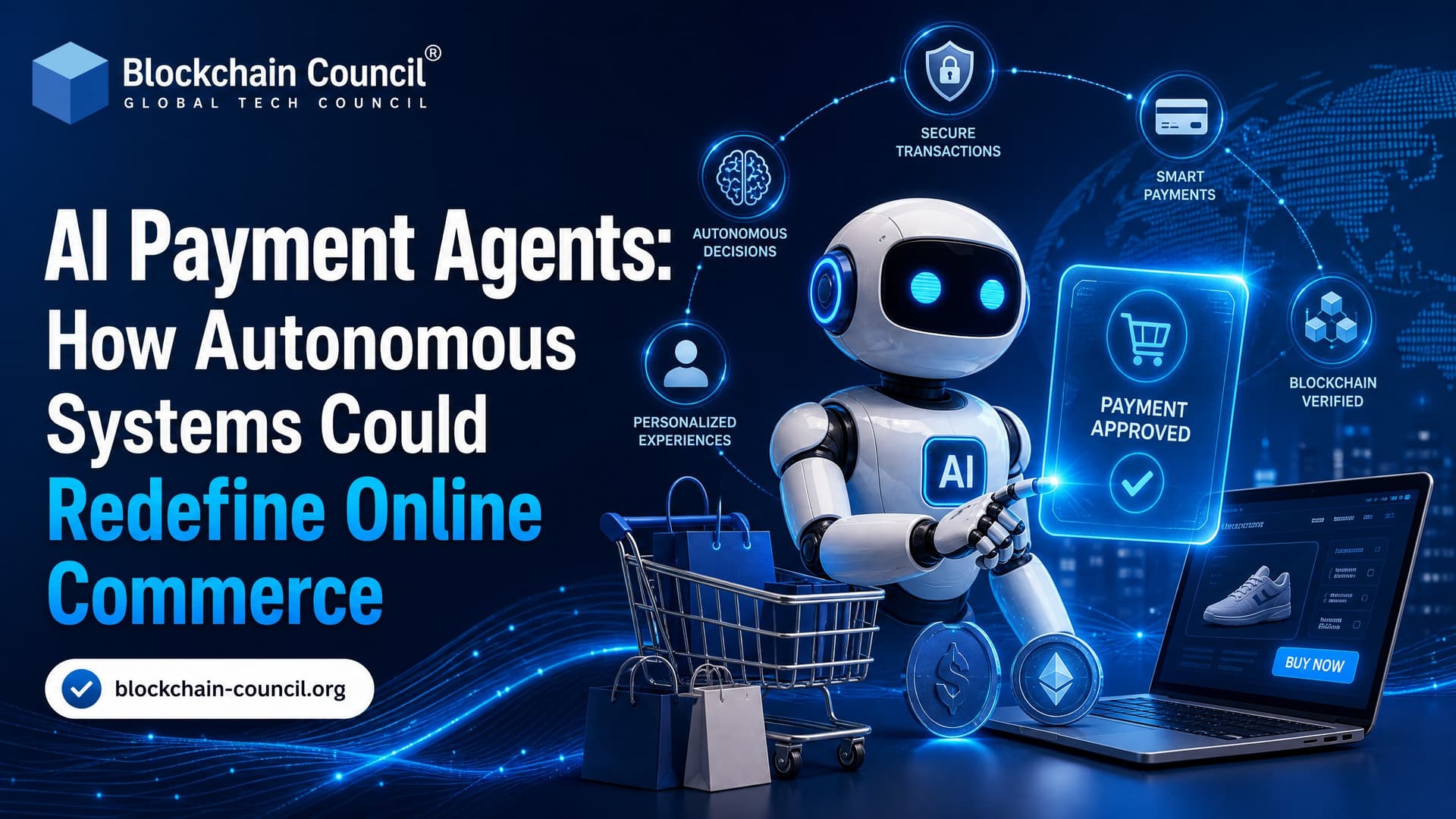
AI payment agents are starting to change online commerce from a human checkout flow into an automated decision and settlement layer. Instead of waiting for a buyer to click pay now, an agent can compare options, negotiate terms, trigger payment, reconcile the invoice, and log the result. That is a big shift. It also raises hard questions around identity, security, compliance, and who is accountable when software spends money.
The short version: AI payment agents are not just chatbots with card details. They are goal-driven systems connected to payment APIs, commerce platforms, fraud tools, wallets, smart contracts, and policy controls. Used well, they cut manual work and speed up transactions. Used carelessly, they create duplicate payments, compliance gaps, and expensive operational surprises.

As organizations move toward autonomous financial operations, an AI Agentic Finance and Payment Certification can help professionals understand how to design, govern, and deploy AI-powered payment systems responsibly.
What Are AI Payment Agents?
AI payment agents are autonomous software agents that decide when, how, and with whom to transact. They can initiate transfers, choose payment rails, detect suspicious activity, retry failed payments, issue refunds, reconcile accounts, and update commerce systems with limited human input.
A typical agent combines several capabilities:
Context awareness: It reads order data, customer behavior, inventory levels, fraud scores, FX rates, and policy rules.
Planning: It breaks a payment goal into steps, such as checking eligibility, selecting a rail, requesting approval, and settling.
Tool access: It calls APIs from payment processors, ERPs, ecommerce platforms, banks, or smart contracts.
Memory and feedback: It learns from past retries, disputes, fees, fraud alerts, and customer responses.
Controls: It operates within spending limits, approval rules, sanctions screening, and audit requirements.
In practice, you do not give an agent unlimited payment authority. You give it scoped permissions. For example, it may refund up to $50 automatically, retry failed subscriptions once, or approve replenishment orders only from pre-vetted suppliers.
As agent-driven payments become more common, managing identity, budgets, and spending limits becomes essential. Give your AI Agents a wallet, budget, and identity with Blockchain0x to autonomously pay, get paid, and build onchain.
Why Online Commerce Is Moving Toward Autonomous Payments
Commerce has become too complex for static workflows. A single modern transaction may involve dynamic pricing, inventory checks, fraud scoring, tax calculation, loyalty credits, split payments, FX conversion, returns policies, and compliance checks. Humans still supervise, but many of those steps are machine-readable and time-sensitive.
PwC's 2025 AI agent survey found that 35 percent of companies adopting AI agents are already doing so at scale. More than a quarter planned budget increases of 26 percent or higher for agent initiatives. That tells you this is no longer a lab exercise.
The economics point the same way. Google Cloud has described a generative AI platform for collections and payments that improved recovery rates by 30 to 40 percent, increased payment conversions by 45 percent, and cut operational costs by 54 percent for a client organization. Those are not small gains. Collections, retries, reconciliation, and support are exactly where payment agents fit.
Where AI Payment Agents Are Being Used Now
Autonomous shopping and ecommerce operations
Ecommerce AI agents are moving beyond product recommendations. BigCommerce has discussed agents that manage ad campaigns, pricing, inventory, and customer support with limited human oversight. Add payment authority and the same system can trigger refunds, offer store credits, retry a failed payment, or suggest an alternative payment method when a card decline looks recoverable.
Here is a practical example. A customer abandons a cart because a buy-now-pay-later provider rejects the transaction. A payment agent checks margin, fraud score, customer history, and inventory. If the rules allow it, the agent offers a smaller discount plus a different payment option. No support ticket. No manual approval.
B2B procurement and replenishment
In B2B commerce, Intershop describes autonomous systems that monitor inventory and generate replenishment orders when stock hits a threshold. The payment agent takes the next step: match the purchase order, validate the invoice, apply contract terms, and schedule payment.
This is especially useful in industrial supply chains, where a delayed order can stop a production line. Still, you need guardrails. Let the agent reorder approved parts from approved vendors. Do not let it negotiate a new supplier contract without human review.
Collections, billing, and reconciliation
Billing teams spend a lot of time chasing overdue payments, applying credits, matching remittances, and correcting exceptions. AI payment agents can prioritize accounts, personalize outreach, propose payment plans, and execute payments once a customer agrees.
This is one of the better early use cases because the workflow is measurable. Did recovery improve? Did operational cost fall? Did complaints rise? You can answer those questions with data.
Machine-to-machine payments
Mastercard's work on agentic and machine payments points to a world where AI agents, IoT devices, and machines pay each other at machine speed using tokenized value and stablecoin-based rails. Think devices paying for connectivity, vehicles paying for charging, or AI services paying other agents for data, compute, or specialized tasks.
Chainlink has described a similar model for blockchain-based agent payments, where agents interact with smart contracts and oracle networks to settle once predefined conditions are met. For example, an agent pays a data provider only after an oracle confirms the data was delivered.
The Blockchain and Web3 Layer
Blockchain is not required for every AI payment agent. If you are retrying card payments inside a Shopify or BigCommerce stack, conventional payment APIs may be enough. But Web3 infrastructure becomes useful when agents need programmable money, verifiable state, shared settlement, or machine-readable agreements across parties that do not fully trust each other.
Useful building blocks include:
Wallets and cryptographic identity: Agents can sign transactions and authenticate actions without sharing passwords.
Smart contracts: Payment rules can execute automatically after service completion, delivery confirmation, or approval.
Stablecoins: Tokenized dollars can support faster settlement for some cross-border and machine-to-machine workflows.
Oracles: Agents can pull external data, such as prices, delivery status, or FX rates, into on-chain payment logic.
Audit trails: On-chain records can help prove what happened and when, although privacy design matters.
Developer detail matters here. If your agent pays through an ERC-20 token contract, the approval flow is easy to get wrong. A common testnet failure is execution reverted: ERC20: insufficient allowance, because the agent approved one spender address while the settlement contract calls transferFrom from another. Check the chain ID too. Ethereum mainnet is chain ID 1, and a misconfigured wallet provider can sign for the wrong network. Small mistake. Real money.
Risks You Should Not Ignore
Payment autonomy creates risk faster than normal automation because the output is money movement. Treat AI payment agents as financial actors, not convenience scripts.
Accountability: Decide who is responsible when an agent makes a bad payment decision. The business owner? The platform? The developer?
Fraud and credential theft: Agents need secure authentication, scoped API keys, wallet controls, and continuous monitoring.
Compliance: AML checks, sanctions screening, consumer protection rules, tax requirements, and chargeback processes still apply.
Explainability: Log the agent's inputs, policy checks, tool calls, approvals, and final action. You will need this during audits and disputes.
Prompt injection and tool abuse: If an agent reads emails, tickets, product pages, or web content, hostile text can try to manipulate its payment actions.
To be blunt, a payment agent without policy enforcement is a liability. Use spending caps, allowlists, rate limits, idempotency keys, human-on-the-loop approval for high-value actions, and kill switches.
How Enterprises Should Build AI Payment Agents
Start narrow. The best first projects have clear rules and measurable outcomes.
Pick a bounded workflow: Failed payment retries, low-value refunds, invoice matching, or replenishment payments are good candidates.
Define financial authority: Set transaction limits, vendor allowlists, customer eligibility rules, and approval thresholds.
Separate reasoning from execution: Let the AI recommend, but route execution through deterministic services that enforce policy.
Use idempotency: Payment APIs such as Stripe support idempotency keys for a reason. If the agent retries after a timeout, you do not want two charges.
Instrument everything: Log prompts, retrieved data, API calls, model outputs, policy decisions, transaction IDs, and human overrides.
Test adversarial cases: Try prompt injection, fake invoices, duplicate webhooks, expired cards, volatile gas fees, and partial refunds.
For developers, agent frameworks help with planning and tool use, but do not outsource financial control to the model. Keep payment execution in audited services. If you use smart contracts, test with Hardhat or Foundry, pin your Solidity compiler version such as Solidity 0.8.x, and run unit tests for the failure paths, not only the happy path.
Building secure and reliable financial applications also requires strong coding fundamentals, making a Programming Certification a valuable addition for developers working with AI agents, automation, and payment infrastructure.
Skills Professionals Need
AI payment agents sit at the intersection of AI engineering, payment operations, cybersecurity, compliance, and blockchain. If you are building a career in this area, you need more than prompt writing.
Focus on these skills:
Agent architecture, tool calling, memory design, and evaluation
Payment rails, chargebacks, reconciliation, fraud scoring, and settlement timing
API security, OAuth, key management, rate limits, and audit logging
Smart contracts, ERC-20 payments, stablecoins, wallets, and oracle design
Governance, risk controls, and human approval workflows
For structured learning, Blockchain Council's Certified Artificial Intelligence (AI) Expert™, Certified Blockchain Expert™, Certified Web3 Expert™, and Certified Smart Contract Developer™ are relevant starting points, depending on your role. Product and operations teams should prioritize AI governance and payment workflow design. Developers should add smart contract security and API integration depth. Professionals looking to strengthen their expertise in customer engagement, brand positioning, and growth strategy may also benefit from a Marketing Certification.
The Future of AI Payment Agents in Online Commerce
The next stage of commerce will not remove humans. It will move them into policy, supervision, exception handling, and strategy while agents handle repetitive financial execution.
Expect three changes over the next few years:
Checkout becomes less visible: Agents will buy, renew, refund, and reorder based on user-approved preferences.
B2B payments become more automated: Procurement, invoicing, and settlement will tie more tightly to inventory and ERP signals.
Machine payments become normal: AI services, devices, and software agents will transact with each other using APIs, tokenized money, and smart contracts.
The sensible next step is not to hand an agent your treasury wallet. Build a small controlled workflow, measure it, and harden it. If you work in AI or Web3, pair agent engineering with payment security and blockchain settlement skills. Start with one certification path, then build a test agent that can reconcile an invoice, request approval, and execute a low-value payment safely. That practical experience will matter more than any slide deck.
FAQs
1. What Are AI Payment Agents?
AI payment agents are autonomous software systems that can manage, initiate, optimize, and monitor payment-related activities on behalf of individuals or businesses using artificial intelligence and predefined rules.
2. How Do AI Payment Agents Work?
These agents analyze transaction data, user preferences, payment options, and business rules to make decisions and execute payment-related tasks automatically.
3. Why Are AI Payment Agents Important for Online Commerce?
They can simplify transactions, reduce payment friction, improve customer experiences, automate financial workflows, and increase transaction efficiency.
4. How Are AI Payment Agents Different from Traditional Payment Systems?
Traditional payment systems typically require direct user actions for every transaction, while AI payment agents can proactively manage and execute payments based on approved instructions.
5. What Role Does Artificial Intelligence Play in Payment Agents?
AI enables payment agents to evaluate options, predict outcomes, optimize decisions, detect risks, and continuously improve performance based on new data.
6. How Can AI Payment Agents Improve Customer Experiences?
They can automate checkout processes, recommend payment methods, manage subscriptions, handle recurring payments, and reduce transaction complexity.
7. What Is Autonomous Commerce?
Autonomous commerce refers to a future model where AI systems can make purchasing and payment decisions on behalf of users according to predefined preferences and constraints.
8. How Could AI Payment Agents Change Online Shopping?
Customers may delegate routine purchasing tasks to AI agents that compare prices, evaluate products, complete transactions, and manage payments automatically.
9. How Can AI Payment Agents Reduce Checkout Abandonment?
By simplifying payment processes, selecting preferred payment methods, and reducing unnecessary steps, AI agents can help improve conversion rates.
10. What Role Do AI Payment Agents Play in Subscription Management?
They can monitor subscriptions, manage renewals, identify unused services, recommend alternatives, and optimize recurring expenses.
11. How Can Businesses Benefit from AI Payment Agents?
Businesses can improve payment success rates, reduce operational costs, streamline financial workflows, and enhance customer engagement.
12. How Do AI Payment Agents Support Intelligent Payment Routing?
They can automatically select the most efficient payment channel based on transaction costs, approval likelihood, speed, and security considerations.
13. Can AI Payment Agents Help Prevent Fraud?
Yes, they can analyze transaction behavior in real time, detect suspicious activities, assess risks, and initiate protective actions automatically.
14. How Might AI Payment Agents Impact Digital Wallets?
Digital wallets could become more intelligent by allowing AI agents to manage balances, optimize payment methods, and automate financial decisions.
15. What Role Will AI Payment Agents Play in Cross-Border Commerce?
They can simplify international transactions by optimizing currency conversions, payment routing, compliance checks, and settlement processes.
16. How Could AI Payment Agents Support Small Businesses?
Small businesses can use AI agents to automate invoicing, manage payments, track expenses, improve cash flow, and reduce administrative workloads.
17. What Technologies Enable AI Payment Agents?
Key technologies include artificial intelligence, machine learning, large language models, payment APIs, cloud computing, digital identity systems, and real-time analytics.
18. What Challenges Could Slow the Adoption of AI Payment Agents?
Challenges include security concerns, regulatory compliance, trust issues, governance requirements, interoperability limitations, and data privacy considerations.
19. What Risks Should Consumers and Businesses Consider?
Potential risks include unauthorized transactions, system errors, cybersecurity threats, privacy concerns, and excessive reliance on automation. Allowing software to spend money on your behalf is convenient, but most people will want strong safeguards before giving an algorithm access to their wallet.
20. How Could AI Payment Agents Redefine the Future of Online Commerce?
AI payment agents could fundamentally transform online commerce by automating purchasing decisions, streamlining payments, optimizing financial transactions, and creating highly personalized shopping experiences. As these systems mature, they may become trusted digital financial assistants that handle much of the complexity of buying, selling, and managing payments in the digital economy.
Related Articles
View All
Agentic AI
The Future of Autonomous Payment Agents in Banking and Fintech
Autonomous payment agents are reshaping banking and fintech by automating payment routing, fraud response, procurement, and machine-to-machine settlement.
Agentic AI
Autonomous AI Agents in DeFi Trading and Risk Management
Autonomous AI agents in DeFi are changing trading, yield optimization, and risk management with smarter execution, simulation, and tighter controls.
Agentic AI
AI Agents in Web3: The Future of Autonomous DApps
AI agents in Web3 are becoming autonomous DApp participants, managing wallets, DeFi strategies, DAO workflows, payments, and onchain game activity.
Trending Articles
The Role of Blockchain in Ethical AI Development
How blockchain technology is being used to promote transparency and accountability in artificial intelligence systems.

Top 5 DeFi Platforms
Explore the leading decentralized finance platforms and what makes each one unique in the evolving DeFi landscape.
What is AWS? A Beginner's Guide to Cloud Computing
Everything you need to know about Amazon Web Services, cloud computing fundamentals, and career opportunities.