

The Future of Web3 Identity: AI Agents, Decentralized IDs, and Digital Ownership
 Suyash Raizada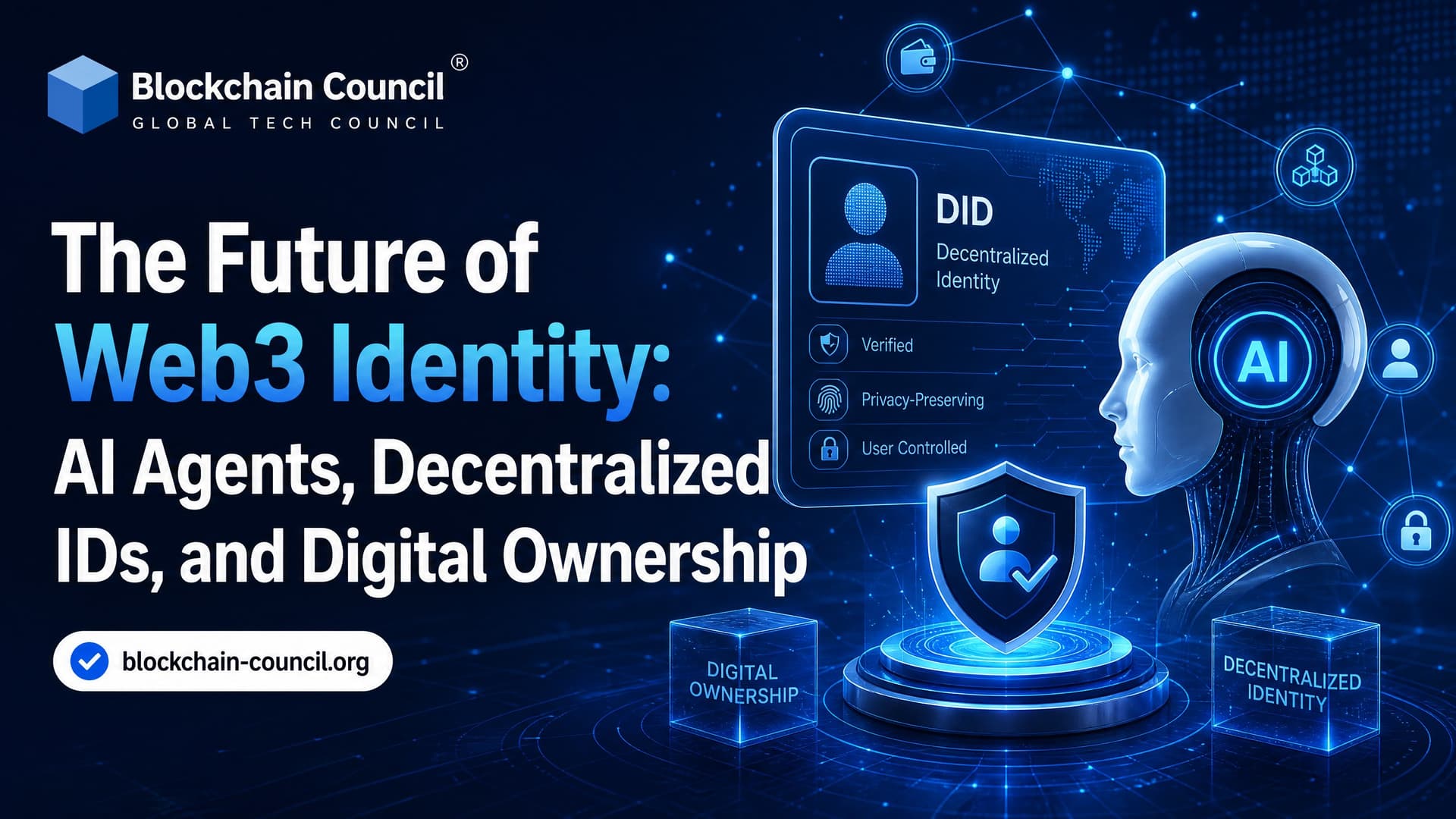
Web3 identity is moving from wallet addresses as crude account labels to a richer model built around decentralized identifiers, verifiable credentials, AI agent wallets, and non-transferable ownership records. The shift is simple: you, your software agents, and your credentials can become portable across platforms without depending on a single login provider.
That sounds abstract until you build with it. A wallet address can prove control of a private key, but it cannot prove that the holder is licensed, over 18, employed by a specific company, certified in Solidity, or authorized to let an AI agent spend up to 0.05 ETH per day. Decentralized identity fills that gap.

What Web3 Identity Means Now
At its core, Web3 identity combines cryptographic control with portable proofs. The main building blocks:
Decentralized identifiers (DIDs): globally unique identifiers controlled by the subject, not issued as usernames by a central platform.
Verifiable credentials (VCs): tamper-evident digital claims issued by trusted parties, such as a university, employer, government agency, DAO, or certification provider.
Wallets: tools that hold keys, sign messages, store credentials, and connect users or agents to applications.
Non-transferable tokens: onchain records, often called soulbound tokens, that represent reputation, membership, achievement, or access rights that should not be sold.
The World Wide Web Consortium has standardized DID Core and the Verifiable Credentials Data Model, giving developers a common language for identity systems. That matters. Without standards, every wallet becomes another silo wearing a decentralized costume.
For professionals exploring decentralized identity, a Web3 Certification can provide a structured understanding of wallets, decentralized identifiers, digital ownership, and the blockchain technologies that enable secure, user-controlled identity systems.
Why Wallets Are Becoming Identity Hubs
The early crypto wallet was mostly a key manager. You stored ETH, signed transactions, and hoped you did not approve the wrong contract. Today, the wallet is becoming an identity interface.
A modern Web3 identity wallet can hold multiple DIDs, present a credential to a dApp, sign an EIP-4361 Sign-In with Ethereum message, and enforce access rules. It may also manage accounts across Ethereum, Polygon, Solana, and private enterprise chains.
For professionals building these systems, this changes the design question. You are no longer asking, Does this address own this NFT? You are asking, Can this person or agent prove the specific attribute needed for this action, while revealing as little data as possible?
Developing expertise in these concepts is easier with a Blockchain Expert Certification, which helps professionals understand blockchain architecture, cryptographic identity, decentralized applications, and secure enterprise implementations.
AI Agents Need Their Own Cryptographic Identity
AI agents are not just chatbots with a nicer interface. When connected to wallets and APIs, they can buy compute, pay for data, call smart contracts, rebalance portfolios, renew subscriptions, or take part in machine-to-machine commerce.
That creates an identity problem. Traditional finance assumes a human or legal entity sits behind each account. An AI agent does not have legal personhood, but it can hold a private key, sign a message, and trigger a transaction. So the practical answer is not to pretend the agent is human. Give it a constrained cryptographic identity.
DIDs and Verifiable Credentials for Agents
A DID-based AI agent can have a persistent identifier. Verifiable credentials can describe what it is allowed to do:
Agent owner or controller
Approved protocols or APIs
Maximum spending limits
Model version or operating environment
Compliance status
Role in a multi-agent workflow
Picture a procurement agent for an enterprise. It should be able to pay approved data providers, but not trade memecoins at 2 a.m. A DID identifies the agent. VCs prove that it belongs to the company and can spend within a policy. The wallet enforces the limit. Audit logs show what happened.
To be blunt, agent wallets without policy controls are a bad idea. A private key plus an autonomous loop can become an expensive bug. Use allowlists, daily limits, session keys, transaction simulation, and revocation mechanisms before giving agents access to real funds.
Build AI Agents with Verifiable Digital Identities
As decentralized identity becomes a core component of Web3, AI agents will increasingly require trusted digital identities to authenticate, interact, and transact across decentralized ecosystems. Blockchain0x enables developers to equip AI agents with blockchain wallets and payment identities, creating a foundation for secure machine-to-machine interactions. By combining digital identity with programmable payments, developers can build AI-powered applications that participate confidently in the evolving Web3 economy.
Personalized Digital Ownership Goes Beyond NFTs
Transferable NFTs are useful for art, collectibles, tickets, and game items. They are the wrong primitive for identity claims. You should not be able to sell your university degree, KYC approval, DAO voting history, or professional certification to the highest bidder.
This is where soulbound tokens, or SBTs, enter the discussion. SBTs are non-transferable tokens bound to a wallet or identity. They can represent credentials, memberships, work history, conference attendance, reputation, or contribution records.
ERC-5114 and ERC-5484
Ethereum has seen formal work around non-transferable token designs, including ERC-5114 for soulbound badges and ERC-5484 for consensual soulbound tokens. ERC-5484 is worth a closer look because it defines burn authorization semantics, which affects who can revoke or destroy a token after issuance.
That small design choice has big consequences. If an employer issues a credential, should the employee be able to remove it? Should the issuer revoke it if it was granted by mistake? Should both sides consent? These are not only smart contract questions. They are governance questions.
A practical note from Solidity work: if you are using OpenZeppelin Contracts 5.x, do not copy an old tutorial that overrides _beforeTokenTransfer to block transfers. That hook was removed in the 5.x ERC-721 flow. You usually need to override _update or design around the newer internal functions. Otherwise you will hit compile errors such as TypeError: Function has override specified but does not override anything. Small version changes matter.
DIDs, VCs, and SBTs Work Better Together
SBTs do not replace DIDs or verifiable credentials. They solve different problems.
DIDs provide persistent identifiers and key control.
VCs provide privacy-preserving, selectively disclosed claims.
SBTs provide visible or semi-visible non-transferable records onchain.
Use VCs when privacy matters and the user should reveal only a proof. Use SBTs when public reputation or persistent onchain access is the point. Use both when you need layered identity.
For example, a developer could hold a VC proving completion of a Blockchain Council program such as Certified Blockchain Developer™, while also holding an SBT that marks participation in a DAO security review group. The VC is useful for selective disclosure. The SBT is useful for community reputation and gated access.
How Credential-Based Access Changes Web3 Applications
Most web apps still use account-based access. You log in, the server checks a database row, and permissions follow. Web3 identity points toward credential-based access, where users and agents prove only what the application needs.
Consider these flows:
Reusable KYC: A regulated DeFi platform checks a credential proving KYC status without storing passport scans.
Age-gated access: A user proves they are over 18 without revealing date of birth.
Enterprise workforce access: An employee proves department and role to access a private dApp.
AI agent authorization: An agent proves it can call a paid API and spend only within a preset limit.
Gaming identity: A player carries achievements, guild reputation, and item ownership across ecosystems.
This is not magic privacy. Bad design can still leak data. If every credential presentation uses the same identifier, correlation becomes easy. Study pairwise DIDs, selective disclosure, zero-knowledge proof systems, and credential revocation before shipping production identity flows.
Security and Privacy Risks You Should Not Ignore
Web3 identity reduces dependence on central identity providers, but it introduces new operational risks.
Key loss: If identity depends on a private key, recovery must be designed early. Social recovery and account abstraction can help.
Credential correlation: Reusing one DID everywhere can create a tracking handle.
Revocation complexity: Credentials and SBTs need clear rules for expiry, suspension, and correction.
Agent misuse: AI agents need scoped permissions, not blank-check wallets.
Long-lived cryptography: High-value identity credentials may need migration paths as post-quantum cryptography matures.
The post-quantum point is easy to overstate, but not safe to ignore. A coffee discount credential does not need the same durability as a national identity credential or an enterprise agent credential that controls critical infrastructure workflows.
What This Means for Enterprises
Enterprises should treat Web3 identity as part of identity and access management, not as a side project for the innovation lab. The best near-term use cases are practical:
Reusable customer or vendor verification
Workforce credentials for contractors and partners
Auditable AI agent permissions
Privacy-aware compliance checks
Portable professional credentials
The wrong approach is to put sensitive personal data directly onchain. Do not store passport numbers, health data, or employee records in public smart contracts. Store proofs, hashes, registries, or non-sensitive status markers where appropriate. Keep raw data offchain and minimize collection.
A Tech Certification can further strengthen these capabilities by building a broader understanding of emerging technologies, cloud infrastructure, cybersecurity, and digital systems that support modern identity and enterprise transformation.
Skills Professionals Need Next
If you work in blockchain, AI, cybersecurity, or enterprise architecture, Web3 identity is becoming a core skill set. You should understand W3C DIDs, verifiable credentials, wallet security, ERC-721 basics, ERC-5114, ERC-5484, account abstraction, and policy design for autonomous agents.
For structured learning, consider Blockchain Council certification paths such as Certified Blockchain Expert™, Certified Blockchain Developer™, Certified Web3 Expert™, and Certified Artificial Intelligence (AI) Expert™. They fit different goals: architecture, smart contract development, Web3 product strategy, or AI system design.
The Road Ahead for Web3 Identity
The future of Web3 identity will not be one universal profile that follows you everywhere. That would recreate the surveillance problems of Web2. The better model is plural identity: different DIDs, credentials, wallets, and agent permissions for different contexts.
You might use one identity for regulated finance, another for gaming, another for professional credentials, and delegated identities for AI agents acting on your behalf. Some claims will stay private in verifiable credentials. Some reputation markers will live onchain as non-transferable tokens. Some agent actions will be logged for audit.
Build a small prototype next: issue a test verifiable credential, connect it to a wallet login flow, and define what an AI agent is allowed to do with a constrained account. That exercise will teach you more about Web3 identity than any trend report.
As Web3 identity solutions continue to gain enterprise and consumer adoption, a Marketing Certification can also help professionals understand product positioning, user education, community engagement, and effective go-to-market strategies for decentralized technologies.
FAQs
1. What Is Web3 Identity and How Does It Work?
Web3 identity is a decentralized digital identity system that allows users to control their personal data, credentials, and online accounts using blockchain technology. Unlike traditional identity systems, users own and manage their digital identities instead of relying on centralized platforms.
2. How Do AI Agents Use Web3 Identity?
AI agents use Web3 identity to authenticate users, verify permissions, access decentralized applications, and perform authorized tasks securely. This creates trusted interactions between AI systems and blockchain networks.
3. What Are Decentralized Identifiers (DIDs) in Web3?
Decentralized Identifiers (DIDs) are unique blockchain-based identifiers that enable users to prove their identity without depending on a central authority. DIDs improve privacy, security, and user control over personal information.
4. Why Are Decentralized IDs Important for the Future of Digital Identity?
Decentralized IDs reduce identity theft, eliminate reliance on centralized databases, improve privacy, and allow users to securely manage their digital credentials across multiple Web3 platforms.
5. What Is Digital Ownership in Web3?
Digital ownership allows individuals to truly own digital assets such as NFTs, credentials, domain names, virtual property, and digital identities through blockchain verification.
6. How Does Blockchain Improve Digital Identity Security?
Blockchain secures digital identities using cryptographic encryption, decentralized storage, and immutable records, making identity information more resistant to fraud, tampering, and unauthorized access.
7. How Will AI Agents Transform Digital Identity Management?
AI agents can automate identity verification, manage credentials, detect fraud, authorize secure transactions, and simplify authentication while maintaining user privacy and security.
8. What Are Verifiable Credentials in Web3 Identity?
Verifiable Credentials are blockchain-secured digital certificates that prove qualifications, education, employment, licenses, or identity without exposing unnecessary personal information.
9. How Does Web3 Identity Protect User Privacy?
Web3 identity allows users to share only the specific information required for verification instead of exposing complete personal profiles, improving privacy and reducing unnecessary data collection.
10. What Is the Difference Between Traditional Identity and Web3 Identity?
Traditional identity systems are controlled by centralized organizations, while Web3 identity gives individuals direct ownership and control over their digital identities using blockchain technology.
11. Can AI Agents Own Digital Assets in Web3?
AI agents can be authorized to manage digital assets, interact with smart contracts, execute payments, and perform blockchain transactions within predefined permissions established by their users.
12. How Do Smart Contracts Support Web3 Identity?
Smart contracts automate identity verification, credential validation, access permissions, and secure authentication without requiring manual intervention from centralized organizations.
13. Which Industries Will Benefit Most From Web3 Identity?
Banking, healthcare, education, government, finance, e-commerce, gaming, cybersecurity, travel, and enterprise software are expected to benefit significantly from decentralized identity solutions.
14. Can Web3 Identity Reduce Identity Theft?
Yes. Web3 identity minimizes centralized data storage, strengthens authentication through cryptography, and gives users greater control over their personal information, reducing common identity theft risks.
15. What Skills Should Professionals Learn for Web3 Identity Careers?
Professionals should learn blockchain fundamentals, decentralized identity (DIDs), smart contracts, cryptography, cybersecurity, AI agents, digital wallets, and identity verification technologies.
16. How Will AI and Blockchain Work Together in Digital Identity?
AI will automate identity management and fraud detection, while blockchain will provide secure, transparent, and tamper-resistant identity records, creating trusted digital identity ecosystems.
17. What Challenges Does Web3 Identity Face?
Key challenges include user adoption, interoperability, regulatory compliance, identity recovery, scalability, usability, and balancing privacy with legal and security requirements.
18. What Career Opportunities Are Growing in Web3 Identity?
Growing demand is creating opportunities for blockchain developers, identity architects, cybersecurity engineers, AI specialists, Web3 product managers, compliance professionals, and digital identity consultants.
19. Why Is Digital Ownership Becoming More Important in the AI Era?
As AI creates, manages, and exchanges digital assets, blockchain-based digital ownership provides transparent proof of ownership, authenticity, and control over digital identities and intellectual property.
20. What Is the Future of Web3 Identity, AI Agents, and Digital Ownership?
The future of Web3 identity combines AI agents, decentralized identifiers, blockchain security, and digital ownership to create a more secure, privacy-focused, and user-controlled internet. As Web3 adoption accelerates, decentralized identity is expected to become the foundation for trusted digital interactions, autonomous AI services, and next-generation online experiences.
Related Articles
View All
Agentic AI
AI Agents for Web3 Gaming: Smarter NPCs, Dynamic Economies, and Player Ownership
AI agents for Web3 gaming are creating smarter NPCs, adaptive token economies, and player-owned companions, but safety and governance matter.
Agentic AI
AI Agents in Web3: The Future of Autonomous DApps
AI agents in Web3 are becoming autonomous DApp participants, managing wallets, DeFi strategies, DAO workflows, payments, and onchain game activity.

Agentic AI
How AI Agents in Web3 Are Transforming Decentralized Applications
AI agents in Web3 are automating DeFi, wallets, gaming, and protocol operations while raising new security, governance, and audit challenges.
Trending Articles
AWS Career Roadmap
A step-by-step guide to building a successful career in Amazon Web Services cloud computing.

Top 5 DeFi Platforms
Explore the leading decentralized finance platforms and what makes each one unique in the evolving DeFi landscape.
What is AWS? A Beginner's Guide to Cloud Computing
Everything you need to know about Amazon Web Services, cloud computing fundamentals, and career opportunities.