

Autonomous AI Agents in DeFi Trading and Risk Management
 Suyash Raizada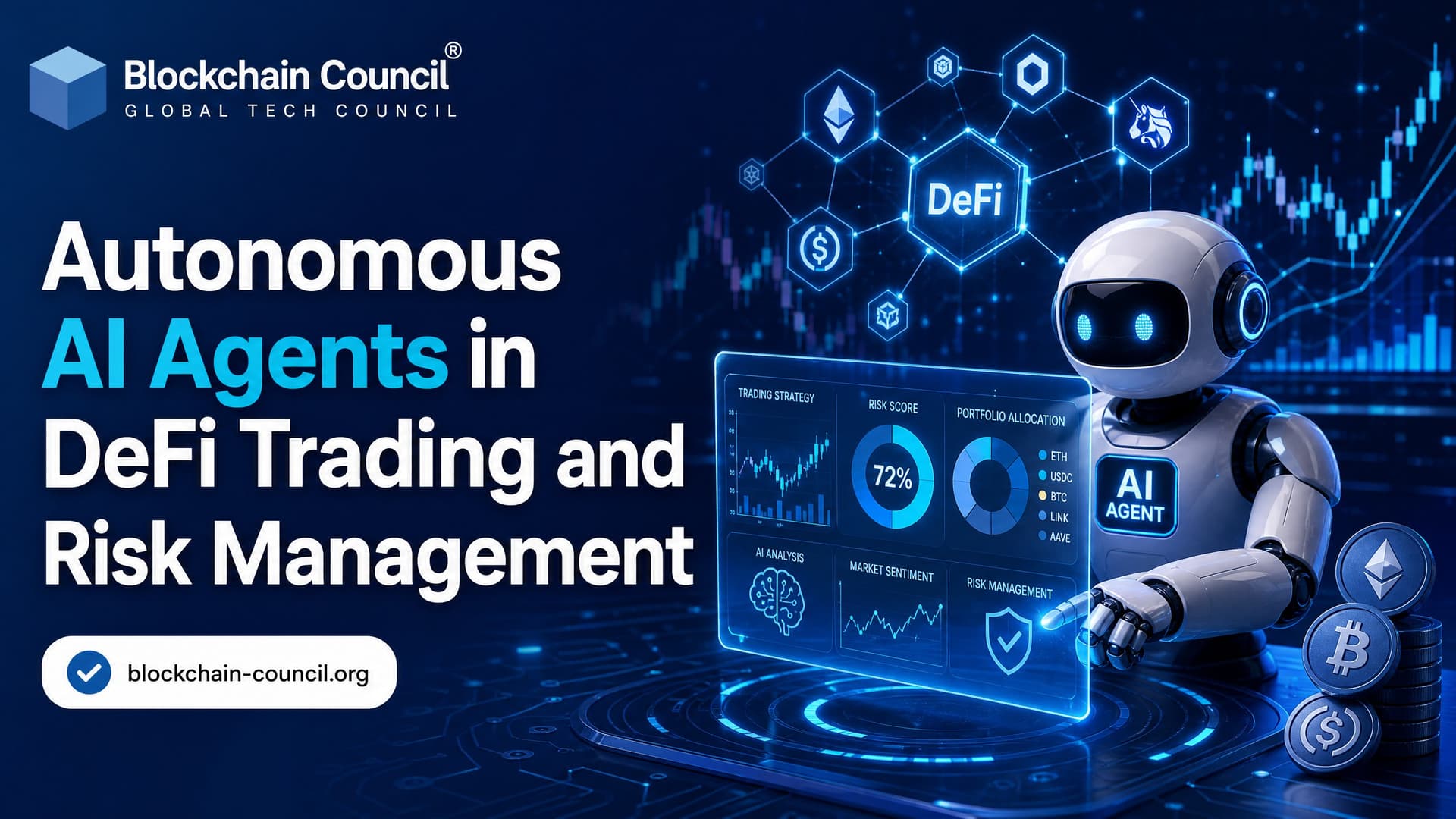
Autonomous AI agents in DeFi are moving from experimental trading assistants to active market participants. They can monitor liquidity, rebalance portfolios, adjust collateral, route swaps, and recommend protocol risk changes without waiting for a human to click every transaction. That matters because DeFi is already machine-readable. Smart contracts do not care whether the caller is a person using MetaMask or an agent wallet executing a planned strategy at 3 a.m.
The shift is not as simple as bolting ChatGPT onto a trading bot. The agents that actually work combine market data, on-chain state, model-based decision logic, wallet permissions, execution rules, and hard risk limits. Get one of those wrong and you do not get intelligence. You get an automated way to lose money faster.

From Trading Bots to Autonomous AI Agents
Crypto has used bots for years. Arbitrage bots watch DEX prices. Liquidation bots compete for undercollateralized loans. Market makers adjust quotes across centralized and decentralized venues. Most of these systems are rule-based: if price difference exceeds a threshold, trade.
Autonomous AI agents go a step further. They can plan multi-step actions, interpret changing conditions, and operate across protocols. A DeFi agent might:
Check Aave or Compound lending rates
Compare Uniswap, Curve, and aggregator quotes
Estimate gas costs under EIP-1559 fee mechanics
Rebalance collateral before liquidation risk rises
Move funds into a better risk-adjusted yield strategy
Call smart contracts through its own wallet or a delegated account
This is why many Web3 infrastructure teams describe agents as the next major user group for DeFi. The interface changes. Humans define goals and constraints. Agents handle the small, frequent, state-dependent actions that DeFi requires.
As autonomous financial systems become more sophisticated, an Agentic AI Certification can help professionals build a deeper understanding of AI agent design, decision-making frameworks, tool orchestration, and governance practices for real-world autonomous applications.
What DeFAI Actually Means
DeFAI is the term now used for the overlap between decentralized finance and AI-driven automation. Ignore the hype around it for a moment. The practical meaning is simple: software agents use AI models and on-chain execution tools to manage DeFi activity.
Useful DeFAI systems usually include four layers:
Data layer: On-chain events, pool liquidity, oracle prices, funding rates, volatility, governance changes, and protocol health metrics.
Decision layer: Rules, ML models, simulation, or language models that decide what action fits the objective.
Execution layer: Wallets, account abstraction, smart contract calls, DEX routers, bridges, and keepers.
Control layer: Spend limits, allowlists, approval limits, circuit breakers, monitoring, and human override.
The control layer is not optional. In production, you do not give an agent unlimited token approvals and hope the prompt behaves. A common beginner mistake is approving a router for an unlimited amount, then forgetting that the approval survives after the bot stops running. If the integration is compromised, the wallet is exposed. Use allowance caps, revoke old approvals, and isolate funds by strategy.
Professionals looking to strengthen their knowledge of decentralized finance may also benefit from becoming a Defi Expert, gaining practical insights into lending protocols, liquidity management, yield strategies, and on-chain risk management.
How Autonomous Agents Improve DeFi Trading
Better execution across DEX liquidity
DEX trading is fragmented. Liquidity may sit across Uniswap v2 pools, Uniswap v3 concentrated liquidity ranges, Curve pools, Balancer pools, and aggregators. An agent can monitor routes continuously and execute only when the net trade still works after gas and slippage.
Anyone who has tested DeFi execution has seen the ugly edge cases. A strategy can look profitable until the transaction reverts with UniswapV2Router: INSUFFICIENT_OUTPUT_AMOUNT or TransferHelper: TRANSFER_FROM_FAILED. That is not a theoretical issue. It usually means the price moved, the allowance was wrong, the token takes transfer fees, or the path cannot deliver the quoted output. Good agents simulate calls before sending transactions and keep fallback routes ready.
Faster arbitrage and market response
Traditional finance offers a useful comparison. Industry estimates often place algorithmic systems at roughly 60 to 75 percent of trading volume across major US, European, and Asian markets. Crypto is moving in the same direction, but with a key difference: DeFi execution happens on public smart contracts, so agents can interact directly with market infrastructure.
That does not mean every AI trading bot wins. Many do not. Fees, MEV, latency, poor data, and changing market regimes crush simplistic strategies. To be blunt, a bot that performs well in a two-week bull market is not evidence of a durable edge.
Autonomous yield optimization
Yield optimization is one of the most practical uses for autonomous AI agents in DeFi. Agents can compare lending APYs, staking rewards, liquidity incentives, borrow costs, stablecoin exposure, and protocol risk signals. Then they can rebalance capital based on a risk budget instead of chasing the highest headline yield.
A simple example: if a user supplies ETH as collateral, borrows a stablecoin, and deploys it into a liquidity pool, an agent can track health factor, pool depth, reward emissions, and liquidation thresholds. If volatility rises, it can repay part of the debt or move to a safer position. That is far more useful than a dashboard that only tells you after the position is already at risk.
How AI Agents Change DeFi Risk Management
Portfolio-level risk controls
At the user level, agents can enforce controls that many manual traders skip:
Automatic collateral top-ups when health factors fall
Dynamic leverage reduction during high volatility
Stop-loss and take-profit rules with slippage checks
Exposure limits by token, protocol, or chain
Stablecoin depeg monitoring
Alerts before governance changes affect a position
This is where AI can help, but only if it is bounded. Historical correlations break. Liquidity vanishes. Oracles can lag during stress. A serious agent should assume that its model will be wrong sometimes and limit damage when it is.
Protocol-level risk simulation
Risk management is not only for traders. Protocols need to set collateral factors, liquidation thresholds, borrow caps, interest rate curves, and incentive parameters. These settings decide whether a lending market grows safely or accumulates bad debt.
Gauntlet is a leading example of simulation-driven DeFi risk infrastructure. Its public materials describe quantitative models that test how parameter changes may affect protocols under different market conditions. This approach helps governance communities evaluate risk before changes go live on mainnet.
For lending protocols and derivatives platforms, this matters. Autonomous trading agents can increase activity, but they can also amplify feedback loops. If many agents react to the same signal at once, liquidity can disappear quickly. Simulation-based risk systems give protocols a way to stress test those conditions instead of learning during a crisis.
A Tech Certification can further broaden these skills by helping professionals understand the emerging technologies, automation frameworks, and digital infrastructure that support AI-powered financial systems and decentralized applications.
Real Market Signals: Automation Is Already Significant
The numbers point in one direction. Automated crypto trading is growing quickly, even if the AI agent category is still young. Market forecasts cited by industry analysts project the crypto trading bot market to reach about 54.07 billion USD in 2026 and around 200.27 billion USD by 2035, implying roughly 14 percent compound annual growth.
On-chain activity also shows demand for automation. Unibot, a DeFi trading bot with a chat-based interface, has been reported at close to 994.93 million USD in lifetime trading volume. Gains Network, a synthetic leverage platform with programmatic trading features, reported more than 25 billion USD in cumulative volume by May 2023.
Risk infrastructure is attracting capital too. Gauntlet raised about 23.8 million USD to expand its DeFi financial modeling and risk management platform. That funding signal matters because institutions do not adopt DeFi at scale without credible risk analytics, monitoring, and control.
Where Autonomous AI Agents Can Fail
The hard part is not making an agent act. The hard part is making it act safely under stress.
Survivorship bias: Successful bots are visible. Failed bots disappear, so performance claims look better than reality.
Regime shifts: A strategy trained on low volatility may fail when spreads widen and liquidity leaves.
Trading costs: Gas, priority fees, slippage, bridge fees, and failed transactions eat returns.
Model opacity: Many products marketed as AI are simple rule engines with weak reporting.
Smart contract risk: The agent may choose a good trade on a bad protocol.
Governance risk: If agents vote or follow governance signals automatically, protocol incentives can become distorted.
My view: agents should not be judged by how autonomous they are. They should be judged by how well they fail. The best systems have narrow permissions, clear logs, deterministic execution checks, and a human kill switch.
What Developers and Enterprises Should Build For
If you are building DeFi agents, start with constraints before intelligence. Define what the agent is allowed to do, which contracts it can call, how much value it can move, and when it must stop.
Developers should learn:
Solidity 0.8.x security patterns and common revert behavior, including panic code 0x11 for arithmetic overflow or underflow
ERC-20 approval risks and token quirks
DEX routing, MEV exposure, and transaction simulation
Oracle design, especially Chainlink-style price feeds and stale data checks
Agent wallet architecture, account abstraction, and key management
Model monitoring, backtesting, and live performance attribution
Enterprises and DAOs should focus on governance. Who approves the strategy? Who can pause it? What happens if the model provider goes offline? What reports are needed for auditors, treasury committees, or regulators?
For structured learning, Blockchain Council readers can connect this topic with Certified DeFi Expert™, Certified Smart Contract Developer™, Certified Blockchain Expert™, and Certified Artificial Intelligence (AI) Expert™ as internal learning paths. The strongest professionals in this area understand both smart contracts and model risk. One without the other is not enough.
The Next Phase of DeFi Will Be Machine-Operated
Autonomous AI agents in DeFi will not replace judgment. They will replace repetitive execution. Trading, yield management, liquidation defense, treasury rebalancing, and protocol parameter analysis are all becoming more automated because DeFi exposes financial infrastructure as callable code.
The winners will not be the flashiest agents. They will be the ones with better data, safer permissions, clearer risk limits, and transparent performance reporting. If you want to work in this space, build a small agent that monitors a testnet portfolio, simulates every transaction, and refuses to act when limits are breached. Then study DeFi mechanics and AI governance formally through the relevant Blockchain Council certifications before putting real capital at risk.
As AI-powered DeFi platforms continue to attract broader adoption, a Marketing Certification can also help professionals understand product positioning, user education, community growth, and effective go-to-market strategies for emerging Web3 technologies.
Enable Secure AI-Driven DeFi Operations
Autonomous AI agents are becoming increasingly valuable for monitoring DeFi markets, optimizing trading strategies, and managing portfolio risk. However, executing financial decisions on-chain requires secure wallet management and programmable payment infrastructure.
Blockchain0x equips AI agents with blockchain wallets, payment identities, and transaction controls that help developers build secure financial automation for decentralized applications. Whether managing liquidity, executing automated payments, or interacting with DeFi protocols, Blockchain0x provides infrastructure that supports responsible AI-driven blockchain transactions.
FAQs
1. What Are Autonomous AI Agents in DeFi?
Autonomous AI agents in decentralized finance (DeFi) are intelligent software systems that analyze blockchain data, monitor markets, execute transactions, and manage financial activities with minimal human intervention using predefined goals and rules.
2. How Do AI Agents Work in DeFi Trading?
AI agents continuously monitor market conditions, liquidity, token prices, on-chain activity, and trading opportunities to execute trades, rebalance portfolios, and optimize investment strategies in real time.
3. Why Are AI Agents Becoming Important in DeFi?
AI agents help automate complex financial decisions, improve trading efficiency, reduce manual effort, enhance risk management, and respond to rapidly changing market conditions around the clock.
4. How Are AI Agents Different from Traditional Trading Bots?
Traditional trading bots follow fixed rules, while AI agents can analyze changing market conditions, adapt strategies, learn from new data, and make more context-aware trading decisions.
5. How Can AI Agents Improve DeFi Trading?
AI agents can identify trading opportunities, optimize trade execution, reduce slippage, monitor liquidity, automate portfolio management, and respond to market volatility more efficiently.
6. What Role Do AI Agents Play in Portfolio Management?
AI agents can monitor asset allocations, evaluate portfolio performance, automatically rebalance holdings, and adjust investment strategies based on predefined objectives and market conditions.
7. How Do AI Agents Support Yield Farming?
AI agents compare yields across protocols, monitor rewards, estimate risks, and automatically move assets to optimize returns while considering transaction costs and changing market conditions.
8. How Can AI Agents Manage Liquidity Across DeFi Protocols?
They analyze liquidity pools, monitor capital efficiency, track pool performance, and recommend or automate liquidity allocation to maximize returns while reducing exposure to unnecessary risk.
9. What Is Risk Management in DeFi?
Risk management involves identifying, monitoring, and reducing risks such as market volatility, smart contract vulnerabilities, liquidity shortages, and protocol failures that may impact digital assets.
10. How Do AI Agents Improve DeFi Risk Management?
AI agents continuously monitor blockchain activity, evaluate market risks, assess protocol health, and recommend or execute protective actions when predefined risk thresholds are reached.
11. Can AI Agents Detect Smart Contract Risks?
Yes. AI agents can monitor smart contract activity, identify unusual transaction patterns, track protocol updates, and flag potential vulnerabilities or abnormal behavior for further review.
12. How Does AI Help Reduce Trading Risks?
AI analyzes market trends, historical data, on-chain signals, and volatility indicators to support more informed trading decisions and reduce exposure to unnecessary risks.
13. Can AI Agents Automate Cross-Chain Trading?
Yes. AI agents can monitor multiple blockchain networks, compare opportunities across ecosystems, optimize bridge selection, and automate cross-chain asset transfers where supported.
14. What Technologies Power Autonomous AI Agents in DeFi?
Core technologies include artificial intelligence, machine learning, blockchain, smart contracts, decentralized finance (DeFi) protocols, large language models (LLMs), APIs, and blockchain analytics.
15. Which DeFi Activities Can AI Agents Automate?
AI agents can automate token swaps, staking, lending, borrowing, liquidity management, yield optimization, portfolio rebalancing, wallet monitoring, and transaction execution.
16. What Challenges Exist When Using AI Agents in DeFi?
Challenges include smart contract vulnerabilities, blockchain congestion, cross-chain complexity, regulatory uncertainty, cybersecurity risks, market volatility, and ensuring reliable AI decision-making.
17. How Can Businesses Prepare for AI-Driven DeFi Operations?
Organizations should strengthen blockchain expertise, implement robust governance, audit smart contracts, establish risk controls, monitor AI performance, and deploy automation gradually through pilot projects.
18. What Skills Are Needed to Work with AI Agents in DeFi?
Professionals should understand blockchain technology, DeFi protocols, cryptocurrency markets, AI fundamentals, smart contracts, risk management, blockchain analytics, and cybersecurity best practices.
19. What Common Mistakes Should Users Avoid When Deploying AI Agents in DeFi?
Avoid granting excessive wallet permissions, using unaudited protocols, ignoring risk limits, relying entirely on automation, and failing to monitor AI decisions. Even advanced AI agents cannot eliminate market volatility, smart contract risks, or protocol failures, making oversight and security essential.
20. How Will Autonomous AI Agents Shape the Future of DeFi Trading and Risk Management?
Autonomous AI agents are expected to make DeFi more efficient by automating trading, optimizing liquidity, strengthening risk management, and improving portfolio performance. As AI and blockchain technologies mature, these agents could become trusted financial assistants that help individuals and institutions navigate increasingly complex decentralized financial ecosystems while balancing automation with governance and security.
Related Articles
View All
Agentic AI
How Autonomous AI Agents Optimize Crypto Payments and DeFi Transactions
Autonomous AI agents are using crypto wallets, stablecoins, and DeFi protocols to automate payments, routing, yield, and risk controls.

Agentic AI
Governance and Risk Management for AI Agents: Policies, Audits, and a Compliance Playbook
Learn governance and risk management for AI agents with actionable policies, audit artifacts, and a step-by-step compliance playbook for secure, compliant agentic AI.
Agentic AI
AI Agents in Web3: The Future of Autonomous DApps
AI agents in Web3 are becoming autonomous DApp participants, managing wallets, DeFi strategies, DAO workflows, payments, and onchain game activity.
Trending Articles
The Role of Blockchain in Ethical AI Development
How blockchain technology is being used to promote transparency and accountability in artificial intelligence systems.

Top 5 DeFi Platforms
Explore the leading decentralized finance platforms and what makes each one unique in the evolving DeFi landscape.

Can DeFi 2.0 Bridge the Gap Between Traditional and Decentralized Finance?
The next generation of DeFi protocols aims to connect traditional banking with decentralized finance ecosystems.