

The Role of Agentic AI in Real-Time Risk Management for Financial Institutions
 Suyash Raizada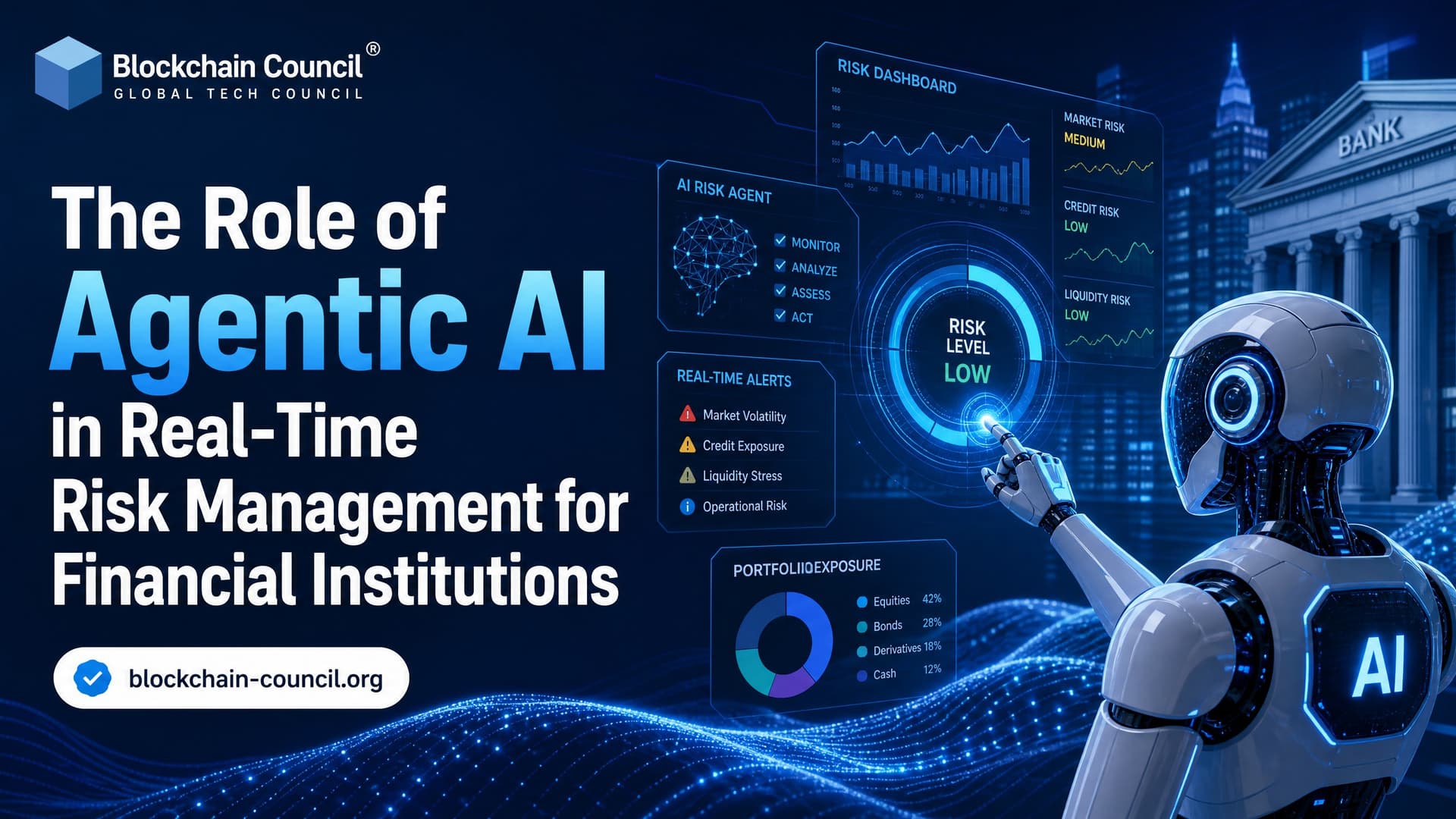
Agentic AI in real-time risk management is changing how financial institutions detect fraud, monitor exposures, and respond to operational issues as they happen. The shift is not simply from old software to new software. It is a move from static reports and rule queues to AI agents that can read context, call tools, compare signals, and recommend or trigger controlled actions.
That matters because risk rarely waits for the month-end pack. A liquidity signal can change within minutes. A fraud pattern can jump channels in an afternoon. A vendor payment anomaly may look harmless until an agent connects it with device, invoice, and approval workflow data.

As financial systems become more dynamic and interconnected, an AI Agentic Finance and Payment Certification can help professionals understand how AI agents monitor risk, automate decisions, and support real-time financial operations while maintaining governance and control.
What Agentic AI Means in Financial Risk
Agentic AI refers to AI systems that can pursue a defined goal across multiple steps. In finance, an agent may monitor card transactions, query a customer profile, check sanctions or fraud rules, assign a dynamic risk score, and route the case to the right team. It does more than produce text from a prompt.
A typical agentic risk system combines several parts:
Large language models for reasoning, summarization, and case explanation.
Specialized machine learning models for fraud scoring, credit risk, anomaly detection, and cyber signals.
Tool access to data warehouses, case management systems, risk engines, payment systems, and reporting dashboards.
Policy guardrails that define what the agent can see, change, block, approve, or escalate.
To be blunt, the useful part is not the chatbot interface. The useful part is orchestration. An agent that can check five systems, compare the result against policy, and create a well-documented case is far more valuable to a risk team than a model that only drafts a paragraph.
As these orchestrated systems take on more responsibility, identity, permissions, and financial controls become critical. Give your AI Agents a wallet, budget, and identity with Blockchain0x to autonomously pay, get paid, and build onchain.
Why Real-Time Risk Management Needs Agents
Traditional risk management often depends on scheduled reports, batch controls, and manual review. Those methods still have a place. But they struggle when the institution needs fast action across fragmented systems.
Real-time risk management uses live or near real-time data from transactions, customer activity, market feeds, logs, and internal workflows. Agentic AI adds a decision layer on top. Instead of waiting for an analyst to inspect every alert, agents can triage, enrich, and prioritize issues before a human sees them.
Core capabilities
Continuous monitoring: Agents scan payment streams, account behavior, vendor records, trading activity, and access logs.
Dynamic risk scoring: Scores update as new evidence arrives, not only after a scheduled batch run.
Automated investigation steps: Agents can request extra data, open a case, collect evidence, or ask for human approval.
Faster escalation: High-severity events move to fraud, compliance, treasury, or cyber teams with context already attached.
Feedback learning: False positives, confirmed incidents, and analyst decisions can improve thresholds and policies over time.
In practice, one detail bites many teams: retries. If an agent consumes transaction events from Apache Kafka and the consumer crashes after creating a case but before committing the offset, the same event may be processed twice. Unless you use an idempotency key such as transaction_id plus alert_type, you get duplicate cases or, worse, duplicate account restrictions. That is not a model problem. It is a production risk engineering problem.
High-Value Use Cases in Financial Institutions
1. Fraud and transaction monitoring
Fraud teams already use machine learning for anomaly detection. Agentic AI can extend that by coordinating the workflow around the alert. For example, an agent assigned to wire transfers can check transaction amount, beneficiary history, device fingerprint, customer communication patterns, and previous fraud markers. If the risk score crosses a policy threshold, it may pause the transaction for review or escalate it to a human investigator.
This works best when actions are bounded. Blocking a transaction should require clear rules, audit logs, and, in many cases, human confirmation. Agents should not be allowed to improvise controls on live money movement.
Maintaining these systems in production requires robust monitoring, governance, and deployment practices, which is why many professionals pursue an MLOps Expert certification to build reliable and compliant AI operations at scale.
2. Credit risk and small business lending
Small business credit decisions often involve incomplete data, changing cash flows, and high manual review cost. Agentic AI can gather bank statement data, repayment behavior, industry signals, and exception notes, then recommend a decision path.
The strong use case is not replacing credit officers for complex exposures. The better fit is consistent triage: low-risk renewals, missing document checks, covenant monitoring, and early warning signals. A relationship manager should still own judgment-heavy decisions, especially where customer context is material.
3. Compliance and regulatory reporting
Compliance work is full of multi-step processes: collect data, reconcile exceptions, compare against policy, document rationale, and report. Agents can reduce operational risk by tracking regulatory changes, preparing evidence packs, and identifying gaps in reports before submission.
For anti-money laundering and sanctions screening, agentic AI can help analysts by summarizing why an alert was raised and what evidence supports escalation. The key word is support. Final decisions need traceability and clear accountability.
4. Operational and process risk
Operational risk often hides in boring places: invoice approvals, vendor master changes, reconciliation breaks, access permissions, and failed controls. Agents can monitor workflow data for unusual patterns, such as a new vendor receiving multiple urgent payments just below approval limits.
This is one of the most practical early areas for agentic AI because the actions can be low-risk: open a case, notify a control owner, request missing evidence, or add an item to an exceptions queue.
5. Cyber and data risk
Financial institutions hold large data estates. Agentic AI can support cyber teams by triaging access anomalies, suspicious data movement, privileged account changes, and failed authentication patterns. Real-time visibility, quick threat detection, and strong data security controls are core parts of AI risk management, and those principles map directly to banking environments.
Governance: The Hard Part Banks Cannot Skip
Agentic AI introduces new risks because the agent can take steps across systems. Banks need to govern end-to-end agent behavior, not only the underlying model. That is the right position.
Treat agents as governed entities. Each agent needs a documented purpose, allowed tools, data access limits, escalation rules, and shutdown procedures.
Controls to put in place
Define permissible actions: Separate read-only agents from agents that can write to case systems or trigger controls.
Use human approval for material actions: Account freezes, credit declines, regulatory filings, and customer-impacting decisions need strict review paths.
Log every tool call: Record prompt, retrieved data references, tool inputs, tool outputs, model response, user approval, and final action.
Monitor drift and behavior: Track false positives, missed incidents, hallucinated rationale, latency, and exception rates.
Control data access: Apply least privilege. A fraud agent does not need unrestricted access to HR records.
Test failure modes: Simulate stale data, unavailable APIs, conflicting signals, prompt injection, and retry storms.
Regulatory expectations are also tightening. The European Union AI Act uses a risk-based approach and can affect high-risk AI systems, including certain credit scoring and financial decision applications. In the United States, model risk management guidance such as SR 11-7 remains relevant because it stresses validation, governance, and ongoing monitoring. Agentic AI does not remove those obligations. It expands them.
Architecture Pattern for Agentic AI Risk Systems
A practical architecture usually has five layers:
Data layer: Transaction streams, market data, customer records, device data, logs, and control evidence.
Model layer: Fraud models, anomaly detectors, credit models, natural language models, and rules engines.
Agent layer: Domain agents for fraud, credit, liquidity, operational risk, compliance, and cyber risk.
Workflow layer: Case management, approvals, notifications, and incident response systems.
Governance layer: Audit logs, policy controls, access management, testing, and monitoring dashboards.
If you are building this, start with read-only agents. Let them enrich alerts and draft case summaries. Measure analyst time saved, error rates, and escalation quality. Only then give agents limited write permissions. Moving straight to autonomous action is usually the wrong choice for regulated finance.
Benefits and Trade-Offs
The benefits are clear, but they are not automatic.
Faster detection: Agents can identify risk signals while data is still fresh.
Better prioritization: Analysts spend less time on low-value alerts.
Consistent evidence gathering: Agents follow the same checklist every time.
Continuous reporting: Dashboards update with current risk indicators instead of stale snapshots.
The trade-offs are just as real:
False confidence: A fluent explanation can still be wrong.
Complex accountability: Multiple agents and tools make root cause analysis harder.
Data leakage risk: Agents with broad access can expose sensitive information.
Operational dependency: If risk teams depend on agents without fallback processes, outages become control failures.
My view: agentic AI is strongest as a decision augmentation layer for the next few years. Full autonomy should stay limited to low-impact, reversible actions until institutions prove control quality under real production stress.
Skills Financial Professionals Need Next
Risk leaders do not need to become full-time machine learning engineers, but they do need enough technical literacy to challenge designs. Developers need to understand governance, not just APIs. Useful learning areas include:
AI agent design and tool use
Model validation and monitoring
Financial risk controls
Data privacy and access governance
Cybersecurity for AI-enabled systems
Audit trails and tamper-evident records, including blockchain-based approaches
For internal learning paths, Blockchain Council's Certified Agentic AI Expert™ is a relevant starting point for professionals designing AI agents and workflows. Risk and technology teams may also pair it with Certified AI Expert™, Certified Cybersecurity Expert™, or Certified Blockchain Expert™ depending on whether the role is focused on AI systems, controls, security, or auditability. Professionals looking to complement their technical expertise with customer engagement, brand strategy, and business growth skills may also benefit from a Marketing Certification.
What Comes Next
Agentic AI in real-time risk management will move from pilots to core risk infrastructure, but only where governance keeps pace with automation. Expect more domain-specific agents, tighter links with enterprise risk platforms, and stronger audit requirements around every agent decision.
Your next step should be practical. Pick one low-risk workflow, such as alert enrichment or operational exception triage. Build a read-only agent. Log every action. Compare its output with experienced analysts for 30 days. If it improves speed without weakening control quality, expand the scope carefully.
FAQs
1. What Is Agentic AI in Financial Risk Management?
Agentic AI refers to autonomous AI systems that can continuously monitor financial activities, assess risks, make decisions, and initiate actions in real time to help financial institutions manage risk more effectively.
2. Why Is Real-Time Risk Management Important for Financial Institutions?
Financial institutions operate in rapidly changing environments where fraud, market volatility, cyber threats, and compliance risks can emerge within seconds. Real-time risk management helps organizations respond quickly and minimize potential losses.
3. How Does Agentic AI Differ from Traditional Risk Management Systems?
Traditional systems often rely on predefined rules and manual reviews, while Agentic AI can dynamically analyze data, adapt to new threats, and take proactive actions without waiting for human intervention.
4. What Types of Risks Can Agentic AI Monitor?
Agentic AI can monitor fraud risk, credit risk, operational risk, cybersecurity threats, compliance violations, market risk, liquidity risk, and transaction-related risks.
5. How Does Agentic AI Support Fraud Detection?
AI agents can continuously analyze transaction patterns, detect anomalies, investigate suspicious activities, and trigger preventive actions before fraud causes significant damage.
6. How Can Agentic AI Improve Credit Risk Assessment?
By analyzing customer behavior, financial history, market conditions, and alternative data sources, Agentic AI can provide more accurate and dynamic credit evaluations.
7. What Role Does Agentic AI Play in Market Risk Management?
It can monitor market movements, identify unusual trading patterns, assess exposure levels, and recommend or execute risk mitigation strategies in response to changing market conditions.
8. How Does Agentic AI Help Manage Operational Risk?
Agentic AI can identify process failures, workflow bottlenecks, system disruptions, and operational anomalies that may affect business continuity.
9. Can Agentic AI Improve Compliance Monitoring?
Yes, AI agents can automate regulatory checks, transaction monitoring, sanctions screening, anti-money laundering (AML) processes, and compliance reporting.
10. How Does Agentic AI Enhance Cybersecurity Risk Management?
AI systems can monitor network activity, detect suspicious behavior, identify security vulnerabilities, and initiate defensive actions against potential cyber threats.
11. What Is Real-Time Decision-Making in Risk Management?
Real-time decision-making allows AI systems to evaluate risks and respond immediately rather than waiting for scheduled reviews or manual intervention.
12. How Can Agentic AI Improve Transaction Monitoring?
AI agents can evaluate transaction behavior continuously, assess risk scores, identify anomalies, and detect suspicious activities as transactions occur.
13. What Benefits Does Agentic AI Offer Financial Institutions?
Benefits include faster threat detection, reduced losses, improved compliance, enhanced operational efficiency, better customer protection, and more informed decision-making.
14. How Does Agentic AI Support Liquidity Risk Management?
It can monitor cash flows, funding requirements, market conditions, and liquidity positions to help institutions maintain financial stability.
15. What Role Does Predictive Analytics Play in Agentic AI?
Predictive analytics enables AI agents to forecast potential risks, identify emerging threats, and recommend preventive actions before problems escalate.
16. How Can Agentic AI Improve Customer Risk Assessments?
AI can evaluate customer behavior, transaction history, account activity, and financial profiles to provide more accurate and personalized risk evaluations.
17. What Technologies Enable Agentic AI for Risk Management?
Key technologies include machine learning, large language models, predictive analytics, real-time data processing, cloud computing, and advanced monitoring systems.
18. What Challenges Are Associated with Agentic AI Adoption?
Challenges include regulatory compliance, model transparency, data quality, cybersecurity concerns, governance requirements, and integration with legacy systems.
19. What Risks Should Financial Institutions Consider Before Deployment?
Organizations must address issues such as model bias, inaccurate predictions, over-automation, privacy concerns, and accountability for AI-driven decisions. In financial services, an automated decision can affect customers, compliance obligations, and revenue simultaneously, which makes oversight particularly important.
20. How Will Agentic AI Shape the Future of Risk Management?
Agentic AI is expected to become a cornerstone of modern risk management by enabling continuous monitoring, predictive threat detection, autonomous response capabilities, and real-time decision-making. Financial institutions that successfully combine Agentic AI with strong governance, regulatory compliance, and human oversight will be better positioned to manage risk, protect customers, and operate efficiently in an increasingly complex financial landscape.
Related Articles
View All
Agentic AI
Autonomous AI Agents in DeFi Trading and Risk Management
Autonomous AI agents in DeFi are changing trading, yield optimization, and risk management with smarter execution, simulation, and tighter controls.

Agentic AI
Agentic AI in Wealth Management: Personalized Portfolios and Automated Advisory
Agentic AI in wealth management is reshaping personalized portfolios, advisory workflows, risk monitoring, and human-led financial planning.

Agentic AI
How Agentic AI in Digital Payments Is Reshaping Financial Services
Agentic AI is moving digital payments from static automation to autonomous, policy-governed financial workflows across fraud, routing, credit, and compliance.
Trending Articles
AWS Career Roadmap
A step-by-step guide to building a successful career in Amazon Web Services cloud computing.

Top 5 DeFi Platforms
Explore the leading decentralized finance platforms and what makes each one unique in the evolving DeFi landscape.
What is AWS? A Beginner's Guide to Cloud Computing
Everything you need to know about Amazon Web Services, cloud computing fundamentals, and career opportunities.