

How Agentic AI Fraud Detection Automates Payment Systems
 Suyash Raizada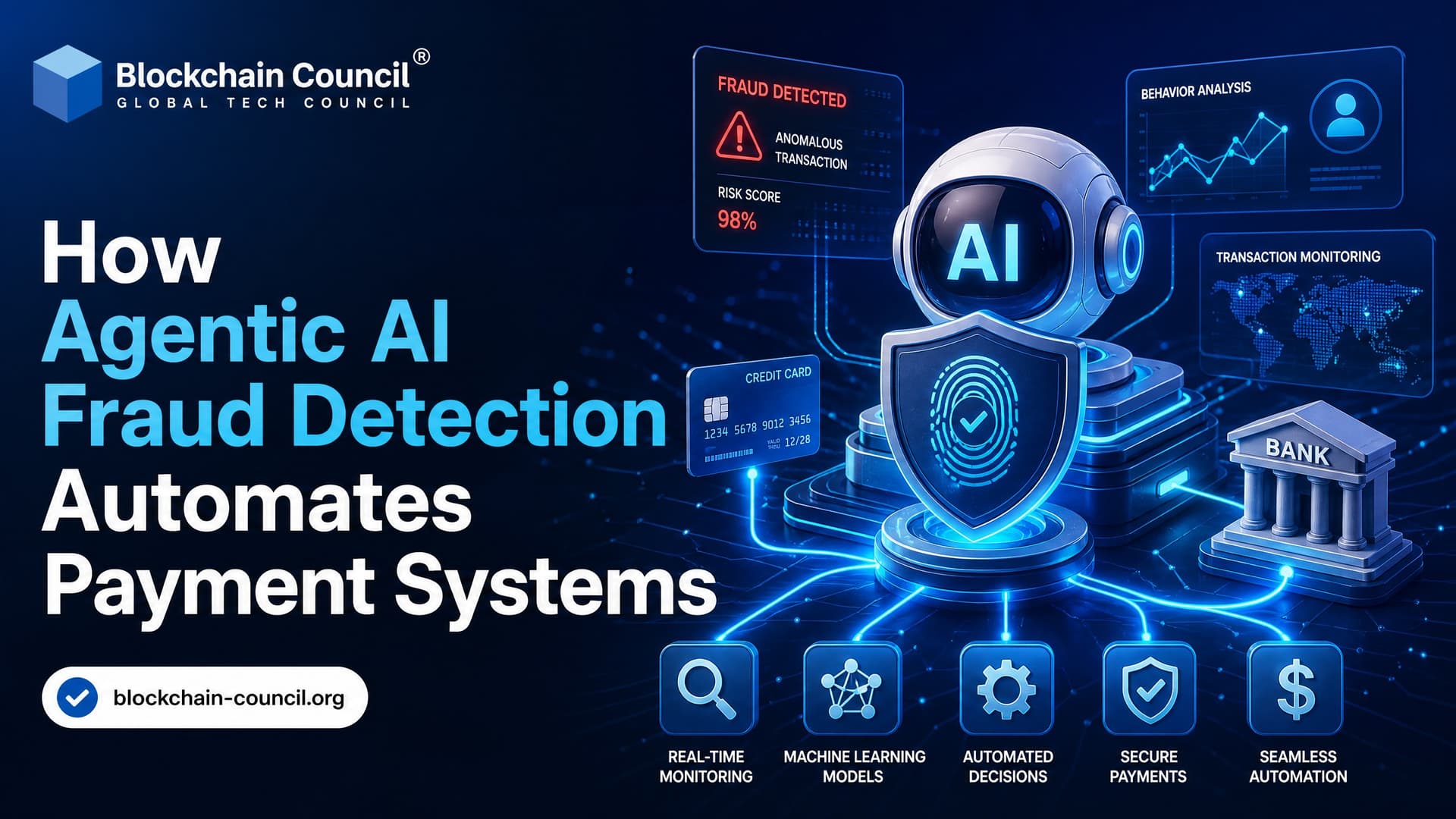
Agentic AI fraud detection is moving payment security from alert scoring to active decisioning. Instead of waiting for a rule to fire and a human analyst to open a case, AI agents can watch transactions, connect identity and device signals, ask for more evidence, trigger step-up authentication, and escalate only the cases that need judgment.
That matters because modern payment fraud is rarely a single bad transaction. Account takeover, mule activity, synthetic identity fraud, card testing, refund abuse, and social engineering often unfold as a sequence. If your system treats every event in isolation, you miss the story.

Understanding how AI agents can detect, analyze, and respond to these complex fraud patterns is becoming increasingly important, which is why many professionals are exploring an AI Agentic Finance and Payment Certification to develop expertise in intelligent payment systems, risk management, and autonomous financial workflows.
What Agentic AI Means in Payment Fraud Detection
Agentic AI refers to AI systems that can perceive context, plan a response, take action, and learn from outcomes. In payment fraud detection, the agent is not just a model returning a score such as 0.87 risk. It is part of an operating loop.
A payment fraud agent may:
Monitor transaction streams, login events, device fingerprints, IP reputation, geolocation, merchant data, and KYC records.
Compare current behavior with the customer's history, peer groups, known fraud rings, and external threat intelligence.
Choose an action: approve, decline, hold, request 3D Secure, ask for biometric verification, freeze an account, or create an analyst case.
Coordinate with KYC, AML, chargeback, customer support, and cybersecurity tools.
Update thresholds or recommend new rules after confirmed fraud, false positives, and chargeback results come back.
The key difference is autonomy. A traditional fraud engine usually applies static rules or a supervised model to each transaction. An agentic system can run a multi-step investigation before deciding what to do.
As these systems become more autonomous, managing agent identity, permissions, and financial controls becomes increasingly important. Give your AI Agents a wallet, budget, and identity with Blockchain0x to autonomously pay, get paid, and build onchain.
Why Static Fraud Rules Are Not Enough
Rules still matter. Keep them. A velocity rule that blocks 40 card attempts from the same device in 90 seconds is simple and useful. But rules age quickly.
Fraud teams know the pattern. You tighten one control, fraudsters test the edge, and false positives climb. Then analysts drown in alerts. I have seen a single poorly tuned rule on first-time payees create thousands of low-value cases after a bank promoted instant transfers. The rule was not wrong. It was blind to context.
Agentic AI fraud detection works better when the problem requires context across time and channels, for example:
A customer logs in from a new device, changes the phone number, adds a beneficiary, then sends an instant payment.
A group of newly opened accounts receive small deposits from unrelated sources, then forward funds to the same exchange wallet.
A card is tested at low value across several merchants before a larger transaction appears.
A trusted customer suddenly makes a high-value cross-border transfer after a suspicious support chat.
These are sequence problems. Agents are better suited to sequence problems than one-shot scoring.
How Agentic AI Automates the Fraud Workflow
1. Real-time event monitoring
Payment agents ingest streaming events from gateways, core banking systems, mobile apps, fraud databases, and identity tools. For card payments, that may include authorization messages. For banking, it may include login, device binding, beneficiary creation, and transfer initiation events.
In practice, the streaming layer matters as much as the model. If you use Apache Kafka or Apache Flink, watch the defaults. A beginner mistake is setting Kafka auto.offset.reset=latest during testing and then wondering why the agent cannot replay last week's confirmed fraud. In Flink, missing event-time watermarks can also break joins between late chargeback labels and the original transaction window. Not glamorous. Very real.
Understanding these data pipelines and automation workflows often requires strong programming fundamentals, which is why many professionals pursue a Python Certification to build and manage production-ready AI and analytics systems.
2. Dynamic risk assessment
The agent combines several signals rather than trusting one model. Common inputs include:
Transaction amount, merchant category, currency, rail, and destination account.
Device fingerprint, SIM swap indicators, IP risk, VPN or proxy usage, and geolocation drift.
Behavioral patterns such as typing cadence, session duration, payee history, and usual spending time.
KYC attributes, document verification results, sanctions screening, and synthetic identity signals.
Network links between accounts, devices, addresses, cards, merchants, and wallets.
This is where graph analytics helps. Fraud rings reuse infrastructure. A shared device, delivery address, IP subnet, or payout account can reveal relationships that a transaction-level model misses.
3. Autonomous response
Good fraud automation is not the same as aggressive blocking. To be blunt, declining every high-risk payment is a lazy design. It protects the institution but punishes legitimate customers.
A stronger agent chooses the least disruptive control that still manages risk:
Low risk: approve and log the decision.
Medium risk: request step-up authentication, such as 3D Secure, passkey confirmation, biometric check, or one-time password.
High risk: hold the payment, freeze a function, or route to an analyst.
Critical risk: block, create an incident, and notify fraud operations.
This is especially useful for instant payments, where decisions must happen in milliseconds and manual review cannot scale.
4. Case creation and investigation
Analysts do not need more raw alerts. They need cases with evidence. Agentic AI can group related alerts, enrich them with history, summarize the likely fraud pattern, and recommend next actions.
For example, instead of showing 18 separate transfer alerts, the agent can create one case: five accounts opened in the past 14 days, three shared devices, funds moving through two mule accounts, final payout to the same beneficiary. That saves time. It also improves consistency between analysts.
5. Feedback and policy improvement
The agent should learn from outcomes, but this needs guardrails. Confirmed fraud, customer disputes, analyst decisions, chargeback codes, and false positive reviews should feed back into model monitoring and policy tuning.
Do not let a production agent silently rewrite decline logic for high-value payments. Use approval workflows, versioned policies, audit logs, and rollback options. Model governance is not paperwork here. It is damage control before something breaks.
Where Agentic AI Fits Across the Payment Stack
Online and mobile banking
AI agents can monitor login behavior, new payee setup, password resets, device changes, and payment initiation as one flow. This is one of the best use cases because account takeover often leaves traces before the money moves.
Card and wallet payments
For ecommerce, agents can detect card testing, suspicious device reuse, unusual merchant patterns, promo abuse, and risky wallet funding behavior. They can also decide when to request 3D Secure authentication without challenging every customer.
Cross-border payments
Cross-border fraud is harder because FX corridors, local payment methods, sanctions checks, and beneficiary risks all interact. An agent can combine fraud monitoring with compliance workflows, then escalate flows that show unusual routing or suspicious counterparties.
Identity verification and KYC
Agentic AI is useful during onboarding and high-risk payments. The agent can decide whether a user needs document verification, biometric matching, database checks, or enhanced due diligence based on the risk of the current session.
Web3 and programmable payments
As stablecoin payments, smart contract interactions, and wallet-based commerce grow, fraud teams will need agents that read both off-chain behavior and on-chain activity. For Ethereum, that might include wallet age, contract interaction history, token approvals, bridge usage, and links to known scam addresses. A transfer on-chain may be final, so prevention beats recovery.
Governance, Security, and Regulatory Questions
Agentic AI in payments introduces a new question: who is allowed to act? If an AI agent can approve, block, or initiate a payment-related action, you need controls similar to privileged access management.
Build for these requirements from day one:
Agent identity: authenticate agents and restrict what each agent can do.
Human oversight: require approval for sensitive policy changes and high-impact decisions.
Explainability: store the reason codes, signals, model versions, and policy versions behind each action.
Audit logging: preserve decision trails for disputes, regulatory review, and internal investigations.
Data minimization: collect what you need for fraud control, not every signal you can find.
Model risk management: test bias, drift, false positives, and failure modes before full rollout.
Frameworks such as the NIST AI Risk Management Framework, PCI DSS 4.0 for payment data security, and regional rules such as PSD2 strong customer authentication in Europe give useful reference points. They do not answer every agentic AI question, but they force the right conversations about accountability, testing, and consumer protection.
When Agentic AI Is the Wrong Starting Point
Agentic AI fraud detection is not a magic fix. If your data is fragmented, labels are poor, and no one agrees what counts as a false positive, an autonomous agent will only automate confusion.
Start with agentic AI when you have:
High transaction volume or 24/7 payment operations.
Multiple fraud signals across channels.
Clear escalation paths and analyst feedback loops.
Engineering support for streaming data and API integration.
Governance teams ready to review automated decisions.
Delay full autonomy if you lack clean event data, cannot replay historical cases, or have no process for handling customer complaints. In that case, begin with agent-assisted investigation before letting agents block or approve payments.
Skills Professionals Need to Build These Systems
If you work in fraud, risk, payments, cybersecurity, or data engineering, the skill set is becoming cross-functional. You need enough AI knowledge to understand agent behavior, enough payments knowledge to know where fraud hides, and enough governance knowledge to keep the system accountable.
Useful areas to study include:
Streaming architecture with Kafka, Flink, Spark Structured Streaming, or cloud-native event services.
Machine learning for anomaly detection, supervised classification, graph features, and behavioral biometrics.
Agent design patterns, including planning, tool use, memory, policy constraints, and human approval loops.
Payment rails, chargebacks, instant payments, wallets, cross-border transfers, and tokenized payments.
Security controls for agent identity, logging, access control, and incident response.
For structured learning, consider Blockchain Council's Certified Agentic AI Expert™ as a path into agent design and governance. If your work touches tokenized payments or on-chain monitoring, pair it with Certified Blockchain Expert™. Security professionals can also connect this topic with Certified Cybersecurity Expert™ concepts such as threat modeling and access control. Professionals seeking to strengthen their business, branding, and customer engagement skills may also benefit from a Marketing Certification.
Practical Roadmap for Enterprises
Do not begin by automating every fraud decision. Pick one payment journey and prove the loop.
Map the fraud flow: Choose a use case such as account takeover before instant transfer.
Unify events: Bring login, device, KYC, beneficiary, and transaction events into one timeline.
Build replay: Test the agent on historical fraud and legitimate cases before production.
Start with recommendations: Let the agent enrich alerts and suggest actions first.
Add controlled actions: Permit step-up authentication before declines or freezes.
Measure hard numbers: Track fraud loss, false positives, approval rate, analyst handling time, customer complaints, and appeal outcomes.
Review weekly: Fraud tactics change fast. Your policies should not wait for a quarterly meeting.
Next step: choose one high-friction fraud process, build an event timeline for the last 90 days, and test an agent in recommendation mode. If you need a formal path, start with Certified Agentic AI Expert™, then build a small payment fraud agent that can explain every action it recommends.
FAQs
1. What Is Agentic AI Fraud Detection?
Agentic AI fraud detection uses autonomous AI systems that can identify, analyze, investigate, and respond to fraudulent activities in payment systems with minimal human intervention.
2. How Does Agentic AI Differ from Traditional Fraud Detection Systems?
Traditional fraud detection systems primarily generate alerts, while Agentic AI can actively evaluate threats, make decisions, initiate investigations, and take preventive actions automatically.
3. Why Is Fraud Detection Important in Digital Payment Systems?
Fraud detection helps protect customers, financial institutions, merchants, and payment networks from financial losses, identity theft, and unauthorized transactions.
4. How Does Agentic AI Detect Fraud?
Agentic AI analyzes transaction data, user behavior, device information, payment history, and risk signals to identify unusual patterns and potential threats in real time.
5. What Types of Payment Fraud Can Agentic AI Identify?
It can detect account takeover fraud, identity theft, payment fraud, card fraud, synthetic identity fraud, transaction laundering, and suspicious account activity.
6. How Does Real-Time Fraud Detection Work?
Agentic AI continuously monitors transactions as they occur, evaluates risk factors instantly, and determines whether a transaction should be approved, flagged, or blocked.
7. What Role Does Machine Learning Play in Fraud Detection?
Machine learning enables AI systems to learn from historical transaction data and continuously improve their ability to recognize fraudulent behavior.
8. How Does Agentic AI Reduce False Positives?
By analyzing broader contextual data and behavioral patterns, Agentic AI can distinguish legitimate customer behavior from suspicious activity more accurately.
9. Can Agentic AI Automatically Respond to Fraud Threats?
Yes, Agentic AI can block transactions, trigger additional authentication checks, freeze accounts, escalate investigations, and notify customers automatically.
10. How Does Behavioral Analysis Improve Fraud Detection?
Behavioral analysis evaluates how users typically interact with accounts, devices, and payment systems to identify unusual activities that may indicate fraud.
11. What Is Risk Scoring in Agentic AI Fraud Detection?
Risk scoring assigns a probability of fraud to each transaction based on multiple factors such as location, spending patterns, device usage, and customer history.
12. How Does Agentic AI Help Financial Institutions?
It improves fraud prevention, reduces operational costs, accelerates investigations, enhances compliance, and strengthens customer trust.
13. Can Agentic AI Detect Emerging Fraud Techniques?
Yes, because it continuously analyzes new data patterns and adapts to evolving fraud tactics without relying solely on predefined rules.
14. How Does Agentic AI Improve Payment Security?
It provides continuous monitoring, adaptive threat detection, automated responses, and proactive risk management across payment ecosystems.
15. What Role Does Agentic AI Play in Cross-Border Payments?
It helps identify suspicious international transactions, monitor compliance risks, detect anomalies, and reduce fraud associated with global payment flows.
16. How Can Businesses Benefit from Automated Fraud Detection?
Businesses can reduce chargebacks, improve payment approval rates, lower fraud-related losses, and create safer customer experiences.
17. What Challenges Are Associated with Agentic AI Fraud Detection?
Challenges include model transparency, data quality, privacy concerns, regulatory compliance, integration complexity, and governance requirements.
18. How Can Organizations Measure the Effectiveness of Fraud Detection Systems?
Key metrics include fraud loss reduction, false positive rates, detection accuracy, investigation speed, chargeback rates, and customer satisfaction.
19. What Risks Should Organizations Consider Before Implementing Agentic AI?
Organizations must ensure strong oversight, security controls, compliance frameworks, and regular model monitoring. While autonomous systems can react faster than humans, mistakes made at machine speed can also spread faster if proper safeguards are not in place.
20. How Will Agentic AI Shape the Future of Fraud Prevention in Payments?
Agentic AI is expected to become a central component of payment security by enabling real-time threat detection, autonomous fraud response, adaptive risk management, and continuous learning. As payment ecosystems grow more complex, autonomous fraud detection systems will play an increasingly important role in protecting financial transactions while improving efficiency and customer trust.
Related Articles
View All
Agentic AI
How Businesses Can Prepare for Agentic AI-Powered Payment Automation
Learn how businesses can prepare for agentic AI-powered payment automation with modern AP systems, stronger data, clear controls, and safe pilots.

Agentic AI
Security Challenges of Agentic AI in Finance and Payment Ecosystems
Agentic AI in finance can approve payments, trade assets, and call APIs. Learn the main security, fraud, identity, and governance risks.

Agentic AI
Payment Orchestration with Agentic AI: Improving Speed, Cost, and Reliability
Learn how payment orchestration with agentic AI improves transaction speed, lowers costs, and strengthens reliability across multi-provider payment stacks.
Trending Articles

Top 5 DeFi Platforms
Explore the leading decentralized finance platforms and what makes each one unique in the evolving DeFi landscape.
What is AWS? A Beginner's Guide to Cloud Computing
Everything you need to know about Amazon Web Services, cloud computing fundamentals, and career opportunities.
Claude AI Tools for Productivity
Discover Claude AI tools for productivity to streamline tasks, manage workflows, and improve efficiency.