

AI Agents Manager Salary in the USA: Average Pay, Factors, and Trends
 Suyash Raizada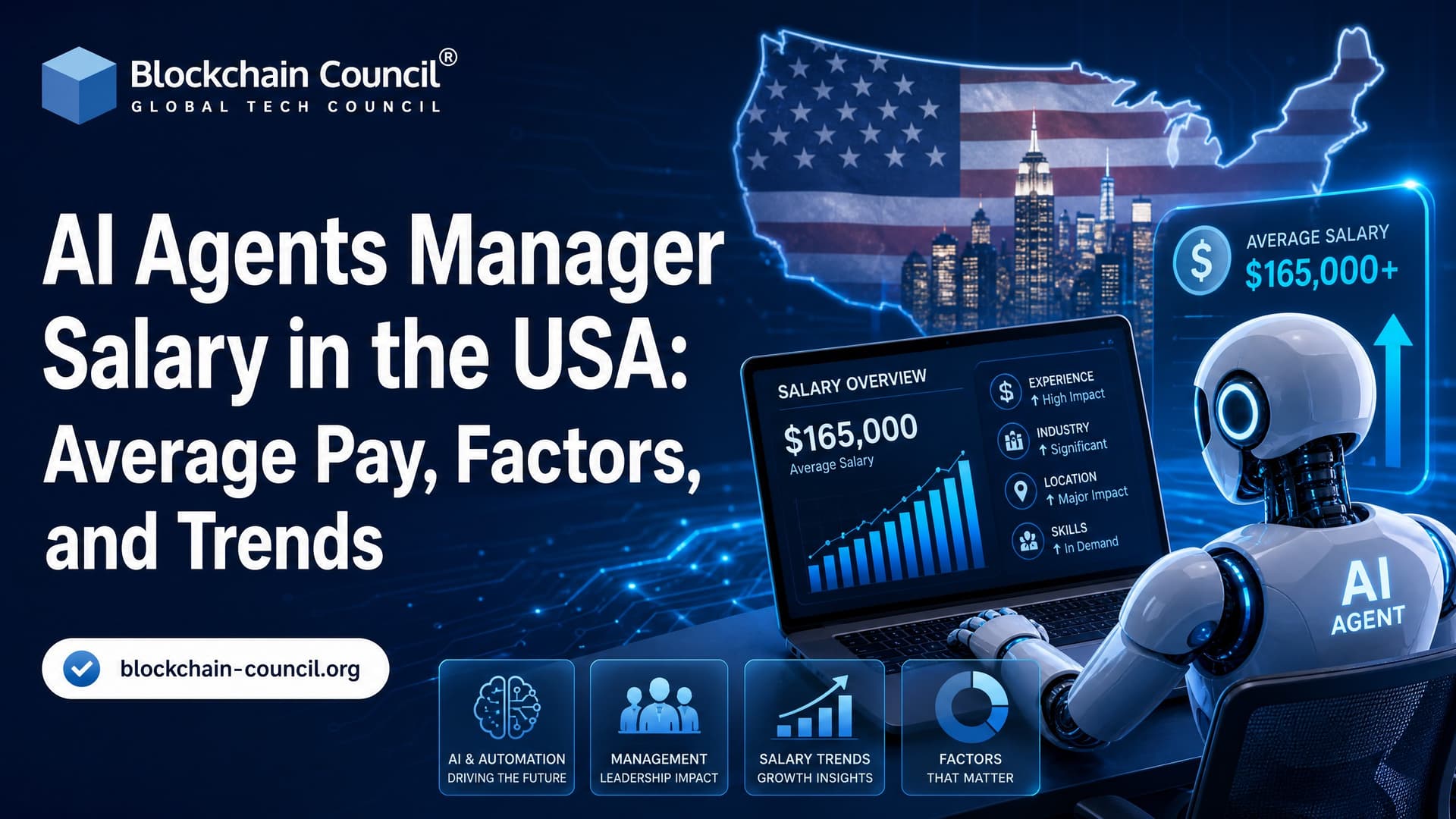
AI Agents Manager Salary data in the USA points to a clear pattern: this is a high-paying, senior-level role, but the job title is still messy. Most compensation shows up under related labels such as AI Manager, AI Product Manager, Agent Platform Lead, AI/ML Manager, or agentic AI product owner. Across current public salary sources, general AI manager roles often sit between 100,000 and 220,000 USD, while agent-focused product and platform leaders at frontier AI companies can reach 350,000 to 700,000 USD or more in total compensation.
That gap matters. If you are pricing your next role, hiring for an agentic AI team, or planning a learning path, you need to know which salary band you are actually looking at. A manager running internal workflow agents at a mid-market firm is not paid the same way as a product leader owning agent infrastructure at OpenAI, Anthropic, Google DeepMind, or Netflix.

As organizations scale AI initiatives across engineering, product, and operations, professionals with a Certified Scrum Master Expert™ background can help coordinate cross-functional teams, manage iterative AI delivery, and keep complex agent development programs aligned with business objectives.
What Does an AI Agent Manager Actually Do?
The title is not standardized yet. In practice, an AI agent manager oversees systems that can plan tasks, call tools, use APIs, reason over context, and complete multi-step workflows with limited human input. You may also see the role described as agent PM, AI product manager, agent platform manager, AI transformation lead, or AI/ML engineering manager.
The best people in this role are not just meeting coordinators. They understand how large language models behave in production, how orchestration frameworks work, where tool calling breaks, and when an agent should not be autonomous at all. To be blunt, a chatbot demo is easy. A production agent that handles permissions, audit logs, retries, data privacy, and human approval is a different job.
A concrete example: teams using LangChain or similar orchestration tools often find that an agent keeps calling the same tool until the run stops with an output like Agent stopped due to iteration limit or time limit. That is not a model problem alone. It is a product, architecture, evaluation, and governance problem. An AI agent manager is expected to catch those issues before they turn into expensive incidents.
Because production AI agents combine orchestration, governance, tool integration, and autonomous decision-making, many professionals strengthen these capabilities through a Certified Agentic AI Expert™ program before taking on leadership responsibilities for enterprise agent platforms.
Average AI Agents Manager Salary in the USA
Because salary platforms rarely use the exact label AI agent manager, the best estimate comes from AI manager and AI product manager benchmarks, plus public market data from agent-focused hiring.
General AI Manager salary range
For broader AI management roles in the United States, public salary data generally falls into the low-to-mid six figures:
ZipRecruiter has reported an average AI Manager salary near 103,000 USD, with many roles between about 55,000 and 142,500 USD, and top earners around 175,000 USD.
Glassdoor has shown higher AI manager estimates, with average pay around 210,000 USD and upper percentiles approaching 380,000 USD.
6figr, which often reflects senior and equity-heavy technology compensation, has reported average total compensation for AI Manager roles above 300,000 USD, with outliers running much higher.
These numbers disagree less than they first appear to. They are measuring different things. Some report base salary. Others fold in bonus and equity. Some capture ordinary enterprise AI roles, while others skew toward senior employees at large technology companies.
Agent-focused AI Product Manager compensation
The top end of the AI Agents Manager Salary market usually comes from product and platform ownership. Agent-focused AI product managers at leading AI companies can earn far more than traditional technology managers.
Recent market commentary has placed AI product manager compensation in the 350,000 to 700,000 USD+ total compensation range for high-demand roles. Public discussions around Anthropic product manager roles have cited total compensation in the high six figures. OpenAI product manager compensation has been discussed at levels that can approach or exceed the upper six-figure range for senior roles. Netflix has posted AI-focused product leadership roles with salary bands reaching up to 900,000 USD for director-level positions.
Those are not entry-level jobs. They typically require judgment across product strategy, model behavior, AI safety, user trust, and engineering execution. If you have only managed standard SaaS features, you are not automatically competitive for this band.
Key Factors That Influence AI Agent Manager Pay
1. Technical depth in LLMs and agent orchestration
Managers who understand LLMs, retrieval-augmented generation, tool calling, evaluation pipelines, and agent orchestration command a premium. You do not need to be the strongest Python engineer on the team, but you should be able to read logs, question evaluation results, and recognize when a model is being asked to do something unsafe or poorly scoped.
Useful technical areas include:
LLM prompting and system instruction design
Function calling and tool-use patterns
Vector databases and retrieval workflows
Agent frameworks such as LangChain, AutoGen, CrewAI, and LlamaIndex
Model evaluation, red teaming, and hallucination testing
AI governance, privacy, and human-in-the-loop controls
2. Company type
Employer type creates one of the biggest salary splits.
Frontier AI labs and major platforms: often offer the highest total compensation, especially once equity is included.
Large enterprises: may pay strong base salaries for AI transformation and automation leaders, usually below frontier lab levels.
Startups: may offer lower cash compensation but meaningful equity, which can be valuable or worthless. Be realistic.
Consulting: can pay well per project, but income is uneven. You are also selling, scoping, and handling client risk.
3. Location
Location still matters, even with remote work. San Francisco, New York, Seattle, and other tech-heavy markets tend to pay above national averages for AI leadership. ZipRecruiter has reported some cities beating the national AI Manager average by 15 percent or more. High-cost locations also attract companies competing for scarce agentic AI talent.
Remote roles can narrow the gap, but many frontier AI companies still prefer hybrid work for senior product, safety, and research-adjacent teams. If you want top-of-market pay, being available to work near the center of AI hiring helps.
4. Seniority and scope
An AI agent manager who owns a small internal automation project may earn around the broader AI manager average. A director owning an agent platform used by millions of users is in a different compensation category.
Scope indicators that usually raise pay include:
Managing cross-functional teams across product, engineering, data science, and risk
Owning revenue-critical AI products
Setting policy for autonomous or semi-autonomous agents
Managing AI safety, security, and compliance requirements
Leading platform strategy rather than a single feature
Market Trends Driving Higher Salaries
Agentic AI is moving from experiments to operations
Companies are no longer only testing chat interfaces. They are building agents that draft code, triage support tickets, summarize contracts, create sales workflows, monitor infrastructure, and run internal knowledge systems. Once an agent touches real customer data or business-critical systems, management quality becomes expensive and necessary.
AI labor demand remains strong
The US Bureau of Labor Statistics projects 26 percent growth for computer and information research scientists from 2023 to 2033, far above the roughly 4 percent projected growth across all occupations. Coursera, citing Glassdoor and BLS data, has also noted that AI professionals earn well above the US median salary. Several industry analysts project the broader AI market to approach the trillion-dollar scale by 2030, which supports continued demand for experienced AI leaders.
Agent security is becoming its own specialty
Agent security is not optional. An agent that can send emails, update records, run code, or trigger payments needs strict permissions. Prompt injection, data leakage, unsafe tool use, and over-permissioned API access are real risks. That is why roles such as Group Product Manager, Agent Security have started appearing in major AI organizations.
This is one reason salaries are high. The role blends product judgment, AI literacy, security awareness, and operational discipline. Few candidates have all four.
How to Increase Your Earning Potential
If you want to move toward the higher end of the AI Agents Manager Salary range, build proof that you can manage agentic systems beyond slide decks.
Build a working agent project. Create an agent that uses retrieval, calls at least one external tool, logs its actions, and includes a human approval step.
Learn evaluation. Hiring teams care about how you measure task success, refusal quality, hallucination rate, latency, and cost per run.
Understand safety and governance. Study permissioning, audit trails, red teaming, and model risk management.
Develop product instincts. Know when an agent is the wrong choice. Many workflows need deterministic automation, not an LLM agent.
Earn credible credentials. For structured learning, consider Blockchain Council programs such as Certified Artificial Intelligence (AI) Expert™, Certified Generative AI Expert™, and Certified Prompt Engineer™. These support your AI fundamentals, prompt design, and applied generative AI knowledge.
Practical Salary Expectations for 2026
For most professionals, a realistic US salary expectation looks like this:
Early AI manager or internal automation lead: about 100,000 to 160,000 USD
Experienced AI/ML manager or agentic AI lead: about 160,000 to 300,000 USD
Senior AI product manager or platform lead: about 250,000 to 500,000 USD total compensation
Director or frontier AI product leader: about 500,000 to 900,000 USD+ in exceptional cases
The smart move is to benchmark by scope, not title. Ask whether the role owns production agents, user safety, revenue impact, platform architecture, and cross-functional delivery. That tells you more than the job label.
Next Step
If you are targeting AI agent manager roles, spend the next 30 days building a small but real agent workflow, then document the architecture, evaluation method, safety controls, and business use case. Pair that portfolio with structured training in AI, generative AI, and prompt engineering through Blockchain Council certification paths. That combination gives you a stronger case for the upper salary bands than a generic AI management resume.
As AI agents increasingly power customer engagement, digital products, and business automation, complementing technical expertise with a Marketing Certification can help professionals connect AI innovation with customer needs, product strategy, and measurable business growth.
FAQs
1. What is the average AI Agents Manager salary in the USA?
AI Agents Manager salaries in the United States vary based on experience, location, industry, and company size. Because this is an emerging role, compensation is often comparable to senior AI program, AI product, or AI operations management positions, with many employers offering competitive base salaries plus bonuses and equity.
2. How much does an entry-level AI Agents Manager earn in the USA?
Entry-level professionals transitioning into AI Agent Management typically earn less than experienced managers. Salaries depend on previous experience in AI, project management, product management, or business operations, as well as the employer's AI maturity.
3. What is the salary for a senior AI Agents Manager?
Senior AI Agents Managers generally earn significantly higher compensation because they oversee enterprise AI strategy, governance, cross-functional teams, and large-scale AI deployments. Total compensation may also include performance bonuses, stock options, and other incentives.
4. Which industries pay the highest salaries for AI Agents Managers?
Technology, financial services, healthcare, cloud computing, consulting, cybersecurity, enterprise software, and AI-focused startups often offer some of the highest salaries due to strong demand for AI leadership and automation expertise.
5. Which US cities offer the highest AI Agents Manager salaries?
Major technology hubs such as San Francisco, Seattle, New York City, Boston, Austin, and Silicon Valley generally offer higher salaries. However, compensation often reflects the local cost of living and demand for AI professionals.
6. What factors affect an AI Agents Manager's salary?
Salary is influenced by experience, technical expertise, leadership skills, company size, geographic location, industry, AI project complexity, certifications, and the ability to demonstrate measurable business outcomes through AI initiatives.
7. Do AI Agents Managers earn more than Project Managers?
In many organizations, AI Agents Managers can earn more than traditional Project Managers because the role requires specialized knowledge of artificial intelligence, automation, governance, and enterprise digital transformation.
8. Can AI Agents Managers receive bonuses and stock options?
Yes. Many technology companies and AI-focused organizations offer performance bonuses, annual incentives, restricted stock units (RSUs), stock options, and profit-sharing programs in addition to base salary.
9. How does experience impact AI Agents Manager salaries?
Professionals with experience in enterprise AI, workflow automation, AI governance, product management, or leading successful AI deployments generally command higher salaries than candidates entering the field for the first time.
10. What skills can increase an AI Agents Manager's earning potential?
Skills in AI strategy, workflow automation, prompt engineering, AI governance, project management, cloud platforms, data analytics, leadership, change management, and enterprise AI implementation can improve earning potential.
11. Do certifications help increase AI Agents Manager salaries?
Professional certifications in AI, cloud computing, project management, Agile, Scrum, cybersecurity, and data analytics may strengthen a candidate's profile. While certifications alone do not guarantee higher pay, they can enhance credibility and support career advancement.
12. How does company size affect AI Agents Manager salaries?
Large enterprises and global technology companies often offer higher compensation packages because they manage more complex AI initiatives. Smaller startups may offer lower base salaries but can provide equity or other long-term incentives.
13. Are remote AI Agents Manager jobs available in the USA?
Yes. Many organizations now offer fully remote or hybrid AI management roles. Remote positions may have location-based salary adjustments, while others provide standardized compensation regardless of where employees live.
14. How does an AI Agents Manager salary compare to an AI Product Manager salary?
Compensation varies by company and responsibilities. AI Product Managers often earn competitive salaries due to their role in product strategy, while AI Agents Managers may receive comparable compensation when managing enterprise AI operations, governance, and automation at scale.
15. Can an AI Engineer transition into a higher-paying AI Agents Manager role?
Yes. Experienced AI Engineers can transition into AI Agent Management by developing leadership, governance, and business strategy skills. In some organizations, this career move can lead to higher overall compensation due to increased managerial responsibilities.
16. What career growth opportunities exist after becoming an AI Agents Manager?
Professionals may advance to roles such as Senior AI Agents Manager, AI Operations Director, Director of AI Strategy, Head of AI Automation, Vice President of AI, or Chief AI Officer (CAIO), depending on organizational structure.
17. Which companies are hiring AI Agents Managers in the USA?
Technology companies, cloud providers, financial institutions, healthcare organizations, consulting firms, software companies, retail businesses, and enterprises investing in AI transformation are increasingly creating roles focused on managing AI agents and intelligent automation.
18. Is demand for AI Agents Managers growing in the United States?
Yes. As organizations adopt AI agents for customer service, workflow automation, software development, and business operations, demand for professionals who can govern, manage, and scale these systems continues to increase.
19. How can professionals increase their salary as an AI Agents Manager?
Professionals can improve earning potential by leading successful AI implementations, developing expertise in enterprise AI platforms, strengthening leadership skills, earning relevant certifications, delivering measurable business results, and staying current with emerging AI technologies.
20. Is AI Agents Manager a high-paying career in the USA?
AI Agents Manager is widely considered a promising and potentially high-paying career due to the rapid adoption of AI across industries. Organizations increasingly value professionals who can combine AI knowledge, business strategy, governance, and leadership to drive successful enterprise AI initiatives, making the role attractive for long-term career growth.
Related Articles
View All
Agentic AI
AI Agents Manager vs AI Engineer: Roles, Skills, and Responsibilities
Compare AI Agents Manager vs AI Engineer roles, skills, responsibilities, use cases, and career paths for agentic AI and production LLM systems.

Agentic AI
AI Agents Manager vs AI Product Manager: Key Differences Explained
Compare AI Agents Manager vs AI Product Manager roles, skills, metrics, risks, and career paths as agentic AI changes product teams.

Agentic AI
AI Agents Manager Interview Questions and Answers for Job Seekers
Prepare for AI Agents Manager interviews with practical questions, model answers, architecture tips, RAG guidance, evals, security, and governance advice.
Trending Articles
AWS Career Roadmap
A step-by-step guide to building a successful career in Amazon Web Services cloud computing.
How Blockchain Secures AI Data
Understand how blockchain technology is being applied to protect the integrity and security of AI training data.

Can DeFi 2.0 Bridge the Gap Between Traditional and Decentralized Finance?
The next generation of DeFi protocols aims to connect traditional banking with decentralized finance ecosystems.