

AI Agents in DePIN: Optimizing Decentralized Physical Infrastructure Networks
 Suyash Raizada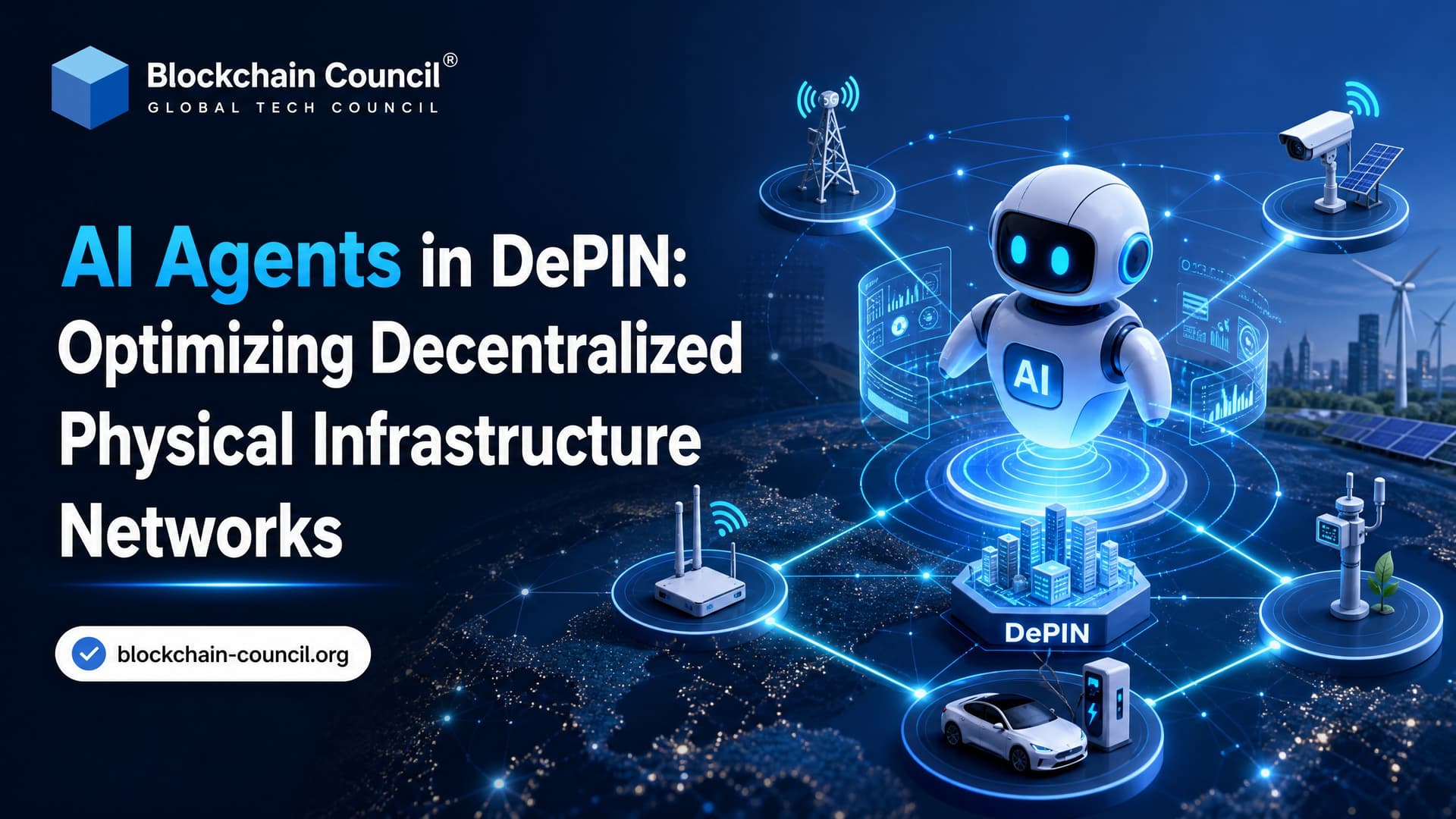
AI agents in DePIN are moving from theory to production. They help decentralized physical infrastructure networks allocate compute, route traffic, check device health, price resources, and coordinate rewards across hardware that may be owned by thousands of independent operators.
That matters because DePIN is not just another crypto category. It connects blockchains to physical assets: GPU clusters, wireless hotspots, storage nodes, sensors, vehicles, batteries, and energy devices. Once infrastructure becomes open, tokenized, and globally distributed, manual coordination breaks quickly. You need automation. In many cases, you need agents.

What DePIN Means in Practice
DePIN, or Decentralized Physical Infrastructure Networks, uses blockchain incentives to coordinate real-world infrastructure. Operators contribute hardware or services. The network verifies useful work. Smart contracts and token mechanisms distribute rewards.
Examples include:
Decentralized GPU networks for AI training and inference
Wireless networks that provide connectivity through community-operated hotspots
Storage networks where independent nodes provide file availability
Sensor networks that collect local data for mobility, weather, energy, or supply chain systems
Energy coordination networks involving batteries, solar assets, or demand response devices
The hard part is not only proving that a device exists. The harder problem is making sure it performs useful work at the right time, at the right price, and under the right service constraints.
This is where AI agents fit.
What AI Agents Do Inside DePIN Networks
An AI agent is software that observes an environment, evaluates options, takes action, and learns or adapts based on feedback. In DePIN, that environment includes node telemetry, job queues, token prices, latency, uptime, stake levels, bandwidth, storage availability, and user demand.
A well-designed DePIN agent can:
Match workloads to available GPUs, storage nodes, or edge devices
Predict congestion or resource shortages
Adjust pricing based on demand and reliability
Detect faulty or dishonest nodes
Trigger on-chain payments, staking changes, or penalties
Route requests across regions to reduce latency
Recommend governance parameter changes for human review
To be blunt, most DePIN systems cannot scale on static rules alone. A fixed reward formula may work at launch, then fail when demand spikes in one region, hardware quality varies, or operators start gaming the incentive model.
Why AI Agents Are Useful for Decentralized GPU Compute
GPU compute is one of the clearest use cases for AI agents in DePIN. Demand for AI inference and training has made GPU access expensive and uneven. DePIN compute networks try to aggregate idle or underused GPUs from many providers, then sell compute to users who need it.
That sounds simple. It is not.
A job scheduler must consider GPU type, VRAM, CUDA support, driver versions, network bandwidth, location, historical uptime, current queue depth, and price. If you have ever deployed a PyTorch workload across mixed GPUs, you know the small failures are painful. A node may pass a basic availability check and still fail at runtime because the driver stack is wrong. One common failure looks like this: CUDA error: no kernel image is available for execution on the device. It often appears when the compiled workload does not match the GPU architecture, for example a binary built for one compute capability running on a card that does not support it. A naive scheduler misses that. A practical agent should not.
In a DePIN GPU market, agents can benchmark nodes, group compatible hardware, predict job duration, and route inference workloads to nodes that meet latency and reliability targets. The result is better utilization for operators and fewer failed jobs for users. As Decentralized Physical Infrastructure Networks (DePIN) continue to transform industries, professionals need expertise in AI, blockchain, cloud computing, and distributed systems. Pursuing a Tech Certification helps build practical knowledge of emerging technologies that power intelligent automation and decentralized infrastructure. These industry-recognized programs prepare professionals to design, deploy, and optimize AI-driven infrastructure networks while staying ahead in the rapidly evolving Web3 ecosystem.
Key Optimization Areas for AI Agents in DePIN
1. Resource Allocation and Scheduling
AI agents can treat compute, bandwidth, storage, and energy as constrained resources. They decide where a workload should run, when it should run, and what trade-off is acceptable between price, speed, and reliability.
Classical optimization still matters here. Linear programming, integer programming, heuristic search, and reinforcement learning can all be useful, depending on the network. You do not need a large language model for every decision. For many scheduling tasks, a smaller policy model plus clean telemetry beats an oversized agent with vague instructions.
2. Dynamic Pricing and Incentive Adjustment
DePIN networks depend on incentives. Pay too little and operators leave. Pay too much and the network subsidizes low-value activity. AI agents can monitor utilization, demand, quality of service, and fraud signals, then recommend or execute pricing changes.
This is especially useful in compute and wireless networks where demand is uneven. A dense urban area, for example, may need different rewards from a rural zone. A high-uptime GPU provider should not be priced the same as a node that drops jobs during peak hours.
3. Predictive Maintenance
Physical infrastructure fails. Fans degrade. Batteries age. Hotspots lose backhaul. Storage disks fill up or develop errors. AI agents can analyze logs, sensor readings, and performance metrics to predict likely failures before they affect users.
Good maintenance agents do three things:
Flag unusual device behavior early
Reroute workloads away from risky nodes
Trigger alerts, service tickets, or incentive changes
For enterprises, this is not a nice extra. If DePIN is supporting a real service, downtime becomes a business issue.
4. Data Quality and Fraud Detection
Many DePIN systems rely on crowdsourced data. That creates an obvious attack surface. A sensor can report false readings. A node can spoof location. A storage provider can claim availability it does not deliver.
AI agents help by scoring reputation, detecting anomalies, comparing nearby data sources, and identifying patterns that look synthetic. Blockchain gives you auditability. It does not automatically give you truth. You still need validation.
5. Multi-Agent Coordination
DePIN is naturally multi-agent. Node operators want revenue. Users want low cost and high quality. Protocol governors want growth without abuse. Regulators want safety and accountability. These objectives can conflict.
Multi-agent systems can represent different stakeholders and negotiate under rules set by the protocol. For example, one agent may bid for compute on behalf of a user, while another manages capacity for a GPU provider. Settlement can happen on-chain, while most analysis happens off-chain for speed and cost.
Where AI Agents in DePIN Are Emerging Now
Decentralized AI Compute
GPU networks are using agentic systems to benchmark nodes, assign jobs, manage pricing, and improve uptime. This is likely to remain one of the fastest-moving DePIN sectors because AI demand is immediate and measurable.
Wireless and IoT Networks
Wireless DePIN projects generate connectivity and telemetry. AI agents can manage routing, congestion, bandwidth allocation, and device reputation. For smart city or industrial IoT systems, that local data can feed machine learning models more effectively than a single centralized source.
Supply Chain Data Networks
Supply chain systems benefit from real-time data: temperature, location, inventory levels, delivery status, and demand signals. DePIN can incentivize data collection, while AI agents make operational decisions such as rerouting shipments or adjusting stock levels.
Energy Coordination
Distributed energy assets need constant balancing. AI agents can help coordinate batteries, solar output, load response, and local pricing. This is promising, but it also carries heavier regulatory and safety requirements than a pure software network.
Confidential AI and Data Marketplaces
Some architectures combine decentralized compute with confidential computing. In these systems, AI agents may select trusted execution environments, verify attestations, and schedule sensitive workloads. This is useful for healthcare, finance, and enterprise data, where privacy controls are non-negotiable.
Connect AI Infrastructure with Blockchain Payments
Decentralized Physical Infrastructure Networks increasingly rely on autonomous coordination between devices and intelligent software. Blockchain0x enables AI agents to manage blockchain wallets and programmable payments, supporting machine-to-machine transactions that can power emerging DePIN ecosystems.
Architecture: How These Systems Usually Work
A practical AI agent powered DePIN stack usually has five layers:
Device layer: GPUs, sensors, routers, storage nodes, or energy assets.
Telemetry layer: Logs, benchmarks, uptime metrics, location proofs, and performance data.
Agent layer: Models and policies that make scheduling, pricing, validation, or maintenance decisions.
Blockchain layer: Smart contracts for staking, rewards, slashing, identity, and settlement.
Oracle and integration layer: Bridges between off-chain data, external systems, and on-chain logic.
Do not put every agent action directly on-chain. That is usually too slow and too expensive. A better pattern is to compute decisions off-chain, commit proofs or signed results on-chain, and keep high-value actions auditable.
Risks and Governance Considerations
AI agents in DePIN introduce new risks. Some are technical. Some are economic. Some are legal.
Model error: A bad policy can route jobs poorly or misprice incentives.
Adversarial behavior: Operators may learn how to manipulate scoring systems.
Regulatory exposure: Telecom, energy, data protection, and securities rules may apply depending on the network.
Opacity: If an agent changes rewards or penalties, users need a clear explanation path.
Centralization drift: If one agent operator controls too many decisions, the network is decentralized in name only.
My view: agent autonomy should be introduced gradually. Start with recommendation mode. Move to limited execution with caps. Use human governance for high-impact parameter changes. Full autonomy sounds attractive, but critical infrastructure deserves guardrails.
Skills Professionals Need to Build in This Area
If you want to work on AI agents in DePIN, focus on the overlap of three skill sets: blockchain systems, applied AI, and infrastructure operations.
Useful topics include:
Smart contracts, staking, slashing, and token incentive design
Solidity 0.8.x, EVM chains, and gas mechanics such as EIP-1559
Agent planning, reinforcement learning, and optimization methods
GPU operations, observability, and distributed job scheduling
Data validation, anomaly detection, and reputation systems
Security, compliance, and audit trails for automated decisions
For structured learning, consider Blockchain Council programs such as Certified Blockchain Expert™, Certified Blockchain Developer™, Certified Artificial Intelligence (AI) Expert™, and Certified Agentic AI Expert™. These connect agentic AI design with blockchain infrastructure, which is exactly the overlap DePIN work demands.
Future Outlook for AI Agents in DePIN
The next phase will be more specialized. General-purpose agents will not be enough for DePIN workloads. Networks will need agents trained or configured for hardware constraints, cryptoeconomic incentives, service-level requirements, and regulatory boundaries.
Expect three developments:
More off-chain intelligence with on-chain accountability: Agents will decide off-chain, while contracts record commitments, payments, and penalties.
Growth in edge and federated learning: DePIN nodes can train or update models closer to where data is produced.
Institutional pilots: Energy, telecom, logistics, and compute buyers will test DePIN where cost, transparency, or resilience justify the added complexity.
AI agents in DePIN will not replace good protocol design. They will expose weak design faster. If incentives are flawed, agents may optimize the wrong thing very efficiently.
Your next step is practical: map one DePIN use case, identify the resource constraint, then design an agent policy for scheduling, pricing, or validation. If you need a formal learning path, start with blockchain fundamentals, then add agentic AI and smart contract development before touching production infrastructure. As DePIN solutions gain enterprise adoption, communicating their value becomes increasingly important. A Marketing Certification helps professionals strengthen digital branding, product positioning, stakeholder communication, and go-to-market strategies. These business skills enable organizations to successfully promote innovative infrastructure solutions while educating customers about the benefits of decentralized technologies.
FAQs
1. What Are AI Agents in DePIN?
AI agents in Decentralized Physical Infrastructure Networks (DePIN) are autonomous software systems that monitor, optimize, and automate physical infrastructure using artificial intelligence and blockchain technology. They help improve network efficiency, automate resource allocation, and support decentralized decision-making.
2. How Do AI Agents Improve Decentralized Physical Infrastructure Networks?
AI agents analyze real-time network data, predict infrastructure demand, optimize resource utilization, automate maintenance tasks, and improve operational efficiency across decentralized physical infrastructure networks.
3. What Is DePIN and Why Is It Important?
DePIN (Decentralized Physical Infrastructure Networks) uses blockchain technology to coordinate and incentivize the deployment of physical infrastructure such as wireless networks, energy grids, sensors, storage, and transportation systems. It enables community-owned infrastructure with transparent governance and token-based incentives.
4. How Do AI Agents Work in DePIN Ecosystems?
AI agents continuously collect and analyze data from decentralized devices, IoT sensors, blockchain networks, and smart contracts. Based on this information, they automatically optimize infrastructure performance, allocate resources, and execute predefined actions.
5. What Are the Benefits of Using AI Agents in DePIN?
AI agents improve network efficiency, reduce operational costs, automate infrastructure management, enhance predictive maintenance, optimize energy consumption, improve scalability, and support decentralized governance.
6. Which Industries Can Benefit From AI-Powered DePIN Solutions?
Industries including telecommunications, renewable energy, logistics, transportation, smart cities, cloud computing, wireless connectivity, IoT, healthcare infrastructure, and decentralized storage can benefit from AI-powered DePIN networks.
7. How Do AI Agents Optimize Resource Allocation in DePIN?
AI agents evaluate network demand, infrastructure capacity, user activity, and operational performance to dynamically allocate resources where they are needed most, reducing waste and improving overall efficiency.
8. Can AI Agents Automate Infrastructure Maintenance in DePIN?
Yes. AI agents can monitor equipment performance, predict hardware failures, schedule maintenance, identify anomalies, and automate operational workflows before infrastructure problems become critical.
9. What Role Does Blockchain Play in AI-Powered DePIN?
Blockchain provides transparency, decentralized governance, secure data sharing, smart contract automation, and immutable record-keeping. AI agents use blockchain to verify data integrity and execute trusted infrastructure operations.
10. How Do Smart Contracts Support AI Agents in DePIN?
Smart contracts automatically execute agreements, distribute rewards, validate infrastructure contributions, and trigger AI-driven operational decisions when predefined conditions are met within decentralized networks.
11. How Can AI Agents Improve Energy Efficiency in DePIN?
AI agents analyze energy consumption patterns, optimize power distribution, forecast demand, and automate energy management, helping decentralized infrastructure operate more sustainably and cost-effectively.
12. What Technologies Power AI Agents in DePIN?
AI agents leverage machine learning, predictive analytics, blockchain, IoT sensors, edge computing, cloud computing, smart contracts, data analytics, and decentralized storage to optimize infrastructure operations.
13. What Challenges Do AI Agents Face in DePIN Networks?
Common challenges include interoperability, data quality, hardware reliability, network scalability, cybersecurity risks, governance complexity, regulatory compliance, and balancing decentralized decision-making with operational efficiency.
14. How Do AI Agents Improve Smart City Infrastructure?
AI agents help manage traffic systems, public utilities, environmental monitoring, smart energy grids, connected transportation, and decentralized communication networks by continuously analyzing data and automating responses.
15. Can AI Agents Detect Infrastructure Failures Before They Occur?
Yes. Predictive AI models analyze historical and real-time operational data to identify early warning signs of equipment failure, allowing proactive maintenance that reduces downtime and repair costs.
16. What Skills Should Developers Learn to Build AI Agents for DePIN?
Developers should understand blockchain development, artificial intelligence, machine learning, IoT, edge computing, smart contracts, Python, cloud infrastructure, cybersecurity, and decentralized networking technologies.
17. What Business Opportunities Exist in AI-Powered DePIN?
Businesses can build decentralized connectivity platforms, AI-powered infrastructure management solutions, smart energy systems, decentralized storage services, logistics automation platforms, IoT management tools, and infrastructure analytics applications.
18. How Is AI Transforming DePIN in 2026?
AI is making DePIN networks more autonomous through predictive maintenance, intelligent resource optimization, automated governance, decentralized machine coordination, real-time analytics, and adaptive infrastructure management.
19. What Career Opportunities Are Emerging in AI and DePIN?
Growing adoption is creating demand for AI engineers, blockchain developers, IoT architects, smart contract developers, DePIN infrastructure specialists, data scientists, cloud engineers, cybersecurity professionals, Web3 product managers, and decentralized systems architects.
20. What Is the Future of AI Agents in Decentralized Physical Infrastructure Networks?
AI agents are expected to become the intelligence layer of DePIN by enabling autonomous infrastructure management, predictive optimization, decentralized coordination, and real-time decision-making. As blockchain, AI, IoT, and edge computing continue to evolve, AI-powered DePIN solutions will play a critical role in building scalable, resilient, transparent, and community-driven physical infrastructure for the next generation of the decentralized internet.
Related Articles
View All
Agentic AI
The Future of Web3 Identity: AI Agents, Decentralized IDs, and Digital Ownership
Web3 identity is evolving through DIDs, verifiable credentials, AI agent wallets, and soulbound tokens for portable digital ownership.

Agentic AI
Decentralized AI Agents: How Blockchain Enables Trust, Transparency, and Automation
Decentralized AI agents use blockchain for auditable actions, smart contract limits, trusted data, and autonomous Web3 workflows across DeFi, gaming, and enterprise systems.

Agentic AI
How AI Agents in Web3 Are Transforming Decentralized Applications
AI agents in Web3 are automating DeFi, wallets, gaming, and protocol operations while raising new security, governance, and audit challenges.
Trending Articles

Top 5 DeFi Platforms
Explore the leading decentralized finance platforms and what makes each one unique in the evolving DeFi landscape.
How Blockchain Secures AI Data
Understand how blockchain technology is being applied to protect the integrity and security of AI training data.
What is AWS? A Beginner's Guide to Cloud Computing
Everything you need to know about Amazon Web Services, cloud computing fundamentals, and career opportunities.