

Decentralized AI Agents: How Blockchain Enables Trust, Transparency, and Automation
 Suyash Raizada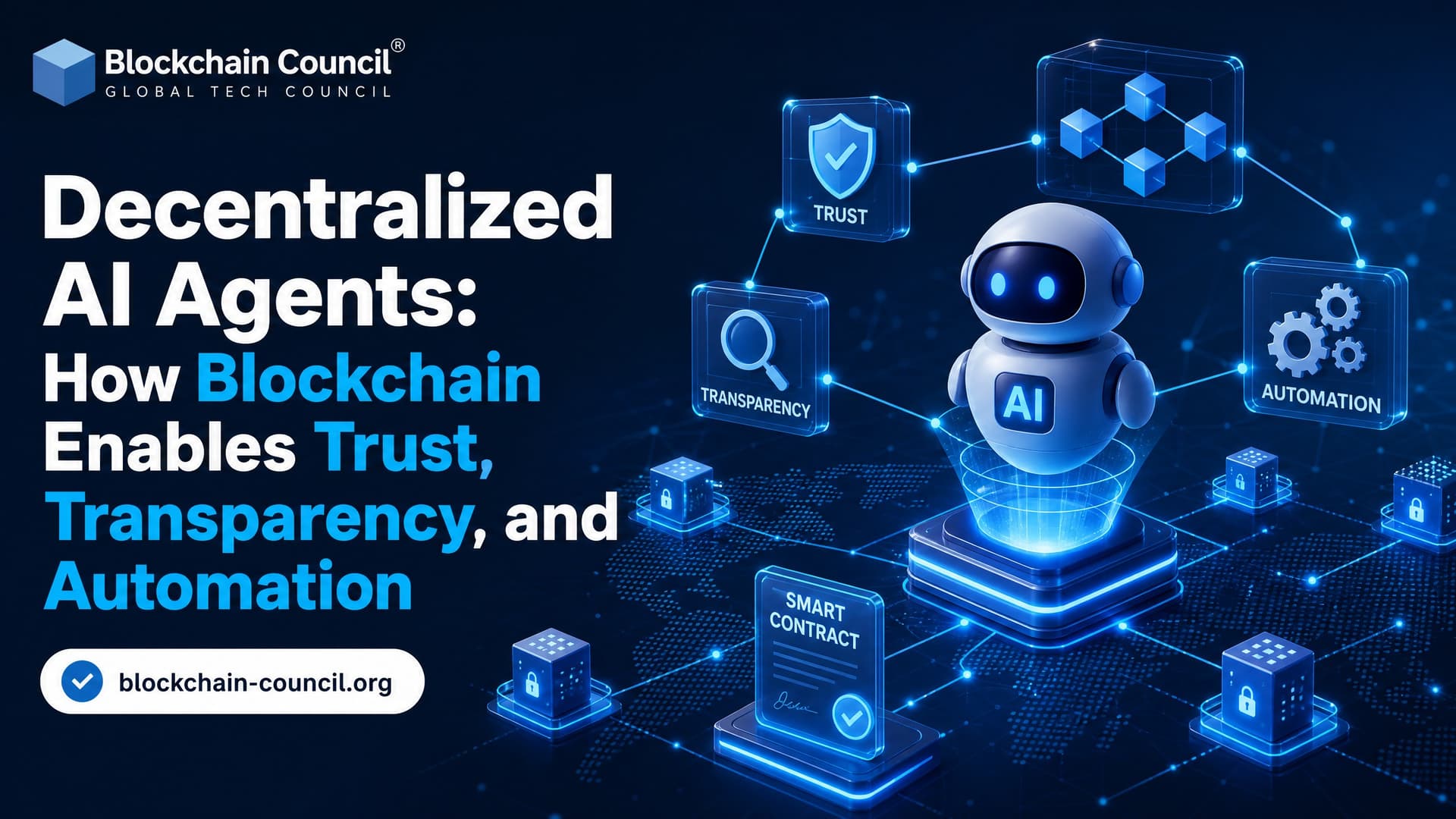
Decentralized AI agents are moving from research demos into production Web3 systems. The idea is simple and powerful: an AI agent can read data, make a decision, hold a wallet, call a smart contract, and leave a public trail that humans can inspect later. That matters because autonomous software is only useful in finance, infrastructure, gaming, or enterprise operations if you can prove what it did and constrain what it is allowed to do.
Blockchain does not make AI smarter. To be blunt, most agent failures still come from poor prompts, weak data, bad permissions, or overconfident models. What blockchain adds is a shared execution and settlement layer: identity, payments, rules, logs, and governance that do not depend on one private server. Decentralized AI agents are transforming how intelligent systems operate across trustless environments. Earning a Tech Certification helps professionals develop expertise in blockchain, artificial intelligence, cloud computing, smart contracts, and decentralized applications. These future-focused certifications prepare developers and technology leaders to build transparent, secure, and autonomous AI systems that operate efficiently within decentralized ecosystems.

What Are Decentralized AI Agents?
Decentralized AI agents are software entities that use machine learning models to observe a digital environment, plan actions, and execute tasks without constant human input. In Web3, that often means the agent has a wallet, signs transactions, interacts with smart contracts, and uses decentralized data or identity systems.
A practical architecture usually has four parts:
AI model and reasoning layer: The model interprets context, plans tasks, and decides what to do next.
Smart contracts: Contracts define hard rules, permissions, incentives, and settlement logic.
Oracles and data feeds: Services such as Chainlink connect agents to market prices, weather, supply chain data, and enterprise systems.
Wallets and identity: Agents need addresses, signing keys, limits, and authentication methods to operate safely.
Think of the blockchain as the agent's public work log and payment rail. The language model may run off chain, because putting model inference directly on a public chain is usually too expensive. The decisions, commitments, payments, and rule checks can still be anchored on chain.
Why Blockchain Improves Trust in AI Agents
Immutable logs of agent actions
Every on chain action creates a timestamped transaction record. If an agent rebalances a DeFi portfolio, votes in governance, pays another agent, or calls a contract, you can inspect that transaction later using a block explorer. This is very different from a black box automation script running on a private cloud instance.
For high value workflows, that audit trail is not a nice extra. It is the control surface. Compliance teams, DAO voters, auditors, and users can review what happened, when it happened, and which contract rules were applied.
Smart contracts enforce limits
AI agents should not have unlimited freedom. A well designed smart contract can restrict maximum trade size, approved assets, withdrawal destinations, gas budgets, emergency pause logic, and upgrade permissions. Multi sig wallets can add another layer of human control.
One common developer mistake is giving an agent a wallet and assuming the model can just trade. It cannot. If an ERC-20 allowance is missing, the transaction will fail with errors such as execution reverted: ERC20: insufficient allowance. In ethers.js v5, you may also see UNPREDICTABLE_GAS_LIMIT before the root cause is obvious. These are not minor details. Permissions are the product.
Better data integrity
AI agents are only as reliable as the data they consume. Oracles help reduce tampering risk by delivering verified off chain data to smart contracts. Chainlink's data standards are widely used for crypto market data, and similar patterns apply to weather, logistics, insurance, and enterprise feeds.
There is a small but costly trap here: many Chainlink price feeds use 8 decimals, not 18. If your agent assumes 18 decimals for an ETH/USD feed, your risk calculations will be wildly wrong. Good agent engineering includes unit tests for data scale, stale feed checks, and fallback rules.
The On Chain AI Agent Economy
A growing category of on chain agents now spans trading, data analysis, portfolio management, virtual characters, fraud monitoring, and buying services from other agents. The pattern is consistent across the projects building in this space: agents that do not just talk, but sign, pay, and execute.
Several industry trackers have started covering this category directly. Web3 prediction reports now include dedicated sections on on chain AI agents, and platform trackers such as DappRadar follow tokens and apps focused on trading bots, virtual assistants, gaming agents, and agent marketplaces. Hardware wallet education has also begun treating AI coins as a distinct category within crypto assets.
The numbers are still early. There is no single industry-wide benchmark for how many decentralized AI agents are active. Still, the signal is clear: builders are moving from chat interfaces toward agents that can sign, pay, coordinate, and execute.
Build Decentralized AI Applications
Blockchain provides the trust layer that allows AI agents to operate independently across decentralized ecosystems. Blockchain0x gives developers the infrastructure to equip AI agents with blockchain wallets, payment identities, and programmable transaction capabilities, enabling autonomous applications to participate securely in the Web3 economy.
Core Use Cases for Decentralized AI Agents
1. DeFi portfolio management
This is the most obvious use case, and also the riskiest. An agent can monitor market data, lending rates, liquidation thresholds, and liquidity positions. It can then rebalance assets, hedge exposure, or adjust collateral through smart contracts.
My view: use agents for monitoring and bounded execution first. Do not hand a model an unrestricted treasury wallet. Start with a small strategy, fixed allowlists, transaction simulation, and human approval for large moves.
2. Compliance and fraud monitoring
Web3 teams can use agents to scan wallets, detect unusual transaction patterns, classify risk, and trigger alerts. Agentic systems are increasingly used to augment compliance officers, fraud analysts, and growth teams across Web3 operations.
The advantage is continuous coverage. The risk is false confidence. Agents should support human review, not quietly become the only line of defense for regulated activity.
3. Supply chain automation
Supply chain systems need reliable event histories: shipment created, container scanned, inventory received, payment released. Blockchain can store or attest to these events, while AI agents optimize routing, procurement, and replenishment.
This works best when the physical data capture is strong. If barcode scans, IoT readings, or ERP records are poor, blockchain will only preserve bad data more permanently.
4. Gaming and virtual worlds
In Web3 gaming, agents can manage non-player characters, item economies, player support, and in game services. A blockchain-backed agent can own assets, pay rewards, and follow transparent game economy rules.
This is useful for persistent worlds where assets and reputations move across systems. It is less useful if the game does not need open ownership or public economic records.
5. Agent service marketplaces
One promising direction is agents that buy and sell digital services from each other. One agent might specialize in market analytics, another in execution, and a third in risk scoring. Smart contracts handle payment, reputation, and dispute rules.
That model is promising, but reputation design will be hard. Sybil resistance, model quality checks, and liability rules need more work before agent labor markets can be trusted at scale.
Governance, Safety, and Regulation
Regulators currently treat crypto and AI mostly as separate domains. Decentralized AI agents sit at the intersection. That raises hard questions:
Who is responsible when an autonomous agent causes financial loss?
What disclosures are required when an agent interacts with consumers?
How should KYC, AML, and sanctions controls apply to agent wallets?
When can a DAO safely update or pause an agent?
How much explainability is needed for high stakes decisions?
Blockchain helps because it gives you logs, policy contracts, multi sig controls, and transparent governance. It does not remove legal responsibility. If you deploy an agent that manages assets, you still need risk controls, documentation, and a clear human escalation path. As decentralized AI solutions become mainstream, organizations must clearly communicate their benefits to users and enterprises. A Marketing Certification helps professionals strengthen product marketing, digital branding, strategic communication, and customer education. These capabilities enable businesses to explain complex decentralized technologies in ways that encourage trust, adoption, and long-term customer engagement.
Technical Design Principles That Actually Matter
If you are building decentralized AI agents, keep the design boring where money is involved. Boring is good.
Separate reasoning from authority: Let the AI suggest actions, but let smart contracts enforce limits.
Use transaction simulation: Simulate calls before signing. Tools such as Tenderly, Foundry, and Hardhat forks help catch failures early.
Set spending caps: Use allowlists, per transaction limits, and daily limits for agent wallets.
Check oracle freshness: Reject stale data. Price feeds are not useful if your agent does not verify timestamps.
Log decisions off chain and on chain: Store enough context to audit why the agent acted, not only that it acted.
Add human override: Emergency pause functions and multi sig controls are not optional for serious deployments.
Skills You Need to Work With Decentralized AI Agents
This field rewards hybrid skills. You need enough AI knowledge to understand agent planning, tool use, evaluation, and hallucination risks. You also need blockchain engineering skills: Solidity 0.8.x, ERC-20 and ERC-721 standards, wallet security, EIP-1559 gas mechanics, oracle integration, and smart contract testing.
If you are building a learning path, consider these Blockchain Council programs as next steps: Certified Agentic AI Expert™ for agent design, Certified AI Expert™ for AI foundations, Certified Blockchain Expert™ for Web3 architecture, and Certified Smart Contract Developer™ for contract-level implementation.
Where Decentralized AI Agents Go Next
The next wave will not be defined by chatbots with wallets. It will be defined by agents that can prove their permissions, source their data from trusted feeds, coordinate with other agents, and operate under human-approved governance.
Start small. Build an agent that monitors one on chain metric, proposes one action, and sends it through a policy contract with clear limits. Then test the ugly paths: stale oracle data, failed approvals, high gas, reverted trades, and model output that looks confident but is wrong. That is where trustworthy automation begins.
FAQs
1. What Are Decentralized AI Agents?
Decentralized AI agents are autonomous software programs that operate on blockchain networks rather than centralized servers. They use artificial intelligence, smart contracts, and decentralized infrastructure to perform tasks securely, transparently, and without relying on a single controlling authority.
2. How Do Decentralized AI Agents Work?
Decentralized AI agents analyze data, make decisions using AI models, and execute actions through blockchain-based smart contracts. They interact with decentralized applications (dApps), digital wallets, and Web3 protocols while maintaining transparency and verifiable execution.
3. Why Are Decentralized AI Agents Important in Web3?
Decentralized AI agents enable trustless automation by eliminating single points of failure. They improve transparency, security, user ownership, and interoperability across decentralized ecosystems while supporting autonomous digital services.
4. How Does Blockchain Enable Trust for AI Agents?
Blockchain provides immutable transaction records, decentralized consensus, cryptographic security, and transparent smart contracts. These features ensure AI agent activities can be verified without depending on centralized intermediaries.
5. What Is the Difference Between Centralized and Decentralized AI Agents?
Centralized AI agents rely on servers controlled by a single organization, while decentralized AI agents operate across distributed blockchain networks. This gives users greater transparency, security, resilience, and ownership over AI-powered processes.
6. How Do Smart Contracts Support Decentralized AI Agents?
Smart contracts automate actions based on predefined conditions. AI agents trigger these contracts to execute transactions, validate agreements, distribute rewards, and automate decentralized workflows without manual intervention.
7. What Are the Benefits of Decentralized AI Agents?
Benefits include improved transparency, enhanced security, reduced reliance on intermediaries, autonomous decision-making, lower operational costs, censorship resistance, greater user control, and scalable Web3 automation.
8. Which Industries Can Benefit From Decentralized AI Agents?
Industries including decentralized finance (DeFi), healthcare, supply chain, cybersecurity, gaming, insurance, logistics, digital identity, decentralized cloud computing, and smart cities can benefit from decentralized AI agents.
9. How Do Decentralized AI Agents Improve Data Privacy?
Decentralized AI agents process and verify information using blockchain and privacy-preserving technologies while minimizing unnecessary exposure of personal data. Users retain greater control over how their information is shared.
10. Can Decentralized AI Agents Communicate With Other AI Agents?
Yes. Decentralized AI agents can collaborate with other agents across blockchain networks to exchange verified information, coordinate workflows, negotiate transactions, and execute multi-agent automation securely.
11. How Do AI Agents Verify Information on Blockchain?
AI agents validate blockchain transactions by reading on-chain data, verifying smart contract conditions, checking digital signatures, and using decentralized consensus mechanisms to ensure trusted information.
12. What Role Does Tokenization Play in Decentralized AI?
Tokenization enables AI agents to manage digital assets, distribute incentives, access decentralized services, participate in governance, and automate economic interactions within blockchain ecosystems.
13. What Challenges Do Decentralized AI Agents Face?
Challenges include blockchain scalability, interoperability, AI model verification, governance complexity, regulatory uncertainty, cybersecurity threats, computational costs, and balancing decentralization with performance.
14. How Can Developers Build Decentralized AI Agents?
Developers should combine AI frameworks with blockchain platforms, smart contracts, decentralized storage, APIs, and Web3 protocols. Knowledge of Python, Solidity, machine learning, and blockchain architecture is highly valuable.
15. How Do Decentralized AI Agents Improve Business Automation?
Businesses can use decentralized AI agents to automate compliance, payments, customer support, supply chain management, identity verification, contract execution, and data analysis while maintaining transparency and auditability.
16. How Are Decentralized AI Agents Different From AI Chatbots?
AI chatbots primarily interact with users through conversations, whereas decentralized AI agents can independently analyze data, execute blockchain transactions, interact with smart contracts, and automate complex workflows across Web3 ecosystems.
17. What Skills Are Needed to Work With Decentralized AI Agents?
Professionals should understand artificial intelligence, blockchain development, smart contracts, decentralized applications (dApps), machine learning, cryptography, cloud computing, APIs, cybersecurity, and Web3 infrastructure.
18. What Career Opportunities Exist in Decentralized AI?
Career opportunities include AI engineer, blockchain developer, Web3 architect, smart contract developer, AI product manager, decentralized systems engineer, AI security specialist, blockchain consultant, and Web3 researcher.
19. How Will Decentralized AI Agents Shape the Future of Web3?
Decentralized AI agents will automate digital services, improve blockchain interoperability, enable trusted autonomous commerce, strengthen decentralized governance, and accelerate adoption of intelligent Web3 applications across industries.
20. What Is the Future of Decentralized AI Agents, Blockchain, and Automation?
The future of decentralized AI agents lies in combining artificial intelligence with blockchain to create secure, transparent, and autonomous digital ecosystems. As Web3 adoption grows, decentralized AI agents will power intelligent automation, trusted data exchange, decentralized governance, and next-generation business applications, transforming how organizations and individuals interact in the decentralized internet.
Related Articles
View All
Agentic AI
AI Agents for Business Process Automation: A Practical Guide for Managers
A practical guide for managers on using AI agents for business process automation, covering use cases, governance, ROI, architecture, and rollout steps.

Agentic AI
The Future of Web3 Identity: AI Agents, Decentralized IDs, and Digital Ownership
Web3 identity is evolving through DIDs, verifiable credentials, AI agent wallets, and soulbound tokens for portable digital ownership.

Agentic AI
AI Agents and Zero-Knowledge Proofs: Privacy-Preserving Automation in Web3
Learn how AI agents and zero-knowledge proofs enable privacy-preserving automation in Web3, from ZKML and identity to compliance proofs.
Trending Articles
The Role of Blockchain in Ethical AI Development
How blockchain technology is being used to promote transparency and accountability in artificial intelligence systems.

Top 5 DeFi Platforms
Explore the leading decentralized finance platforms and what makes each one unique in the evolving DeFi landscape.
What is AWS? A Beginner's Guide to Cloud Computing
Everything you need to know about Amazon Web Services, cloud computing fundamentals, and career opportunities.