

AI Agents for Developers: Code Review, PR Automation, Debugging, and DevOps Runbooks

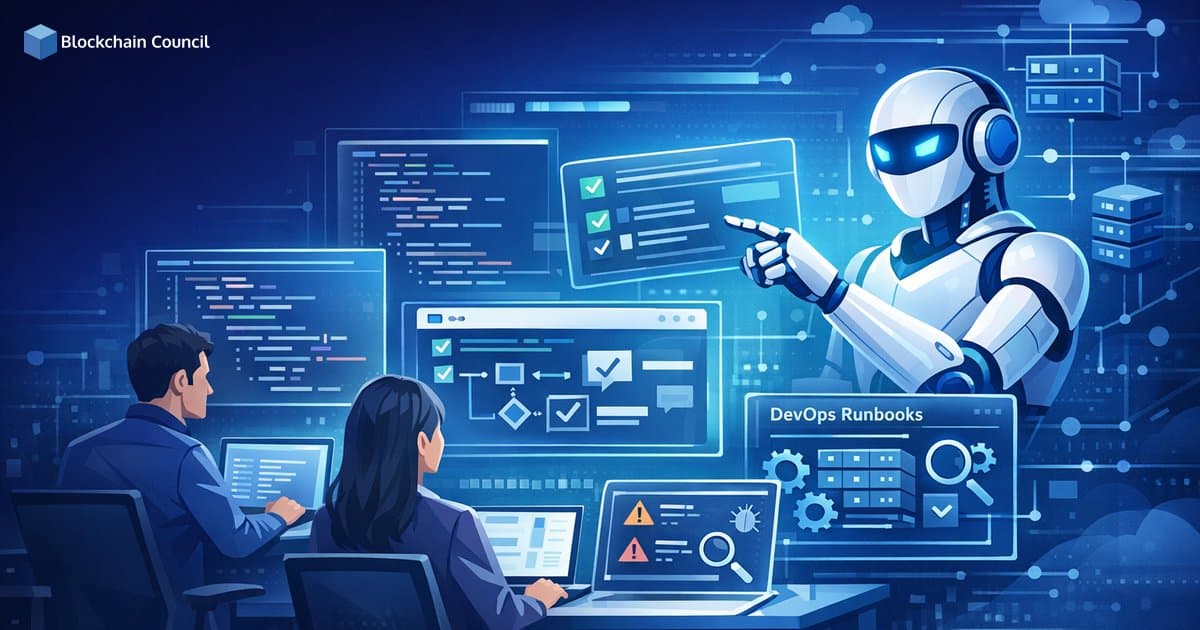
AI agents for developers are moving well beyond autocomplete and chat-based assistance into workflow agents that can review code, triage pull requests (PRs), debug failures, and execute DevOps runbooks with limited human supervision. The clearest evidence of adoption is PR automation: Microsoft reports its internal AI code review assistant supports over 90% of PRs and handles more than 600,000 pull requests per month, with early rollouts across 5,000 repositories showing a 10% to 20% median PR completion time improvement.
This shift changes how engineering teams allocate attention. Instead of spending reviewer time on routine feedback and repeated checks, teams can use agents as first-pass reviewers, triage assistants, and operational copilots, while keeping humans accountable for approvals and production changes.

What Are AI Agents for Developers?
In modern software teams, AI agents are tools that can plan and execute multi-step tasks across the developer lifecycle. Unlike a single prompt-and-response assistant, an agent can:
Observe context from repositories, PRs, tests, CI/CD pipelines, and issue trackers
Take actions such as creating summaries, proposing patches, or editing pipeline steps
Iterate by running tests, diagnosing failures, and refining changes
Request approval at defined checkpoints, including merge, release, and production runbook execution
The current market trend is toward layered agents rather than one all-purpose assistant. Many teams combine a coding agent, a review agent, and a workflow automation agent to reduce risk and make behavior more predictable across different tasks.
Why Code Review and PR Automation Lead Adoption
Code review is the most mature agentic use case because it fits existing workflows and produces measurable outcomes. Microsoft describes an internal AI reviewer that integrates directly into PRs by leaving comments, suggesting fixes, generating PR summaries, and supporting interactive Q&A inside review threads. The same internal work informed GitHub's Copilot for Pull Request Reviews, which reached general availability in April 2025.
What PR Review Agents Do Well Today
PR summaries: explain intent, impacted modules, and key changes so reviewers can orient faster
First-pass review comments: flag style issues, risky patterns, and missing checks
Patch suggestions: propose code snippets for safer APIs, edge-case handling, or refactoring
Thread-level Q&A: answer questions about why changes were made or what tests cover
Why This Creates ROI Without Changing Governance
PR automation improves cycle time while preserving human sign-off. This matters for enterprises because it aligns with auditability and accountability requirements: the agent drafts feedback and fixes, but the team still controls approvals, merges, and releases.
AI Agents for Debugging: From Diagnosis to Iterative Fixes
Developer AI tooling is expanding beyond code generation into debugging, refactoring, and documentation. Debugging agents typically work by building a hypothesis loop:
Reproduce: run tests or scripts, capture logs, and identify failing conditions
Localize: map the failure to likely files, functions, or recent PR changes
Propose: generate a targeted patch and update tests where appropriate
Validate: rerun tests and confirm the fix does not break related behavior
Summarize: document root cause and mitigation for the PR or incident record
Agentic IDE and CLI workflows are becoming standard, with tooling emphasizing evaluation, debugging, tracing, and deployment from the inner development loop. The practical outcome is that agents can help developers move from a failing test to a plausible patch faster, especially in large codebases where context gathering accounts for most of the time spent.
Where Debugging Agents Help Most
CI failures and flaky tests: triage logs, identify suspect tests, propose stabilization steps
Regression analysis: correlate failures with recent merges and changed files
Dependency issues: propose version constraints, lockfile fixes, or build configuration updates
Onboarding: explain system behavior and conventions by referencing repository context
DevOps Runbooks and Agentic Operations
DevOps runbook automation has become a formal product category. Harness, for example, documents an AI DevOps Agent designed to create and edit pipeline steps and stages. This reflects a broader shift: once agents can understand repository context and CI/CD signals, extending automation into delivery workflows becomes a natural next step.
What Runbook Automation Means in Practice
A runbook is a step-by-step operational playbook for common scenarios such as rollback, scaling, cache purge, certificate rotation, or incident triage. Agentic operations tools can support runbooks by:
Drafting and updating pipeline steps: propose YAML changes, approvals, and staged rollouts
Triage and routing: summarize alerts, correlate logs, and open actionable tickets
Guided execution: suggest commands and checks, then pause for approval before applying changes
Post-incident documentation: create incident summaries, timelines, and remediation PRs
For most teams, the practical path is machine-assisted, human-approved execution. This preserves operational control while reducing cognitive load during incidents.
Workflow Orchestration: The Multi-Agent Stack Model
Industry practice increasingly points to an orchestration approach: developers supervise multiple specialized agents rather than relying on one monolithic assistant. The value comes not only from model capability, but also from integration depth across the tools teams already use:
Source control and PRs
CI/CD pipelines and deployment systems
Issue trackers and on-call alerting
Chat and collaboration tools
This is also where enterprise differentiation becomes visible. As baseline model quality converges across vendors, teams evaluate agents on context access, permissioning, audit trails, and alignment with governance requirements.
Enterprise Considerations: Trust, Governance, and Self-Hosting
Enterprises generally want the productivity benefits of AI agents while maintaining control over code and operational changes. Several implementation patterns are emerging:
Recommended Governance Pattern
Use agents for first-pass analysis and drafts: comments, summaries, patch suggestions, and runbook steps
Require human approval for irreversible actions: merges, releases, production changes, and credential operations
Maintain auditability: log agent prompts, actions taken, and approvals for compliance purposes
Scope permissions: apply least-privilege access to repos, pipelines, and environments
Self-Hosted and Open-Source Options
Self-hosted or open-source agent stacks remain relevant when privacy, data residency, or customization are deciding factors. Teams should plan for deployment and configuration complexity, including model hosting, connectors, policy enforcement, and ongoing evaluation.
How Developers Can Start Using AI Agents Today
For practical benefits quickly, prioritize workflows with clear feedback loops and low blast radius.
High-Confidence Starting Points
PR automation: summaries, routine review comments, and suggested fixes
Boilerplate updates: lint fixes, formatting, and small refactors with tests
Test triage: classify failures, propose likely root causes, generate reproduction steps
Pipeline edits in non-production: draft CI stages, improve caching, adjust build steps
What to Measure
PR cycle time: time from open to merge, including review latency
Review load: number of human comments needed per PR for routine issues
Defect escape rate: bugs found post-merge versus pre-merge
Incident time-to-mitigate: speed and accuracy of runbook steps with approvals
Developers can also build deeper skill in this area through structured learning. Blockchain Council's AI Certification covers LLM fundamentals and evaluation; a DevOps Certification supports CI/CD and runbook discipline; and a Cybersecurity Certification helps teams design least-privilege access, auditability, and secure automation workflows.
Future Outlook: More Context-Aware Review and Executable Runbooks
Several trends are likely to shape the next phase of AI agents for developers:
Context-aware PR review: repo-specific guidance, references to past PRs, and alignment with team conventions
Issue-to-fix workflows: agents that move from a customer-reported bug to a validated PR with limited intervention
Executable DevOps runbooks: operational playbooks evolving into machine-assisted or machine-executed workflows with approval gates
Differentiation by integration and controls: governance, auditability, and CI/CD integration becoming competitive advantages
Human review remains necessary throughout this evolution. The most resilient implementations treat agents as first-pass reviewers and workflow copilots, while keeping accountable engineers in control of decisions and production actions.
Conclusion
AI agents for developers are becoming practical workflow tools, especially for code review and PR automation where adoption and measurable cycle-time improvements are already visible at scale. Debugging agents extend this value by shortening the path from failure to validated fix, while DevOps runbook agents push automation further into CI/CD and operational response.
For developers and engineering leaders, the winning approach is orchestration: adopt specialized agents for review, debugging, and operations; integrate them into existing workflows; and enforce human approval for high-impact actions. Implemented carefully, agentic tooling can reduce PR latency, improve consistency, and accelerate teams without compromising governance.
Related Articles
View All
Agentic AI
AI Agents for Business Process Automation: A Practical Guide for Managers
A practical guide for managers on using AI agents for business process automation, covering use cases, governance, ROI, architecture, and rollout steps.

Agentic AI
AI Agents and Zero-Knowledge Proofs: Privacy-Preserving Automation in Web3
Learn how AI agents and zero-knowledge proofs enable privacy-preserving automation in Web3, from ZKML and identity to compliance proofs.

Agentic AI
Decentralized AI Agents: How Blockchain Enables Trust, Transparency, and Automation
Decentralized AI agents use blockchain for auditable actions, smart contract limits, trusted data, and autonomous Web3 workflows across DeFi, gaming, and enterprise systems.
Trending Articles

Can DeFi 2.0 Bridge the Gap Between Traditional and Decentralized Finance?
The next generation of DeFi protocols aims to connect traditional banking with decentralized finance ecosystems.
How to Install Claude Code
Learn how to install Claude Code on macOS, Linux, and Windows using the native installer, plus verification, authentication, and troubleshooting tips.
Blockchain in Supply Chain Provenance Tracking
Supply chains are under pressure to prove not just efficiency, but also authenticity, sustainability, and fairness. Customers want to know if their coffee really is fair trade, if the diamonds are con