

Using AI Agents in Customer Support: Triage, Resolution Automation, and QA

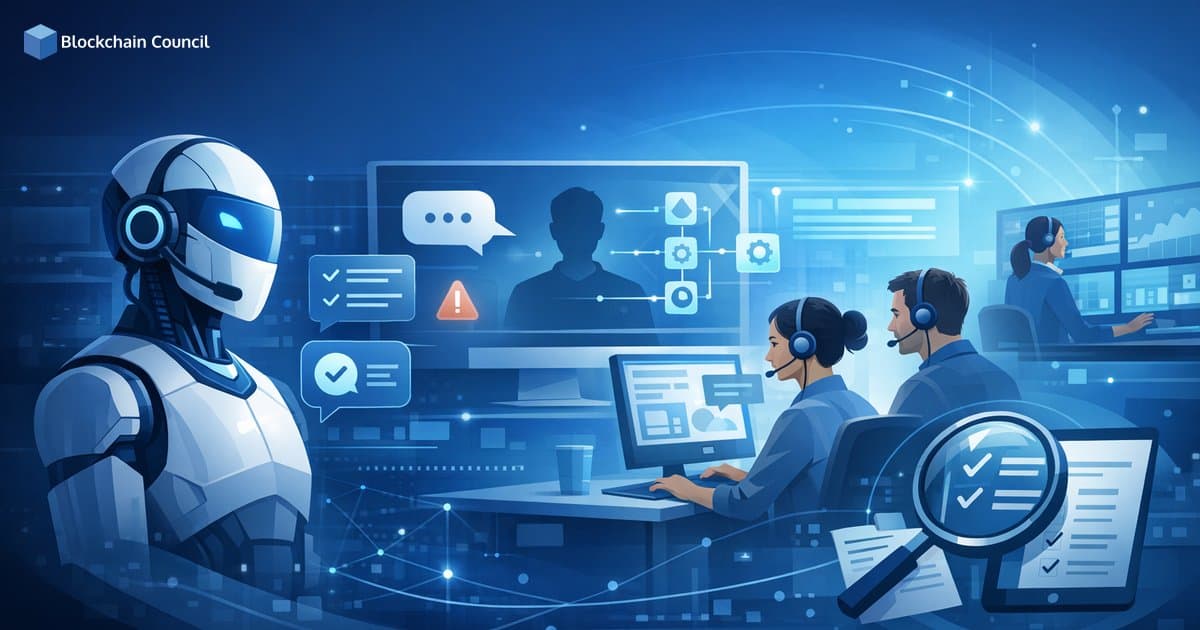
Using AI agents in customer support has moved well beyond basic FAQ chatbots. Enterprises now deploy agentic systems across the full support lifecycle: triage and routing, resolution automation (self-service and agent-assist), and quality assurance (QA) at scale. When these systems are designed with clear escalation rules, strong guardrails, and ongoing governance, teams report faster resolutions, meaningful cost savings, and improved customer satisfaction scores.
This article explains how AI agents function in each phase, which metrics matter most, and how to build a closed-loop improvement cycle where QA insights continuously strengthen both human and AI performance.

What AI Agents Mean in Modern Customer Support
Traditional chatbots relied primarily on scripted flows and keyword matching. Modern AI agents combine three capabilities that make them operationally useful across customer support functions:
Natural language reasoning using large language models (LLMs) to understand issues and respond conversationally.
Tool use to take actions through APIs and internal systems such as CRM, helpdesk, billing, order management, and identity platforms - for example, issuing refunds, changing subscription plans, or triggering password resets.
Policy and safety guardrails that constrain what the agent can say or do, and define when a human must take over.
Many organizations now treat support AI as a unified stack that includes routing, autonomous or semi-autonomous agents, agent copilots, workflow automations, and QA analytics - all working together with shared context and policies.
1. AI Agents for Triage: Routing, Prioritization, and Escalation
Triage is often the highest-ROI starting point because every interaction benefits from faster classification and correct routing. AI-powered triage typically handles:
Intent classification (billing, delivery, technical issue, account access, complaint).
Sentiment detection (frustration, urgency, risk of churn).
Customer value signals (tier, lifetime value, contract SLA) to prioritize response times.
High-stakes detection (cancellations, legal threats, compliance topics) to trigger immediate handoff.
Smart Escalation Rules as a Core Guardrail
Well-designed triage systems avoid a common failure mode: the AI pushing through uncertainty and guessing incorrectly. Strong implementations set explicit handoff triggers, including:
Repeated failed intents or looping behaviors
Direct requests such as "agent" or "human"
Detected frustration or escalating negative sentiment
High-stakes topics (refund disputes, harassment, legal matters, regulated disclosures)
Low confidence in the classification or proposed next step
Equally important, every handoff should include full context: conversation transcript, customer profile, detected intent, sentiment, and attempted solutions. This reduces rework and prevents customers from repeating themselves to a human agent.
2. AI Agents for Resolution Automation: Self-Service and Agent Assist
Resolution automation is where AI agents shift from answering questions to completing tasks. Most organizations deploy two complementary patterns:
Full containment (self-service): the AI resolves the issue end-to-end without human involvement.
Agent assist (copilot): the AI drafts responses, retrieves knowledge, suggests next steps, and fills fields while a human agent remains in control.
Common Self-Service Workflows
High-volume, low-risk tasks are the strongest candidates for containment, particularly when the agent is integrated with backend tools:
Account management: password resets, profile updates, subscription changes
Order and delivery support: tracking, address changes, delivery updates, return initiation
Policy explanations grounded in the knowledge base using retrieval-augmented generation (RAG), with confidence thresholds applied
In routine cases, self-service automation is commonly reported to save 5 to 10 minutes of agent time per resolution, which compounds substantially at scale.
Where Agent Assist Drives Immediate Productivity
Agent-assist tools reduce handle time even when full automation is not appropriate. Typical capabilities include:
Drafting customer replies that agents review and approve
Suggesting next-best actions based on similar cases and internal documentation
Automatically summarizing interactions and updating CRM or ticket fields
Surfacing relevant policies and troubleshooting steps in real time
Measuring Automation with a Balanced Scorecard
Support leaders increasingly manage AI agents with a balanced set of metrics rather than a single KPI. The most practical measures include:
Containment rate: percentage of issues resolved without human involvement
First contact resolution (FCR): issues resolved in a single interaction
Escalation rate and reasons: where the agent hands off and why
CSAT and NPS: ensuring automation does not trade customer experience for cost savings
Average handle time (AHT): for human-assisted interactions, particularly with copilots
A key operational principle: high containment paired with poor satisfaction is not success. Organizations that track containment alongside CSAT, sentiment, and QA scoring are better positioned to build durable, trusted automation.
3. AI-Driven Quality Assurance: From Sampling to Broad Coverage
AI-driven QA is one of the most mature applications of agentic AI in customer operations. Rather than manually reviewing a small sample of interactions, AI systems can analyze content, tone, sentiment, and policy adherence across large volumes of chat, email, and voice interactions.
What AI-Driven QA Evaluates at Scale
Resolution quality: completeness, correctness, and whether the customer's actual problem was solved
Communication quality: tone, empathy, clarity, and professionalism
Process adherence: required steps followed and correct documentation completed
Compliance: required disclosures, consent language, and prohibited statements
Reported Outcomes from AI QA Deployments
Examples from vendors and operators illustrate the practical impact of scaling QA coverage:
A global fintech scaled from manually reviewing approximately 1% of interactions to analyzing over 50% with AI-driven QA, improving compliance oversight and enabling targeted agent coaching.
An online retailer using AI-driven QA for chat reported a 30% reduction in customer complaints and a 20% increase in first-contact resolution, alongside higher satisfaction and lower operational costs.
In some deployments, AI QA operates in near-real-time across most or all interactions, helping teams identify emerging issues far earlier than traditional weekly or monthly review cycles allow.
QA as the Training Loop for AI Agents
A mature approach to using AI agents in customer support treats those agents like new team members who require ongoing coaching. QA insights can feed back into:
Updates to knowledge base articles and troubleshooting guides
Revisions to escalation rules and confidence thresholds
New guardrails for sensitive topics and regulated flows
Improved prompts, tool permissions, and workflow design
This creates a closed-loop system where quality monitoring serves not just as a scorecard, but as a control mechanism that continuously improves outcomes.
Implementation Blueprint: Deploying AI Agents Across Triage, Automation, and QA
Enterprises tend to succeed faster when they implement in phases and put governance in place early.
Step 1: Start with Triage and Safe Deflection
Deploy intent classification and sentiment detection on inbound messages.
Route to the appropriate queue or specialist AI based on topic and risk level.
Implement clear human handoff triggers and pass full context to receiving agents.
Step 2: Add Tool-Enabled Resolution Automation
Prioritize workflows with clear steps and low risk, such as password resets, order status checks, and basic returns.
Integrate with CRM, helpdesk, identity, billing, and order systems so the agent can complete tasks rather than simply explain policies.
Apply permissions and approval requirements for sensitive actions such as refund thresholds and account changes.
Step 3: Scale QA and Establish a Governance Cadence
Define a QA scorecard aligned to KPIs including CSAT, NPS, FCR, and compliance requirements.
Monitor for performance drift, emerging issue categories, and shifts in sentiment trends.
Run regular reviews with support leaders, QA, security, and compliance teams.
Risks and Controls: Privacy, Compliance, and Workforce Adoption
Agentic support systems touch sensitive customer data and regulated processes. Common challenges include:
Data privacy: recorded and analyzed interactions must align with GDPR, CCPA, and applicable sector-specific regulations.
Integration complexity: legacy systems can limit automation unless APIs and data access are modernized.
Workforce concerns: AI can be perceived as surveillance or a replacement threat if QA and coaching programs are not implemented transparently.
Controls that appear consistently in successful programs include role-based permissions, audit logs for all tool actions, clear customer disclosures where required, and human-in-the-loop approvals for high-risk outcomes.
Skills and Learning Pathways for Agentic Customer Support Teams
As AI handles more triage and routine resolutions, human agents increasingly focus on complex problem-solving, escalation handling, and empathy-driven conversations. QA teams shift toward programmatic oversight and model governance.
For teams building these capabilities, relevant learning paths include Blockchain Council training and certifications such as:
AI and machine learning certifications covering LLM fundamentals, evaluation, and safe deployment
Data science and analytics programs for QA measurement design, dashboards, and experimentation
Cybersecurity certifications addressing privacy, access control, and risk management in AI-integrated workflows
Conclusion: AI Agents Work Best as an End-to-End System
Using AI agents in customer support is most effective when triage, resolution automation, and QA are designed as a single operating system. Triage ensures the right issue reaches the right resolver quickly. Resolution automation reduces repetitive workload through safe containment and effective agent assist. AI-driven QA provides the feedback loop that improves consistency, compliance, and customer outcomes at scale.
The strongest results come from hybrid design: clear escalation triggers, confidence thresholds, tool permissions, and continuous monitoring. With that foundation in place, AI agents can increase speed and coverage without sacrificing trust, safety, or customer experience.
Related Articles
View All
Agentic AI
AI Agents for Customer Support: Improve Service and Cut Costs
Learn how AI agents for customer support improve response quality, automate routine workflows, reduce costs, and keep humans in the loop.

Agentic AI
AI Agents for Business Process Automation: A Practical Guide for Managers
A practical guide for managers on using AI agents for business process automation, covering use cases, governance, ROI, architecture, and rollout steps.

Agentic AI
AI Agents and Zero-Knowledge Proofs: Privacy-Preserving Automation in Web3
Learn how AI agents and zero-knowledge proofs enable privacy-preserving automation in Web3, from ZKML and identity to compliance proofs.
Trending Articles
The Role of Blockchain in Ethical AI Development
How blockchain technology is being used to promote transparency and accountability in artificial intelligence systems.
How Blockchain Secures AI Data
Understand how blockchain technology is being applied to protect the integrity and security of AI training data.
Claude AI Tools for Productivity
Discover Claude AI tools for productivity to streamline tasks, manage workflows, and improve efficiency.