

AI Agents and Smart Contracts: Building Self-Executing Web3 Workflows
 Suyash Raizada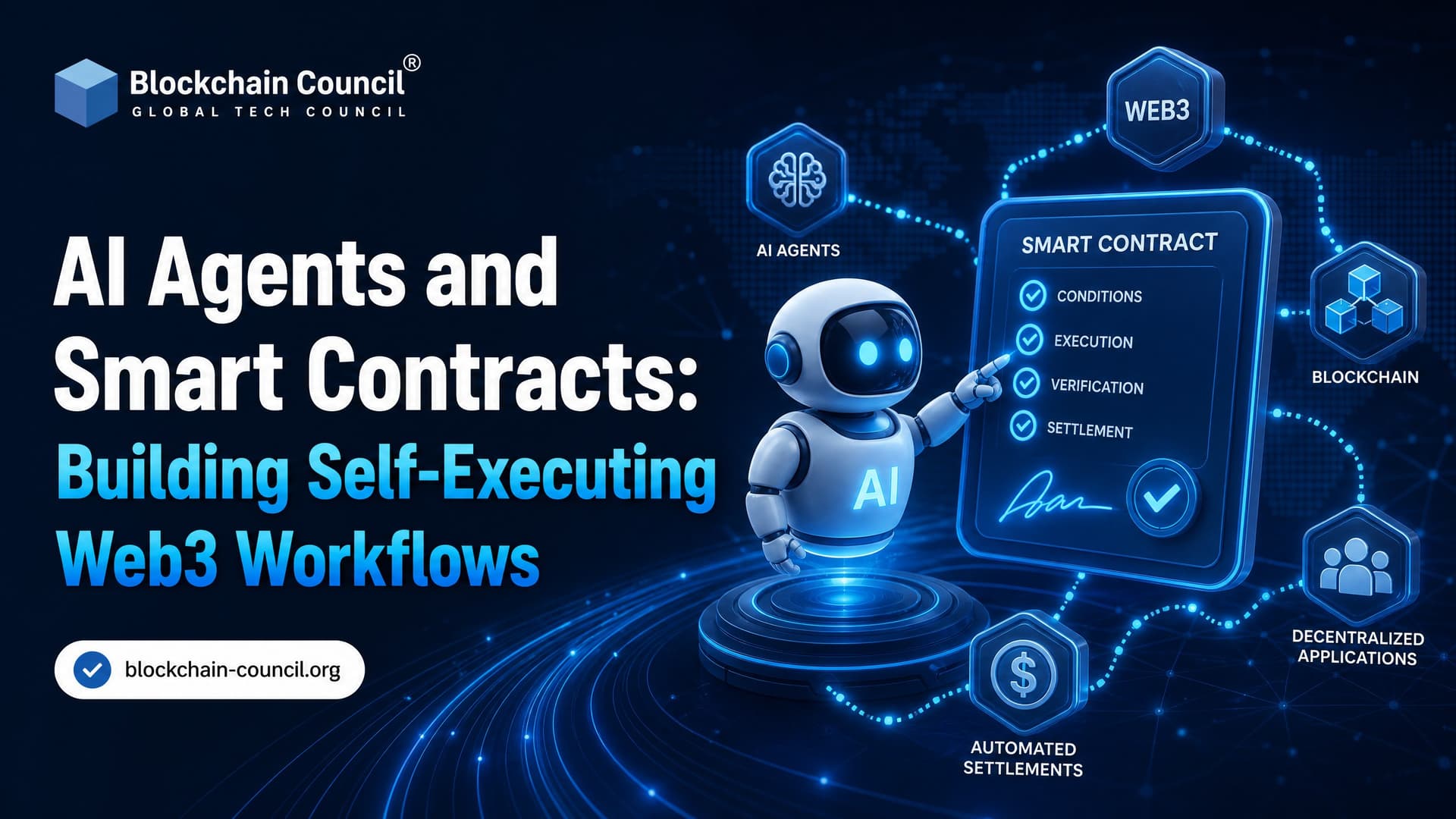
AI agents and smart contracts are becoming a practical pattern for Web3 automation. The agent observes data and decides what to do. The smart contract records and enforces the result on-chain. This matters most in DeFi, trading, treasury operations, insurance, data sharing, and contract management, where workflows often depend on repeated decisions under changing conditions.
The core idea is simple. Do not put a large language model inside a smart contract. That is usually the wrong design. Run the AI agent off-chain, constrain what it can do, then let a smart contract handle settlement, permissions, and state changes. You get flexible decision-making without giving up blockchain auditability.

What Are AI Agents in Web3?
An AI agent is software that can sense inputs, reason against a goal, and take action. In a Web3 workflow, those actions often include signing transactions, calling smart contract functions, reading blockchain events, checking oracle data, or interacting with DeFi protocols.
A smart contract is deterministic code deployed to a blockchain. On Ethereum, for example, a contract written in Solidity 0.8.x executes the same way for every node, provided it receives the same input and state. That determinism is why smart contracts are useful for asset transfers, escrow, governance execution, and settlement.
Put them together and you get a split architecture:
The AI agent handles interpretation, prediction, planning, and scheduling.
The smart contract handles rules, funds, permissions, and final execution.
Oracles and data services connect off-chain facts to on-chain logic.
Wallets or key management systems sign transactions on behalf of the agent within defined limits.
That last point is where beginners get burned. If your agent holds a raw private key in a .env file on a cloud VM, you do not have automation. You have a future incident report.
As autonomous AI systems become more capable, an Agentic AI Certification can help professionals develop practical skills in agent design, decision-making, governance, and the safe deployment of AI-powered automation across blockchain environments.
Three Common Architecture Patterns
1. Off-chain AI agent with on-chain execution
This is the most practical design today. The AI agent runs on a server, local machine, or agent platform. It reads market prices, protocol events, user instructions, and risk limits. When conditions match, it sends a transaction to a smart contract.
Take a concrete example. An agent monitors a Uniswap pool on Base, estimates whether a rebalance is worth the gas cost, then calls a contract that adjusts a liquidity position. The agent decides. The contract enforces.
2. Hybrid agents with verifiable computation
Some workflows need proof that an off-chain computation was performed correctly. In that case, the model output or computation can be verified through oracle networks, zero-knowledge proofs, trusted execution environments, or other verification layers before the smart contract acts.
This pattern is heavier, but it fits high-value workflows such as credit risk scoring, insurance payouts, and institutional settlement, where participants need stronger assurance than the agent said so.
3. AI-enhanced smart contracts
Here, a smart contract uses AI-derived inputs, often through an oracle or approved agent, to adjust parameters. Think dynamic collateral ratios, risk scores, payout triggers, fraud signals, or routing rules.
Be careful with this pattern. AI output is probabilistic. Smart contract execution is final. If the model is manipulated or simply wrong, the chain will still execute the transaction unless you add limits, delays, or human review for sensitive actions.
Professionals who want to build secure blockchain applications can further strengthen these skills by becoming a Smart Contract Developer, gaining hands-on expertise in Solidity, contract security, testing frameworks, and decentralized application development.
Where Self-Executing Web3 Workflows Make Sense
Autonomous trading and DeFi operations
Trading agents are the most visible use case because the feedback loop is short. The agent monitors prices, liquidity, gas fees, and slippage. It then signs a swap, adds liquidity, removes liquidity, or triggers an arbitrage route through smart contracts.
A typical flow looks like this:
The agent reads on-chain events, DEX prices, and off-chain market data.
It applies a strategy or model to decide whether to act.
It checks policy rules, such as maximum trade size, allowed tokens, and slippage limits.
It signs and submits a transaction.
The smart contract executes, fails, or reverts. The result is visible on-chain.
Small implementation detail, big pain. With ethers.js v6, many older tutorials break because contract.address was replaced by await contract.getAddress(). I have seen agent scripts fail silently after a dependency upgrade because the transaction target became undefined. Pin your versions. Test against a fork before you let an agent touch funds.
Portfolio rebalancing and treasury management
DAOs and protocol teams can use agents to monitor treasury allocations, stablecoin exposure, liquidity positions, and governance-approved limits. The agent can recommend action, execute small pre-approved changes, or queue larger transactions for multisig review.
This is a sane middle ground. Full autonomy for a nine-figure treasury is reckless. Bounded autonomy for routine maintenance can save hours and reduce missed signals.
Contract lifecycle and data sharing
AI agents can also support contract management: drafting, review, renewal reminders, compliance checks, and clause comparison. When paired with smart contracts, the system can trigger payments, data access rights, service credits, or renewal events based on verified conditions.
This is especially relevant in Europe. The EU Data Act includes requirements for smart contracts used in data sharing, including controls for interruption and termination. That pushes developers toward pause functions, reset mechanisms, and clear governance procedures instead of the old idea that every contract must run forever.
Security Risks You Cannot Ignore
AI agents and smart contracts create a sharp risk profile. The agent can act quickly. The contract can move value permanently. That combination needs discipline.
Key exposure: Use hardware-backed signing, MPC wallets, account abstraction policies, or vault-based key management. Do not store hot wallet keys casually.
Prompt injection: If an agent reads untrusted web pages, governance posts, or token metadata, attackers may try to influence its instructions.
Oracle manipulation: A bad price feed can cause bad trades, liquidations, or payouts.
Front-running and sandwich attacks: Public mempools expose transactions before confirmation. Private transaction routes may be needed for sensitive trades.
Gas and nonce failures: Agents must handle stuck transactions, replacement fees, and errors like
nonce too loworreplacement transaction underpriced.Model drift: A strategy that worked in one market regime may degrade when liquidity, volatility, or user behavior changes.
Good smart contracts limit blast radius. Add role-based access control, per-transaction caps, daily limits, allowlists, pausable functions, and event logs. If an agent has permission to call everything, your contract design has already failed.
Regulation and Accountability
Regulators are no longer treating AI and blockchain as separate conversations. The EU AI Act, which entered into force in 2024, uses a risk-based framework for AI systems. If an AI agent affects financial access, credit decisions, insurance outcomes, or critical infrastructure, expect higher documentation and oversight duties.
The EU Data Act also matters for smart contracts used in data sharing arrangements. Its focus on interruption, termination, and reset controls conflicts with the older blockchain culture of unstoppable code. For enterprise teams, that conflict is not academic. You may need a technical kill switch, a legal process for using it, and logs that prove who triggered what and why.
The accountability question is still unsettled. Who is responsible when an autonomous agent submits a harmful transaction? The developer? The deployer? The DAO? The signer? Until courts and regulators give clearer answers, design as if you will need to explain every agent decision after the fact.
A Tech Certification can further broaden your understanding of emerging technologies, cloud infrastructure, AI systems, and digital transformation, helping professionals navigate the technical and governance challenges of modern Web3 applications.
How to Build a Safer AI Agent and Smart Contract Workflow
If you are building this now, start narrow. A useful first version should do one job well, not act like a general-purpose financial operator.
Define the agent goal: For example, rebalance only one liquidity position or monitor one contract obligation.
Separate decision and execution: Keep model reasoning off-chain and put hard limits in the smart contract.
Use verified data sources: Prefer established oracle networks and authenticated APIs.
Add policy checks: Enforce maximum value, allowed assets, time delays, and emergency pause rules.
Simulate before sending: Use Hardhat, Foundry, Tenderly, or mainnet forks to test calls against realistic state.
Monitor everything: Log prompts, model outputs, transaction hashes, gas usage, reverts, and manual overrides.
Review like an attacker: Audit the contract and test the agent against manipulated inputs.
For developers, Foundry is excellent for fast Solidity testing, especially with fuzz tests. Hardhat is still friendly for JavaScript and TypeScript teams. Use the tool your team will actually maintain. A perfect stack that nobody understands is a liability.
Build Intelligent Smart Contract Automation
AI agents are making smart contracts more dynamic by enabling them to monitor conditions, trigger actions, and execute workflows without constant human intervention. To support these autonomous interactions, developers need infrastructure that allows AI agents to securely manage blockchain identities and transactions.
Blockchain0x provides AI agent wallets, programmable payment capabilities, spending controls, and developer APIs that help build self-executing Web3 workflows. By combining smart contracts with AI-powered automation, developers can create decentralized applications capable of executing transactions, accessing services, and managing financial operations with minimal manual oversight.
Skills Professionals Need
To work with AI agents and smart contracts, you need more than model prompting or Solidity syntax. You need to understand transaction mechanics, gas, wallets, oracles, security patterns, and governance.
Useful learning paths include Blockchain Council programs such as Certified Smart Contract Developer™, Certified Blockchain Developer™, Certified Web3 Expert™, and Certified Artificial Intelligence (AI) Expert™. These give readers structured training across blockchain development and applied AI.
What Comes Next
AI agents and smart contracts will not replace every Web3 interface. Many actions still need human judgment, especially when user funds, legal rights, or governance decisions are involved. But for bounded, repeatable workflows, agentic automation is already useful.
Your next step: build a small agent that watches a testnet contract event, runs a simple policy check, and submits one controlled transaction. Then add limits, logging, and failure handling. If you can make that boring and reliable, you are ready to study production-grade agentic Web3 workflows.
As AI-powered blockchain applications reach wider audiences, a Marketing Certification can also help professionals understand product positioning, user adoption, community engagement, and go-to-market strategies for innovative Web3 solutions.
FAQs
1. What Are AI Agents in Web3?
AI agents are autonomous software programs that use artificial intelligence to analyze data, make decisions, and perform tasks on blockchain networks. They can interact with decentralized applications (DApps), smart contracts, and digital assets with minimal human intervention.
2. What Are Smart Contracts?
Smart contracts are self-executing programs stored on a blockchain that automatically perform predefined actions when specific conditions are met. They enable secure, transparent, and trustless transactions without intermediaries.
3. How Do AI Agents Work with Smart Contracts?
AI agents analyze data, monitor blockchain events, and trigger smart contracts based on predefined rules or real-time conditions. This combination enables intelligent automation across decentralized applications and Web3 ecosystems.
4. Why Are AI Agents and Smart Contracts Important for Web3?
Together, they enable autonomous workflows that reduce manual intervention, improve operational efficiency, enhance decision-making, and automate complex blockchain-based processes across multiple industries.
5. How Are AI Agents Different from Smart Contracts?
Smart contracts follow fixed rules and execute predefined actions, while AI agents can analyze changing conditions, adapt to new information, make context-aware decisions, and interact with multiple smart contracts.
6. What Are Self-Executing Web3 Workflows?
Self-executing Web3 workflows are automated blockchain processes where AI agents and smart contracts work together to complete tasks such as payments, asset transfers, governance actions, and compliance checks without continuous human involvement.
7. How Can AI Agents Automate Smart Contract Execution?
AI agents monitor blockchain events, market data, user requests, or external information and automatically initiate smart contract functions when predefined conditions or business rules are satisfied.
8. What Role Do AI Agents Play in Decentralized Finance (DeFi)?
AI agents can automate lending, borrowing, staking, liquidity management, portfolio rebalancing, yield optimization, and risk monitoring by interacting directly with DeFi smart contracts.
9. Can AI Agents Automate Blockchain Payments?
Yes. AI agents can schedule recurring payments, optimize transaction routing, monitor wallet balances, select efficient blockchain networks, and execute crypto payments using smart contracts.
10. How Can AI Agents Improve DAO Governance?
AI agents can analyze governance proposals, summarize community discussions, monitor voting activity, and automate governance workflows while supporting informed decision-making within decentralized autonomous organizations (DAOs).
11. How Do AI Agents Support Supply Chain Smart Contracts?
AI agents can verify shipment milestones, monitor IoT data, trigger smart contract payments, track inventory, and automate logistics workflows based on real-time supply chain information.
12. What Role Does Artificial Intelligence Play in Smart Contract Automation?
AI enhances automation by interpreting complex data, identifying patterns, generating recommendations, and deciding when predefined smart contract actions should be initiated within established rules and permissions.
13. Which Technologies Power AI-Driven Web3 Workflows?
Key technologies include blockchain, smart contracts, artificial intelligence, machine learning, large language models (LLMs), decentralized applications (DApps), APIs, oracles, and decentralized storage networks.
14. Which Industries Can Benefit from AI Agents and Smart Contracts?
Industries such as finance, healthcare, insurance, logistics, real estate, gaming, digital identity, manufacturing, and supply chain management can benefit from AI-powered blockchain automation.
15. Can AI Agents Operate Across Multiple Blockchains?
Yes. AI agents can monitor multiple blockchain networks, coordinate cross-chain workflows, interact with bridges where supported, and automate operations across interoperable Web3 ecosystems.
16. What Challenges Exist When Combining AI Agents with Smart Contracts?
Challenges include smart contract vulnerabilities, oracle reliability, blockchain scalability, interoperability, regulatory uncertainty, AI reliability, cybersecurity risks, and governance of autonomous systems.
17. How Can Businesses Prepare for AI-Powered Web3 Automation?
Organizations should implement strong governance, audit smart contracts, establish security controls, define clear automation policies, train employees, and begin with controlled pilot projects before scaling.
18. What Skills Are Needed to Build AI-Driven Web3 Workflows?
Professionals should understand blockchain technology, smart contracts, AI fundamentals, decentralized finance (DeFi), Web3 development, APIs, blockchain security, cryptography, and workflow automation.
19. What Common Mistakes Should Organizations Avoid When Deploying AI Agents and Smart Contracts?
Avoid granting excessive permissions, relying on unaudited smart contracts, ignoring governance frameworks, using unreliable data sources, and deploying autonomous workflows without monitoring. Effective implementations require security audits, human oversight, clearly defined execution rules, and ongoing performance monitoring.
20. How Will AI Agents and Smart Contracts Shape the Future of Web3?
AI agents and smart contracts are expected to drive the next generation of autonomous Web3 applications by enabling intelligent decision-making, automated transactions, and self-executing workflows. As blockchain, AI, and decentralized infrastructure continue to mature, organizations will be able to automate increasingly sophisticated business processes while balancing innovation with security, governance, transparency, and regulatory compliance.
Related Articles
View All
Agentic AI
AI Agents for Web3 Cybersecurity: Detecting Threats and Preventing Smart Contract Attacks
Learn how AI agents monitor on-chain activity, detect smart contract attacks, and support safer Web3 cybersecurity operations with controlled autonomy.

Agentic AI
Human-in-the-Loop AI Agents: Why Oversight Matters in Agentic Workflows
Human-in-the-loop AI agents add approval gates, escalation, audit trails, and human judgment to agentic workflows where errors carry real business risk.

Agentic AI
The Future of Web3 Identity: AI Agents, Decentralized IDs, and Digital Ownership
Web3 identity is evolving through DIDs, verifiable credentials, AI agent wallets, and soulbound tokens for portable digital ownership.
Trending Articles
AWS Career Roadmap
A step-by-step guide to building a successful career in Amazon Web Services cloud computing.
How Blockchain Secures AI Data
Understand how blockchain technology is being applied to protect the integrity and security of AI training data.

Can DeFi 2.0 Bridge the Gap Between Traditional and Decentralized Finance?
The next generation of DeFi protocols aims to connect traditional banking with decentralized finance ecosystems.