

AI Agents for Web3 Gaming: Smarter NPCs, Dynamic Economies, and Player Ownership
 Suyash Raizada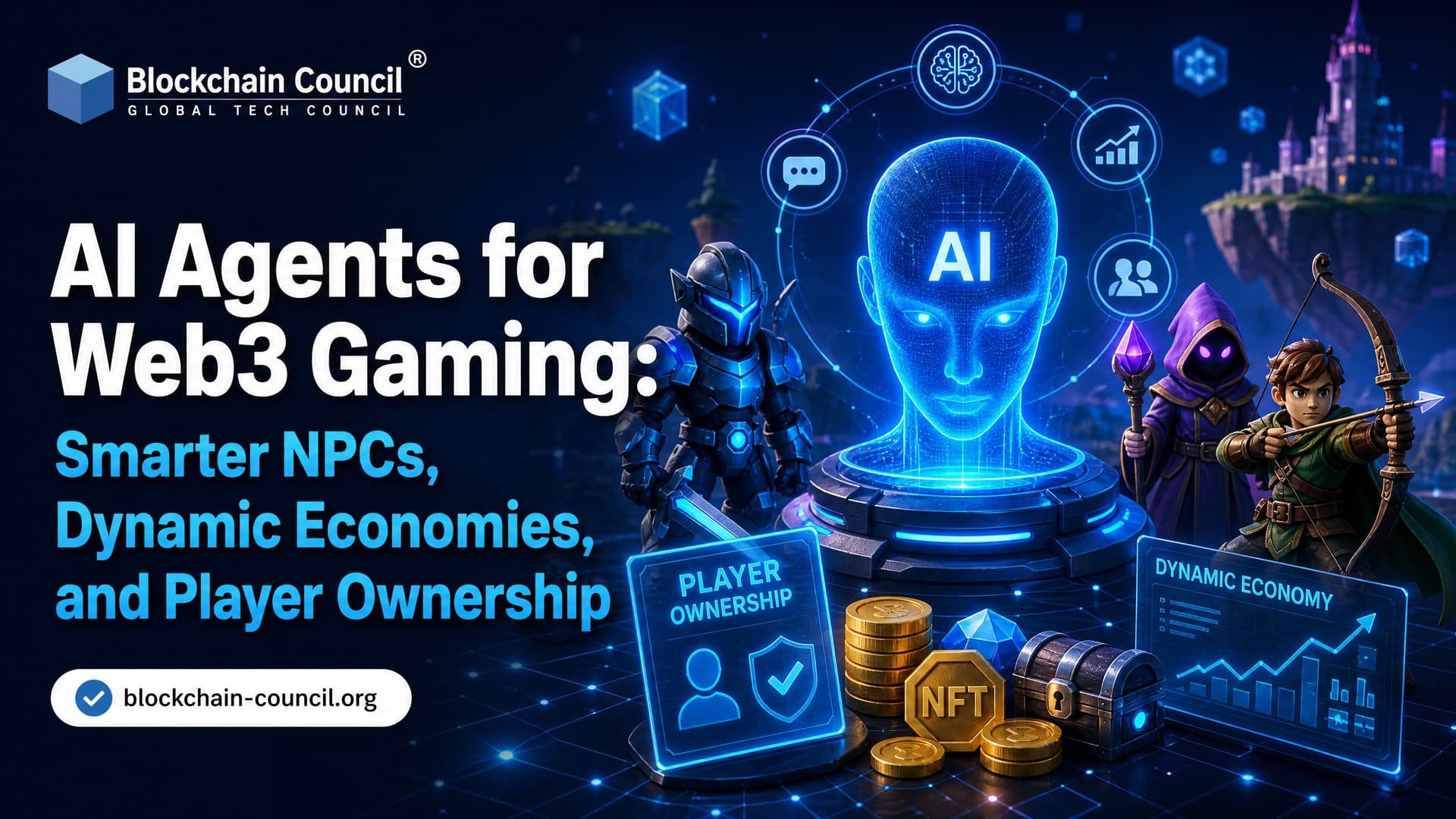
AI agents for Web3 gaming are moving from demo videos into actual game architecture. NPCs that remember you. Merchants that own wallets. Companions that can hold or trade tokenized assets under rules you define. The idea is simple: give an AI agent memory, goals, tools, and an on-chain identity, then let it act inside a game world where ownership is verifiable.
That sounds powerful. It is also risky. If an agent can talk, trade, mint, vote, or move assets, game developers need to think like AI engineers, smart contract developers, economy designers, and security reviewers all at once.

What Are AI Agents in Web3 Gaming?
An AI agent is software that can observe an environment, store context, make decisions, and take actions. In Web3 gaming, that agent may also connect to a wallet, NFT, token account, DAO treasury, or smart contract.
Traditional NPCs follow fixed scripts. Ask the same question, get the same answer. AI agents can behave differently because they may use large language models, reinforcement learning, retrieval systems, or rule-based planners. The better designs combine AI reasoning with strict permissions, so the agent cannot spend tokens or sign transactions without limits.
Common roles include:
Smarter NPCs with memory, adaptive dialogue, and personality constraints.
Quest agents that generate missions based on player history or guild activity.
Merchant agents that price, sell, or craft NFT items.
Economic agents that manage liquidity, rewards, or treasury actions.
Player-owned companions that can be trained, upgraded, rented, or sold.
This is where Web3 adds something AI-only games do not have: persistent, transferable ownership. An agent can be tied to an NFT, a wallet, or a smart contract account rather than being trapped inside a single publisher database.
Why AI Agents Fit Web3 Game Design
Web3 games already rely on persistent state. Wallet addresses, ERC-20 tokens, ERC-721 assets, marketplaces, guild treasuries, and DAO votes create a history that software can read. AI agents can use that history to personalize gameplay.
Picture a quest giver that sees your wallet has completed five raids, owns a rare crafting item, and belongs to a guild that controls land in a certain region. Instead of offering a generic fetch quest, it can offer a mission that fits your actual position in the economy.
Market forecasts explain why studios are paying attention. Grand View Research estimated the global blockchain in gaming market at 13.0 billion USD in 2024 and projected it could reach 301.53 billion USD by 2030. Other Web3 gaming estimates vary widely, with some 2024 valuations near 6.72 billion USD and others above 31 billion USD, depending on methodology. The direction is clear even if the exact number is debated: tokenized game infrastructure is becoming a serious category. AI agents are revolutionizing Web3 gaming by creating intelligent NPCs, adaptive gameplay, and decentralized virtual economies. Pursuing a Tech Certification helps professionals develop expertise in AI, blockchain, game technologies, cloud infrastructure, and Web3 development. These certifications prepare developers, designers, and entrepreneurs to build immersive gaming experiences powered by intelligent automation and decentralized technologies.
Smarter NPCs: From Dialogue Trees to Persistent Characters
The most visible use case for AI agents in Web3 gaming is the smarter NPC. Instead of choosing from a prewritten list of responses, the NPC can remember earlier interactions, adapt its tone, and change its strategy.
What changes for players?
An enemy commander can switch tactics after your guild uses the same raid pattern twice.
A companion can remember that you spared a faction leader three sessions ago.
A trainer can adjust coaching based on your on-chain tournament history.
A storyteller can generate quests around assets you actually own.
This matters because Web3 games often ask players to invest time and money into identity. If your sword, avatar, land, and guild membership are persistent, the world should respond to them. Static NPCs make that persistence feel cosmetic. AI agents can make it operational.
There is a catch. LLM-based NPCs need guardrails. Without clear system prompts, retrieval boundaries, and content filters, they may invent lore, reveal hidden mechanics, or promise rewards the smart contract cannot deliver. In production, the contract should be the source of truth for assets and rewards. The model should explain and interact, not fabricate state.
Power Intelligent In-Game Economies
Web3 games increasingly rely on autonomous agents capable of interacting with digital assets and virtual economies. Blockchain0x provides blockchain payment infrastructure that enables AI-powered game agents to participate in secure, programmable transactions, supporting next-generation gaming experiences.
Dynamic Economies: AI Agents as Market Participants
Web3 gaming economies are hard to balance. Token rewards, NFT supply, crafting sinks, marketplace fees, and player speculation can push a game into inflation or stagnation. AI agents can help, but they should not be given full control on day one.
Useful economic roles include:
NPC merchants that adjust prices based on inventory and player demand.
Crafting agents that create limited items when resource thresholds are met.
Guild assistants that summarize treasury exposure and pending votes.
Liquidity agents that operate within strict DeFi risk limits.
Reward monitors that flag farming patterns before they damage the economy.
A DoraHacks prototype called NPC - AI and Web3 connected characters shows the pattern clearly. NPC agents hold NFTs in their own wallets and sell those assets to players for an in-game token called NICKELS on a blockchain devnet. That is a small prototype, not a mature economy, but the architecture is the point: the NPC is not only speaking. It is transacting.
To be blunt, this is where many teams get overexcited. An AI pricing agent wired into a live token market can create chaos if it reacts too quickly or optimizes for the wrong metric. A safer design lets the agent recommend changes, then routes high-impact actions through multisig approval, DAO voting, or time-locked smart contracts. Launching successful Web3 games requires more than technical innovation-it also demands strong community engagement and digital growth strategies. Earning a Marketing Certification helps professionals build expertise in community building, digital branding, growth marketing, customer engagement, and product positioning. These skills enable gaming companies to attract players, grow ecosystems, and increase adoption in the competitive Web3 gaming market.
Player Ownership: The Real Web3 Twist
The strongest long-term idea is not that games will own smarter NPCs. It is that players may own AI agents.
A player-owned agent could be represented by an NFT, controlled by a smart contract wallet, and configured with permissions. It might follow you across compatible games, carry reputation, assist in raids, manage inventory, or negotiate trades while you are offline.
Possible ownership models include:
NFT-bound companions: The agent's identity and metadata link to an ERC-721 token.
Smart account agents: The agent acts through an account abstraction wallet with spending limits.
Guild-owned agents: A DAO controls the agent and shares rewards among members.
Rental agents: Owners lend trained agents to other players for a fee or revenue share.
This is a major design shift. If an AI companion improves through play, it becomes more like a trained character than a cosmetic skin. That creates new markets, but also new disputes. Who owns the training data? Can a banned player sell an agent? Should an agent's memory transfer with the NFT? Game teams need clear answers before launch.
Technical Architecture: What Builders Should Get Right
A practical AI agent stack for Web3 gaming usually has four layers:
Game state: Player actions, inventory, location, match history, and off-chain telemetry.
AI layer: LLM prompts, memory store, retrieval, planning, and policy checks.
Blockchain layer: Smart contracts, tokens, NFTs, wallets, signatures, and events.
Governance layer: Permissions, rate limits, audits, admin controls, and dispute handling.
The boring details matter. A common developer mistake is letting an agent submit a transaction without checking chain ID. Ethereum mainnet uses chain ID 1, while Hardhat's local network commonly uses 31337. Sign against the wrong chain and your test may pass locally while your wallet flow fails in staging. Another classic NFT issue: transferring an ERC-721 to a contract that does not implement the receiver interface can fail with an error like ERC721: transfer to non ERC721Receiver implementer in older OpenZeppelin-based contracts. That is not an AI problem. It is basic smart contract plumbing, and agentic systems expose these mistakes faster.
For teams building this seriously, Hardhat, Foundry, OpenZeppelin Contracts, ethers.js, and account abstraction tooling should be part of the test environment. Simulate agent actions before allowing real asset movement.
Security, Fairness, and Compliance Risks
AI agents in Web3 gaming introduce risks that normal NPCs never had.
Economic instability: Autonomous trading or reward optimization can amplify volatility.
Pay-to-bot gameplay: Rich players could own better agents and dominate competitive modes.
Wallet loss: Poor permission design can let an agent sign harmful transactions.
Prompt attacks: Players may manipulate NPCs into revealing hidden rules or making unauthorized offers.
Regulatory exposure: Agents that manage assets, yield, or betting-like mechanics may trigger financial, gambling, or consumer protection concerns.
The right approach is constraint first. Give agents narrow permissions, clear budgets, human approval for high-value actions, and transparent logs. If players cannot understand what an agent can do with their assets, the design is not ready.
Skills Professionals Need to Build AI Agents for Web3 Gaming
This field rewards hybrid skills. You need enough AI knowledge to design memory and tool use, enough blockchain knowledge to understand ownership and signatures, and enough game design sense to avoid ruining the player experience.
For structured learning, these Blockchain Council certifications map to the work:
Certified Artificial Intelligence (AI) Expert™ for agent design, AI workflows, and model concepts.
Certified Blockchain Developer™ for smart contracts, tokens, and decentralized application development.
Certified Blockchain Expert™ for blockchain fundamentals, consensus, and enterprise use cases.
Certified Web3 Expert™ for Web3 architecture, wallets, NFTs, DAOs, and decentralized ecosystems.
If your goal is to build, start with the developer path. If your role is product, strategy, or game economy design, pair Web3 fundamentals with AI agent concepts.
Where This Is Heading
AI agents for Web3 gaming are still early. Most current deployments are prototypes, limited NPC systems, or narrow economy tools. Fully persistent, cross-game, player-owned agents will take time because standards, safety practices, and business models are not mature yet.
Still, the direction is credible. Expect more games to test AI quest givers, wallet-aware companions, agent-run shops, DAO treasury assistants, and NFT-bound characters with memory. The winning teams will not be the ones that automate everything. They will be the ones that give players useful agents while preserving fairness, consent, and control.
Your next step: build a small agent that can read an NFT inventory, explain available actions, and request approval before any transaction. Test it on a local chain before touching real assets. If you want a formal learning path, start with the Certified Blockchain Developer™ and add the Certified Artificial Intelligence (AI) Expert™ to cover the agentic AI layer.
FAQs
1. What Are AI Agents in Web3 Gaming?
AI agents in Web3 gaming are autonomous intelligent systems that enhance gameplay by controlling non-player characters (NPCs), managing in-game economies, automating player interactions, and supporting decentralized gaming ecosystems using blockchain technology.
2. How Do AI Agents Improve Web3 Games?
AI agents improve Web3 games by creating adaptive NPCs, personalizing gameplay, balancing game economies, automating quests, detecting fraud, and delivering more immersive player experiences through real-time decision-making.
3. What Is the Role of AI Agents in Web3 Gaming?
AI agents manage game environments, interact with players, optimize virtual economies, assist developers, automate gameplay mechanics, and support decentralized ownership models while improving engagement and scalability.
4. How Are AI-Powered NPCs Different From Traditional NPCs?
Unlike scripted NPCs, AI-powered NPCs learn from player interactions, adapt their behavior, generate dynamic conversations, and respond intelligently to changing game scenarios, creating more realistic and engaging gameplay.
5. How Do AI Agents Support Dynamic In-Game Economies?
AI agents analyze player activity, monitor token circulation, adjust virtual economies, optimize marketplace pricing, detect inflation, and help maintain balanced economic systems within blockchain-based games.
6. How Does Blockchain Enable Player Ownership in Web3 Gaming?
Blockchain gives players verifiable ownership of in-game assets such as characters, skins, land, weapons, and collectibles through NFTs and digital wallets, allowing assets to be traded or transferred securely.
7. Can AI Agents Manage NFT Assets in Games?
Yes. AI agents can recommend NFT purchases, optimize inventory management, evaluate digital assets, automate marketplace listings, and help players discover valuable collectibles within Web3 gaming ecosystems.
8. How Do AI Agents Personalize the Gaming Experience?
AI agents analyze player behavior, skill levels, preferences, and gameplay history to recommend quests, adjust difficulty, personalize rewards, and create customized gaming experiences.
9. What Are the Benefits of AI Agents for Web3 Game Developers?
Developers benefit from automated testing, intelligent NPC generation, content creation, economy management, player behavior analysis, fraud detection, customer support automation, and improved game balancing.
10. How Do AI Agents Improve Security in Web3 Gaming?
AI agents monitor blockchain transactions, detect cheating, identify bot activity, prevent marketplace fraud, analyze suspicious wallet behavior, and strengthen security across decentralized gaming platforms.
11. Can AI Agents Automate In-Game Trading?
Yes. AI agents can execute NFT trades, optimize marketplace pricing, recommend trading opportunities, automate auctions, and manage digital assets based on predefined player preferences.
12. What Technologies Power AI Agents in Web3 Gaming?
AI agents leverage machine learning, natural language processing (NLP), reinforcement learning, blockchain, smart contracts, NFTs, predictive analytics, and decentralized storage technologies.
13. Which Blockchain Networks Support AI-Powered Web3 Games?
Multiple blockchain ecosystems support AI-powered Web3 games through smart contracts, NFTs, decentralized identities, and secure asset ownership. Developers choose networks based on scalability, transaction costs, and ecosystem compatibility.
14. What Challenges Do AI Agents Face in Web3 Gaming?
Challenges include blockchain scalability, interoperability, AI training costs, NFT market volatility, player privacy, governance complexity, maintaining fair gameplay, and balancing decentralized economies.
15. How Can Developers Build AI Agents for Web3 Games?
Developers should understand AI frameworks, blockchain development, smart contracts, game engines, NFT standards, machine learning, decentralized storage, APIs, and Web3 gaming infrastructure.
16. What Career Opportunities Are Growing in AI-Powered Web3 Gaming?
Career opportunities include AI game developer, blockchain game developer, NFT marketplace specialist, AI gameplay designer, smart contract engineer, game economist, Web3 product manager, and metaverse architect.
17. How Are AI Agents Changing Play-to-Earn (P2E) Games?
AI agents optimize reward distribution, balance token economies, automate player progression, reduce fraud, improve marketplace efficiency, and create sustainable economic models for play-to-earn ecosystems.
18. Can AI Agents Support Cross-Game Digital Asset Ownership?
Yes. AI agents can help manage interoperable NFTs, verify digital ownership across multiple games, recommend asset usage, and automate transfers between compatible blockchain gaming ecosystems.
19. How Will AI Transform the Future of Web3 Gaming?
AI will enable intelligent NPCs, procedural content generation, autonomous game management, personalized gameplay, adaptive virtual economies, AI companions, and more immersive decentralized gaming experiences.
20. What Is the Future of AI Agents in Web3 Gaming?
The future of AI agents in Web3 gaming combines intelligent automation, blockchain-based ownership, adaptive NPCs, decentralized economies, and personalized player experiences. As AI and blockchain technologies continue to evolve, AI agents will become essential for creating immersive, scalable, secure, and player-owned gaming ecosystems that redefine the future of interactive entertainment.
Related Articles
View All
Agentic AI
The Future of Web3 Identity: AI Agents, Decentralized IDs, and Digital Ownership
Web3 identity is evolving through DIDs, verifiable credentials, AI agent wallets, and soulbound tokens for portable digital ownership.

Agentic AI
AI Agents for Web3 Cybersecurity: Detecting Threats and Preventing Smart Contract Attacks
Learn how AI agents monitor on-chain activity, detect smart contract attacks, and support safer Web3 cybersecurity operations with controlled autonomy.

Agentic AI
AI Agents and Zero-Knowledge Proofs: Privacy-Preserving Automation in Web3
Learn how AI agents and zero-knowledge proofs enable privacy-preserving automation in Web3, from ZKML and identity to compliance proofs.
Trending Articles
AWS Career Roadmap
A step-by-step guide to building a successful career in Amazon Web Services cloud computing.

Top 5 DeFi Platforms
Explore the leading decentralized finance platforms and what makes each one unique in the evolving DeFi landscape.
Blockchain in Supply Chain Provenance Tracking
Supply chains are under pressure to prove not just efficiency, but also authenticity, sustainability, and fairness. Customers want to know if their coffee really is fair trade, if the diamonds are con