

Building AI Agent Marketplaces in Web3: Opportunities for Developers and Businesses
 Suyash Raizada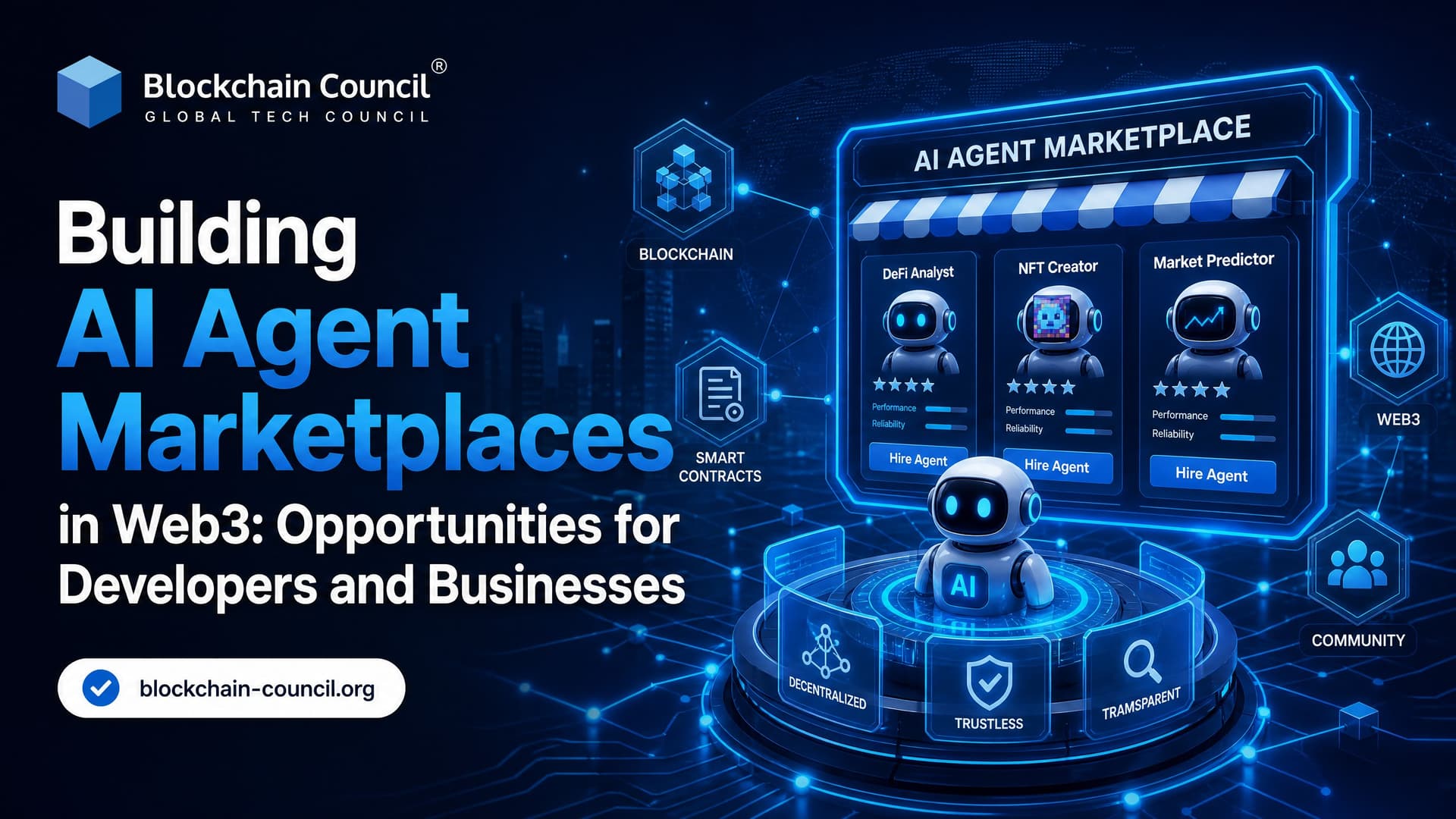
AI agent marketplaces in Web3 are becoming the place where autonomous software agents get listed, discovered, paid, and reused like digital services. For developers, that means a new distribution channel for agents. For businesses, it means programmable automation that can touch wallets, APIs, data feeds, and smart contracts without a human approving every step.
The idea is simple. The implementation is not. Once an agent can move funds, query private data, rebalance a DeFi position, or trigger a supplier payment, your choices around identity, permissions, payment, and auditability matter far more than the model prompt.

What Is a Web3 AI Agent Marketplace?
A Web3 AI agent marketplace is a decentralized or token-based platform where AI agents and AI services can be published, found, called, combined, and paid for through crypto rails. Think of it as an app store for autonomous services, except smart contracts handle registration, access, payments, reputation, and sometimes governance.
Most marketplaces share four layers:
Agent layer: Agents perform tasks such as trading, data analysis, identity checks, customer support, fraud detection, or supply chain monitoring.
Protocol layer: Smart contracts manage listing, discovery, fee logic, reputation, and service rules.
Token and incentive layer: Tokens may be used for access, staking, rewards, voting, or usage fees.
Infrastructure layer: Agents run on cloud compute, decentralized compute, or hybrid systems, often using oracles and on-chain data.
The better marketplaces do not just list agents. They make agents composable. One agent can fetch market data, another can evaluate risk, and a third can execute a transaction within preset limits. That is where the Web3 part earns its keep.
As autonomous AI systems become more capable, an Agentic AI Certification can help professionals build practical skills in agent design, orchestration, governance, and the secure deployment of AI-powered automation across decentralized ecosystems.
The Current Landscape: Who Is Building?
This is no longer only a whitepaper category. SingularityNET, Fetch.ai Agentverse, Bittensor, and ChainGPT all show different versions of the same idea.
SingularityNET
SingularityNET is a decentralized AI services marketplace where developers can publish AI models and services for users to call and pay for with crypto. Its long-term design focuses on AI service interoperability, so separate AI modules can be joined into larger workflows.
Fetch.ai Agentverse
Fetch.ai Agentverse gives developers a hosted environment for creating, deploying, and discovering autonomous agents. This matters because most developers do not want to run custom agent infrastructure, message routing, monitoring, and discovery services from scratch.
Bittensor
Bittensor takes a different route. It organizes AI work into subnets, where participants compete to provide useful model outputs and earn token rewards. A subnet can specialize in a type of intelligence, such as inference, data extraction, or prediction. It is closer to an incentive market for machine intelligence than a simple service catalog.
ChainGPT and Web3-native agents
ChainGPT focuses on Web3-oriented AI agents, including trading, support, development assistance, and blockchain-related workflows. That is a natural fit, since crypto users already need agents that understand wallets, tokens, contracts, and transaction risk.
Sector trackers such as CoinGecko have reported several hundred AI agent crypto projects, with combined market capitalization in the low billions of dollars and large daily token volume at certain points. Treat those numbers carefully. Token volume is not the same as real enterprise adoption. Still, the project count tells you something useful: developers are actively testing the model.
Professionals looking to deepen their knowledge of decentralized technologies may also benefit from becoming a WEB3 Expert, gaining practical expertise in blockchain infrastructure, smart contracts, token economies, and Web3 application development.
How the Technical Architecture Works
A working marketplace needs more than a chatbot with a wallet. You need a service boundary, a payment model, an identity layer, and a failure policy.
Smart contract-native controls
Some agents live mostly off-chain and call smart contracts when needed. Others place more rules directly on-chain. A DeFi rebalancing agent, for example, might be allowed to move funds only between approved contracts, only below a daily value limit, and only when an oracle price sits within a defined range.
Solidity 0.8.x helps by checking arithmetic overflow by default, but that does not save you from bad business logic. A very common beginner failure is approving the wrong spender address and then hitting execution reverted: ERC20: insufficient allowance during a token transfer. In an agent marketplace, that is not a small bug. It means the agent cannot complete the paid task, and your reputation score should reflect it.
Payments and incentives
Common payment patterns include:
Pay-per-use: A user pays for each API call, prediction, report, or completed task.
Subscription access: Users pay for a recurring service tier or usage quota.
Staking: Providers stake tokens to signal commitment or absorb penalties for poor behavior.
Performance rewards: Networks such as Bittensor reward contributors based on measured usefulness.
Revenue sharing: Multi-agent workflows split fees among agent providers.
Stablecoins are practical for business users because finance teams dislike budgeting in volatile tokens. Native tokens can still make sense for governance, staking, and network incentives, but using them for every payment adds friction.
Discovery and reputation
Discovery gets hard once a marketplace grows past a few dozen agents. Search tags are not enough. You need agent cards, version history, uptime data, pricing, audit status, test results, and user feedback.
Do not trust a marketplace that ranks agents only by token activity. The useful signals are task success rate, latency, cost per completed task, failure reasons, and whether the agent can explain its actions in a form humans can review.
Power AI Agent Marketplaces with Blockchain Payments
AI agent marketplaces depend on seamless, secure, and programmable transactions between autonomous systems. Blockchain0x provides developers with blockchain wallets, payment infrastructure, spending controls, and APIs that enable AI agents to buy services, access APIs, and receive payments autonomously. These capabilities help create scalable marketplaces where AI agents can interact and transact without traditional payment barriers.
Business Use Cases That Make Sense
Some Web3 agent ideas are overbuilt. A coffee-ordering agent does not need a token. The stronger use cases involve multi-party coordination, audit trails, payments, or shared data.
DeFi and trading
Agents can monitor lending rates, rebalance collateral, identify arbitrage windows, or automate market-making. This is attractive because DeFi runs around the clock. It is also risky. If an agent has signing power, set strict permissions. Use allowlists, spending caps, simulation checks, and emergency stop controls.
Compliance and monitoring
Compliance agents can monitor wallets, flag suspicious transaction patterns, and combine on-chain analysis with off-chain risk databases. This helps exchanges, custodians, DAOs, and payment providers. It also creates privacy obligations, especially under regulations such as the EU AI Act and data protection laws.
Supply chain and enterprise workflows
Enterprise agents can watch shipment events, verify provenance records, trigger smart contract payments, and alert teams when contract conditions are missed. The value is not just automation. It is shared evidence across organizations that do not fully trust each other.
DAO governance
Governance agents can summarize proposals, compare treasury impact, simulate voting outcomes, and suggest votes based on a DAO's policy. I would not let an agent vote without human oversight on high-value decisions. For triage and analysis, though, agents save serious time.
Opportunities for Developers
If you are a developer, the best entry point is not a general-purpose agent. Build a narrow agent that solves a painful job better than a generic model.
Publish specialized agents: Package domain logic as callable services, such as token risk scoring, smart contract explanation, invoice reconciliation, or wallet monitoring.
Build marketplace tooling: Monitoring, evaluation, audit logs, agent identity, permission managers, and testing frameworks are still underdeveloped.
Join incentive networks: Bittensor-style subnets suit developers who can improve model performance for a specific task.
Create vertical workflows: DeFi, logistics, compliance, insurance, and customer support all need purpose-built agents.
Improve developer experience: SDKs, templates, and agent registries will matter as teams move from experiments to production.
For skills, pair smart contract knowledge with AI engineering. Blockchain Council's Certified Blockchain Developer™, Certified Smart Contract Developer™, and Certified Artificial Intelligence (AI) Expert™ are sensible learning paths for developers building in this category.
A Tech Certification can further strengthen this foundation by expanding your understanding of emerging technologies, cloud infrastructure, AI systems, and the digital tools that support enterprise-grade Web3 applications.
Opportunities for Businesses
Businesses should start with workflows where a marketplace agent can be tested safely before it gets more authority.
Low-risk automation: Reporting, data extraction, ticket triage, and transaction monitoring.
Revenue opportunities: Turn internal models, risk engines, or analytics into paid agent services.
Cross-company processes: Use agents and smart contracts for partner workflows that need shared records.
Auditability: Record agent actions, payments, and approvals on-chain or in tamper-resistant logs.
The wrong move is to give a new agent broad wallet permissions because a demo looked good. Start with read-only access. Then add constrained execution. Only later should an agent control value, and even then with limits.
Risks, Regulation, and Governance
The EU AI Act introduces risk-based obligations for AI systems, including transparency and safety requirements. In the United States, AI and digital asset rules continue to develop across federal and state levels. Marketplaces that serve regulated industries will need compliance by design, not compliance as an afterthought.
Key risks include:
Poor agent quality and unreliable outputs
Hidden centralization of models, compute, or governance
Data privacy failures
Market manipulation by autonomous trading agents
Smart contract bugs and unsafe wallet permissions
Use kill switches, role-based permissions, audit trails, model evaluation, and human approval for high-impact actions. To be blunt, a marketplace without agent constraints is not infrastructure. It is a liability.
How to Get Started
Developers should build one narrow agent, expose it through a clean API, add smart contract-based payment, and measure every failure. Businesses should choose one workflow where auditability and automation both matter, then run a limited pilot with spending caps.
If you want a structured path, start with blockchain fundamentals, then smart contracts, then agentic AI design. Blockchain Council's Certified Web3 Expert™, Certified Blockchain Developer™, and Certified Artificial Intelligence (AI) Expert™ can help you build the base before you design production-grade AI agent marketplaces in Web3.
As AI-powered Web3 platforms continue to mature, a Marketing Certification can also help professionals understand product positioning, user adoption, community engagement, and go-to-market strategies for decentralized technologies and AI-driven services.
FAQs
1. What Is an AI Agent Marketplace in Web3?
An AI agent marketplace is a decentralized platform where developers and businesses can create, publish, discover, buy, sell, or deploy AI agents that perform tasks such as automation, data analysis, trading, customer support, and workflow management.
2. How Do AI Agent Marketplaces Work?
AI agent marketplaces connect AI developers with users through blockchain-based platforms. Smart contracts manage transactions, licensing, payments, and access, while users deploy AI agents for specific business or personal tasks.
3. Why Are AI Agent Marketplaces Important for Web3?
They make AI services more accessible, encourage collaboration, enable decentralized innovation, and create new business models where developers can monetize AI agents and organizations can access specialized AI capabilities.
4. How Are AI Agent Marketplaces Different from Traditional AI Platforms?
Traditional AI platforms are typically operated by centralized companies. Web3 AI agent marketplaces use blockchain technology, decentralized governance, digital ownership, and smart contracts to manage transactions and access.
5. What Types of AI Agents Can Be Offered in Web3 Marketplaces?
Marketplaces can include AI agents for customer support, blockchain analytics, DeFi trading, research, content generation, cybersecurity, data processing, automation, software development, and digital assistants.
6. How Can Developers Benefit from AI Agent Marketplaces?
Developers can publish AI agents, reach global users, generate revenue through licensing or subscriptions, receive crypto payments, and continuously improve their agents based on marketplace feedback.
7. How Can Businesses Use AI Agent Marketplaces?
Businesses can discover specialized AI agents, automate repetitive workflows, improve customer service, analyze blockchain data, optimize operations, and reduce development time without building every AI solution from scratch.
8. What Role Do Smart Contracts Play in AI Agent Marketplaces?
Smart contracts automate payments, licensing agreements, revenue sharing, subscriptions, usage tracking, and marketplace transactions while reducing the need for intermediaries.
9. How Do AI Agents Interact with Decentralized Applications (DApps)?
AI agents can connect with DApps through smart contracts and APIs to automate workflows, analyze blockchain data, execute transactions, and assist users across decentralized ecosystems.
10. How Can AI Agent Marketplaces Support DeFi?
AI agents can assist with portfolio monitoring, yield optimization, liquidity management, market analysis, risk assessment, trading automation, and transaction monitoring within decentralized finance protocols.
11. Can AI Agent Marketplaces Improve Developer Collaboration?
Yes. Developers can share reusable AI agents, integrate third-party services, contribute improvements, build open ecosystems, and accelerate innovation through decentralized collaboration.
12. What Technologies Power AI Agent Marketplaces?
Core technologies include artificial intelligence, machine learning, blockchain, smart contracts, decentralized applications (DApps), large language models (LLMs), APIs, decentralized storage, and digital wallets.
13. How Can AI Agent Marketplaces Create New Business Opportunities?
Organizations can offer AI-as-a-Service, subscription-based automation, agent licensing, enterprise AI solutions, blockchain analytics, decentralized customer support, and specialized AI services for different industries.
14. Which Industries Can Benefit from AI Agent Marketplaces?
Industries such as finance, healthcare, logistics, education, gaming, cybersecurity, legal services, retail, marketing, manufacturing, and enterprise software can all benefit from AI-powered marketplaces.
15. How Can Businesses Evaluate AI Agents Before Deployment?
Businesses should review agent capabilities, security practices, performance history, supported integrations, documentation, pricing models, user feedback, governance policies, and compliance requirements before adoption.
16. What Challenges Do AI Agent Marketplaces Face?
Common challenges include agent security, smart contract vulnerabilities, quality assurance, interoperability, intellectual property protection, regulatory uncertainty, scalability, and marketplace governance.
17. How Can Developers Build Successful AI Agents for Web3?
Developers should focus on solving real business problems, ensuring security, providing clear documentation, designing scalable architectures, integrating with blockchain standards, and maintaining their AI agents through regular updates.
18. What Skills Are Needed to Build AI Agent Marketplaces?
Professionals should understand blockchain development, smart contracts, artificial intelligence, machine learning, Web3 architecture, decentralized identity, APIs, cybersecurity, cloud infrastructure, and marketplace design.
19. What Common Mistakes Should Businesses and Developers Avoid When Using AI Agent Marketplaces?
Avoid deploying unaudited AI agents, ignoring smart contract security, overlooking governance policies, failing to define permissions, and relying solely on automation without oversight. Businesses should also verify marketplace credibility, evaluate AI performance regularly, and ensure compliance with security and privacy requirements.
20. How Will AI Agent Marketplaces Shape the Future of Web3?
AI agent marketplaces are expected to become a key part of the Web3 economy by enabling decentralized AI distribution, intelligent automation, and new digital business models. As AI and blockchain technologies mature, these marketplaces could help developers monetize AI innovations, allow businesses to rapidly deploy specialized AI solutions, and create more open, interoperable, and autonomous digital ecosystems powered by decentralized technologies.
Related Articles
View All
Agentic AI
AI Agents and Smart Contracts: Building Self-Executing Web3 Workflows
Learn how AI agents and smart contracts power self-executing Web3 workflows in DeFi, trading, contract management, and enterprise automation.

Agentic AI
Voice AI Agent Branding with Stock Illustration: Designing Trustworthy Avatars for Web3, Fintech, and Customer Support
Learn how to use stock illustration to brand voice AI agents with trustworthy avatars for Web3, fintech, and customer support, with disclosure-first design patterns.

Agentic AI
Building Secure, Compliant AI Agent Platforms: Governance, Observability, and Cybersecurity Controls
Learn how to build secure, compliant AI agent platforms with governance control planes, audit-ready observability, and cybersecurity controls for autonomous workflows.
Trending Articles
What is AWS? A Beginner's Guide to Cloud Computing
Everything you need to know about Amazon Web Services, cloud computing fundamentals, and career opportunities.
Claude AI Tools for Productivity
Discover Claude AI tools for productivity to streamline tasks, manage workflows, and improve efficiency.
How to Install Claude Code
Learn how to install Claude Code on macOS, Linux, and Windows using the native installer, plus verification, authentication, and troubleshooting tips.