

AI Agent Harnesses, Tools & Context: The Infrastructure Behind Autonomous AI
 Suyash Raizada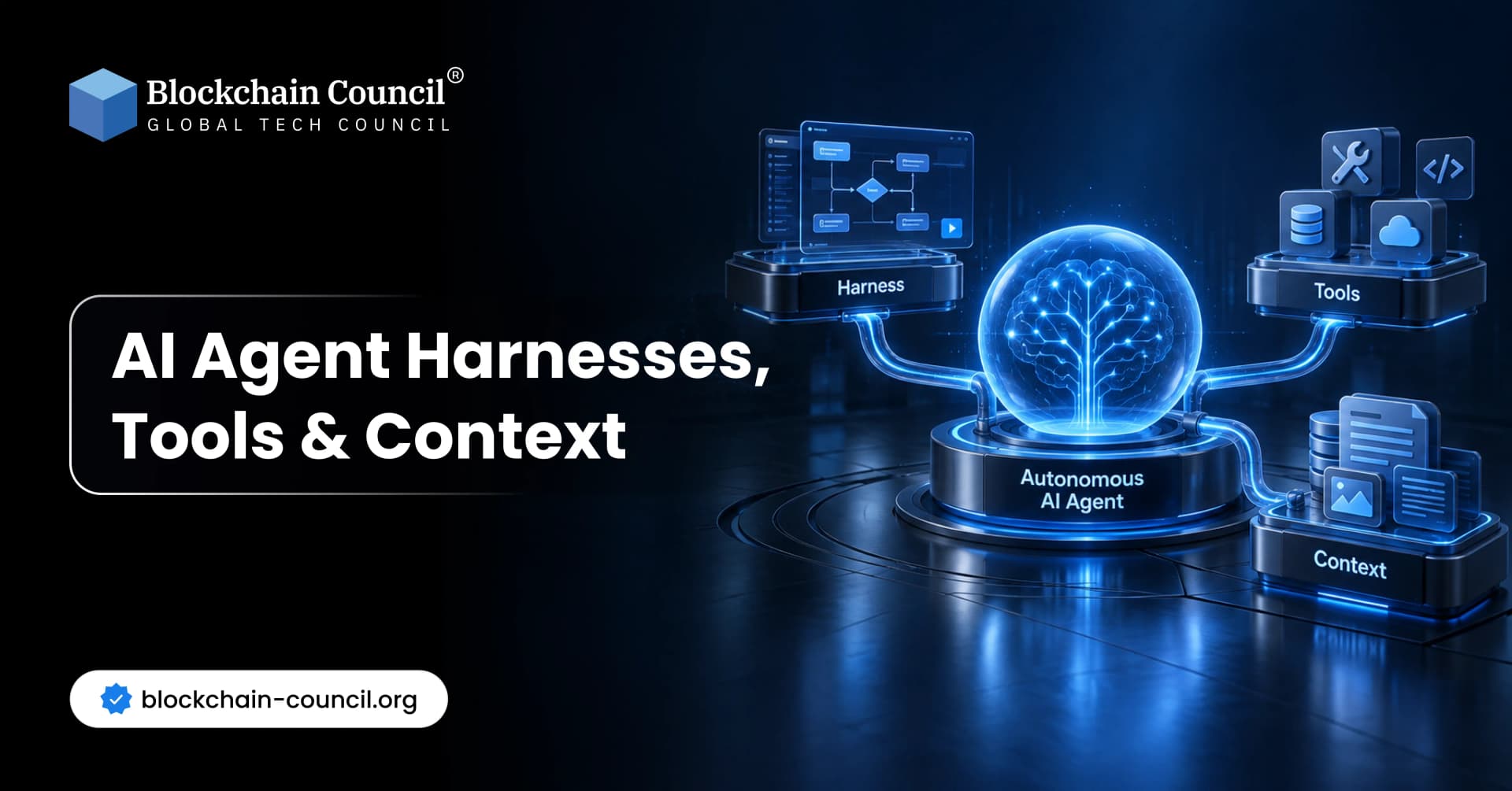
A powerful language model is like a brilliant person locked in an empty room. It can think and talk, but it cannot open a file, check a database, or remember yesterday. What turns that model into a working agent is the infrastructure around it. Understanding AI agent harnesses, tools, and context is the key to seeing how autonomous AI actually works in the real world. If you want to turn that understanding into a career skill, the Certified Agentic AI Expert program is a solid place to start.
This guide explains each building block in plain language, from the harness that runs the agent to the guardrails that keep it safe. Beginners will get clear analogies, and professionals will find practical design ideas they can apply right away.

What Is an AI Harness?
An AI harness is the software layer that wraps around a language model and turns it into an agent. The model produces text and decisions. The harness does everything else: it builds the prompts, offers tools, runs the loop, stores memory, enforces rules, and records what happened.
The Racing Analogy
Think of the model as a strong horse and the harness as the gear that lets a rider steer it. Without the harness, the horse has power but no direction. With it, that power can pull a cart to a chosen destination. Engineers sometimes describe the model as the engine and the harness as the rest of the car.
What Lives Inside a Harness
Most harnesses include a loop controller, a tool registry, a context builder, a memory system, permission checks, and logging. Some products call this layer an agent framework or runtime, but the idea is the same: the model is one part, and the harness is the rest of the machine. In short, AI agent harnesses, tools, and context form the infrastructure that decides what an agent can see, what it can do, and what it must never do.
Why Agents Need a Harness
Models are trained on past data and respond to the text in front of them. On their own, they have no access to live systems, no lasting memory, and no built-in safety limits. These gaps are not flaws in the model. They are simply outside its job, which is why another layer must fill them.
Models Cannot Act Alone
A model can write “send the invoice,” but only software can actually send it. The harness connects the model’s words to real actions and returns the results so the model can continue. A typical task may pass through this handoff dozens of times before it is complete.
Reliability and Control
A good harness keeps the agent on track. It limits the number of steps, retries failed calls, and stops runaway behavior. Developers who want to build these systems themselves can study the Certified Agentic AI Developer curriculum.
The Same Model, Different Results
Two teams can use the same model and get very different outcomes. The difference is usually the harness. Better tools, cleaner context, and stricter checks often improve results more than switching to a larger model.
Tools and Function Calling
Tools are the hands of an agent. A tool is any function the agent can use, such as a web search, a calculator, a code runner, or an email sender.
How Function Calling Works
The developer describes each tool to the model with a name, a plain-language purpose, and the inputs it needs. When the model decides a tool will help, it outputs a structured request, often in JSON format. The harness runs the tool and feeds the result back to the model.
Writing Good Tool Descriptions
Models choose tools by reading their descriptions, so clarity matters. A vague name like “process” confuses the model, while “lookup_order_status” is easy to understand. Clear inputs, examples, and error messages all improve accuracy. When a tool fails, a helpful message such as “order number not found, please check the format” lets the model correct itself, while a cryptic code leaves it stuck.
Fewer, Sharper Tools
Giving an agent too many tools can cause wrong choices. Start with a small set that covers the job, and add more only when needed. Many teams group related actions into one well-designed tool instead of exposing dozens of tiny ones.
APIs and External Systems
Most useful tools connect to the outside world through APIs, which are standard ways for software to talk to other software.
Connecting to Business Systems
Through APIs, an agent can read a customer record, create a support ticket, update a spreadsheet, or check a shipping status. Each connection expands what the agent can do, and also what can go wrong. A tool that can read a calendar is low risk, while one that can transfer money needs far stricter controls.
Standards Like MCP
The Model Context Protocol, introduced by Anthropic in late 2024, is an open standard for connecting agents to tools and data sources in a consistent way. Instead of building a custom link for every pair of systems, teams can use a shared format. Many tool makers now support it.
Handling Real-World Messiness
External systems are slow, change without warning, and sometimes fail. A strong harness handles timeouts, rate limits, and unexpected responses gracefully rather than letting the agent guess. For example, if a payment service does not answer, the agent should wait and retry, not assume the payment went through.
Context Engineering for Agents
Context is everything the model can see when it makes a decision. Context engineering is the craft of choosing what goes into that view.
More Than Prompt Writing
Prompt writing focuses on how to phrase an instruction. Context engineering is broader. It covers instructions, tool descriptions, retrieved documents, conversation history, and results from earlier steps, and it asks which of these deserve space right now.
Why Less Can Be More
Models can lose focus when overloaded with irrelevant text. Including only what helps the current step usually leads to sharper, cheaper, and more accurate results. The same habit also keeps the cost of each task under control.
A Practical Approach
Place the goal and key rules clearly at the start, include only relevant facts, label each piece of information, and remove stale details. Treat the context like a well-organized desk rather than a pile of papers. A support agent, for instance, needs the customer’s recent orders and the refund policy, not the entire company handbook.
Context Windows and State Management
Every model has a context window, which is the maximum amount of text it can consider at once. Long tasks can easily outgrow it.
Understanding the Limit
Think of the window as a whiteboard of fixed size. Once it is full, something must be erased before anything new can be written. Larger windows help, but they do not remove the need for good judgment, because more text can also mean more noise and higher cost.
Techniques for Long Tasks
Harnesses manage this limit in several ways. They summarize older steps, trim tool outputs to the useful parts, store details outside the window, and split large jobs among several agents that each work with a smaller view.
State Management
State is the agent’s progress report: what is finished, what is pending, and what failed. Saving state outside the model lets an agent pause, resume after a crash, or hand off to a person. Leaders who oversee how these systems are run and reviewed can learn more through the Certified AI Agents Manager program.
Agent Memory
Memory helps an agent stay consistent across steps and across sessions.
Short-Term Memory
Short-term memory is the working context of the current task, including the goal, recent actions, and results. It disappears when the task ends unless the harness saves it.
Long-Term Memory
Long-term memory persists over time. It can hold user preferences, past decisions, company knowledge, and lessons from earlier mistakes. Stored in a database, it is pulled back into context only when relevant.
Memory Needs Care
Bad memories can mislead an agent, and private data should not be stored without clear rules. Good systems let users review and delete memories, expire old facts, and avoid saving sensitive information that is not needed. Transparent memory also builds user trust, because people can see what the agent knows about them.
Retrieval-Augmented Generation (RAG)
Retrieval-augmented generation, or RAG, is a method that lets a model look up information before answering. The idea was described in research from 2020 and is now a standard technique.
How RAG Works
Documents are split into small chunks and converted into numerical representations called embeddings, which capture meaning. These are stored in a vector database. When a question arrives, the system finds the chunks closest in meaning and places them into the context, so the model answers using real sources.
Why It Helps Agents
RAG gives agents current and private knowledge that the model never saw in training, such as company policies or product manuals. It also reduces made-up answers because the model can point to supporting text.
Common Pitfalls
Poor chunking, outdated documents, and weak search can all return the wrong material. Teams improve results by cleaning their sources, testing retrieval quality, and showing the source of each answer so people can verify it. Combining keyword search with meaning-based search often finds better matches than either method alone.
Guardrails and Permissions
The more an agent can do, the more important it is to limit what it should do.
Permissions and Least Privilege
Give each agent only the access it needs. A reporting agent may read data but never delete it. Separate accounts, narrow scopes, and spending limits reduce the damage from any single mistake.
Human Approval
Risky or irreversible actions, such as large payments or public posts, should pause for human approval. Low-risk, reversible tasks can run automatically.
Defending Against Prompt Injection
Prompt injection happens when hidden instructions in a web page, email, or document trick an agent into misbehaving. Defenses include treating outside content as data rather than commands, filtering outputs, restricting tool access, and sandboxing code. Sandboxing means running code in an isolated space where mistakes cannot reach important systems. No single measure is perfect, so layers work best. Treat every outside document as untrusted, even when it comes from a familiar source.
Observability and Agent Evaluation
You cannot improve or trust what you cannot see. Observability means recording enough detail to understand what an agent did and why.
Logging and Tracing
A trace follows one task from start to finish, showing each prompt, tool call, result, and decision, along with timing and cost. When something goes wrong, a trace shows where. Without traces, debugging an agent feels like guessing.
Evaluating Agents
Evaluation tests whether an agent does its job well. Teams build sets of realistic tasks and measure success rate, accuracy, speed, cost, and how often humans must step in. Testing edge cases, such as confusing requests or failing tools, is just as important as testing the happy path. Teams rerun these tests after every change to catch regressions. Gartner has warned that more than 40 percent of agentic AI projects may be canceled by the end of 2027 because of cost, unclear value, or weak risk controls, which makes careful measurement essential.
Building the Skills
Observability, security, and cloud operations all meet in agent engineering. Professionals who want a broad technical foundation can explore a Tech Certification path to support this work.
Conclusion
AI agents are not just models. They are systems made of a harness, well-described tools, carefully chosen context, memory, retrieval, guardrails, and monitoring. Each part solves a specific weakness of the raw model, and together they turn clever text into dependable action. When an agent fails, the cause is often a missing tool, a cluttered context, or a weak rule, not the model itself.
To get started, pick one narrow task, give the agent a few clear tools, keep its context clean, and watch its traces closely. Business professionals who want to apply agents to campaigns, content, and customer journeys may also benefit from a Marketing Certification to pair strategy with automation.
FAQs
1. What Is an AI Agent Harness?
An AI agent harness is the software infrastructure that surrounds an AI model and enables it to perform tasks through tools, context, and repeated execution. It manages activities such as model calls, tool execution, state tracking, error handling, and stopping conditions. The harness helps transform a model's capabilities into a functioning AI agent.
2. Why Are Harnesses Important for Autonomous AI?
Harnesses help AI agents operate beyond a single prompt-and-response interaction. They coordinate tools, manage task progress, process results, and apply operational limits. Without this supporting infrastructure, even a capable model may struggle to complete complex workflows consistently.
3. What Is the Difference Between an AI Model and an AI Agent Harness?
An AI model processes inputs and generates outputs, such as text, predictions, or tool requests. An agent harness manages how the model is used within a broader application, including executing tools, maintaining context, and handling errors. The model provides core AI capabilities, while the harness organizes their use in a workflow.
4. What Are the Main Components of an AI Agent Harness?
A typical harness includes a model interface, instruction management, context handling, tool integration, an execution loop, and task-state tracking. It may also include memory, logging, permissions, evaluation systems, and human approval mechanisms. The specific components depend on the agent's purpose and the risks associated with its tasks.
5. What Are Tools in an AI Agent System?
Tools are functions or external services that allow an AI agent to interact with other systems and perform specific operations. Examples include web search, database queries, code execution, file processing, and business application APIs. Tools extend an agent's capabilities beyond generating responses, subject to the access and permissions configured by developers.
6. How Do AI Agents Select and Use Tools?
An AI model evaluates the task and available tool descriptions to determine whether a tool could help. It generates a structured request, and the harness validates and executes that request before returning the result to the model. The agent can then use the result to choose its next action.
7. What Is Context Engineering in AI Agent Systems?
Context engineering is the process of selecting, organizing, and managing the information supplied to an AI model. In agent systems, context can include system instructions, user requests, conversation history, retrieved documents, tool outputs, and task state. Effective context engineering helps ensure that the model receives relevant information without being overwhelmed by unnecessary details.
8. How Does Context Management Improve AI Agent Performance?
Context management helps maintain the information an agent needs to understand its current task and previous actions. It can involve summarizing long conversations, retrieving relevant documents, removing outdated details, and prioritizing important instructions. Good context management can improve consistency, although it cannot guarantee accurate decisions.
9. What Is the Role of Memory in an AI Agent Harness?
Memory enables an agent system to retain or retrieve information relevant to current or future tasks. Short-term memory may preserve intermediate results, while persistent memory can store selected information across sessions. The harness can determine when information is saved, retrieved, updated, or removed, subject to the system's design and privacy requirements.
10. How Does an AI Agent Execution Loop Work?
An execution loop repeatedly processes the current context, asks the model to select an action, executes the action, and evaluates the result. The cycle continues until the task is complete, an error requires intervention, or a stopping condition is reached. The harness manages this cycle and prevents uncontrolled or unnecessary execution through appropriate limits.
11. What Is the Difference Between an AI Agent Harness and an AI Agent Framework?
An agent framework generally provides reusable abstractions, libraries, or components for building AI agents. A harness refers more specifically to the runtime infrastructure that manages how an agent operates, including tools, context, execution, and controls. In practice, frameworks can provide harness components, and the terminology may overlap between different projects.
12. How Do AI Agent Harnesses Handle Errors?
Harnesses can detect tool failures, invalid inputs, timeouts, and unsuccessful operations. Depending on the system, they may retry an action, return an error to the model, use an alternative tool, or stop the workflow. Retry limits, error classification, and clear recovery rules help prevent repeated failures and excessive resource consumption.
13. How Do Harnesses Support Multi-Agent Systems?
In multi-agent systems, a harness or orchestration layer can assign tasks, coordinate specialized agents, manage communication, and combine results. For example, one agent might gather research, another analyze the information, and a third check the final report. Effective orchestration helps coordinate the workflow, but developers must account for conflicting outputs, duplicated work, and additional costs.
14. How Do AI Agent Harnesses Improve Security?
Harnesses can enforce access permissions, validate tool requests, restrict available operations, and log agent activities. They may also use sandboxed environments and require human approval before sensitive actions. These measures help reduce risk, particularly when agents can access private data, modify files, or interact with external services.
15. What Is the Role of Human Oversight in AI Agent Infrastructure?
Human oversight allows people to review or approve actions that are uncertain, sensitive, or consequential. A harness can pause execution before sending a message, changing a record, publishing content, or making a financial commitment. The appropriate level of oversight depends on the task's potential impact and the system's reliability.
16. How Are AI Agent Harnesses Used in Software Development?
Coding agents can use harnesses to inspect repositories, modify code, run tests, analyze errors, and revise implementations. The harness controls access to development tools and returns execution results to the model. Developers should still review changes, check security implications, and verify that tests cover the intended requirements.
17. How Can Businesses Use AI Agent Infrastructure?
Businesses can use agent infrastructure to support customer service, internal knowledge search, document processing, research, reporting, and workflow automation. Harnesses connect AI models to approved data sources and applications while managing task execution and permissions. Successful deployment requires reliable integrations, data protection, measurable performance, and suitable human review.
18. What Are the Biggest Challenges in Building AI Agent Harnesses?
Common challenges include managing long context, handling unreliable tool outputs, preventing repeated execution, maintaining task state, and controlling computational costs. Security risks and integration complexity can also increase as agents gain access to more applications. Developers need robust testing, clear execution policies, monitoring, and well-defined recovery mechanisms.
19. How Can Developers Evaluate an AI Agent Harness?
Developers can measure task completion rates, tool-call accuracy, error recovery, response latency, and cost per completed task. They can also evaluate permission enforcement, reliability across repeated runs, and how often human intervention is needed. Testing the complete system is important because model quality alone does not determine agent performance.
20. What Is the Future of AI Agent Harnesses, Tools, and Context Management?
AI agent infrastructure is likely to evolve toward more sophisticated tool orchestration, better context selection, improved memory management, and stronger monitoring. Harnesses may increasingly support long-running tasks and collaboration between specialized agents. The central challenge will be making these systems more capable while keeping their actions secure, observable, efficient, and appropriately controlled.
Related Articles
View All
Agentic AI
AI Agent Orchestration Guide: Coordinating Tools, Tasks, and Multi-Agent Systems
A practical guide to AI agent orchestration, covering tools, task routing, shared state, governance, platforms, and multi-agent system patterns.

Agentic AI
AI Agent Monitoring and Observability: Tools, Metrics, and Strategies
A practical guide to AI agent monitoring and observability, covering telemetry, traces, metrics, governance, and tool choices for reliable production agent systems.

Agentic AI
AI Agent MLOps Playbook: How to Build, Deploy, Monitor, and Govern Autonomous Agents at Scale
A practical AI Agent MLOps playbook to design, deploy, monitor, and govern autonomous agents with secure tooling, observability, CI/CD, and policy controls.
Trending Articles
AWS Career Roadmap
A step-by-step guide to building a successful career in Amazon Web Services cloud computing.
How Blockchain Secures AI Data
Understand how blockchain technology is being applied to protect the integrity and security of AI training data.
What is AWS? A Beginner's Guide to Cloud Computing
Everything you need to know about Amazon Web Services, cloud computing fundamentals, and career opportunities.