

Agentic AI Explained: The Evolution From Chatbots to Autonomous AI
 Suyash Raizada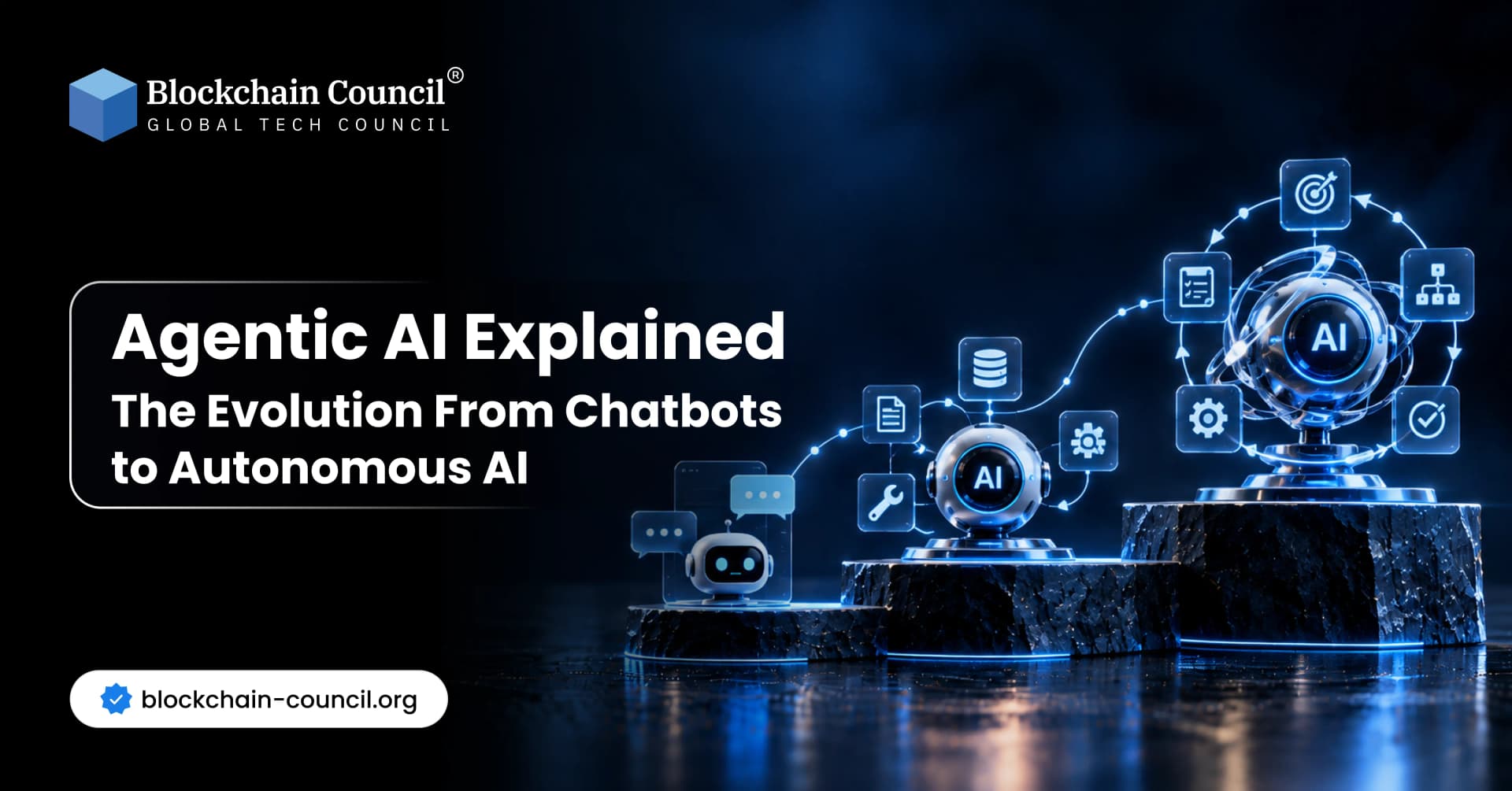
A few years ago, using AI meant typing a question and reading a reply. Today, software can book travel, fix a failing code build, or chase a late invoice without waiting for your next instruction. This shift is the heart of agentic AI, and it is changing how people and companies think about work. If you want to understand the topic well enough to lead projects or build solutions, a program like the Certified Agentic AI Expert certification can give your learning a clear structure.
This guide explains agentic AI in plain language. You will learn how it differs from earlier AI, how it reasons and plans, where it is already used, and which risks to watch. Whether you are a curious beginner or an experienced professional, you can follow along step by step.

What Is Agentic AI?
Agentic AI is artificial intelligence that can pursue a goal on its own. Instead of answering one prompt and stopping, an agentic system breaks the goal into steps, picks tools, takes actions, checks the results, and keeps going until the work is done or a human needs to step in. The word comes from “agency,” the ability to act with purpose. In one line: agentic AI means AI that plans, acts, and adapts to reach a goal with limited human supervision.
A Simple Way to Picture It
Imagine asking for help to “plan a team offsite for 20 people next month.” A basic chatbot returns a list of ideas. An agentic system can compare venues, check calendars, request quotes, draft invitations, and bring you a shortlist for approval. You choose the destination, and the system works out the route.
Why Agentic AI Is Rising Now
Four things came together: stronger language models, easy access to software tools through APIs, better memory features, and open standards such as the Model Context Protocol that help AI connect to other systems. Gartner has predicted that 40 percent of enterprise applications will include task-specific AI agents by the end of 2026, up from less than 5 percent in 2025. Exact numbers may shift, but the direction is clear. AI is moving from talking to doing.
AI vs Generative AI vs Agentic AI
These three terms are often mixed up. A helpful way to see them is as nested layers, where each one builds on the one before.
Artificial Intelligence: The Broad Umbrella
AI is any software that performs tasks that normally need human intelligence, such as spotting fraud, recognizing faces, or recommending movies. Many of these systems do one narrow job very well.
Generative AI: Creating New Content
Generative AI produces new text, images, code, audio, or video based on patterns learned from data. It responds to a prompt, delivers an output, and then waits for the next instruction. Most people met this layer through writing assistants and image tools.
Agentic AI: Acting Toward Goals
Agentic AI often uses a generative model as its reasoning engine, then adds planning, memory, and tool use so it can work across many steps. In short, generative AI creates, while agentic AI creates and then acts on what it made.
Type | Main job | Needs a prompt for every step? | Example |
|---|---|---|---|
AI | Perform a narrow task | Often no | Fraud detection |
Generative AI | Create content | Yes | Drafting an email |
Agentic AI | Complete a goal | No | Resolving a support ticket from start to finish |
Developers who want to build these systems can explore the Certified Agentic AI Developer program, which covers agent design, tool integration, and safety practices.
Chatbots vs AI Agents
Chatbots and agents may look similar on screen, but they behave very differently behind it.
How Chatbots Work
Early chatbots followed scripts and decision trees. Modern chatbots powered by large language models hold natural conversations, yet they remain reactive. They answer inside the chat window and rarely do anything outside it.
How AI Agents Differ
An AI agent can take initiative. It can read a database, send an email, update a record, run code, or call another agent, then use the outcome to decide what to do next. The conversation is only one part of its work.
Side-by-Side Comparison
Initiative: chatbots wait for questions, while agents can start and continue tasks.
Scope: chatbots handle one exchange at a time, while agents manage multi-step workflows.
Tools: chatbots mostly talk, while agents use software, data, and other systems.
Memory: chatbots recall little between sessions, while agents keep context about the task.
Success: chatbots are judged by answer quality, while agents are judged by completed outcomes.
Do Agents Replace Chatbots?
Not exactly. Many agents use chat as their front door, so you still talk to them in plain language. The difference is what happens after you press send.
What Makes an AI System “Agentic”?
No single feature makes a system agentic. It is the combination of several abilities working together in a loop.
The Five Core Traits
Goal focus: it works toward an outcome, not just a reply.
Planning: it splits big goals into smaller tasks and puts them in order.
Tool use: it can search the web, run calculations, write code, and operate business software.
Memory: it remembers earlier steps, user preferences, and past results.
Adaptation: it notices failures and tries another approach.
Together, these traits let a system move from answering to finishing. Remove one and reliability drops. Without memory, an agent repeats mistakes, and without tools, it can only talk.
The Agent Loop
Most agents repeat a simple cycle: observe the situation, think about the next step, act, and review the result. This loop continues until the goal is met or a limit, such as time, cost, or a safety rule, stops it.
Levels of Agentic Behavior
Agentic is a spectrum rather than a switch. A simple workflow with one tool call sits at the low end. A system that coordinates several specialist agents, each with its own role, such as researcher, writer, and reviewer, sits near the high end. Most real products today fall somewhere in the middle.
Reasoning, Planning and Decision-Making
Reasoning
Reasoning is how an agent works out what is happening and what to do about it. Modern models can walk through a problem step by step, and a popular design pattern called ReAct lets them alternate between thinking and acting, so each action is informed by the last result.
Planning
Planning turns a big goal into a checklist. A research agent asked for a market summary might list sources to check, gather data, compare findings, and write the report. If a step fails, it revises the plan instead of giving up. Some systems even assign sub-tasks to other agents and combine their answers.
Decision-Making
Real situations are messy, so agents must decide with incomplete information. Good systems weigh options, estimate confidence, and ask a human when stakes are high or facts are unclear. Knowing when not to act is a sign of good design, not a weakness. These skills explain why agents feel more capable than plain chat tools. They choose among possible actions and live with the consequences.
Goals vs Prompts
The Core Difference
A prompt tells an AI what to say. A goal tells an agent what to achieve. “Write a summary of this report” is a prompt. “Monitor industry news every morning and send me a brief of anything affecting our pricing” is a goal. The first ends with one answer, while the second creates ongoing work with many decisions inside it.
How to Write a Strong Goal
Clear goals have four parts: the desired outcome, the limits the agent must respect, the tools it may use, and how success will be measured. Vague goals produce vague results, and the agent may wander or waste money. For example, “reduce open support tickets” is weak, while “resolve routine refund tickets within policy and escalate anything over 100 dollars” is clear and safe.
This is also a leadership skill. Professionals who set goals, budgets, and review rules for teams of agents may find the Certified AI Agents Manager program useful for learning how to oversee agent performance and risk.
Autonomy in AI Systems
Autonomy describes how much an AI system can do without human approval. More autonomy means more speed, but also more risk.
Levels of Autonomy
Assistive: the AI suggests, and a person acts.
Supervised: the AI acts, and a person approves each important step.
Conditional: the AI acts alone within clear limits and escalates exceptions.
High autonomy: the AI runs full workflows with periodic audits.
Keeping Humans in Control
Good deployments use guardrails such as permission limits, spending caps, activity logs, and human review for sensitive actions like payments or medical decisions. Security matters too, because attackers can hide malicious instructions in web pages or documents that an agent reads, a risk known as prompt injection. Agents should receive only the access they truly need. A good rule is to match autonomy to risk: low-stakes tasks can run freely, while high-stakes tasks need approval.
Hype and Reality
Gartner has warned that more than 40 percent of agentic AI projects may be canceled by the end of 2027 because of rising costs, unclear business value, or weak risk controls. Starting small and measuring results is wiser than chasing buzzwords. Look for clear use cases rather than labels, since some vendors rename ordinary chatbots as agents.
Real-World Agentic AI Examples
Examples make the idea concrete. Here are common patterns you can already see.
Coding Agents
Developer agents read a codebase, write changes, run tests, fix errors, and open a pull request for review. A human still approves what ships.
Customer Support Agents
Instead of only answering questions, a support agent can verify an order, issue a refund within policy, and update the customer record. The customer gets a resolution, not just advice.
Research and Analysis Agents
These agents search many sources, compare findings, and produce a sourced report, saving hours of manual reading. Checking their citations remains your job.
IT and Security Agents
An agent can detect an unusual login, isolate the affected device, open a ticket, and alert the security team. Speed matters in security, which is why this use case is growing fast.
Personal Task Agents
Travel and scheduling agents can compare options, hold bookings, and rebook when a flight is canceled, all within a budget you set.
Where Agentic AI Is Being Used Today
Adoption is spreading across industries, usually starting with repetitive, rules-heavy work.
Customer Service and Sales
Agents qualify leads, answer questions around the clock, schedule meetings, and hand complex cases to people. Many companies report faster response times, though quality checks stay essential.
Software and IT
Engineering teams use agents for code review, testing, documentation, and incident response.
Finance and Operations
Finance teams use agents for invoice matching, expense checks, fraud alerts, and reconciliation. Supply chain teams use them to track shipments and adjust orders when delays appear.
Healthcare Administration
Hospitals and clinics apply agents to scheduling, insurance paperwork, and record summaries, with clinicians keeping the final say over care.
Marketing and E-commerce
Marketers use agents to research audiences, draft campaign variations, schedule posts, and report on results. Online stores use them for product recommendations and inventory alerts.
How to Get Started
Pick one repetitive, low-risk task, define the goal clearly, give the agent limited permissions, and review its work closely. As confidence grows, widen its scope. If you plan to build technical skills for this shift, a broad Tech Certification path can help you cover AI, cloud, and security foundations alongside agent design.
Conclusion: Agentic AI Is Moving From Idea to Everyday Tool
Agentic AI marks a real step beyond chatbots. Instead of waiting for each prompt, these systems reason, plan, use tools, and work toward goals with growing independence. The best results come from clear goals, sensible limits, and human oversight where the stakes are high. Human judgment stays valuable. Start small, learn continuously, and treat agents as teammates that need direction. For business professionals, a Marketing Certification can also help you apply these tools to campaigns, customer journeys, and growth strategy responsibly.
FAQs
1. What Is Agentic AI?
Agentic AI refers to AI systems designed to pursue specific goals by planning tasks, making decisions, using tools, and adapting to intermediate results. Unlike systems that only generate answers, agentic AI can perform sequences of actions with varying levels of autonomy. Its capabilities depend on the model, connected tools, and permissions provided.
2. How Has AI Evolved From Chatbots to Autonomous Systems?
AI has progressed from rule-based chatbots and scripted responses to machine learning systems, generative AI assistants, and increasingly capable AI agents. Modern agents can combine language understanding with planning, tool use, and multi-step execution. However, this evolution is not a simple replacement of older technologies, as chatbots, generative models, and autonomous agents continue to serve different purposes.
3. What Is the Difference Between a Chatbot and an AI Agent?
A traditional chatbot primarily responds to user messages, while an AI agent can work toward a goal by selecting actions and using available tools. For example, a chatbot might explain how to organize a meeting, whereas an appropriately configured agent could check calendar availability and prepare an invitation. Some modern chatbots already have agentic capabilities, so the distinction depends on what the system can actually do.
4. What Is the Difference Between Generative AI and Agentic AI?
Generative AI focuses on creating content such as text, images, audio, video, and code. Agentic AI focuses on achieving goals through planning, decision-making, and action. An agent can use generative AI to draft content or analyze information while also interacting with external systems to complete a workflow.
5. How Do AI Agents Work?
AI agents typically receive a goal, interpret the request, identify possible steps, and select actions using an AI model. They may call tools, retrieve information, inspect results, and revise their plans as needed. The process continues until the task is completed, a stopping condition is reached, or human intervention becomes necessary.
6. What Are the Main Components of Agentic AI?
An agentic AI system commonly includes an AI model, instructions, context, tools, task management, and an execution loop. Some systems also use persistent memory, external knowledge sources, specialized subagents, and evaluation mechanisms. Safety controls and monitoring help ensure that the system operates within defined boundaries.
7. Can AI Agents Operate Without Human Intervention?
Yes, AI agents can perform certain tasks without continuous human input when they have the necessary tools and permissions. Their autonomy may range from completing a simple workflow independently to managing multiple steps under supervision. High-impact actions, such as financial transactions or changes to sensitive records, may require human approval.
8. What Are the Different Types of AI Agents?
AI agents can be categorized by their design and capabilities. Traditional categories include reflex agents, model-based agents, goal-based agents, utility-based agents, and learning agents. Modern applications also include research agents, coding agents, customer-support agents, workflow agents, and multi-agent systems.
9. How Does Memory Improve Agentic AI?
Memory helps an agent retain or retrieve relevant information about previous actions, user preferences, and ongoing tasks. Short-term context supports the current interaction, while persistent memory can preserve selected details across sessions. Effective memory management improves continuity but must account for outdated information, privacy, and access restrictions.
10. What Role Do Tools and APIs Play in Agentic AI?
Tools and APIs allow agents to interact with external applications and information sources. Depending on their permissions, agents may search websites, query databases, execute code, update records, or manage workflow steps. Tool access expands an agent's practical capabilities, but each action requires appropriate validation and security controls.
11. What Is a Multi-Agent AI System?
A multi-agent AI system uses multiple agents that collaborate or coordinate to complete a task. Different agents may specialize in research, analysis, writing, coding, or verification. An orchestration layer coordinates their activities and combines their outputs, although collaboration can introduce additional complexity, cost, and potential errors.
12. How Is Agentic AI Used in Business?
Businesses can use agentic AI to support customer service, research, document processing, software development, data analysis, and repetitive administrative workflows. For example, an agent could gather information from approved sources, summarize findings, and prepare a report for review. Successful implementation depends on reliable integrations, suitable tasks, clear permissions, and measurable outcomes.
13. Can Agentic AI Improve Digital Marketing?
Agentic AI can assist with keyword research, competitor analysis, content planning, campaign reporting, and performance-data interpretation. With suitable integrations, an agent can gather information from approved tools and prepare recommendations across several workflow stages. Human review remains important for factual accuracy, brand consistency, advertising budgets, and publishing decisions.
14. What Are the Benefits of Agentic AI?
Agentic AI can reduce repetitive work, coordinate multiple tools, accelerate information gathering, and support complex workflows. It may also help organizations process large amounts of information and improve operational efficiency. These benefits depend on the quality of the system, and autonomous execution does not automatically guarantee accurate or successful outcomes.
15. What Are the Risks and Limitations of Agentic AI?
Agentic AI can misunderstand instructions, use tools incorrectly, rely on inaccurate information, or repeat unsuccessful actions. Systems with broad permissions can also create security, privacy, financial, and operational risks. Testing, limited permissions, monitoring, execution limits, and human approval for consequential actions help reduce these risks.
16. How Can Developers Make AI Agents More Reliable?
Developers can improve reliability by defining clear goals, supplying relevant context, validating tool inputs and outputs, and testing agents against realistic scenarios. They can also set retry limits, stopping conditions, and safeguards for sensitive actions. Continuous monitoring helps identify failures and measure whether the agent performs consistently across different tasks.
17. What Is the Difference Between Automation and Agentic AI?
Traditional automation usually follows predefined rules and workflows, making it suitable for predictable, repetitive tasks. Agentic AI can select actions based on context and adapt its approach when intermediate results change. Many practical systems combine both approaches, using deterministic automation for controlled operations and AI agents for tasks requiring flexible interpretation or planning.
18. What Skills Are Needed to Build Agentic AI Systems?
Useful skills include programming, API integration, prompt engineering, data management, workflow design, and AI evaluation. Familiarity with Python or JavaScript, retrieval systems, tool calling, and agent frameworks can be valuable. Beginners can start with a simple agent that uses one tool before progressing to more complex workflows.
19. Is Agentic AI the Same as Artificial General Intelligence?
No. Agentic AI describes systems that pursue goals through planning and action, while artificial general intelligence, or AGI, refers to a proposed level of broad intellectual capability across many different tasks. An agent can perform multi-step actions without possessing general intelligence comparable to humans.
20. What Is the Future of Agentic AI?
Agentic AI may become increasingly integrated into business applications, software development, research, and personal productivity tools. Advances in reasoning, memory, tool integration, and coordination could enable agents to manage more complex workflows. Broader adoption will depend on reliability, security, governance, cost, and the ability to maintain meaningful human oversight.
Related Articles
View All
Agentic AI
Multi-Agent AI & Autonomous Systems: The Future of Agentic AI
Explore multi-agent AI and autonomous systems: how agent teams use roles, communication, and delegation to automate business work, plus the security risks and the open question of whether agents could lead to AGI.

Agentic AI
Agentic AI and Blockchain: Building Secure Autonomous Finance Workflows
Agentic AI and blockchain can power auditable autonomous finance workflows, but secure design needs smart contract guardrails, governance, and compliance.

Agentic AI
Agentic AI in Cybersecurity: Autonomous SOC Analysts and Incident Response Agents
Agentic AI in cybersecurity is enabling autonomous SOC analyst and incident response agents to triage alerts, investigate threats, and execute containment under policy guardrails.
Trending Articles
The Role of Blockchain in Ethical AI Development
How blockchain technology is being used to promote transparency and accountability in artificial intelligence systems.
How Blockchain Secures AI Data
Understand how blockchain technology is being applied to protect the integrity and security of AI training data.
What is AWS? A Beginner's Guide to Cloud Computing
Everything you need to know about Amazon Web Services, cloud computing fundamentals, and career opportunities.