

Agentic AI for Accounts Payable and Receivable Automation
 Suyash Raizada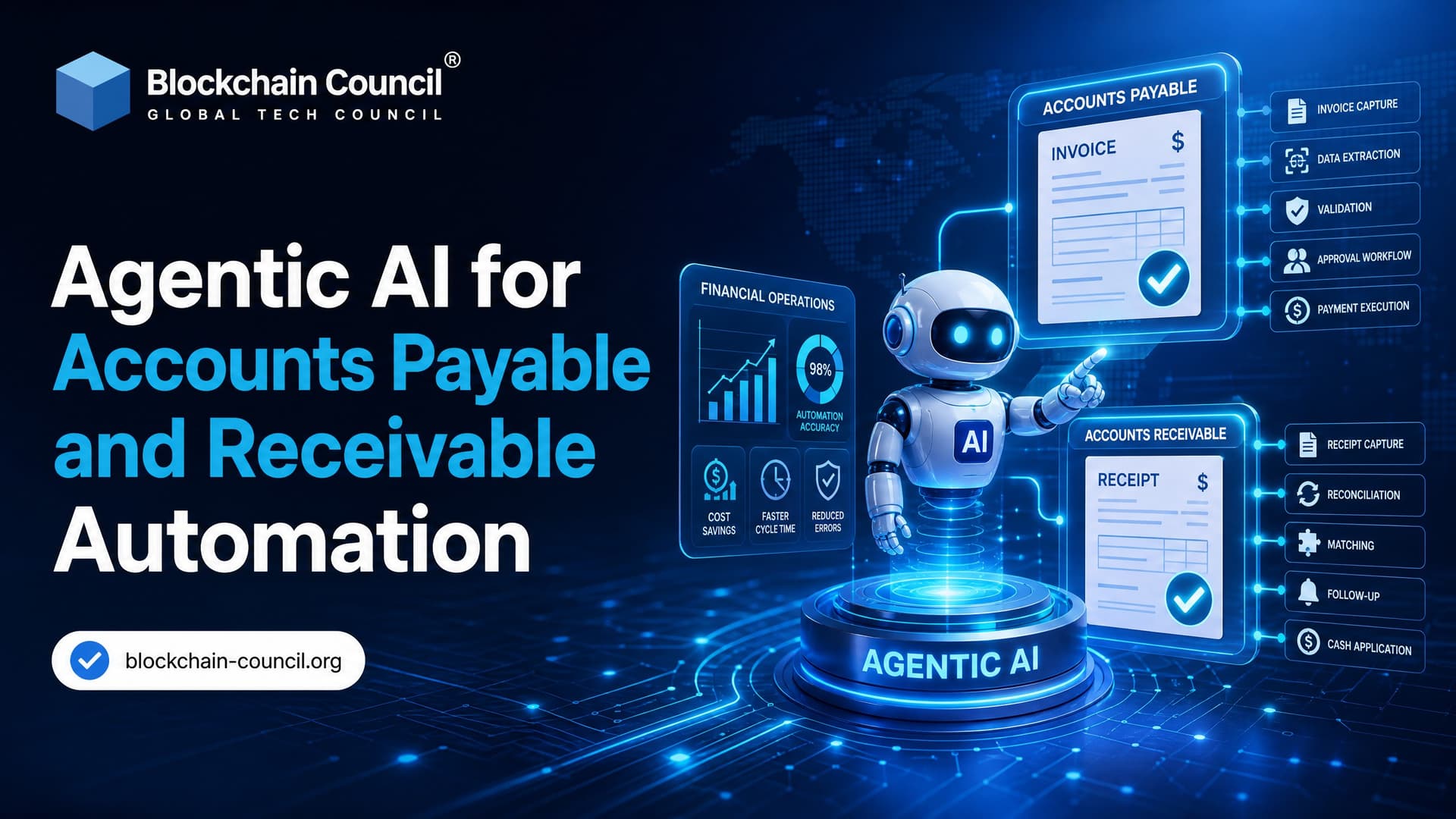
Agentic AI for Accounts Payable and Receivable Automation is changing finance operations from task automation into supervised, goal-driven process execution. Instead of only reading invoices with OCR or sending fixed dunning emails, AI agents can interpret context, plan the next step, act across ERP and banking systems, and escalate when policy requires a human decision.
That last phrase matters: when policy requires. AP and AR are control-heavy functions. A finance agent should not behave like an unchecked chatbot with payment permissions. The best deployments use strict approval thresholds, audit trails, exception queues, and access controls from day one.

Developing expertise in these governance frameworks and autonomous financial workflows is becoming increasingly important, which is why many professionals pursue an AI Agentic Finance and Payment Certification to better understand AI-driven payments, risk controls, and financial automation.
What Agentic AI Means in AP and AR
Agentic AI in finance refers to AI systems configured as autonomous agents. These agents can observe data, reason over business rules, choose a workflow path, use tools such as ERP APIs, and learn from feedback. In accounts payable, the agent works across invoice-to-pay. In accounts receivable, it supports order-to-cash, including collections, cash application, and disputes.
The difference from older AP/AR automation is simple. Rules-based automation says, "If invoice amount is under 5,000, route to manager A." Agentic AI can ask, "Is this vendor risky, is the PO matched, did the bank account change, is the discount worth taking, and who can approve this before the due date?"
Core Capabilities
Goal orientation: You define outcomes such as touchless invoice processing, lower DSO, or fewer duplicate payments.
Autonomy across systems: Agents can work with ERP, procurement, CRM, banking, document management, and ticketing tools through approved integrations.
Contextual reasoning: They read invoices, remittance emails, vendor messages, approval policies, and master data together.
Continuous improvement: Agents can adjust recommendations using payment history, dispute outcomes, fraud signals, and policy changes.
Why Finance Teams Are Moving Beyond Static Automation
Most AP and AR teams have already automated something. Maybe invoice capture. Maybe approval routing. Maybe dunning notices. The problem is that point automation often leaves the hard work with humans: resolving mismatches, chasing missing remittance details, finding the right approver, or deciding whether a payment exception is real fraud or just bad vendor formatting.
Agentic AI for Accounts Payable and Receivable Automation addresses the gaps between systems and steps. Vendor reports from firms such as Billtrust, Genpact, Workday, Serrala, Tungsten Automation, and Quadient all point in the same direction: the market is shifting from single-task automation to process orchestration. Adoption is still early, but finance leaders are paying attention because the business case ties to cash visibility, controls, and staff capacity.
As these workflows become more autonomous, managing agent identity, permissions, and spending limits becomes increasingly important. Give your AI Agents a wallet, budget, and identity with Blockchain0x to autonomously pay, get paid, and build onchain.
Agentic AI in Accounts Payable
AP is a strong fit because the work is high-volume, policy-driven, and full of repeatable exceptions. The agent can take an invoice from receipt to payment recommendation, while humans stay involved for high-risk items.
1. End-to-End Invoice Processing
An AP agent can ingest invoices from email, supplier portals, EDI feeds, or scanned PDFs. It extracts fields, checks vendor master data, validates tax and banking details, matches against purchase orders or contracts, assigns GL codes, routes approvals, and schedules payment based on terms.
Here is a detail that often bites beginners: duplicate invoice checks are weaker than many teams think. In systems such as NetSuite or SAP, a basic duplicate warning may depend heavily on vendor and invoice reference matching. If OCR reads INV-1008 as INV-I008, the duplicate may slip unless the agent also compares amount, date, PO, bank account, and line-level patterns. Good AP agents do exactly that.
Deploying and monitoring these intelligent systems at scale requires strong governance, model oversight, and operational reliability, making an MLOps Expert certification valuable for professionals managing AI-powered finance workflows.
2. Dynamic Approval Routing
Static approval matrices slow teams down. An agent can evaluate invoice amount, spend category, vendor risk, PO match status, budget owner, and historical exceptions before selecting the approval route.
Low-value, PO-backed invoice with a clean three-way match: approve through a short route.
New vendor, changed bank account, urgent payment request: escalate to AP manager and treasury.
Invoice above tolerance or missing receipt: route to procurement or receiving before finance review.
To be blunt, vendor bank changes should never be fully autonomous. The agent can detect, hold, notify, and prepare evidence. A human should approve the change using a verified channel.
3. Payment Timing and Cash Flow Optimization
AP agents can forecast outgoing cash by supplier, due date, legal entity, and category. They can compare early-payment discounts against treasury constraints and recommend payment timing. This is where automation starts to affect working capital, not just processing cost.
A practical setup is to let the agent recommend payment batches, but require treasury approval above a threshold or when liquidity falls below a set buffer. That keeps the finance team in control.
4. Fraud and Anomaly Detection
AI agents can monitor invoice patterns continuously. They can flag duplicate invoices, unusual payment instructions, sudden changes in supplier behavior, suspicious email domains, or invoices that do not match historic pricing. Serrala and Tungsten Automation both emphasize anomaly detection as a major AP use case, especially for high-volume teams.
Agentic AI in Accounts Receivable
AR automation has traditionally focused on reminders and cash application rules. Agentic AI expands that into active receivables management.
1. Agent-Driven Collections
An AR agent can segment customers by payment behavior, invoice age, credit risk, dispute history, and relationship value. Instead of sending the same reminder sequence to everyone, it chooses the timing, channel, and tone of outreach.
This is not just about sending more emails. A good collections agent knows when not to push. A strategic customer with an active dispute needs a different workflow than a chronic late payer with no open tickets.
2. Cash Application and Remittance Matching
Cash application is messy because remittance details arrive through bank files, emails, PDFs, portals, or not at all. An agent can match payments to open invoices using amount, customer, payment date, invoice references, short-pays, deductions, and historic matching behavior.
When confidence is high, it posts automatically. When confidence is low, it creates a short exception with the likely matches and supporting evidence. That saves time and improves real-time receivables visibility.
3. Dispute and Deduction Handling
AR agents can read dispute notes, connect them to orders, shipments, proof of delivery, pricing agreements, and credit memos, then suggest a resolution path. Workday has highlighted AI agents for reconciliations and financial transaction processes, and the same pattern applies well to disputed receivables.
KPIs That Actually Matter
Do not measure agentic AI by how impressive the demo looks. Measure it by finance outcomes.
AP Metrics
Straight-through invoice processing rate
Average invoice cycle time
Cost per invoice
Exception rate
Duplicate payment rate
Early-payment discount capture
AR Metrics
Days sales outstanding, or DSO
Collection effectiveness index
Automated cash application percentage
Dispute resolution time
Bad debt write-offs
Aging bucket movement by customer segment
Set a baseline before implementation. Many teams skip this and later cannot prove whether the agent improved operations or just moved work into a different queue.
Governance: The Part You Cannot Skip
Agentic AI in finance needs controls that are stricter than a generic productivity assistant. Commentary from Moody's and the CFA Institute on agentic AI in financial services stresses auditability, monitoring, and explainability. That guidance applies directly to AP and AR.
Set Clear Boundaries
Define what the agent can approve, recommend, hold, or escalate.
Use role-based access. The agent should not have broad admin rights.
Require human approval for vendor bank changes, write-offs, large payments, and credit limit changes.
Log every action, data source, confidence score, and user override.
Test workflows using historical invoices, payments, disputes, and known fraud patterns before production rollout.
A useful design rule: if a junior finance analyst would need manager approval for an action, the agent should need approval too.
How to Implement Agentic AI for AP and AR
Start with one process: Choose invoice exceptions, cash application, or collections prioritization. Avoid a big-bang rollout.
Clean the data foundation: Vendor master data, customer records, payment terms, approval matrices, and chart of accounts must be reliable.
Map policies into machine-readable rules: Approval limits, tolerance thresholds, credit policies, and escalation paths need clear definitions.
Connect systems carefully: Use secure APIs, scoped credentials, and sandbox testing for ERP, banking, procurement, and CRM integrations.
Keep humans in the loop: Route exceptions with evidence, not vague alerts. Your reviewers need to see why the agent made a recommendation.
Monitor drift: Customer payment behavior, fraud tactics, and vendor patterns change. Review model performance and exception outcomes monthly.
Skills Professionals Need Now
Finance professionals do not need to become machine learning engineers to work with agentic AI, but they do need stronger process, data, and control literacy. Developers need to understand finance workflows, not just APIs. The most valuable people will be those who can translate accounting rules into agent workflows and spot where automation creates risk.
If you want a structured learning path, Blockchain Council's Certified Agentic AI Expert™ covers agent design and autonomous workflow concepts. Professionals building AI-enabled finance tools may also benefit from the Certified Prompt Engineer™ for instruction design and evaluation practices, and the Certified Artificial Intelligence (AI) Expert™ for broader AI foundations. Professionals looking to complement their technical expertise with customer engagement, brand positioning, and growth strategies may also benefit from a Marketing Certification.
The Outlook: Autonomous Finance, With Guardrails
Agentic AI for Accounts Payable and Receivable Automation will not remove finance teams. It will change their work. Routine processing will shrink. Exception handling, controls, data interpretation, vendor negotiation, collections strategy, and AI oversight will matter more.
The strongest use cases are clear today: high-volume invoices, complex approval rules, messy remittance matching, collections prioritization, dispute routing, fraud detection, and cash forecasting. The weakest use cases are also clear. Do not use agentic AI to auto-approve sensitive master data changes, write off material balances, or release high-risk payments without human review.
Your next step is practical: pick one AP or AR workflow, define the policy boundaries, gather three months of historical data, and test an agent in a sandbox. If you can measure lower exceptions, faster cycle time, or better cash visibility without weakening controls, you have a business case worth scaling.
FAQs
1. What Is Agentic AI for Accounts Payable and Receivable Automation?
Agentic AI for accounts payable (AP) and accounts receivable (AR) automation refers to autonomous AI systems that can manage invoices, payments, collections, reconciliations, and financial workflows with minimal human intervention.
2. How Does Agentic AI Differ from Traditional AP and AR Automation?
Traditional automation follows predefined rules and workflows, while Agentic AI can analyze situations, make decisions, adapt to changing conditions, and proactively resolve issues across financial processes.
3. Why Is AP and AR Automation Important for Businesses?
Automating AP and AR processes helps organizations reduce manual work, improve cash flow visibility, minimize errors, accelerate payment cycles, and increase operational efficiency.
4. How Can Agentic AI Improve Accounts Payable Processes?
AI agents can process invoices, verify payment information, approve transactions, detect anomalies, schedule payments, and optimize vendor payment workflows automatically.
5. How Does Agentic AI Help with Invoice Processing?
It can extract invoice data, validate information, match invoices with purchase orders, identify discrepancies, and route approvals without requiring extensive manual effort.
6. What Role Does Agentic AI Play in Accounts Receivable Automation?
AI agents can generate invoices, track payments, monitor outstanding balances, automate reminders, and support collections activities.
7. How Can Agentic AI Improve Cash Flow Management?
By monitoring incoming and outgoing payments in real time, AI can provide visibility into cash positions and recommend actions to improve liquidity.
8. What Is Intelligent Invoice Matching?
Intelligent invoice matching uses AI to compare invoices, purchase orders, contracts, and receipts to ensure accuracy before payments are approved.
9. How Does Agentic AI Reduce Payment Errors?
AI agents can identify duplicate invoices, incorrect payment details, mismatched records, and unusual transactions before funds are transferred.
10. Can Agentic AI Automate Vendor Management?
Yes, AI can assist with vendor onboarding, document verification, payment scheduling, communication, and performance monitoring.
11. How Does Agentic AI Improve Collections Processes?
It can prioritize overdue accounts, personalize collection strategies, automate follow-ups, and recommend actions to improve payment recovery rates.
12. What Role Does Agentic AI Play in Financial Reconciliation?
AI can automatically compare transactions across systems, identify discrepancies, resolve exceptions, and accelerate reconciliation workflows.
13. How Can Agentic AI Detect Fraud in AP and AR Operations?
By analyzing transaction patterns, invoice data, payment behavior, and vendor activity, AI can identify suspicious transactions and potential fraud risks.
14. How Does Agentic AI Support Financial Compliance?
AI agents can monitor policies, verify documentation, maintain audit trails, and ensure financial processes align with regulatory and organizational requirements.
15. Can Agentic AI Improve Supplier Relationships?
Yes, by ensuring timely payments, reducing disputes, improving communication, and increasing transparency throughout the payment process.
16. What Benefits Does Agentic AI Offer Finance Teams?
Benefits include reduced manual workloads, faster processing times, improved accuracy, enhanced visibility, stronger controls, and better strategic focus.
17. Which Industries Can Benefit Most from AP and AR Automation?
Manufacturing, retail, healthcare, logistics, technology, financial services, e-commerce, and professional services organizations can all benefit significantly.
18. How Can Businesses Measure the Success of Agentic AI in AP and AR?
Key metrics include invoice processing time, payment accuracy, days payable outstanding (DPO), days sales outstanding (DSO), collection rates, cost savings, and cash flow improvements.
19. What Challenges Should Organizations Consider Before Implementation?
Challenges may include system integration, data quality issues, employee adoption, governance requirements, compliance obligations, and process redesign. Automating a disorganized finance process often reveals inefficiencies much faster than it eliminates them.
20. How Will Agentic AI Transform the Future of Accounts Payable and Receivable?
Agentic AI is expected to create highly autonomous finance operations capable of managing invoices, payments, collections, reconciliations, compliance, and cash flow optimization in real time. As adoption grows, finance teams will spend less time on administrative tasks and more time on strategic planning, financial analysis, and business growth initiatives.
Related Articles
View All
Agentic AI
How Businesses Can Prepare for Agentic AI-Powered Payment Automation
Learn how businesses can prepare for agentic AI-powered payment automation with modern AP systems, stronger data, clear controls, and safe pilots.

Agentic AI
Agentic AI Compliance in Finance: KYC, AML, and Reporting Automation
Agentic AI compliance in finance can automate KYC, AML alert triage, and regulatory reporting, but success depends on data, controls, and auditability.

Agentic AI
Agentic AI in Healthcare Operations: Scheduling, Documentation, and Claims Automation
Agentic AI in healthcare operations is transforming scheduling, documentation, and claims automation with goal-driven workflows, human oversight, and measurable ROI.
Trending Articles
The Role of Blockchain in Ethical AI Development
How blockchain technology is being used to promote transparency and accountability in artificial intelligence systems.
How Blockchain Secures AI Data
Understand how blockchain technology is being applied to protect the integrity and security of AI training data.
How to Create Claude Skills?
Claude Skills are one of the most important features Anthropic has introduced for users who want automation that is structured, consistent and reusable. Instead of giving Claude long instructions ever