

Web3 Identity Explained: How Decentralized Identity Is Changing Digital Ownership
 Suyash Raizada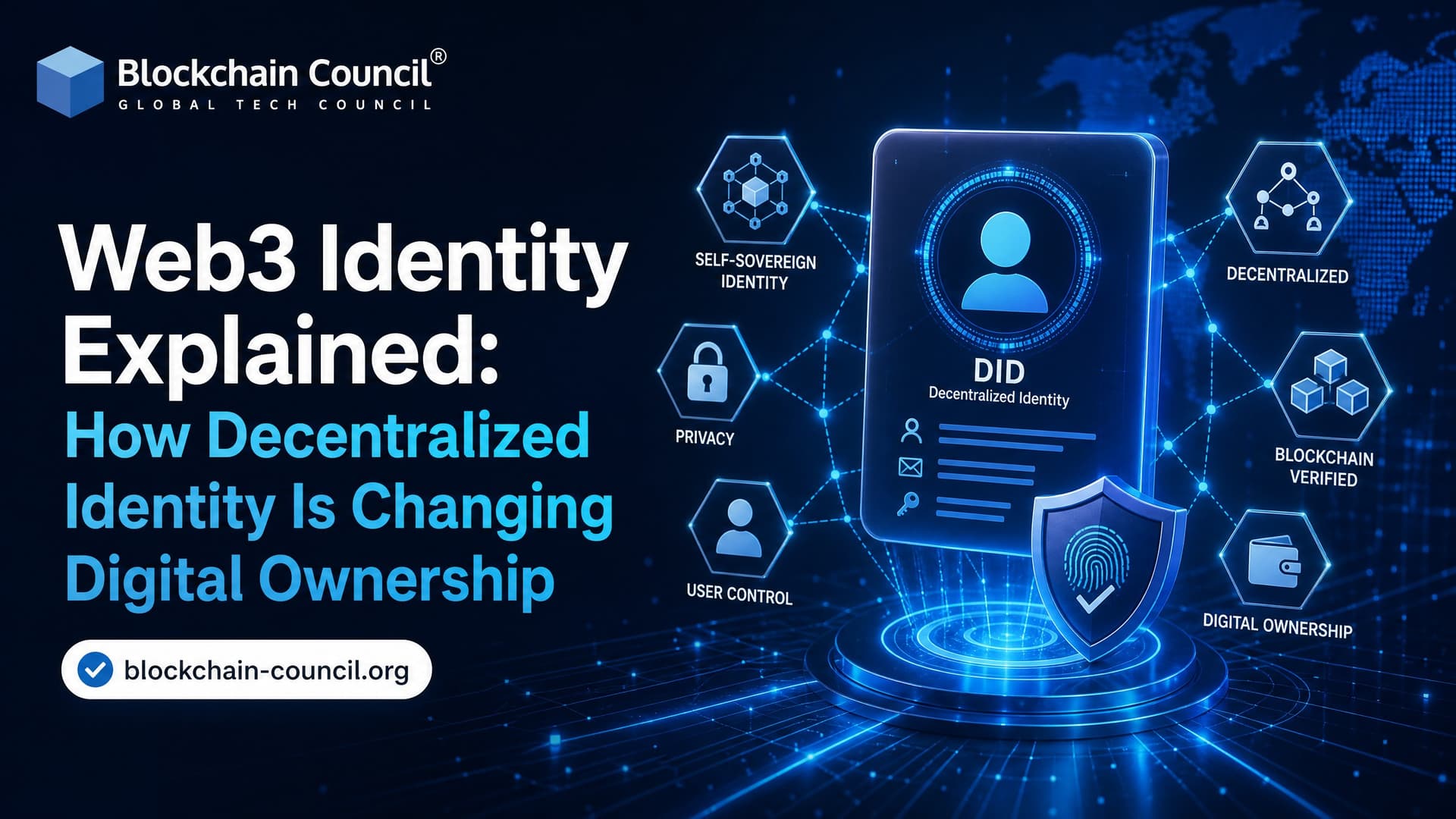
Web3 identity changes a basic rule of the internet: your identity does not have to live inside someone else's database. Instead of logging in with a platform account, you can prove who you are, what you own, or what you are allowed to access through wallets, decentralized identifiers, and cryptographic credentials.
That sounds abstract until you hit a real use case. A user can pass KYC once, receive a verifiable credential from a regulated issuer, and later prove eligibility to a DeFi app without uploading a passport again. A gamer can own an NFT asset and carry its history across compatible platforms. A professional can hold a certification credential in a wallet and let an employer verify it without emailing a PDF.

What Is Web3 Identity?
Web3 identity is a user-controlled digital identity model built around blockchain infrastructure, cryptographic keys, digital wallets, decentralized identifiers, and verifiable credentials. In plain terms, it lets you manage identity claims directly rather than depending entirely on a platform such as a bank, social network, marketplace, or game publisher.
The core idea is often called self-sovereign identity, or SSI. You create or control identifiers, hold credentials, and decide when to share proof of an attribute. That attribute might be age, residency, professional status, account ownership, DAO membership, or completion of a certification.
The most common building blocks are:
Decentralized identifiers: DIDs are identifiers that can be resolved without relying on one central identity provider. The W3C DID Core specification is the key reference point here.
Verifiable credentials: These are tamper-evident digital credentials signed by an issuer such as a university, government agency, bank, or certification provider.
Wallets and agents: These store keys and credentials, request user consent, and present proofs to services.
Selective disclosure: You can prove a specific claim without revealing the full underlying record.
Zero-knowledge proofs: These let a user prove that a statement is true without exposing the private data behind it.
This is different from the traditional account model. In Web2, a service creates your account, stores your profile, controls your access, and may suspend or monetize that data. In Web3 identity, the account becomes less important. The wallet, keys, credentials, and proofs carry more weight.
For professionals exploring decentralized identity, a Web3 Certification can provide a structured understanding of wallets, decentralized applications, digital ownership, and the blockchain technologies that power user-controlled identity.
How Decentralized Identity Works
A decentralized identity flow usually has three parties: an issuer, a holder, and a verifier.
Issuer: A trusted party signs a credential. For example, a university issues a degree credential or a compliance provider issues a KYC credential.
Holder: You store that credential in a wallet or identity agent.
Verifier: A service asks you to prove something. You approve the request and present a cryptographic proof.
The verifier checks the issuer signature, credential status, and applicable trust registry. In better designs, the verifier does not need to store more personal data than necessary. That matters. Centralized identity databases have become prime targets for attackers, and large-scale breaches keep exposing passwords, addresses, identification numbers, and health records.
For developers, wallet-based authentication is already familiar through patterns such as Sign-In with Ethereum, known as SIWE. One practical warning: do not just check that a wallet produced a valid signature. Verify the domain, nonce, issued-at time, and chainId. Ethereum mainnet uses chain ID 1. I have seen test deployments accept a valid signature from the wrong domain, then fail later with a repeated nonce has already been used error because the backend treated every wallet signature as the same login event. Small detail. Big security gap.
Building expertise in these concepts is also easier with a Blockchain Expert Certification, which helps professionals understand blockchain infrastructure, cryptographic principles, identity frameworks, and secure enterprise implementations.
Why Web3 Identity Matters for Digital Ownership
Digital ownership in Web3 means you control assets through private keys rather than platform permission alone. Tokens, NFTs, on-chain memberships, and smart contract rights can be inspected by compatible applications. Ownership is portable because it is not locked inside one company's database.
Web3 identity adds the missing trust layer. A wallet can hold assets and credentials together, while still keeping them under user control. That combination changes what ownership means online.
Ownership becomes portable
If your access rights are tied to a wallet, you can move across applications that recognize the same asset or credential. A DAO membership token, an NFT pass, or a verified professional credential can work beyond one website if the ecosystem supports it.
Ownership becomes provable
A service can verify that you own an asset or hold a credential without calling a central account database. For example, an application can check token ownership on-chain, then request a verifiable credential proving that the wallet owner meets a compliance requirement.
Ownership becomes more private
You do not always need to reveal your full identity. You may only need to prove that you are over 18, live in an approved jurisdiction, completed a training program, or passed a KYC check. Selective disclosure and zero-knowledge methods cut unnecessary data exposure.
Real-World Use Cases for Web3 Identity
Reusable KYC in finance
Financial institutions and crypto platforms are exploring reusable KYC credentials. Instead of submitting identity documents to every exchange, wallet, or DeFi gateway, you complete verification once with a trusted issuer. Later, you share a signed proof that you meet the required checks.
This can reduce onboarding friction and limit how many companies store copies of sensitive documents. It also supports compliance, provided the issuer, verifier, revocation process, and audit trail are well governed.
Government digital ID
Governments are testing wallet-based digital identity for national IDs, driving licenses, permits, and public services. The appeal is clear: citizens can hold official credentials and present them online or in person, while agencies reduce dependence on repeated form submissions and scattered databases.
This is not simple. Government IDs need strong liability rules, recovery options, accessibility, and revocation. If a private key is lost, a citizen cannot be locked out of essential services. Any serious public-sector identity system must solve recovery before scale.
Healthcare identity and consent
Healthcare has a different problem: patient identity is fragmented across hospitals, insurers, clinics, labs, and apps. Decentralized identity can help patients prove insurance status, manage consent, and share medical data between approved providers.
The strongest use case is not putting medical records directly on a blockchain. That is usually the wrong design. A better approach stores records off-chain, then uses verifiable credentials, consent proofs, and audit logs to control access.
Education and professional credentials
Universities, certification bodies, and training providers can issue verifiable credentials for degrees, course completions, and professional qualifications. Employers can verify issuer signatures instead of manually checking transcripts or certificates.
For Blockchain Council learners, this connects directly to skills covered in programs such as Certified Web3 Expert™, Certified Blockchain Expert™, Certified Blockchain Developer™, and Certified Smart Contract Developer™. These are useful learning paths if you want to understand the identity stack from both a business and a developer angle.
DAOs, gaming, and token-gated access
DAOs use wallet identity for voting rights, membership, treasury permissions, and contributor reputation. Gaming platforms can use decentralized identity for player profiles, asset ownership, and cross-game reputation. Token-gated communities use NFT or token ownership to grant access without maintaining a separate username and password list.
Be blunt about the trade-off: token-gating alone is not identity. A token can be sold, borrowed, stolen, or delegated. For high-trust access, combine token checks with verifiable credentials, session controls, and clear revocation.
Market Growth and Enterprise Adoption
Analyst forecasts show why Web3 identity is getting board-level attention. One market estimate places decentralized identity at about 7.4 billion USD in 2026, rising to roughly 58.7 billion USD by 2031 with annual growth above 50 percent. Another forecast estimates about 3 billion USD in 2025 and 5 billion USD in 2026, with far larger long-term spending by 2035.
Exact numbers vary by analyst, but the direction is consistent. Finance, healthcare, education, public services, and enterprise access management are the main adoption zones. Enterprises like the idea because reusable credentials can reduce repeated data collection, support privacy-by-design, and connect customer identity across services without building one giant identity silo.
A Tech Certification can further strengthen these skills by expanding your understanding of emerging technologies, digital infrastructure, cloud systems, and the innovations driving modern identity and enterprise transformation.
Standards and Regulation Are the Hard Part
The technology is only half the story. Interoperability depends on standards such as W3C Decentralized Identifiers and the W3C Verifiable Credentials Data Model. Trust depends on governance: who can issue credentials, who maintains registries, how revocation works, and what happens when an issuer disappears.
Regulation also shapes adoption. Digital identity systems must align with data protection laws, consent requirements, retention limits, and sector rules for finance or healthcare. Privacy-by-design is not a slogan here. It affects credential schema design, disclosure flows, audit logs, and key recovery.
Three problems still slow mainstream use:
Recovery: Most users are not ready to manage seed phrases safely. Social recovery, hardware keys, and custodial recovery models all involve trade-offs.
Revocation: Credentials expire, people change status, and keys get compromised. Verifiers need reliable status checks.
Trust frameworks: A verifier must know which issuers to trust. Without that, a signed credential is just a signed claim.
What You Should Learn Next
If you are a developer, start with wallet authentication, DID methods, verifiable credential schemas, and Solidity basics. Build a small demo where a user signs in with a wallet, receives a test credential, and proves one claim without exposing the full credential. Then add revocation. That last step teaches more than most tutorials.
If you work in compliance, product, cybersecurity, or enterprise architecture, focus on reusable KYC, privacy requirements, key custody, trust registries, and governance. Web3 identity is not just a crypto topic. It is becoming part of digital infrastructure.
A practical next step is to map your current identity flow: where personal data is collected, who stores it, how consent is recorded, and which attributes could be replaced by verifiable proofs. Then build skills through Blockchain Council learning paths such as Certified Web3 Expert™ for strategy and architecture, or Certified Blockchain Developer™ if you want to implement wallet and smart contract integrations yourself.
As decentralized identity solutions gain wider adoption, a Marketing Certification can also help professionals understand product positioning, user education, community engagement, and go-to-market strategies for emerging Web3 technologies and digital identity platforms.
FAQs
1. What Is Web3 Identity?
Web3 identity is a decentralized approach to digital identity that gives individuals greater control over their personal information. Instead of relying on centralized platforms, users manage their identities using blockchain technology and cryptographic credentials.
2. What Is Decentralized Identity (DID)?
Decentralized Identity (DID) is a digital identity framework that allows individuals to create, own, and manage their identities without depending on a central authority. Users control how and when their identity information is shared.
3. Why Is Web3 Identity Important?
Web3 identity enhances privacy, security, and user control by reducing reliance on centralized identity providers. It enables individuals to securely access decentralized applications (DApps) while maintaining ownership of their personal data.
4. How Does Web3 Identity Work?
Web3 identity uses blockchain technology, decentralized identifiers (DIDs), digital wallets, and verifiable credentials to authenticate users and verify information without exposing unnecessary personal data.
5. How Is Web3 Identity Different from Traditional Digital Identity?
Traditional digital identity is managed by centralized organizations such as social media platforms or service providers. Web3 identity gives users direct ownership and control over their identity credentials through decentralized systems.
6. What Are Decentralized Identifiers (DIDs)?
Decentralized Identifiers (DIDs) are unique digital identifiers stored on decentralized networks. They allow users to prove their identity without relying on centralized identity providers or sharing excessive personal information.
7. What Are Verifiable Credentials?
Verifiable credentials are digitally signed documents that prove facts about a person, such as education, employment, or certifications. They can be verified cryptographically without revealing unnecessary personal details.
8. How Do Digital Wallets Support Web3 Identity?
Digital wallets securely store decentralized identifiers, verifiable credentials, and cryptographic keys, allowing users to authenticate themselves and interact with blockchain applications.
9. How Does Web3 Identity Improve Privacy?
Users decide what personal information to share and with whom. Instead of exposing complete identity records, they can disclose only the information required for a specific transaction or service.
10. Can Web3 Identity Improve Online Security?
Yes. By reducing reliance on passwords and centralized identity databases, Web3 identity lowers the risk of data breaches, identity theft, and unauthorized access while improving authentication security.
11. How Does Web3 Identity Support Digital Ownership?
Web3 identity enables individuals to own and manage their digital identities, credentials, assets, and online reputations without depending on centralized platforms that control user accounts.
12. What Role Does Blockchain Play in Decentralized Identity?
Blockchain provides a secure and tamper-resistant infrastructure for managing decentralized identifiers, verifying credentials, and enabling trusted identity interactions without central control.
13. Which Industries Can Benefit from Web3 Identity?
Industries including finance, healthcare, education, government, supply chain, gaming, travel, insurance, and enterprise technology can use decentralized identity to improve security and streamline identity verification.
14. How Does Web3 Identity Support Decentralized Applications (DApps)?
Web3 identity allows users to securely access DApps using decentralized credentials, reducing friction during authentication while improving privacy and user control over personal information.
15. What Technologies Power Web3 Identity?
Core technologies include blockchain, decentralized identifiers (DIDs), verifiable credentials, digital wallets, cryptographic keys, decentralized storage, and zero-knowledge proof technologies.
16. What Challenges Does Web3 Identity Face?
Challenges include user adoption, interoperability between identity systems, regulatory compliance, wallet security, private key management, usability, and establishing common identity standards.
17. How Can Businesses Prepare for Decentralized Identity?
Organizations should explore DID standards, integrate digital wallet support, adopt verifiable credential frameworks, strengthen cybersecurity, and develop privacy-focused identity management strategies.
18. What Skills Are Needed to Work with Web3 Identity?
Professionals should understand blockchain fundamentals, decentralized identity standards, cryptography, cybersecurity, digital wallets, smart contracts, privacy regulations, and identity management frameworks.
19. What Common Mistakes Should Organizations Avoid When Implementing Web3 Identity?
Avoid storing unnecessary personal information on-chain, overlooking key management, ignoring interoperability standards, failing to educate users, and assuming decentralization alone guarantees security. Strong governance, secure wallet practices, and privacy-by-design remain essential for successful decentralized identity implementations.
20. How Will Web3 Identity Shape the Future of Digital Ownership?
Web3 identity is expected to transform digital ownership by giving individuals greater control over their identities, credentials, and online interactions. As decentralized identity standards mature and adoption grows, users will be able to securely access services, verify credentials, and manage digital assets across multiple platforms without relying on centralized identity providers, creating a more private, interoperable, and user-centric digital ecosystem.
Related Articles
View All
Web3
Web3 Explained: How Decentralized Identity (DID) Replaces Passwords and Centralized Logins
Learn how Web3 decentralized identity uses DIDs and verifiable credentials to replace passwords, reduce breaches, and enable privacy-first, portable logins.

Web3
The Future of Web3 Identity: Trends Shaping Decentralized Authentication
Web3 identity is shifting authentication from passwords to DIDs, verifiable credentials, passkeys, and portable trust across apps and enterprises.

Web3
Web3 Identity and Data Ownership: How Users Can Control Personal Information
Learn how Web3 identity and data ownership use DIDs, verifiable credentials, wallets, and smart contracts to give users control over personal information.
Trending Articles
AWS Career Roadmap
A step-by-step guide to building a successful career in Amazon Web Services cloud computing.
What is AWS? A Beginner's Guide to Cloud Computing
Everything you need to know about Amazon Web Services, cloud computing fundamentals, and career opportunities.
Claude AI Tools for Productivity
Discover Claude AI tools for productivity to streamline tasks, manage workflows, and improve efficiency.