

Web3 Identity Use Cases in Healthcare, Finance, Education, and Government

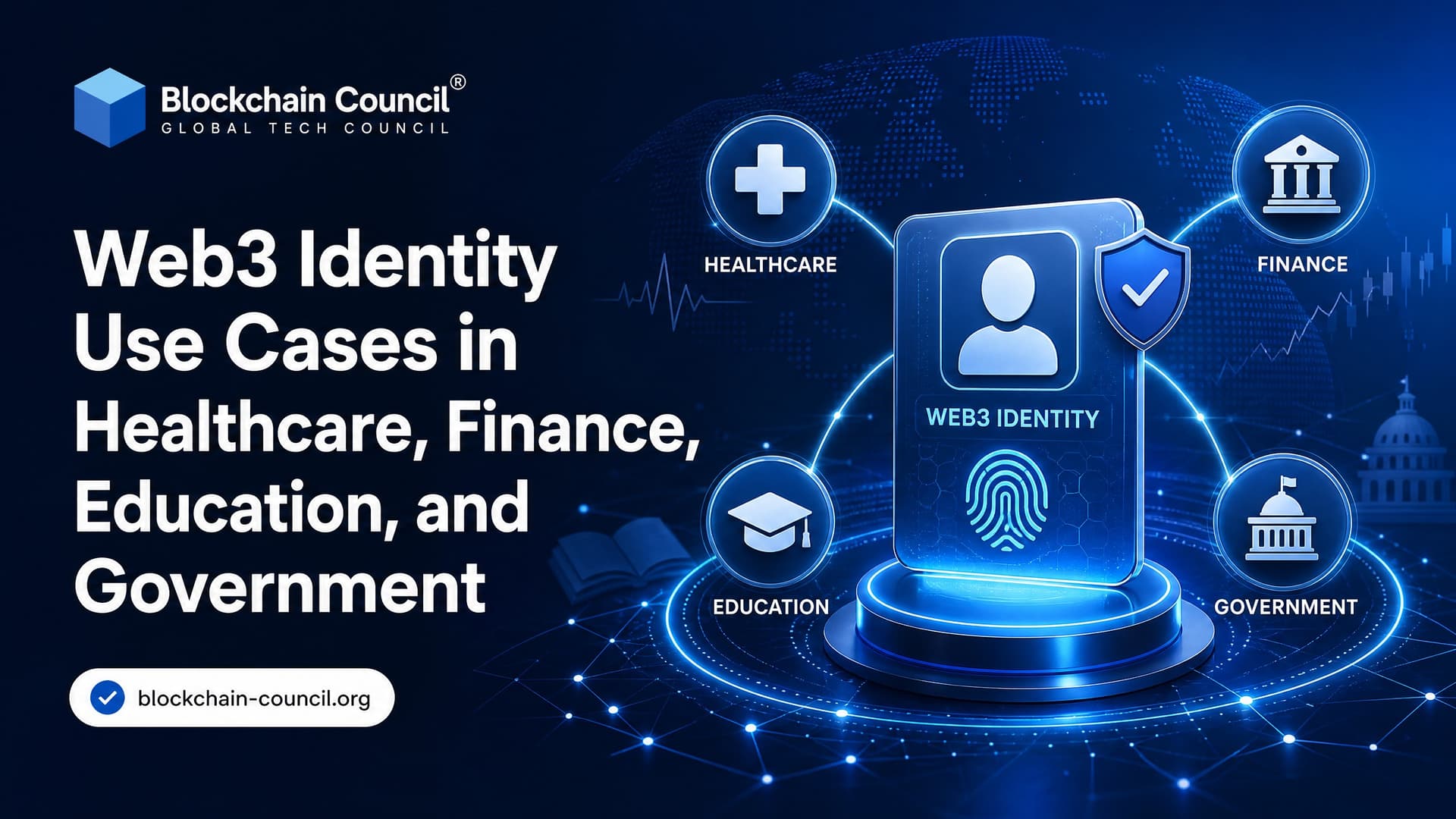
Web3 identity use cases are becoming practical in healthcare, finance, education, and government because they answer a hard question: how do you prove something about yourself without handing over every personal detail? The usual answer is self-sovereign identity, or SSI, built with decentralized identifiers (DIDs) and verifiable credentials (VCs).
This is not full-scale infrastructure yet. Most deployments are pilots, limited networks, or early production systems. Still, the direction is clear. Instead of every hospital, exchange, university, and agency keeping separate identity records, users hold credentials in a digital wallet and share proofs when needed.

What Web3 Identity Actually Means
Web3 identity refers to user-controlled digital identity systems that do not depend on one central identity provider. A DID can identify a person, organization, device, or wallet. A verifiable credential is a signed claim from an issuer, such as a bank confirming KYC completion or a university confirming a degree.
The standards work here matters. W3C DID Core and the W3C Verifiable Credentials Data Model give teams a shared language for identifiers, issuers, holders, and verifiers. Without those standards, Web3 identity becomes another set of disconnected login systems.
In practice, strong Web3 identity systems usually follow three rules:
- Keep sensitive data off-chain: Do not put medical records, passports, or transcripts on a public blockchain.
- Use blockchain for trust anchors: Store identifiers, issuer registries, credential status, or hashes where appropriate.
- Let users disclose less: Prove age, eligibility, or accreditation without exposing the full document.
A common beginner mistake is trying to store personal data directly in a smart contract. Bad idea. Even if the contract has access controls, public chain data is hard to delete and may conflict with privacy laws. Use encrypted off-chain storage, signed credentials, and revocation mechanisms instead.
Web3 Identity Use Cases in Healthcare
Patient-controlled records and consent
Healthcare is one of the strongest areas for Web3 identity because patient data is fragmented and highly sensitive. A patient may have records across hospitals, labs, pharmacies, insurers, and telehealth platforms. Each institution maintains its own account, identity check, and access policy.
With SSI, a hospital can issue a patient a verifiable credential for insurance status, treatment history, vaccination record, or lab result. The patient then shares selected proofs with another provider. The provider verifies the issuer signature rather than calling every prior institution.
Serious healthcare designs keep clinical records off-chain. The blockchain or decentralized registry stores DIDs, credential schemas, consent events, or access references. Smart contracts may record consent decisions and audit access requests, but the actual clinical data stays in compliant storage systems.
Privacy-preserving health proofs
Anonymous credentials and selective disclosure are especially useful here. A patient might prove they are over a required age, covered by a certain insurer, or eligible for a clinical trial without exposing their full identity or entire medical file.
Some SSI implementations use privacy-enhanced anonymous credentials, often called AnonCreds. If you have worked with AnonCreds-style revocation, you know the awkward bit: revocation registries are operational infrastructure, not a checkbox. If issuers do not update and publish credential status correctly, verifiers may trust credentials that should no longer be valid.
For healthcare AI, Web3 identity can also support consented data access. A patient could grant a research network access to a specific dataset for a specific purpose, then revoke future access. That does not solve every compliance issue, but it gives auditors a clearer chain of authorization.
Web3 Identity Use Cases in Finance and DeFi
Reusable KYC credentials
Finance is moving faster than most sectors because KYC, AML, and sanctions screening are non-negotiable. The current process is painful. You upload the same passport, proof of address, and selfie to multiple exchanges, fintech apps, and brokers. Each platform becomes another breach target.
With Web3 identity, a regulated provider can verify you once and issue a KYC credential. Later, you present a proof to a DeFi protocol, exchange, or tokenized asset platform. The verifier checks the signature and status of the credential, not your raw documents.
This is a strong fit for institutional DeFi. Asset managers, banks, and market makers cannot participate in anonymous liquidity pools without compliance controls. SSI-based KYC creates a middle path: users keep privacy where possible, while platforms prove they checked eligibility, jurisdiction, or accreditation.
Zero-knowledge proofs for compliance
Zero-knowledge proofs can reduce data exposure in finance. A wallet could prove that its holder passed KYC with an approved issuer and is not from a restricted jurisdiction, without showing name, address, or passport number to the protocol.
Be careful with the marketing here. Zero-knowledge proofs do not magically make a protocol compliant. Regulators still care about issuer quality, auditability, sanctions updates, record retention, and enforcement. The better view is simple: privacy-preserving identity helps compliance workflows share less data while still producing verifiable evidence.
If you are building in this space, study credential revocation early. A KYC credential needs a way to expire or be revoked when sanctions status, residency, or risk classification changes.
Web3 Identity Use Cases in Education
Portable diplomas and professional credentials
Education is an obvious fit because credentials are already attestations. A university says you completed a degree. A training provider says you passed an exam. A certification body confirms you hold a professional credential.
Verifiable credentials make those claims machine-checkable. An employer can verify a signed diploma or certificate without emailing a registrar. A learner can keep credentials from multiple institutions in one wallet and present them to employers, licensing bodies, or graduate programs.
This matters for global hiring. Manual verification is slow, especially across countries and languages. A VC can include issuer identity, credential type, issuance date, expiration rules, and credential status. The verifier still needs to trust the issuer, but the cryptographic check becomes instant.
Skills-based access and automated eligibility
Education platforms can also automate eligibility. A learner could prove they completed a prerequisite course before enrolling in an advanced program. A professional could prove continuing education credits to a licensing board.
For Blockchain Council readers, this is directly relevant. Learning paths could connect Web3 identity topics with the Certified Web3 Expert™, Certified Blockchain Expert™, and Certified Smart Contract Developer™ programs as related certification routes. If your goal is to build credential systems, learn both the identity standards and the smart contract layer that manages issuer registries or credential status.
Web3 Identity Use Cases in Government
Digital identity wallets for public services
Governments can issue verifiable credentials for legal identity, residency, licenses, permits, tax status, or benefits eligibility. A citizen could use a wallet to access public services without creating separate accounts for every agency.
This model can reduce dependence on central databases. A government may still act as a trusted issuer, but verification can happen across a wider network of public and private services. Some decentralized identifier models let public identifiers be anchored across many independent servers, which reduces single points of failure.
Examples include digital driver's licenses, professional licenses for doctors or engineers, social benefit eligibility, and residency proofs for cross-border services.
Trust frameworks across sectors
Government has another role: setting trust rules. A national or regional trust framework can define approved issuers, credential schemas, revocation rules, wallet requirements, and dispute processes.
This is where many pilots slow down. The cryptography may work, but policy questions are harder. Who can issue a legal identity credential? What happens when a credential is wrong? How does a person recover access if they lose a device? How do agencies handle people who cannot use smartphones?
Good Web3 identity design must include recovery, accessibility, and governance. Otherwise it becomes secure technology that fails real citizens.
What Is Holding Adoption Back?
The main barriers are not just technical. They are organizational and legal.
- Interoperability: Wallets, issuers, and verifiers must support compatible DID methods, credential formats, and schemas.
- Regulatory fit: Healthcare privacy laws, financial compliance rules, and public records laws differ by jurisdiction.
- Legacy integration: Hospitals have EHR systems. Banks have compliance platforms. Governments have national ID databases.
- Key recovery: Users lose phones and seed phrases. Identity systems need safe recovery without recreating centralized control.
- Issuer trust: A signed credential is only as useful as the issuer behind it.
To be blunt, Web3 identity is overhyped when it is sold as a replacement for every login system. It is strongest where proofs, credentials, consent, and cross-organization trust matter. It is not the right tool for a simple newsletter account.
What Professionals Should Learn Next
If you work in healthcare, finance, education, or government, start with the model: issuer, holder, verifier. Then study DIDs, verifiable credentials, selective disclosure, credential revocation, wallet security, and trust frameworks.
Developers should build a small proof of concept before touching production data. Issue a test credential, store it in a wallet, verify it from a separate app, then add credential status checks. That exercise reveals the real design questions quickly.
For structured learning, consider the Certified Web3 Expert™ if you want the strategic and architectural view, or the Certified Smart Contract Developer™ if you plan to build registry, consent, or verification logic. Web3 identity is still early, but the professionals who understand both the standards and the sector constraints will be the ones trusted to deploy it properly.
Related Articles
View All
Web3
Self-Sovereign Identity in Web3: Benefits, Use Cases, and Real-World Examples
Self-Sovereign Identity in Web3 lets users prove credentials, access rights, and compliance status without exposing unnecessary personal data.
![Why Your Business Must Be Web3 Ready [Top Benefits & Use Cases]](/_next/image/?url=%2Fblog-media%2Fposts%2F12f7rpmzbwh5%2FWhy-Your-Business-Must-Be-Web3-Ready-Top-Benefits-Use-Cases-01-1185e529-thumb.jpg&w=1920&q=75)
Web3
Why Your Business Must Be Web3 Ready? [Top Benefits & Use Cases]
Ever since the concept of Web3 emerged, users have been getting excited day by day. That’s understandable, considering the tons of benefits that users can have. The question, though, is, what’s in it for businesses? Has the time arrived for businesses to get Web3 ready? Let’s…
Web3
Top Web3 Real World Use Cases
You might have come across the term decentralization of the Internet time and again, but several thoughts would have rushed the first time you heard it. Happens! Quite confused, right? Well, Let’s clarify this by explaining Web3. Web3 is a term that describes the idea of a new and improved…
Trending Articles
AWS Career Roadmap
A step-by-step guide to building a successful career in Amazon Web Services cloud computing.

Top 5 DeFi Platforms
Explore the leading decentralized finance platforms and what makes each one unique in the evolving DeFi landscape.
How to Install Claude Code
Learn how to install Claude Code on macOS, Linux, and Windows using the native installer, plus verification, authentication, and troubleshooting tips.