

How to Build a Web3 Identity Solution: Key Technologies and Architecture

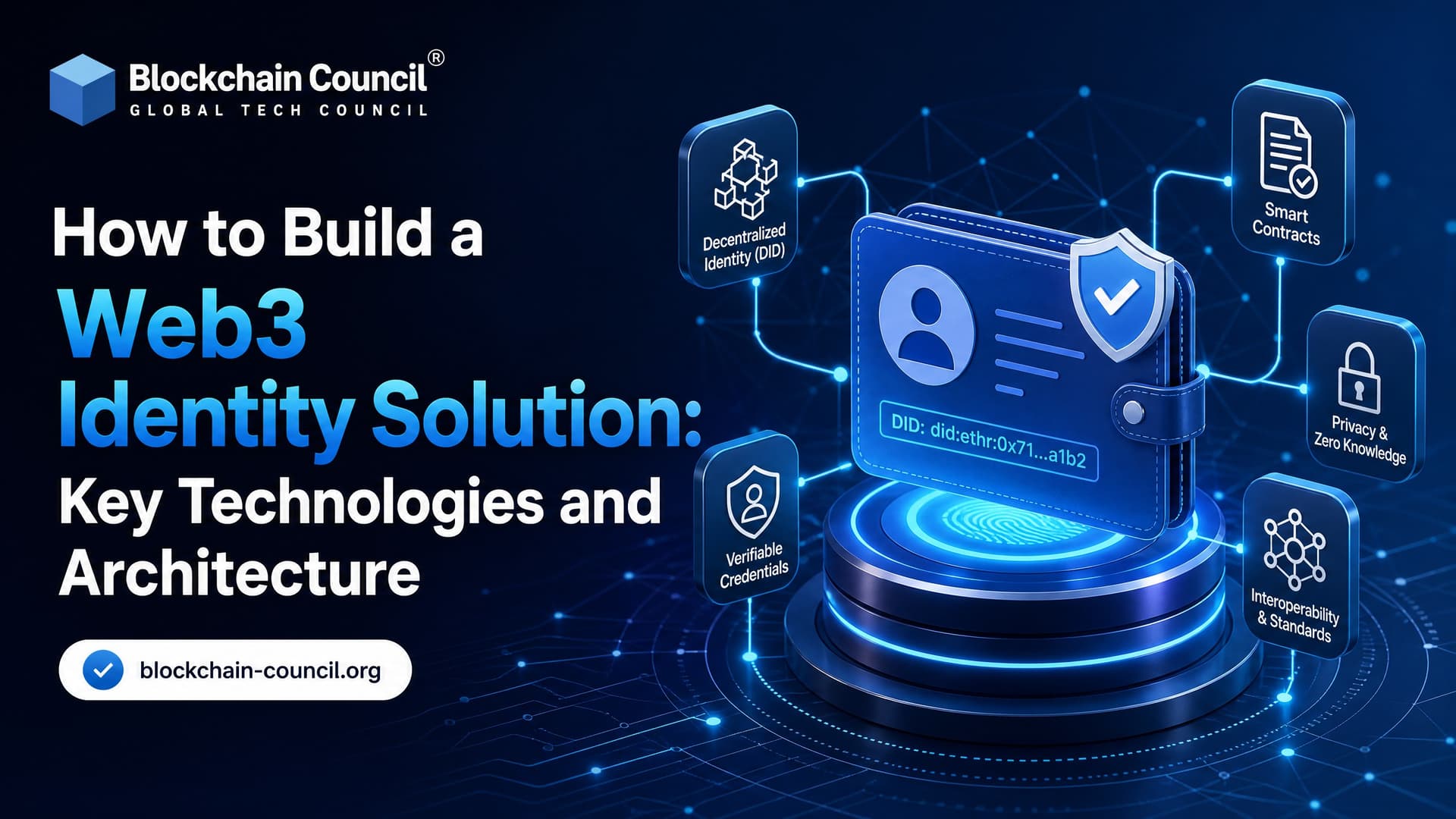
A Web3 identity solution should not start with a token contract. Start with decentralized identifiers, verifiable credentials, wallet-based authentication, and a privacy model that keeps personal data off-chain. Get that foundation wrong and the dApp may still run, but it will fail under audit, regulation, or basic user trust.
The mature pattern is now clear. Use W3C Decentralized Identifiers for identity anchors, W3C Verifiable Credentials for claims, Sign-In with Ethereum for wallet authentication where EVM accounts are involved, and zero-knowledge proofs when users need to prove facts without exposing raw data. This architecture fits dApps, enterprise platforms, and regulated services that need stronger identity without rebuilding Web2 data silos.

Why Web3 Identity Is Moving From Theory to Infrastructure
Web3 identity has shifted from whitepapers to production systems. W3C DID Core became a Recommendation in 2022, giving teams a standard way to create globally resolvable identifiers controlled by the subject rather than a central database. The W3C Verifiable Credentials Data Model 1.1 also reached Recommendation status in 2022, and VC 2.0 became a Recommendation in 2025, extending the model for broader credential formats and status mechanisms.
The business case is just as direct. Centralized identity databases are breach targets. They also create poor user experiences, repeated KYC checks, and limited data portability. A well-designed Web3 identity solution lets a user prove eligibility, employment, age, membership, or KYC status without every service storing the same sensitive data.
Europe is pushing this further through eIDAS 2.0 and the European Digital Identity Wallet. The EUDI Wallet model gives citizens and businesses a way to store official identity attributes and share them selectively. For architects, this matters because public-sector wallet patterns are starting to look a lot like Web3 wallet and verifiable credential patterns.
Core Technologies in a Web3 Identity Solution
1. Decentralized Identifiers
A decentralized identifier, or DID, is a globally unique identifier that resolves to a DID Document. That document can contain public keys, service endpoints, authentication methods, and verification methods. The DID subject can be a person, organization, device, software agent, or wallet-controlled account.
Do not treat a DID as just another user ID column. It is the primary identifier that survives key rotation, wallet changes, and service migration. Your database can index it, but your trust model should not depend on the database owning it.
Choosing a DID method is a serious architecture decision. A method defines how identifiers are created, updated, and resolved. Some methods anchor to public blockchains, some use consortium infrastructure, and some are peer-based. Compare transaction cost, finality, governance, censorship resistance, and recovery support before you commit.
2. Verifiable Credentials
Verifiable Credentials are signed claims. The standard model has three roles:
- Issuer: The party that signs the credential, such as a university, KYC provider, employer, DAO, or government authority.
- Holder: The user or entity that stores the credential in a wallet or agent.
- Verifier: The application or service that checks the credential proof and decides whether to grant access.
VCs beat putting identity data directly on-chain. A credential can say a user passed KYC, holds a certification, lives in a supported jurisdiction, or is over 18. The verifier checks the proof without collecting the full underlying document.
Schema governance is where many teams stumble. If two issuers define employment status differently, verifiers will not know what to trust. Decide who controls schemas, how versions are published, and how deprecated credential types are handled.
3. Identity Wallets and Agents
The wallet is where the user experience lives. It stores keys, DIDs, credentials, and consent records. It also builds presentations when a dApp asks for proof.
For consumer products, mobile-first identity wallets usually make sense. For enterprises, you may also need organizational agents that hold credentials for companies, servers, IoT devices, or AI agents. Machine identity is becoming more relevant as autonomous agents transact, request APIs, and sign messages on behalf of users or organizations.
Recovery deserves early design time. A beautiful DID architecture is useless if users lose access after replacing a phone. Support key rotation, backup, social recovery, or custodial recovery options depending on the risk level.
4. Wallet-Based Authentication
For EVM ecosystems, ERC-4361 Sign-In with Ethereum is the standard pattern for authenticating users to off-chain services. SIWE uses a structured message containing fields such as domain, address, URI, version, chain ID, nonce, issued-at, and expiration time. The user signs it with a wallet. The server verifies the signature and creates a session.
A single field can break the flow. In local development, MetaMask may sign on chain ID 31337 if you are using Hardhat, while your backend expects chain ID 1 for Ethereum mainnet. The signature can be valid and still fail policy checks. Watch nonce handling too. Reusing a nonce after login is a common bug that opens replay risk.
SIWE proves control of an address. It does not prove legal identity by itself. To bind an address to a DID, many systems issue a credential stating that a DID controls one or more blockchain addresses. Then the dApp can authenticate the wallet and evaluate credentials linked to that DID.
Reference Architecture for Web3 Identity
A practical Web3 identity solution usually has five layers.
Identity Layer
- DID registry or DID method infrastructure.
- DID resolution services.
- Key management for users, organizations, devices, and agents.
- Recovery and key rotation flows aligned with the chosen DID method.
Credential Layer
- Issuer service for creating and signing VCs.
- Credential schemas for KYC, education, employment, membership, licenses, or device attestations.
- Holder wallet or agent for secure storage.
- Verifier service for checking signatures, proof formats, issuer trust, and credential status.
Access and Authorization Layer
- SIWE or equivalent wallet sign-in for authentication.
- Policy engine that maps claims to access decisions.
- Optional smart contracts for permissioned on-chain actions.
Data and State Layer
- Minimal on-chain data, such as DID anchors, revocation commitments, status list roots, or permission flags.
- Encrypted off-chain storage for sensitive attributes and documents.
- Audit logs that record decisions without exposing personal data.
Trust and Governance Layer
- Trust registry listing approved issuers and their DIDs.
- Rules for issuer onboarding, suspension, credential revocation, and dispute handling.
- Compliance controls for GDPR, financial regulation, health data rules, or sector-specific obligations.
How the Identity Flow Works
- Enrollment: The user creates or imports a wallet, generates a DID, and stores keys securely.
- Issuance: A trusted issuer verifies the subject and signs a VC, such as proof of KYC status or a professional qualification.
- Storage: The holder keeps the credential in an identity wallet or agent, not in every application database.
- Presentation: A verifier asks for a specific claim, such as age over 18 or residency in a supported country.
- Proof: The wallet creates a verifiable presentation, ideally with selective disclosure or zero-knowledge proofs.
- Decision: The verifier checks cryptographic proof, issuer trust, and revocation status, then grants or denies access.
Privacy-Preserving Cryptography
Zero-knowledge proofs are no longer optional for sensitive identity use cases. They let a user prove a statement is true without revealing the full credential. A user can prove they are over 18 without sharing a date of birth, or prove KYC approval without revealing passport details.
Polygon ID, now folded into Privado ID documentation, is a useful production pattern. It combines DIDs, verifiable credentials, and zero-knowledge proofs so issuers, holders, and verifiers can interact while keeping attributes private. Chainlink has also described identity compliance designs where dApps consume eligibility proofs rather than raw personal data.
Use ZK carefully. Circuits must be audited. Credential status checks must be handled correctly. If the proof says a user was KYC-approved but your system ignores revocation status, you have a compliance gap.
Soulbound Tokens, Reputation, and Proof of Personhood
Soulbound tokens can represent non-transferable memberships, attendance, licenses, or reputation markers. They work for low-sensitivity public reputation. They are a poor default for private identity. Public chains are public. Once you put a sensitive attribute on-chain, you may not be able to undo the harm.
Proof-of-personhood systems are worth watching too. Worldcoin uses iris-based biometric uniqueness, but regulators in several jurisdictions have questioned its data protection model. The takeaway is blunt. Biometrics can provide strong uniqueness, but they carry high legal and ethical risk. For many dApps, web-of-trust attestations, rate limits, device credentials, non-transferable reputation, and selective credentials offer enough Sybil resistance with far less personal data exposure.
Design Checklist for Builders
- Define the trust model first: Are users pseudonymous, real-name verified, or both?
- Use open standards: Build around W3C DIDs, W3C VCs, and ERC-4361 where relevant.
- Minimize on-chain personal data: Store proofs, commitments, and status references, not raw PII.
- Plan revocation: Credentials expire, licenses change, and KYC status can be withdrawn.
- Design wallet recovery: Lost keys should not mean lost identity forever.
- Audit cryptography: Treat ZK circuits and verifier contracts as security-critical code.
- Create issuer governance: Decide who can issue credentials and how their authority is removed.
- Test bad paths: Expired credentials, wrong chain IDs, revoked issuers, replayed SIWE nonces, and malformed DID Documents should fail safely.
Learning Path for Professionals
If you are building this architecture for production, combine standards knowledge with hands-on smart contract and wallet integration practice. Blockchain Council programs such as Certified Web3 Expert, Certified Blockchain Developer, and Certified Smart Contract Developer give readers structured training around Web3 systems, Solidity, dApps, and decentralized architecture.
Start small this week. Build a SIWE login, issue one test verifiable credential, store it in a wallet or agent, and verify it in a sample dApp. Then add revocation and selective disclosure. That sequence teaches the real architecture faster than drawing another identity diagram.
Related Articles
View All
Web3
Web3 Identity vs Traditional Digital Identity: Key Differences Businesses Should Know
Compare Web3 identity vs traditional digital identity, including control, authentication, privacy, compliance, use cases, and adoption risks for businesses.

Web3
The Future of Web3 Identity: Trends Shaping Decentralized Authentication
Web3 identity is shifting authentication from passwords to DIDs, verifiable credentials, passkeys, and portable trust across apps and enterprises.

Web3
Web3 Identity Use Cases in Healthcare, Finance, Education, and Government
Explore practical Web3 identity use cases in healthcare, finance, education, and government, including SSI, DIDs, verifiable credentials, and compliance.
Trending Articles
AWS Career Roadmap
A step-by-step guide to building a successful career in Amazon Web Services cloud computing.

Top 5 DeFi Platforms
Explore the leading decentralized finance platforms and what makes each one unique in the evolving DeFi landscape.
How Blockchain Secures AI Data
Understand how blockchain technology is being applied to protect the integrity and security of AI training data.