

Self-Sovereign Identity in Web3: Benefits, Use Cases, and Real-World Examples
 Suyash Raizada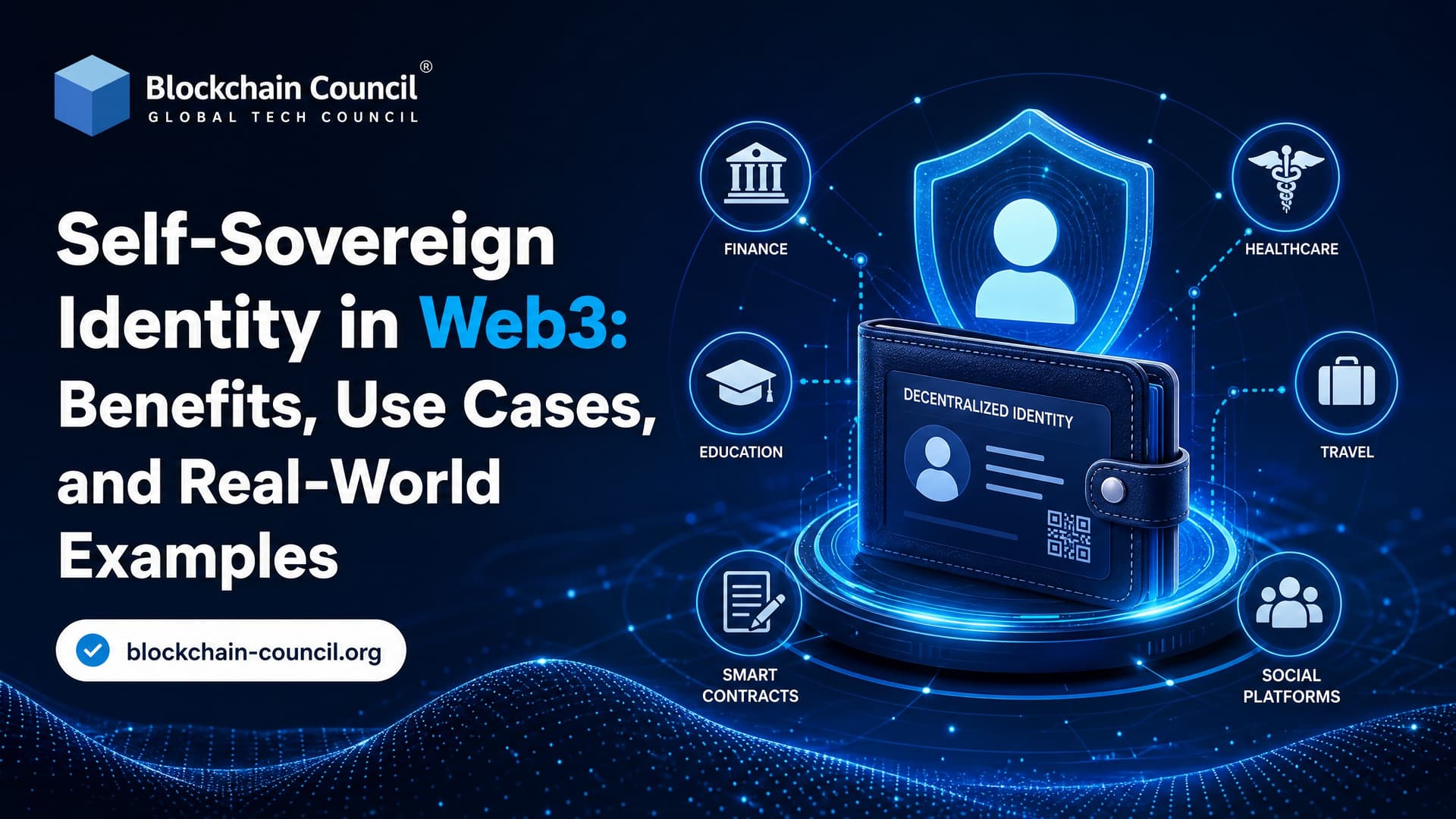
Self-Sovereign Identity in Web3 gives users and organizations a way to prove who they are, what they own, or what they are allowed to do without handing every application a full identity file. Instead of creating a new account for each dapp, you can use cryptographic identifiers and verifiable credentials that travel with you.
That sounds simple. The hard part is doing it without rebuilding the same centralized identity systems Web3 was meant to avoid. Good SSI design keeps personal data off public chains, uses open standards, and gives relying parties enough proof to make a decision without collecting more data than they need.

What Is Self-Sovereign Identity in Web3?
Self-sovereign identity, or SSI, is a digital identity model where the subject controls identifiers and credentials through cryptographic keys. The subject may be a person, company, device, DAO, or software agent.
In a Web3 setting, SSI usually combines three building blocks:
Decentralized identifiers, or DIDs: W3C DID Core defines DIDs as identifiers that can be resolved without depending on a single central registry.
Verifiable credentials, or VCs: W3C Verifiable Credentials provide a standard way for issuers to sign claims, such as KYC status, age range, training completion, or employment role.
Blockchain or decentralized infrastructure: Chains can anchor DID registries, revocation records, issuer registries, and smart contract access rules. They should not store raw personal data.
The roles are easy to remember. An issuer creates a credential. A holder stores it in a wallet. A verifier checks it. For example, a regulated institution can issue a credential stating that you completed KYC. A DeFi protocol can verify that credential without asking for your passport scan.
For professionals looking to build expertise in decentralized identity and blockchain ecosystems, a Web3 Certification provides a structured foundation in wallets, decentralized applications, digital identity, and the technologies driving Web3 adoption.
Why SSI Matters for Web3
Web3 has a contradiction. Wallet addresses are portable, but they are poor identity tools on their own. A public address can show ownership and transaction history, but it does not prove that you are accredited, certified, over a certain age, employed by a supplier, or allowed to enter a regulated market.
SSI fills that gap. It adds portable trust to wallet-based interaction.
Privacy and Data Minimization
The best reason to use SSI is not novelty. It is restraint. A verifier should ask for the smallest proof that answers its business question.
For example:
A gaming platform may need proof that a player is over 18, not a date of birth.
A DeFi app may need proof that KYC was completed by an approved institution, not a copy of the user document.
An employer may need proof that a candidate completed a certification, not a full academic history.
This is where selective disclosure and zero-knowledge proofs matter. Be careful, though. Not every verifiable credential is automatically privacy preserving. A plain JSON-LD credential can still reveal too much if the issuer includes unnecessary attributes. Design matters.
Lower Security Risk
Centralized identity databases are valuable targets. When every service stores its own copy of user documents, the attack surface grows fast. SSI reduces repeated collection by letting users reuse signed credentials.
Verifiers can check:
The issuer signature
Whether the issuer is trusted for that credential type
Whether the credential has expired
Whether it has been revoked
That turns many manual checks into programmable policy. It also reduces PDF fraud, screenshot fraud, and slow back-office review.
Portability Across Dapps
A DID and credential wallet can follow a user across DeFi, NFT platforms, games, DAO tools, and enterprise portals. This is stronger than a Web2 single sign-on model because the credential does not have to live inside one identity provider account.
Portability is not automatic, though. It requires common standards, trusted issuer lists, wallet compatibility, and governance. Without those, SSI becomes just another silo with better cryptography.
Building a deeper understanding of these concepts is easier with a Blockchain Expert Certification, which helps professionals strengthen their knowledge of blockchain architecture, decentralized identity frameworks, and secure enterprise implementations.
How SSI Works in a Real Web3 Flow
Here is a practical flow for privacy-preserving KYC:
A user completes KYC with a regulated provider.
The provider issues a verifiable credential to the user wallet.
The credential says the user meets a policy, such as KYC completed or residency checked.
A dapp requests proof from the wallet.
The user approves the presentation.
The dapp verifies the issuer signature, credential status, and policy match.
The smart contract or backend grants access without storing the underlying identity documents.
One detail that trips teams up: do not put passport data, names, or even document hashes directly on-chain. A hash of personal data can still become sensitive if the original document later leaks or can be guessed. Put proofs, registries, and revocation pointers on-chain. Keep personal data in the holder wallet or an encrypted storage design.
Another common developer mistake is DID network mismatch. In did:ethr demos, a credential issued against Sepolia chain ID 11155111 may fail resolution if your resolver is configured for Ethereum mainnet chain ID 1. The error usually looks like a signature or DID resolution failure, but the root cause is configuration. Check the chain, registry address, and method-specific identifier before blaming the wallet.
Benefits of SSI for Web3 Teams
For Users
Control: You decide which credentials to present and to whom.
Less repeated paperwork: A reusable credential can replace repeated onboarding.
Reduced lock-in: Reputation, qualifications, and access rights can move between services.
Better privacy: Selective disclosure limits unnecessary exposure.
For Enterprises
Faster onboarding: Machine-readable credentials reduce manual document review.
Cleaner compliance: Policies can accept credentials only from approved issuers.
Lower data liability: Less identity data stored means less breach impact.
Partner access control: Vendors, contractors, and machines can present role or clearance credentials.
For Developers
Composable trust: Credentials can become access primitives for dapps and APIs.
Programmable verification: Smart contracts and backend services can enforce issuer, expiry, and revocation rules.
Better UX than repeated KYC: A wallet-based presentation is faster than uploading documents again.
Real-World Use Cases and Examples
DeFi and Financial Services
Financial applications need identity checks, but public blockchains are the wrong place to store identity records. SSI supports reusable KYC and AML workflows where a trusted issuer provides a credential and the user presents proof to multiple services.
cheqd has worked on decentralized identity infrastructure and participated in UK financial services experimentation around reusable digital identity, including work connected to the Financial Conduct Authority Digital Sandbox. The broader lesson is clear: regulated Web3 will need proof of compliance that does not expose full identity data to every protocol.
Professional Certifications and Education
Verifiable credentials fit naturally with education. A certification provider can issue a tamper-resistant credential that a learner stores in a wallet and presents to employers, freelance platforms, or DAO governance tools.
For Blockchain Council learners, this is directly relevant. If you are studying Web3 architecture through programs such as Certified Web3 Expert™, Certified Blockchain Expert™, or Certified Blockchain Developer™, SSI is one of the identity patterns worth understanding because it affects how credentials, access, and reputation are verified in decentralized systems.
Enterprise IAM and Workforce Access
SSI does not have to replace enterprise identity and access management. In most companies, it will sit beside existing IAM tools.
A contractor might receive a verifiable credential proving safety training, supplier approval, or project assignment. When the contractor requests access to a portal or facility system, the verifier checks the credential and grants the correct permission. If the contract ends, revocation can update access across relying systems.
This model is useful in supply chains, healthcare networks, public sector services, and any environment where many organizations must trust each other's attestations.
NFTs, Gaming, and Digital Communities
NFT ownership proves control of a token, not necessarily reputation or eligibility. SSI can add richer context.
NFT communities can verify membership without collecting real names.
Games can issue achievement or anti-cheat credentials that travel across platforms.
DAOs can use credentials for role-based voting, contributor reputation, or access to private working groups.
Use this carefully. Tying too much identity to a public wallet can create surveillance risk. For consumer apps, let users separate personas where possible.
A Tech Certification can further expand these skills by providing broader knowledge of emerging technologies, cloud infrastructure, cybersecurity, and digital systems that support modern identity management and enterprise innovation.
Healthcare and Public Services
Healthcare and public service pilots often explore SSI for portable health records, vaccination credentials, licenses, and access to benefits. The value is obvious: people can carry trusted proofs between providers or agencies.
The risk is also obvious. These credentials are sensitive. Strong consent flows, recovery options, issuer governance, and legal recognition are not optional.
Current Challenges
SSI is promising, but it is not magic. To be blunt, many demos look better than production deployments.
Key recovery is hard: If users lose wallet keys, they may lose access to credentials unless recovery is designed well.
Interoperability is uneven: DID methods, credential formats, wallet support, and revocation mechanisms still vary.
Governance is unresolved: High-value credentials need trusted issuers, dispute processes, and revocation rules.
Regulation is still catching up: Legal recognition differs across jurisdictions, especially for cross-border identity.
User experience needs work: If credential presentation feels like signing an unknown transaction, mainstream users will hesitate.
My view: SSI is the right pattern for portable trust, but it is the wrong choice if your team cannot support recovery, consent, revocation, and issuer governance. Cryptography does not fix bad process.
What Comes Next for SSI in Web3
Expect SSI to become part of the default Web3 identity stack in regulated DeFi, enterprise blockchain, education credentials, and high-trust communities. The strongest near-term use cases are not vague metaverse identity projects. They are specific workflows where verification is expensive today: KYC reuse, workforce access, certification proof, supplier onboarding, and gated digital rights.
If you are building with SSI, start small. Build a credential issuance and verification prototype using W3C DIDs and verifiable credentials. Test revocation. Test wallet recovery. Test what happens when the verifier is offline. Then decide what belongs on-chain and what must stay off-chain.
For a structured learning path, pair SSI study with smart contract and Web3 fundamentals through Blockchain Council programs such as Certified Web3 Expert™, Certified Blockchain Developer™, and Certified Smart Contract Developer™. Your next practical task: issue a simple training credential, verify it in a dapp login flow, and make sure no personal data touches a public chain.
As decentralized identity solutions gain wider enterprise and consumer adoption, a Marketing Certification can also help professionals understand product positioning, user education, community engagement, and go-to-market strategies for Web3 technologies.
FAQs
1. What Is Self-Sovereign Identity (SSI)?
Self-Sovereign Identity (SSI) is a decentralized identity model that allows individuals to own, control, and manage their digital identities without relying on centralized organizations. Users decide how and when their personal information is shared.
2. How Does Self-Sovereign Identity Work?
SSI uses decentralized identifiers (DIDs), verifiable credentials, blockchain technology, and digital wallets to enable secure identity verification while giving users full control over their personal data.
3. Why Is Self-Sovereign Identity Important?
SSI improves privacy, security, and user autonomy by reducing dependence on centralized identity providers. It enables trusted digital interactions while minimizing the risk of identity theft and data breaches.
4. How Is Self-Sovereign Identity Different from Traditional Digital Identity?
Traditional digital identity is controlled by governments, employers, or online platforms. SSI gives individuals direct ownership of their identity credentials, allowing them to share only the information required for a transaction.
5. What Are the Benefits of Self-Sovereign Identity?
Key benefits include greater privacy, improved security, user-controlled data sharing, reduced identity fraud, simplified verification, better interoperability, and enhanced trust across digital services.
6. What Are Decentralized Identifiers (DIDs)?
Decentralized Identifiers (DIDs) are unique digital identifiers that enable users to establish and verify their identities without depending on centralized identity providers or exposing unnecessary personal information.
7. What Are Verifiable Credentials?
Verifiable credentials are cryptographically secured digital documents that confirm information such as educational qualifications, employment history, or professional certifications while allowing secure and privacy-preserving verification.
8. How Do Digital Wallets Support Self-Sovereign Identity?
Digital wallets securely store decentralized identifiers, verifiable credentials, and cryptographic keys, allowing users to manage their identities and authenticate themselves across Web3 applications.
9. How Does SSI Improve Privacy?
SSI allows users to selectively disclose only the information needed for verification instead of sharing complete identity records, helping reduce unnecessary exposure of personal data.
10. How Does Self-Sovereign Identity Improve Security?
By eliminating centralized identity databases and using cryptographic verification, SSI reduces the risk of data breaches, unauthorized access, and identity theft while strengthening digital authentication.
11. What Are the Main Use Cases of Self-Sovereign Identity?
SSI is used for digital identity verification, financial services, healthcare records, educational credentials, employee onboarding, travel documents, government services, and decentralized application (DApp) authentication.
12. How Is SSI Used in Financial Services?
Financial institutions can use SSI to streamline Know Your Customer (KYC) processes, improve identity verification, reduce fraud, and enhance customer privacy while meeting compliance requirements.
13. How Is Self-Sovereign Identity Used in Healthcare?
Healthcare providers can use SSI to securely verify patient identities, share medical credentials with consent, protect sensitive records, and improve interoperability across healthcare systems.
14. What Are Some Real-World Examples of Self-Sovereign Identity?
Examples include decentralized identity initiatives based on W3C Decentralized Identifiers (DIDs) and Verifiable Credentials standards, as well as projects like Microsoft Entra Verified ID, the European Digital Identity Wallet (EUDI Wallet), Hyperledger Indy, and the Sovrin Network, which support secure digital identity verification.
15. Which Technologies Power Self-Sovereign Identity?
SSI relies on blockchain technology, decentralized identifiers (DIDs), verifiable credentials, cryptography, digital wallets, decentralized storage, and open identity standards such as those developed by the W3C.
16. What Challenges Does Self-Sovereign Identity Face?
Common challenges include user adoption, interoperability between identity systems, regulatory compliance, wallet security, private key management, usability, and widespread implementation of shared standards.
17. How Can Businesses Prepare for Self-Sovereign Identity?
Organizations should explore decentralized identity standards, integrate verifiable credential support, strengthen cybersecurity, implement privacy-by-design principles, and prepare systems for digital wallet interoperability.
18. What Skills Are Needed to Work with Self-Sovereign Identity?
Professionals should understand blockchain technology, cryptography, decentralized identity standards, digital wallets, cybersecurity, privacy regulations, identity management, and Web3 technologies.
19. What Common Mistakes Should Organizations Avoid When Implementing SSI?
Avoid storing sensitive personal information directly on public blockchains, neglecting private key protection, ignoring interoperability standards, overlooking user education, and assuming decentralized identity removes all security risks. Successful SSI implementations require strong governance, secure credential management, and compliance with applicable privacy regulations.
20. How Will Self-Sovereign Identity Shape the Future of Digital Identity?
Self-Sovereign Identity is expected to redefine digital identity by giving individuals greater ownership and control over their personal information. As global standards mature and adoption expands, SSI could simplify identity verification across finance, healthcare, education, government, and Web3 while improving privacy, security, interoperability, and user trust in digital ecosystems.
Related Articles
View All
Web3
Web3 Identity Use Cases in Healthcare, Finance, Education, and Government
Explore practical Web3 identity use cases in healthcare, finance, education, and government, including SSI, DIDs, verifiable credentials, and compliance.
![Why Your Business Must Be Web3 Ready [Top Benefits & Use Cases]](/_next/image/?url=%2Fblog-media%2Fposts%2F12f7rpmzbwh5%2FWhy-Your-Business-Must-Be-Web3-Ready-Top-Benefits-Use-Cases-01-1185e529-thumb.jpg&w=1920&q=75)
Web3
Why Your Business Must Be Web3 Ready? [Top Benefits & Use Cases]
Ever since the concept of Web3 emerged, users have been getting excited day by day. That’s understandable, considering the tons of benefits that users can have. The question, though, is, what’s in it for businesses? Has the time arrived for businesses to get Web3 ready? Let’s…
Web3
Top Web3 Real World Use Cases
You might have come across the term decentralization of the Internet time and again, but several thoughts would have rushed the first time you heard it. Happens! Quite confused, right? Well, Let’s clarify this by explaining Web3. Web3 is a term that describes the idea of a new and improved…
Trending Articles
The Role of Blockchain in Ethical AI Development
How blockchain technology is being used to promote transparency and accountability in artificial intelligence systems.

Top 5 DeFi Platforms
Explore the leading decentralized finance platforms and what makes each one unique in the evolving DeFi landscape.
What is AWS? A Beginner's Guide to Cloud Computing
Everything you need to know about Amazon Web Services, cloud computing fundamentals, and career opportunities.