

Web3 Identity and Data Ownership: How Users Can Control Personal Information

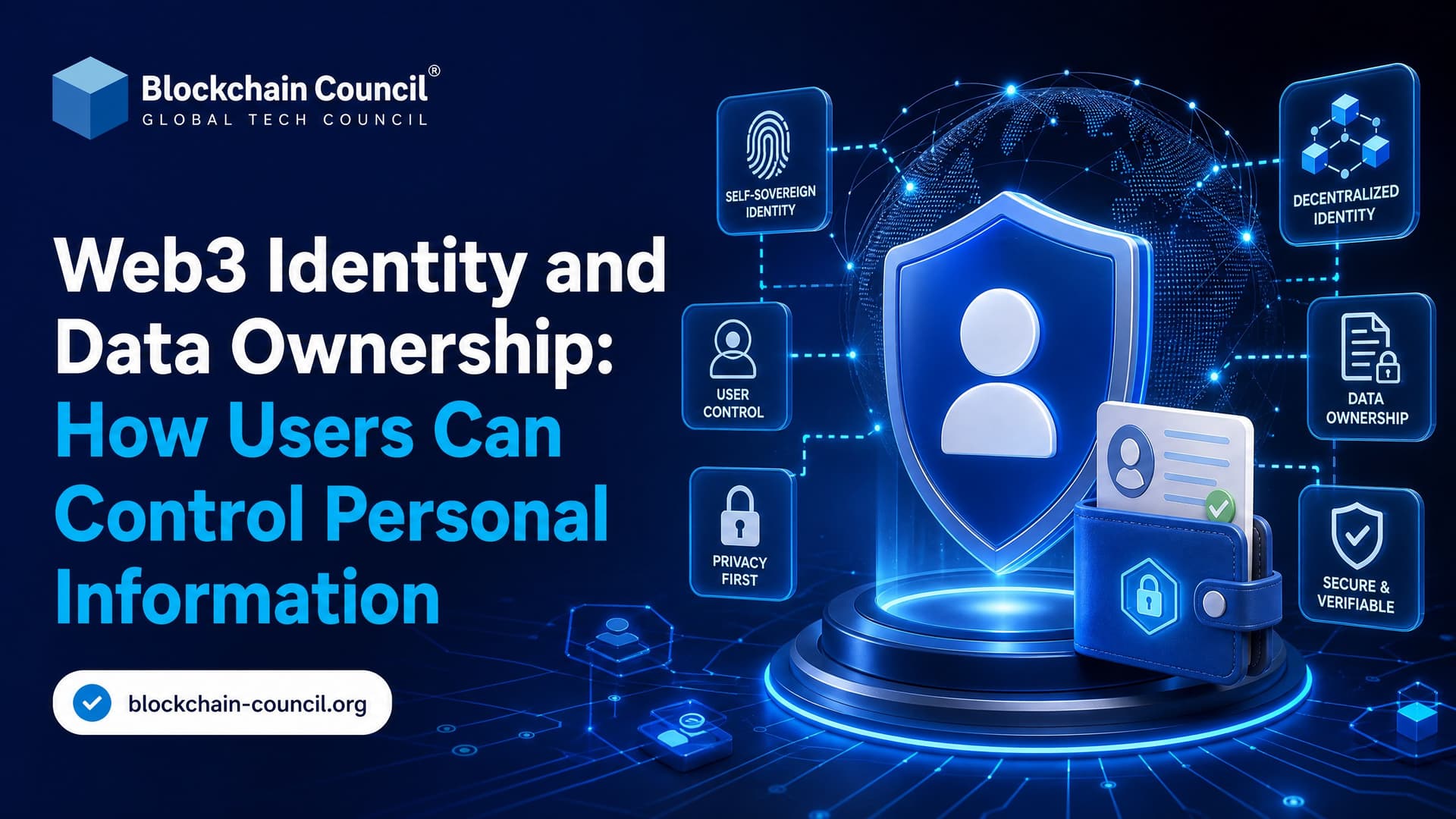
Web3 identity and data ownership challenges a basic internet assumption: your account should not have to live inside someone else's platform. Instead, you control identifiers, credentials, permissions, and access to personal data through wallets, cryptographic keys, decentralized identifiers, and verifiable credentials.
That sounds simple. It is not. The technology is promising, but the real work sits in the details: key recovery, credential formats, wallet UX, issuer trust, data protection law, and whether two systems can actually verify the same credential without breaking. If you are building Web3 products or evaluating decentralized identity for an enterprise, this is where the hard decisions begin.

What Web3 Identity Means
Traditional identity depends on accounts controlled by platforms. You sign in with an email address, a password, a phone number, or a social login. The platform stores your profile, tracks activity, resets access, and often decides what data third parties can see.
Web3 identity takes a different route. You hold a private key in a wallet. That key controls an identifier, signs requests, proves ownership of credentials, and grants access to services. The goal is not anonymity by default. The goal is user-controlled disclosure.
The main building blocks are:
- Decentralized Identifiers, or DIDs: W3C-standard identifiers that can refer to a person, organization, device, or digital resource.
- DID documents: Metadata files that contain public keys, verification methods, and service endpoints.
- Verifiable Credentials, or VCs: Tamper-evident claims issued by trusted parties, such as proof of age, a university degree, employment status, or KYC approval.
- Identity wallets: Apps or hardware-backed tools that store keys, DIDs, and credentials.
- Smart contracts and access controls: Rules that manage consent, revocation, audit trails, and sometimes payments.
- Privacy tools: Selective disclosure and zero-knowledge proofs that let you prove a fact without exposing the full record.
How Data Ownership Works in Web3
Web3 data ownership does not mean every file is stored on a blockchain. Please do not put passports, medical records, or customer profiles on-chain. That is one of the fastest ways to create a privacy and compliance problem you cannot easily undo.
A better architecture keeps sensitive data off-chain, encrypted, and controlled by user-held keys or delegated agents. The blockchain records permissions, hashes, audit events, or payment logic. In some designs, confidential computing environments process encrypted data so a model, app, or marketplace can use the data without ever receiving the raw file.
In practice, a user might:
- Create a DID in an identity wallet.
- Receive a verifiable credential from a bank, school, employer, or government agency.
- Connect to a dApp and present only the required claim.
- Approve temporary access to a data vault.
- Revoke access later through wallet controls or smart contract rules.
This is a major shift from the familiar consent banner. Instead of clicking accept and hoping the platform behaves well, you can design systems where consent is specific, auditable, and technically enforceable.
Why DIDs and Verifiable Credentials Matter
The World Wide Web Consortium published Decentralized Identifiers v1.0 as a W3C Recommendation in 2022. That matters because identity systems fail quickly when every vendor invents a private format. The W3C work on DIDs and Verifiable Credentials gives developers a shared foundation for identifiers and attestations.
A DID resolves to a DID document. That document tells a verifier which public keys can authenticate the DID subject or verify signatures. The DID itself can be independent of a centralized login provider.
Verifiable Credentials add the claim layer. For example, a licensed exchange could issue a credential stating that you passed KYC. A DeFi application could then verify the credential and allow access without collecting your passport scan.
One practical warning from implementation work: a credential version mismatch can waste hours. If your verifier expects the W3C Verifiable Credentials Data Model 2.0 structure and the wallet emits a VC 1.1-style credential, validation may fail before your business logic even runs. The error often looks like a signature or JSON-LD context problem, but the root cause is a data model mismatch. Test with real wallets early, not just hand-written JSON examples.
Where Web3 Identity Is Already Useful
Decentralized Authentication
Sign-in with Ethereum, wallet signatures, DIDs, and VCs can reduce dependence on platform-managed accounts. For low-risk dApps, a wallet signature may be enough. For regulated services, you need stronger assurance through credentials issued by trusted entities.
Reusable KYC
Reusable KYC is one of the clearest enterprise use cases. A user completes verification once with a qualified provider, stores a credential, and presents it to other services. This can cut duplicate checks and limit the number of companies storing sensitive documents.
Do not oversell it. Financial institutions still need issuer trust, revocation checks, audit logs, and jurisdiction-specific controls. A pretty credential card in a wallet is not enough.
Healthcare, Education, and Employment Records
Portable credentials can represent medical eligibility, professional licenses, degrees, training records, or employment history. The value is portability. You can prove a claim without asking every verifier to call the original issuer manually.
Data Marketplaces and Confidential Computing
Some Web3 systems let users grant paid access to data or insights while keeping raw data protected. Smart contracts can coordinate permissions and payment. Trusted execution environments and other privacy-preserving compute methods can process data under defined conditions.
This model is still early. It works best where the data has clear value, the buyer can accept computed outputs, and the user experience does not force people to manage dozens of confusing permissions.
The Market Is Growing, But Adoption Is Still Early
Grand View Research estimated the global self-sovereign identity market at about 1.9 billion USD in 2024 and projected it could reach roughly 38.1 billion USD by 2030. Other estimates run higher, with projections in the tens of billions over the coming decade.
The direction is clear. Enterprises want identity systems that reduce fraud, improve privacy, and support cross-platform verification. Finance, healthcare, education, public services, and supply chains are likely early adopters.
Still, growth forecasts are not deployment guarantees. Many pilots never reach production because recovery, compliance, issuer governance, and interoperability turn out harder than the proof of concept suggested.
Regulatory and Security Challenges
Web3 identity sits close to data protection law, financial regulation, cybersecurity, and consumer protection. That makes the policy side unavoidable.
- GDPR and deletion rights: Immutable ledgers do not pair neatly with the right to erasure. Store personal data off-chain and minimize on-chain metadata.
- Liability: If a credential is wrong, revoked late, or accepted by the wrong verifier, the accountability chain must be defined.
- Issuer trust: Cryptography proves who signed a credential. It does not prove the issuer was competent or legally authorized.
- Key loss: If users lose keys, they may lose access to identifiers and credentials unless recovery is designed carefully.
- Interoperability: Multiple DID methods, chains, wallets, and VC formats can fragment the market.
To be blunt, key management is still the biggest user problem. A seed phrase written on paper is not a consumer-friendly identity recovery system. Social recovery, hardware security modules, passkeys, guardians, and custodial options all carry trade-offs. Pick based on risk, not ideology.
How Users Can Control Personal Information
If you are evaluating a Web3 identity product, look for practical controls, not slogans.
- Selective disclosure: Can you prove you are over 18 without sharing your full birth date?
- Credential revocation: Can issuers revoke expired or invalid claims, and can verifiers check status safely?
- Data minimization: Does the app ask only for the attributes it needs?
- Key recovery: What happens if you lose your device?
- Permission expiry: Can access expire automatically after a set time?
- Auditability: Can you see who accessed your data and why?
- Off-chain storage: Is sensitive information encrypted outside the blockchain?
For developers, start with standards-based components. Use W3C DID and VC specifications where possible. Test against multiple wallets and verifiers. Keep personal data out of smart contract storage. If you write Solidity access-control logic, remember that events are public and storage is inspectable, even when your frontend hides it.
What Professionals Should Learn Next
Web3 identity and data ownership takes more than blockchain basics. You need enough cryptography to understand signatures and proofs, enough architecture to design off-chain storage safely, and enough compliance awareness to avoid dangerous design choices.
If you are building technical depth, Blockchain Council's Certified Web3 Expert™ is a useful learning path for Web3 architecture, identity concepts, and decentralized applications. Developers working on smart contract permissions should also consider the Certified Smart Contract Developer™. For broader distributed ledger foundations, Certified Blockchain Expert™ is a solid starting point.
Your next step: build a small proof of concept. Issue one verifiable credential, store it in a wallet, verify it in a demo app, and add revocation. Then test recovery. That last step is where the classroom idea becomes a real identity system.
Related Articles
View All
Web3
Web3 Identity for DeFi: Reduce Fraud Without Exposing Users
Web3 identity for DeFi can reduce fraud with zk-KYC, verifiable credentials, and onchain reputation while limiting unnecessary user data exposure.

Web3
Web3 Identity Explained: How Decentralized Identity Is Changing Digital Ownership
Web3 identity uses wallets, DIDs, and verifiable credentials to give users control over access, data sharing, and digital ownership.

Web3
The Future of Web3 Identity: Trends Shaping Decentralized Authentication
Web3 identity is shifting authentication from passwords to DIDs, verifiable credentials, passkeys, and portable trust across apps and enterprises.
Trending Articles
The Role of Blockchain in Ethical AI Development
How blockchain technology is being used to promote transparency and accountability in artificial intelligence systems.
AWS Career Roadmap
A step-by-step guide to building a successful career in Amazon Web Services cloud computing.
Blockchain in Supply Chain Provenance Tracking
Supply chains are under pressure to prove not just efficiency, but also authenticity, sustainability, and fairness. Customers want to know if their coffee really is fair trade, if the diamonds are con