

Decentralized Identifiers (DIDs): The Backbone of Web3 Identity Systems

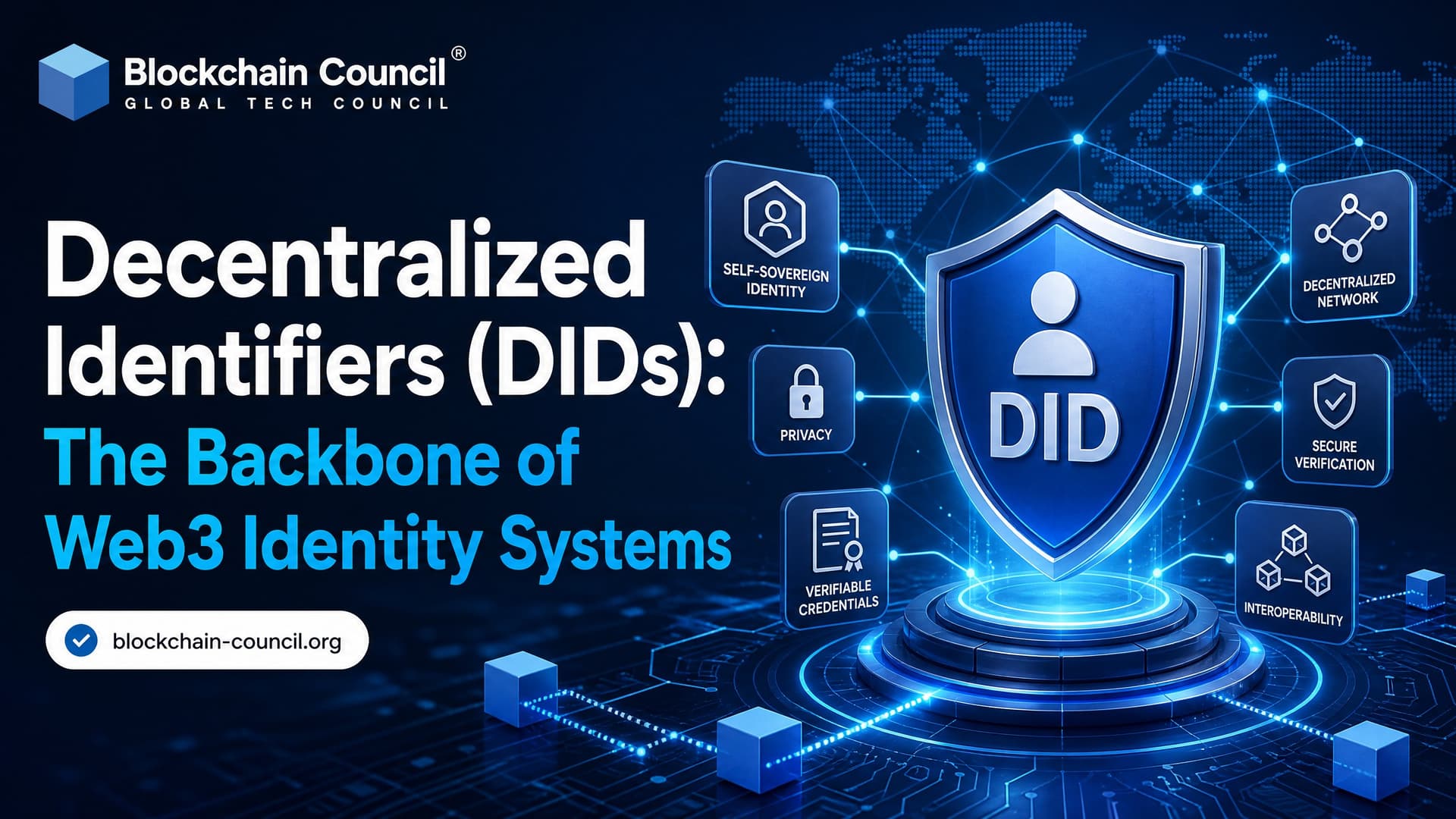
Decentralized Identifiers (DIDs) are becoming the practical identity layer Web3 has been missing. They give people, organizations, devices, wallets, and even software agents a cryptographically verifiable identifier that does not depend on a single login provider, a corporate database, or a centralized registry.
That sounds abstract until you build with one. A DID is not a profile page. It is closer to an addressable root of trust. The identifier resolves to a DID document, and that document tells other systems which public keys, verification methods, and service endpoints can be used to interact with the subject. If you have ever debugged a DID resolver returning invalidDid: DID must start with did:, you already know the standard is strict for a reason. Small syntax mistakes break trust chains.

What Are Decentralized Identifiers?
A Decentralized Identifier is a globally unique identifier defined by the W3C DID specification. The basic format is simple:
did:method:method-specific-id
A DID might use a method such as did:key, did:web, or a ledger-specific method. The method defines how the DID is created, resolved, updated, and deactivated. That method-based design is why DIDs can work across blockchains, distributed ledgers, and non-blockchain infrastructure.
Every DID is linked to a DID document. This document usually contains:
- Public keys used to verify signatures
- Verification methods for authentication or assertion
- Service endpoints for secure communication or credential exchange
- Controller information that defines who can update the DID document
The W3C DID Core v1.0 Recommendation standardized the core data model, DID URI syntax, and resolution concepts. Later revisions have refined security and privacy guidance based on early implementation lessons. For professionals, that matters. DIDs are no longer just an experimental identity idea. They are part of a standards-based identity stack.
Why DIDs Matter in Web3 Identity Systems
Web3 identity needs more than wallet addresses. A wallet address can prove control of a private key, but it says little about the person, company, or device behind it. DIDs fill that gap by connecting cryptographic control with verifiable claims.
The common pattern looks like this:
- A user creates or receives a DID.
- An issuer, such as a university, employer, government agency, or exchange, issues a verifiable credential to that DID.
- The user stores the credential in a wallet or agent.
- The user presents a proof to a verifier, often without exposing the full credential.
- The verifier checks the issuer signature and DID document cryptographically.
This is the foundation of self-sovereign identity, often shortened to SSI. The user controls the identifier and decides when to present credentials. The verifier does not need to call a central identity provider every time. That is a major shift from OAuth-style logins, where platforms mediate identity and collect behavioral data.
DIDs and Verifiable Credentials
DIDs and verifiable credentials are usually discussed together, but they are not the same thing. The DID identifies the subject or issuer. The verifiable credential contains claims.
A credential might state:
- You are over 18
- You passed KYC with a regulated institution
- You hold a professional qualification
- A device was manufactured by a specific company
- A DAO member has voting rights
The interesting part is selective disclosure. In a well-designed credential system, you should not need to show your full passport to prove your age. You should be able to present only the required attribute. Ethereum.org documentation, Hedera materials, and recent academic surveys all point to this data minimization model as a core reason DIDs are gaining attention.
To be blunt, this is where many Web3 identity demos get it wrong. They put too much personal data on-chain. DIDs should not become permanent public dossiers. In most architectures, the blockchain anchors trust or supports resolution. The sensitive credential data stays off-chain, in the user's wallet, agent, or encrypted storage.
How Major Web3 Ecosystems Use DIDs
Ethereum
Ethereum is often used for decentralized identity through attestations, smart contract registries, wallet-based authentication, and DID methods. Ethereum.org describes decentralized identity as a way to support user-controlled identifiers, selective disclosure, and credentials issued by institutions such as governments or universities.
For developers, the trade-off is cost and privacy. Writing identity state directly to Ethereum mainnet can be expensive and too public. Many teams use Layer 2 networks, off-chain credential storage, or registry-based approaches instead. If your DID update requires an on-chain transaction every time a key rotates, think carefully about gas and operational recovery.
Hedera
Hedera positions decentralized identity around consent-driven sharing and data minimization. Enterprises can issue credentials to employees, partners, or devices, then verify access without repeatedly collecting static identity documents.
This fits supply chains, IoT fleets, and partner networks where no single company should control the full identity database.
XRP Ledger
The XRP Ledger documentation describes DIDs as W3C-defined identifiers that can be associated with on-ledger accounts and services. This points to a broader pattern: DIDs are not tied to one chain. The method determines the infrastructure.
Real-World DID Use Cases
Government Digital Identity
A government could issue a verifiable credential for a driver's license, residency status, or national ID to a citizen's DID. The citizen could then prove age or residency to a service provider without exposing the full document. Ethereum.org has described this kind of use case for foundational identity documents.
The hard part is not the cryptography. It is governance. Who can issue credentials? What happens after revocation? Which courts or regulators recognize the proof? These questions decide whether a DID system works outside a pilot.
Financial Services and KYC
J.P. Morgan's Kinexys has described Web3 identity as a way for applicants to prove identity, employment, or income using reusable credentials. Instead of sending the same pay stubs and documents to every bank, a user could present signed claims from trusted issuers.
That model can reduce onboarding friction, but it will not remove compliance obligations. Banks still need KYC, AML, auditability, and liability rules. DIDs help encode trust relationships digitally. They do not magically replace regulated due diligence.
Wallet Login and dApps
In dApps, DIDs can support wallet login, token-gated access, DAO membership, reputation, and Sybil resistance. A user might prove membership in a group or completion of a course without exposing their legal identity.
This is a better direction than forcing every user to connect a public wallet that reveals their NFT history, DeFi positions, and transaction graph. Pairwise or context-specific DIDs reduce correlation across apps.
Device and IoT Identity
DIDs are not only for people. IoT devices, vehicles, sensors, and AI agents need verifiable identities too. A device DID can be tied to keys generated during manufacturing, while credentials can state model type, firmware status, or authorization level.
This matters in smart transportation and industrial networks, where devices from different vendors must authenticate without one central operator controlling every identity record.
Key Challenges With DIDs
DIDs are useful, but they are not a shortcut. Several issues still trip teams up.
- Interoperability: DID methods vary. A wallet that supports did:key may not support a ledger-specific method. Build to standards, then test with real resolvers.
- Correlation risk: Reusing one DID everywhere creates a tracking handle. Use pairwise DIDs or context-specific identifiers where privacy matters.
- Key recovery: If users lose keys, they may lose control of identity. Social recovery, custodial agents, and hardware-backed keys each involve trade-offs.
- Revocation: Verifiers need to know whether a credential is still valid. Revocation registries must be privacy-preserving, or they become surveillance tools.
- Governance: A credential is only as trustworthy as the issuer and the rules behind it. Technical signatures cannot fix weak governance.
What Developers Should Learn Before Building DID Systems
If you are building Web3 identity, start with the standards before picking a chain. Read the W3C DID Core specification, the W3C Verifiable Credentials model, and the DID method documentation you plan to use. Then prototype resolution, credential issuance, presentation, and revocation end to end.
Do not start by writing personal data to a smart contract. Start with threat modeling:
- Who controls the DID?
- Who can rotate keys?
- What data is public during DID resolution?
- Can the user present different proofs to different verifiers?
- How does revocation work without exposing behavior?
If you want structured learning, pair hands-on practice with Blockchain Council programs such as Certified Web3 Expert™, Certified Blockchain Developer™, and Certified Smart Contract Developer™. These help connect identity architecture with wallets, smart contracts, and decentralized applications.
The Future of Decentralized Identifiers
DIDs will likely become less visible to end users and more important under the hood. Wallets, enterprise identity agents, government digital ID systems, and AI agents can all use DIDs without showing raw DID strings to users.
The next phase will focus on privacy-preserving credentials, zero-knowledge proofs, better wallet recovery, and clearer trust frameworks. Expect more activity in financial services, public sector identity, education credentials, IoT, and AI agent authentication.
For now, the best next step is practical: create a test DID, resolve its DID document, issue a sample verifiable credential, and verify a presentation. If you can explain where the keys live, how revocation works, and what metadata leaks during verification, you are already ahead of most Web3 identity discussions.
Related Articles
View All
Web3
The Future of Web3 Identity: Trends Shaping Decentralized Authentication
Web3 identity is shifting authentication from passwords to DIDs, verifiable credentials, passkeys, and portable trust across apps and enterprises.

Web3
Web3 Identity Explained: How Decentralized Identity Is Changing Digital Ownership
Web3 identity uses wallets, DIDs, and verifiable credentials to give users control over access, data sharing, and digital ownership.

Web3
AI Agents with Web3: How Autonomous Software Is Changing Decentralized Systems
AI agents with Web3 are becoming active on-chain participants, powering DeFi automation, compliance, security, DAOs, and digital services.
Trending Articles

Top 5 DeFi Platforms
Explore the leading decentralized finance platforms and what makes each one unique in the evolving DeFi landscape.
What is AWS? A Beginner's Guide to Cloud Computing
Everything you need to know about Amazon Web Services, cloud computing fundamentals, and career opportunities.

Can DeFi 2.0 Bridge the Gap Between Traditional and Decentralized Finance?
The next generation of DeFi protocols aims to connect traditional banking with decentralized finance ecosystems.