

Web3 Facts: What Web3 Is, How It Works, and Where It Is Headed (2026-2027)
 Suyash Raizada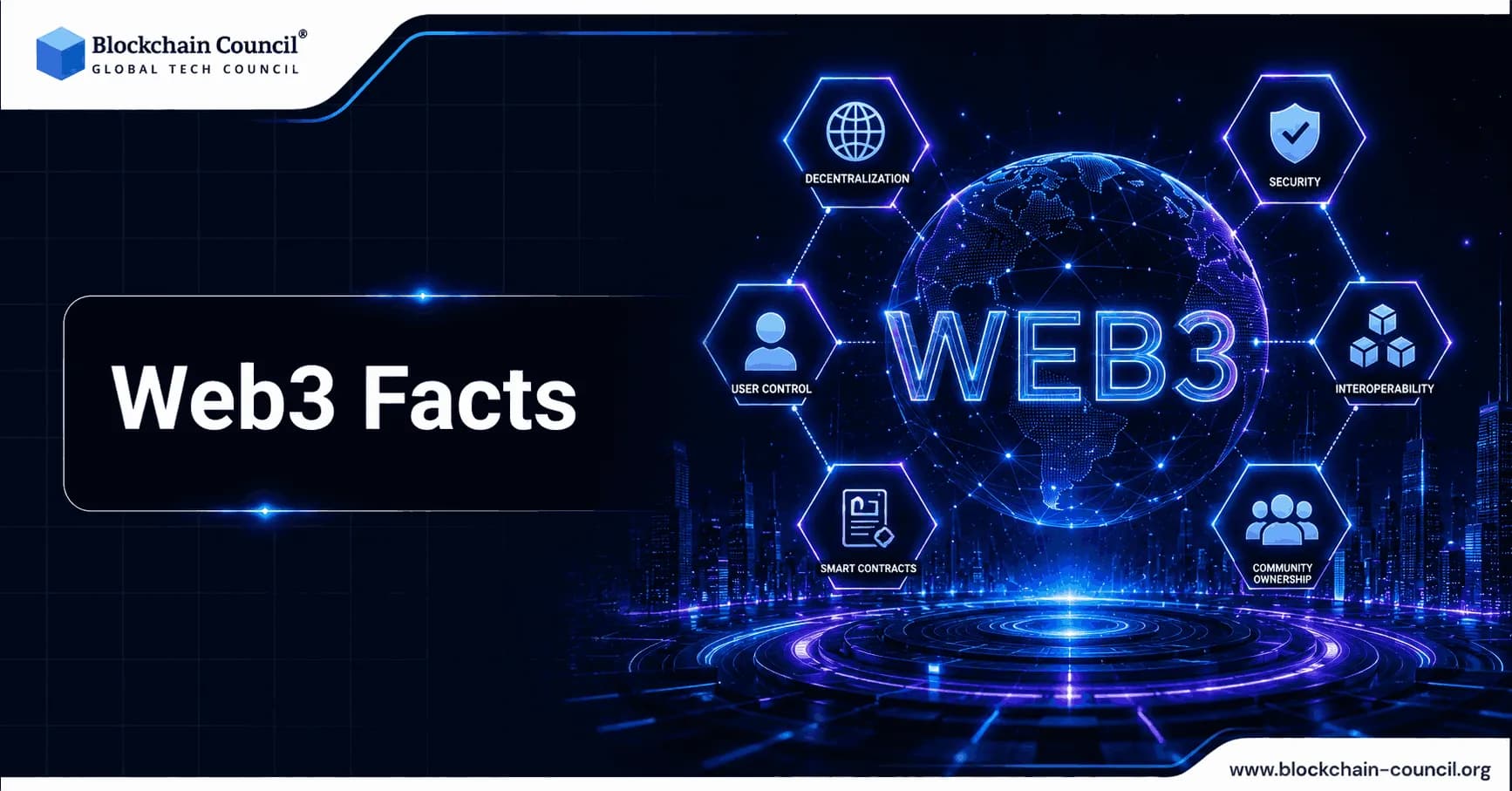
Web3 is the next generation of internet infrastructure built on public blockchains, smart contracts, and token-based incentives. Instead of relying on centralized platforms to store data, manage identity, and enforce rules, Web3 uses cryptography and open networks to enable user ownership, decentralization, and trust minimization. Below is a research-driven guide to essential Web3 facts, covering adoption signals, major use cases, security realities, and trends shaping 2025-2027.
As Web3 continues to evolve beyond experimentation, professionals are expected to understand blockchain infrastructure, decentralized applications, token economies, digital identity, and smart contracts. Earning a Certified Web3 Expert credential helps build this foundation, enabling individuals to navigate the rapidly expanding Web3 ecosystem with greater confidence and practical knowledge.

1) Web3 Definition
Web3 is not a single product. It is a stack of technologies and design principles that shift control from intermediaries to networks and users.
Core Principles of Web3
Decentralization: Control is distributed across a network of participants rather than concentrated in a single company.
Trust minimization: Rules are enforced by code and cryptography, reducing reliance on centralized gatekeepers.
Tokenized incentives: Tokens coordinate behavior, reward contributors, and enable governance.
User ownership and portability: Users hold assets, identities, and data in ways that are transferable across applications and platforms.
Technical Building Blocks
Public blockchains: Examples include Ethereum, Solana, and Bitcoin, plus Layer 2 networks such as Optimism, Arbitrum, Base, and zkSync.
Smart contracts: Programmable agreements that execute automatically when predefined conditions are met.
Wallets: User-controlled accounts secured by private keys, replacing traditional username-password identity systems.
Tokens and NFTs: Digital assets representing value, governance rights, membership, and ownership of digital or real-world items.
Decentralized storage and compute: Systems such as IPFS and Arweave for storage, alongside decentralized compute networks for specialized workloads.
For professionals building skills in this stack, structured learning paths typically span blockchain fundamentals, smart contract development, tokenomics, and security. Relevant programs from Blockchain Council include Certified Blockchain Expert, Certified Ethereum Developer, and Certified Smart Contract Developer.
2) Current State of Web3 in 2025-2026: From Experimentation to Infrastructure
Many analysts in 2026 describe the Web3 ecosystem as functioning infrastructure rather than purely speculative experimentation. Reported directional trends include record-high DeFi total value locked (TVL), millions of daily decentralized application interactions, expanding Layer 2 usage, and increased enterprise and public sector pilots.
Adoption Signals
Layer 2 scaling has become mainstream: Layer 2 networks increasingly exceed Layer 1 activity on major ecosystems, reflecting a shift toward cheaper, faster execution while settling security on base layers.
DeFi usage has recovered and expanded: Growth is associated with liquid staking derivatives, restaking, and real-world asset tokenization.
Enterprise deployments are increasing: Reports from 2026 describe record-high enterprise activity and growing institutional participation.
Decentralized finance has become one of the strongest drivers of Web3 adoption, creating demand for professionals who understand lending protocols, decentralized exchanges, staking, liquidity management, and tokenized financial products. A Certified Defi Expert credential helps develop these specialized skills, making it easier to understand the financial layer powering many Web3 applications.
3) Web3 Funding Facts: Investment Scale and What It Implies
Web3 has attracted more than 100 billion USD in investment over roughly a decade, according to Crunchbase data. Several projects raised funding at multi-billion-dollar scale, and some companies reached valuations in the tens of billions during peak market cycles. While funding volumes declined after 2022 compared to 2021 peaks, multiple venture analyses indicate renewed interest in infrastructure, gaming, and real-world asset (RWA) projects in 2024-2026.
Funding cycles fluctuate, but sustained allocation to tooling and infrastructure signals continued long-term building. For teams hiring Web3 talent, this translates to demand for smart contract engineers, security specialists, protocol analysts, and product engineers who understand wallets, key management, and on-chain user experience.
4) Web3 Facts About DeFi, Wallets, and On-Chain Activity
Because Web3 data changes rapidly, the most reliable facts are directional: Layer 2 usage has grown, active wallets are rising, and DeFi liquidity expanded again by early 2026 across several analyses.
What Is Driving DeFi Growth in 2025-2026
Liquid staking derivatives: Users can stake assets while maintaining liquidity through derivative tokens.
Restaking: Some protocols allow staked assets to secure additional services, creating new yield and security models.
RWA tokenization: Tokenized Treasuries and similar instruments have become a significant driver of on-chain finance growth.
Wallet Growth and User Onboarding
Analyses from 2026 highlight double-digit year-over-year growth in active wallet addresses across major chains, supported by improved onboarding flows and better user experience. Growth is increasingly associated with smart contract interactions rather than only speculative transfers.
5) Institutional and Government Adoption: A Major Web3 Development in 2026
Institutions have increasingly moved toward the center of Web3 activity, particularly around tokenization, staking-related strategies, and on-chain settlement experiments.
Where Institutions Are Focusing
Tokenization of real-world assets: Bonds, money market funds, and other instruments represented as on-chain tokens.
Payments and cross-border settlement: Faster settlement and programmability are strong drivers for experimentation.
Institutional staking and restaking: These products align with long-term positioning, with risk management as a key differentiator.
Public Sector Pilots
Governments have piloted blockchain-based public services in areas such as land registries, procurement transparency, digital identity, and digital currency initiatives. These efforts vary widely by jurisdiction, but reporting in 2026 points to movement beyond proofs-of-concept in several cases.
6) Real-World Web3 Use Cases
Web3 is most clearly understood through concrete categories where public blockchains and smart contracts create new capabilities.
Developer Infrastructure and Middleware
Alchemy: Developer APIs and tools that simplify node access, monitoring, and analytics.
Polygon: Ethereum scaling and infrastructure options, including multiple scaling approaches.
Chainlink: A decentralized oracle network connecting off-chain data such as prices and events to smart contracts.
DeFi (Decentralized Finance)
Lending and borrowing: Money markets such as Aave and Compound.
Decentralized exchanges: Automated market makers such as Uniswap and Curve, plus Layer 2-native exchanges.
Stablecoins and collateral: Stable-value assets and on-chain collateral management powering trading and payments.
RWA Tokenization
RWA tokenization is widely cited as a top trend in 2026 because it links traditional finance with on-chain settlement. Institutions are drawn to 24-7 transferability, programmable compliance controls, and fractional ownership models for traditionally illiquid assets.
NFTs, Gaming, and Digital Ownership
NFT activity as collectibles cooled after earlier peaks, but the technology remains relevant for ticketing, memberships, loyalty programs, and licensing. In gaming, NFTs enable item ownership and open marketplaces. By 2026, industry commentary highlights a stronger focus on player-first user experience and experiments combining AI agents with Web3 gaming environments.
Identity and Credentials
On-chain credentials and verifiable identity systems give users portable proofs without exposing unnecessary personal data. Use cases include education credentials, KYC workflows, DAO reputation systems, and access control. This creates a natural connection between Web3 and cybersecurity skills, making programs such as Certified Blockchain Security Expert directly relevant for practitioners in this space.
Web3 development increasingly overlaps with cloud computing, cybersecurity, artificial intelligence, APIs, distributed systems, and data analytics. Pursuing a broader Tech Certification helps professionals strengthen these complementary technical skills, improving their ability to design, build, and manage modern decentralized applications.
7) Security Is a Defining Web3 Challenge: Bridges, Bugs, and Operational Risk
Web3 remains vulnerable to security incidents, including smart contract bugs, compromised private keys, governance attacks, and bridge exploits. One publicly tracked incident involved a reported exploit of the TAC bridge (Ethereum to TON) for approximately 2.8 million USD, which forced operational pauses and liquidity restoration steps.
What This Means for Builders and Enterprises
Security is not optional: Audits, formal verification, and continuous monitoring increasingly define which protocols and products earn trust.
Bridges are high-risk components: Cross-chain messaging and interoperability remain critical capabilities, but they have been repeatedly exploited across the industry.
Operational controls matter: Incident response plans, admin key management, and upgrade policies reduce catastrophic failure modes.
8) Regulation: Improving Clarity and Compliance-First Web3
Regulatory uncertainty has been a significant constraint, but 2026 commentary points to clearer frameworks emerging in key markets. In the United States, the direction cited is toward clearer digital asset classification and more defined rules around custody and stablecoins, alongside stronger enforcement against fraud. Globally, jurisdictions such as the EU, UK, Singapore, UAE, and Hong Kong have developed more standardized licensing regimes for exchanges, custodians, and token issuance. FATF Travel Rule and AML-KYC expectations continue to shape how virtual asset service providers operate.
A practical consideration for enterprises is that compliant infrastructure is increasingly a parallel track to permissionless systems. Expect continued growth in permissioned pools, regulated frontends, and on-chain compliance tooling.
9) Emerging Web3 Trends to Watch (2025-2027)
RWA tokenization: Expands on-chain finance beyond crypto-native assets into traditional financial instruments.
Zero-knowledge proofs: Applied to scalability and privacy-preserving verification, including identity and compliance use cases.
AI and blockchain integration: AI agents and AI-enhanced risk tooling are being explored in DeFi, gaming, and workflow automation.
Restaking and new security models: Offers potential yield and shared security, while introducing correlated risk that requires careful management.
Modular architectures: Splits blockchain functions across specialized layers for improved scalability and performance.
Layer 2 expansion and developer tooling: Continued movement of users and liquidity to Layer 2 networks, plus new developer options such as WebAssembly-based execution environments on select networks.
Conclusion: Key Web3 Facts to Remember
Web3 represents a shift in how the internet can be built: open networks, programmable value, and verifiable ownership. The directional picture is consistent across sources - Layer 2 usage is rising, tokenization and on-chain finance are expanding, and institutional participation is growing as regulatory clarity improves. At the same time, security incidents remain a persistent reality, particularly around bridges and complex smart contract systems.
For professionals and teams, the opportunity is to treat Web3 as a serious engineering and risk discipline. Prioritize fundamentals such as smart contract safety, key management, compliance-aware design, and scalable architecture. Blockchain Council certifications covering blockchain fundamentals, Ethereum development, smart contracts, DeFi, and blockchain security offer structured paths for building verifiable expertise in these areas.
Building innovative Web3 solutions is only one part of achieving widespread adoption. Success also depends on communicating value effectively to developers, enterprises, investors, and end users. A Marketing Certification helps professionals strengthen expertise in product positioning, digital marketing, community engagement, and go-to-market strategy, supporting the long-term growth of Web3 products and services.
AI & Technology
One emerging application is AI microdrama, where generative AI helps bring serialized stories, characters, and fictional worlds to life. These AI-assisted storytelling formats illustrate how generative technology is expanding beyond productivity and coding into creative experiences, content development, and new forms of digital entertainment.
FAQs
1. What is Web3?
Web3 is the next evolution of the internet that uses blockchain technology, decentralized networks, and cryptographic systems to enable users to own digital assets, interact directly with decentralized applications (dApps), and participate in online ecosystems without relying entirely on centralized intermediaries. While definitions vary, Web3 generally emphasizes transparency, user ownership, interoperability, and programmable digital services.
2. How is Web3 different from Web1 and Web2?
Web1 primarily consisted of static websites where users consumed information. Web2 introduced interactive platforms, social media, cloud services, and user-generated content, often managed by centralized companies. Web3 builds on these developments by incorporating decentralized infrastructure, blockchain-based ownership, digital wallets, and tokenized economies that give users greater control over assets and identities.
3. How does Web3 work?
Web3 applications operate on blockchain networks using smart contracts, decentralized storage solutions, digital wallets, and cryptographic verification. Instead of relying solely on centralized servers, transactions and application logic can be distributed across participating network nodes, improving transparency and resilience.
4. What are smart contracts?
Smart contracts are self-executing programs stored on a blockchain that automatically perform predefined actions when specified conditions are met. They power decentralized finance (DeFi), NFT marketplaces, decentralized autonomous organizations (DAOs), gaming platforms, supply chain solutions, and many other Web3 applications.
5. What role do cryptocurrency wallets play in Web3?
Crypto wallets serve as digital gateways to Web3 ecosystems by allowing users to store digital assets, manage cryptographic keys, authenticate transactions, and interact with decentralized applications. Depending on the wallet type, users may control their own private keys or rely on custodial services.
6. What are decentralized applications (dApps)?
Decentralized applications, or dApps, are software applications that use blockchain technology for some or all of their functionality. They often combine smart contracts with traditional user interfaces to provide services such as trading, lending, gaming, identity management, governance, and digital collectibles.
7. Why is decentralization important?
Decentralization distributes responsibility across multiple participants instead of concentrating control within a single organization. This approach can improve transparency, reduce single points of failure, encourage innovation, and provide users with greater control over digital assets and online interactions.
8. What are tokens in Web3?
Tokens are blockchain-based digital assets that represent value, utility, governance rights, ownership, or access to specific services. Different token types serve different purposes, including cryptocurrencies, stablecoins, governance tokens, utility tokens, security tokens where permitted, and non-fungible tokens (NFTs).
9. What industries are adopting Web3?
Web3 technologies are being explored across finance, supply chain management, healthcare, gaming, digital identity, entertainment, real estate, education, logistics, manufacturing, intellectual property management, and public sector initiatives. Adoption varies by industry, geography, and regulatory environment.
10. How does Web3 improve digital ownership?
Blockchain technology allows users to hold and transfer verifiable ownership of eligible digital assets using cryptographic keys. This can reduce dependence on centralized platforms for managing certain digital assets, although practical implementation depends on the specific blockchain and application.
11. What challenges does Web3 face?
Common challenges include scalability, transaction costs, user experience, security risks, interoperability, evolving regulations, energy considerations for some blockchain networks, and the complexity of onboarding new users. Addressing these issues remains a major focus for developers and ecosystem participants.
12. How is AI influencing Web3?
Artificial intelligence is increasingly being integrated with Web3 for fraud detection, smart contract analysis, customer support, blockchain analytics, decentralized identity verification, governance insights, and automation. The combination of AI and blockchain is expected to support new decentralized applications while requiring careful oversight for security and privacy.
13. What role do Layer 2 networks play?
Layer 2 solutions are designed to improve blockchain scalability by processing transactions more efficiently while leveraging the security of underlying blockchain networks. They can help reduce transaction costs, increase throughput, and improve the user experience for decentralized applications.
14. How important is interoperability in Web3?
Interoperability enables different blockchain networks and applications to communicate and exchange assets or information more efficiently. Technologies such as blockchain bridges, cross-chain messaging, and interoperability protocols are helping build more connected multi-chain ecosystems.
15. What regulatory trends are shaping Web3 between 2025 and 2027?
Governments and regulators are expected to continue developing frameworks for digital assets, stablecoins, tokenized securities, decentralized finance, anti-money laundering (AML), consumer protection, and taxation. Regulatory approaches will likely differ across jurisdictions, making compliance an important consideration for businesses and developers.
16. How is enterprise adoption evolving?
Businesses are increasingly evaluating blockchain technology for supply chain visibility, digital identity, payments, tokenization, document verification, financial services, and operational automation. Enterprise adoption is expected to grow gradually as infrastructure, standards, and regulatory clarity continue to mature.
17. What trends are expected in Web3 gaming and the metaverse?
Developers are expected to continue exploring player-owned digital assets, interoperable identities, blockchain-based marketplaces, and token-enabled gaming economies. Growth will likely depend on user experience, sustainable game design, and broader consumer adoption rather than blockchain integration alone.
18. What skills are valuable for Web3 careers?
Professionals entering Web3 may benefit from knowledge of blockchain fundamentals, smart contracts, cybersecurity, decentralized finance, tokenomics, cryptography, product management, AI integration, cloud computing, regulatory awareness, and data analysis. Strong communication and problem-solving skills remain valuable across technical and non-technical roles.
19. What are common misconceptions about Web3?
A common misconception is that Web3 is solely about cryptocurrencies. In reality, Web3 encompasses decentralized infrastructure, programmable applications, digital identity, governance systems, tokenization, privacy technologies, and many emerging business models. Another misconception is that decentralization eliminates all risks, when security, governance, and regulatory challenges still require careful attention.
20. Where is Web3 headed between 2025 and 2027?
Between 2025 and 2027, Web3 is expected to continue evolving through improvements in scalability, interoperability, user experience, AI integration, enterprise adoption, regulatory maturity, and tokenized digital services. While the pace of adoption will vary across industries and regions, the long-term direction points toward more interconnected blockchain ecosystems and broader experimentation with decentralized technologies. Success will depend on balancing innovation with security, usability, compliance, and real-world value rather than technology alone. The future of Web3 may not arrive all at once, but it is unlikely to ask permission before adding another wallet, another network, and another software update to everyone's weekend plans.
Related Articles
View All
Web3
Personalized Payment Experiences in Web3 Using Artificial Intelligence
Learn how AI is shaping personalized payment experiences in Web3 through smart wallets, stablecoin routing, agent payments, fraud scoring, and adaptive UX.

Web3
AI Payment Bots and Autonomous Wallets: Web3 Commerce Moves to Agentic Payments
AI payment bots and autonomous wallets are enabling agentic Web3 commerce through stablecoins, scoped permissions, and programmable wallet infrastructure.

Web3
The Future of Web3 Identity: Trends Shaping Decentralized Authentication
Web3 identity is shifting authentication from passwords to DIDs, verifiable credentials, passkeys, and portable trust across apps and enterprises.
Trending Articles
The Role of Blockchain in Ethical AI Development
How blockchain technology is being used to promote transparency and accountability in artificial intelligence systems.
AWS Career Roadmap
A step-by-step guide to building a successful career in Amazon Web Services cloud computing.
How Blockchain Secures AI Data
Understand how blockchain technology is being applied to protect the integrity and security of AI training data.