

Layer 2 Smart Contracts: Scaling Ethereum with Rollups and Sidechains

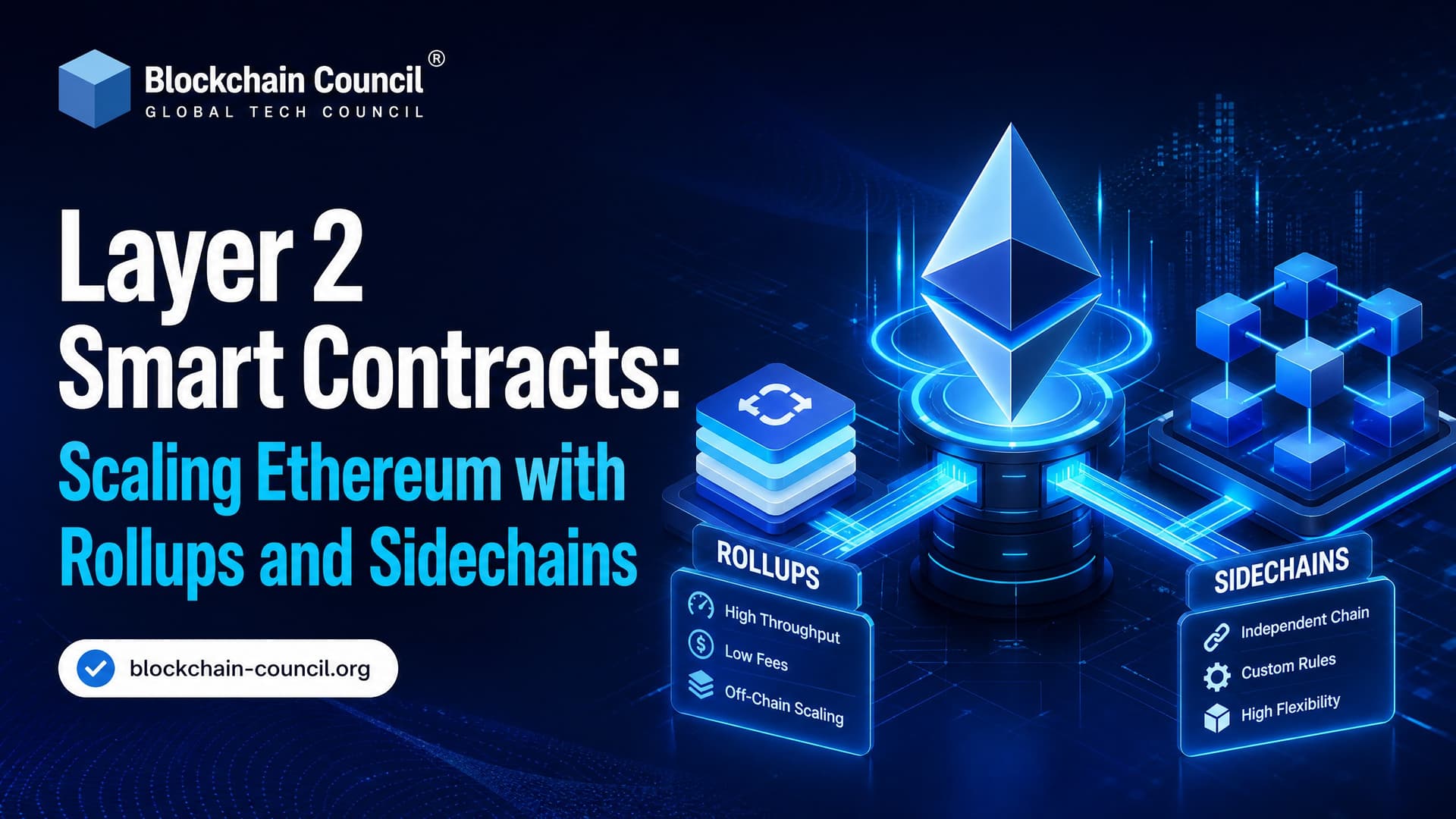
Layer 2 smart contracts have changed where Ethereum applications actually run. Instead of pushing every user action to Ethereum mainnet, developers now deploy contracts on rollups and, in some cases, sidechains, then use Ethereum for settlement, security, or asset anchoring. The result is simple for users: faster confirmations, much lower fees, and applications that can handle far more than a handful of transactions per second.
This matters because Ethereum mainnet was never built to execute every global application interaction directly. Its base layer puts security and decentralization first. Layer 2 networks move execution elsewhere while keeping a link back to Ethereum. That design is now central to how Ethereum scales.

What Are Layer 2 Smart Contracts?
Layer 2 smart contracts are self-executing programs deployed on networks built above Ethereum. In most major ecosystems, you still write contracts in Solidity or Vyper, compile to EVM-compatible bytecode, and use familiar tools such as Hardhat, Foundry, Ethers.js, MetaMask, and block explorers.
The difference is where execution happens. On Ethereum L1, every node processes the transaction. On an L2, transactions execute on the L2 network, then the network posts compressed data, commitments, or proofs back to Ethereum. That saves gas and reduces congestion.
Two architecture families dominate the conversation:
- Rollups: Networks that batch off-chain transactions and settle them to Ethereum. These are generally treated as true Layer 2 systems because they inherit Ethereum security to a meaningful degree.
- Sidechains: Independent blockchains connected to Ethereum through bridges. They can be fast and cheap, but their security comes from their own validator set, not Ethereum mainnet.
Rollups: The Main Path for Ethereum Scaling
Rollups process transactions off-chain, bundle them, and post data or proofs to Ethereum. Vitalik Buterin described rollups as a core part of Ethereum scaling in An Incomplete Guide to Rollups, noting that they can increase throughput by roughly 100 times compared with Ethereum L1 in practical designs.
Historically, Ethereum handled around 15 transactions per second. Rollups can push practical throughput into the hundreds or thousands, depending on the implementation and the data availability model. Aggregate rollup throughput is often discussed in the 2,000 to 7,000+ TPS range, with much larger long-term targets tied to Ethereum data availability improvements.
Optimistic Rollups
Optimistic rollups assume transactions are valid unless someone challenges them. If a batch is wrong, a fraud proof can be submitted during a challenge window. Arbitrum and Optimism are the best-known examples.
The trade-off is clear. Optimistic rollups are mature and EVM-friendly, which makes them practical for DeFi and general dApp deployment. But withdrawals to Ethereum can take longer because the fraud challenge period has to pass first. If your product needs instant L1 withdrawal finality, you will need liquidity providers, fast bridge services, or a different architecture.
ZK Rollups
ZK rollups use validity proofs to show that state transitions are correct. Instead of waiting for fraud challenges, Ethereum verifies a cryptographic proof. Starknet and zkSync Era are prominent examples, and ZK systems are drawing attention for privacy, institutional finance, and high-assurance settlement.
ZK rollups are technically harder to build. Proving systems, circuits, prover costs, and compatibility gaps can all slow development. Still, the security model is strong. To be blunt, ZK rollups are where much of the long-term research energy sits.
Sidechains: Useful, But Not the Same as Rollups
Sidechains run in parallel to Ethereum and connect through bridges. They have their own consensus mechanisms, validators, native tokens, and governance rules. Assets usually move through a two-way bridge: tokens are locked on one chain and minted or released on the other.
Industry explainers often describe sidechains as a faster and cheaper route for Ethereum users, but they do not inherit Ethereum security the way rollups do. Vitalik Buterin has drawn this line clearly: sidechains are scalability tools, but they are not true Layer 2 systems in the stricter technical sense.
That does not make sidechains useless. They can fit high-throughput games, social apps, test environments, or systems that need custom rules. They are the wrong choice when you need Ethereum-level settlement guarantees for high-value assets.
Post-Dencun: Why L2 Fees Dropped So Hard
Ethereum's Dencun upgrade in March 2024 introduced EIP-4844, also called proto-danksharding. It added blob data, a cheaper way for rollups to post data to Ethereum. This was not a small optimization. It changed L2 economics.
Multiple ecosystem trackers reported fee reductions of more than 90 percent across many L2 networks after Dencun. Some periods saw average L2 swap costs fall well under a dollar, and Optimism and Arbitrum transaction fees dropped below $0.01 during quieter stretches, compared with much higher historical mainnet costs for complex interactions.
Developers should still avoid a lazy assumption: blobs cut rollup data costs, but they do not make every interaction free. Contract storage writes, calldata patterns, oracle updates, and bridge operations still matter. I have seen Hardhat deployment scripts fail with ProviderError: max fee per gas less than block base fee because someone copied old mainnet gas settings into an L2 deployment config. Check the target chain's gas model before you ship.
How L2 Smart Contracts Work in Practice
From a developer's seat, the workflow often feels familiar:
- Write the smart contract in Solidity 0.8.x or Vyper.
- Test locally with Hardhat or Foundry.
- Configure the L2 RPC endpoint and chain ID.
- Deploy to networks such as Arbitrum, Optimism, Base, Starknet, zkSync Era, or a sidechain.
- Monitor events, bridge messages, sequencer status, and contract upgrades.
The hidden complexity starts after deployment. You need to understand message passing between L1 and L2, withdrawal delays, sequencer assumptions, bridge risk, and data availability. A contract that is safe on mainnet may behave differently when part of the business logic depends on cross-chain state.
One practical example: on optimistic rollups, an L2 contract can emit an event quickly, but final settlement on Ethereum is not the same as local L2 confirmation. If your compliance or treasury workflow treats those as identical, you may create accounting and risk problems.
Rollups vs Sidechains: Security and Trade-Offs
Use this rule of thumb:
- Choose rollups when you need stronger Ethereum-linked security, DeFi composability, and a growing developer ecosystem.
- Choose optimistic rollups when EVM compatibility and mature tooling matter more than instant L1 withdrawals.
- Choose ZK rollups when validity proofs, faster finality assumptions, or privacy-oriented designs matter.
- Choose sidechains when you need high throughput, custom governance, or low-cost experimentation and can accept a weaker security model.
Bridge risk deserves special attention. Many of the largest losses in crypto history have involved bridges, not basic ERC-20 transfer logic. If your application moves high-value assets across chains, audit the bridge assumptions as carefully as your own smart contracts.
Real-World Use Cases for Layer 2 Smart Contracts
DeFi
Layer 2 smart contracts make frequent trading, lending, borrowing, and stablecoin transfers cheaper. Low fees also help smaller users who would be priced out by mainnet gas during congestion. Base, Arbitrum, and Optimism have become major environments for consumer activity and DeFi liquidity.
Gaming and NFTs
Games and NFT platforms need high-volume, low-value transactions. Minting an item, updating game state, or transferring a collectible should not cost several dollars. L2 networks make these interactions practical, especially where UX matters more than direct L1 execution.
Enterprise Workflows
Enterprises can use L2 smart contracts for B2B payments, tokenized asset operations, loyalty systems, supply chain events, and automated settlement. The main design question is risk. A rollup is usually better for regulated or high-value settlement. A sidechain may be enough for internal workflows or applications where performance matters more than Ethereum-grade security.
What Professionals Should Learn Next
If you work with smart contracts, you can no longer treat L2 as an optional topic. A large and growing share of new Ethereum smart contracts now deploy directly on Layer 2 networks, and L2s process far more daily transactions than Ethereum L1 across dozens of active chains.
Focus on four skills:
- Rollup architecture: Learn fraud proofs, validity proofs, sequencers, data availability, and settlement.
- Secure Solidity development: L2 does not remove reentrancy, access control, oracle, or upgrade risks.
- Cross-chain design: Study bridges, message delays, replay protection, and chain-specific assumptions.
- Deployment operations: Practice with Hardhat, Foundry, block explorers, RPC providers, and monitoring tools on real testnets.
For structured learning, Blockchain Council's Certified Smart Contract Developer™ covers the Solidity and contract deployment skills that carry over to L2. Professionals who need broader Ethereum and enterprise architecture context can connect this topic with Certified Blockchain Developer™ or Certified Blockchain Architect™.
Final Takeaway
Layer 2 smart contracts are now the practical execution layer for much of Ethereum. Rollups give developers lower fees and higher throughput while keeping a security link to Ethereum. Sidechains offer speed and flexibility, but with a different trust model.
Your next step is concrete: deploy the same simple Solidity contract to Ethereum Sepolia, an optimistic rollup testnet, and a ZK rollup testnet. Compare gas, confirmation behavior, explorer data, and withdrawal flow. That exercise teaches more than another architecture diagram ever will.
Related Articles
View All
Smart Contracts
How to Deploy Smart Contracts on Ethereum, Testnets, and Layer 2 Networks
Learn how to deploy smart contracts on Ethereum mainnet, Sepolia, Arbitrum, Base, and zkSync Era using Hardhat, Remix, wallets, faucets, bridges, and explorers.

Smart Contracts
Solidity Programming Guide: How to Build Secure Ethereum Smart Contracts
A practical Solidity programming guide covering compiler settings, secure patterns, storage layout, testing, and modern Ethereum smart contract security.

Smart Contracts
Ethereum Smart Contracts Explained: Features, Standards, and Development Basics
Ethereum smart contracts power tokens, DeFi, NFTs, stablecoins, and RWAs. Learn their features, EVM basics, standards, development lifecycle, and risks.
Trending Articles
The Role of Blockchain in Ethical AI Development
How blockchain technology is being used to promote transparency and accountability in artificial intelligence systems.
How Blockchain Secures AI Data
Understand how blockchain technology is being applied to protect the integrity and security of AI training data.

Can DeFi 2.0 Bridge the Gap Between Traditional and Decentralized Finance?
The next generation of DeFi protocols aims to connect traditional banking with decentralized finance ecosystems.