

Cross-Chain Smart Contracts: Bridges, Interoperability, and Multi-Chain dApps

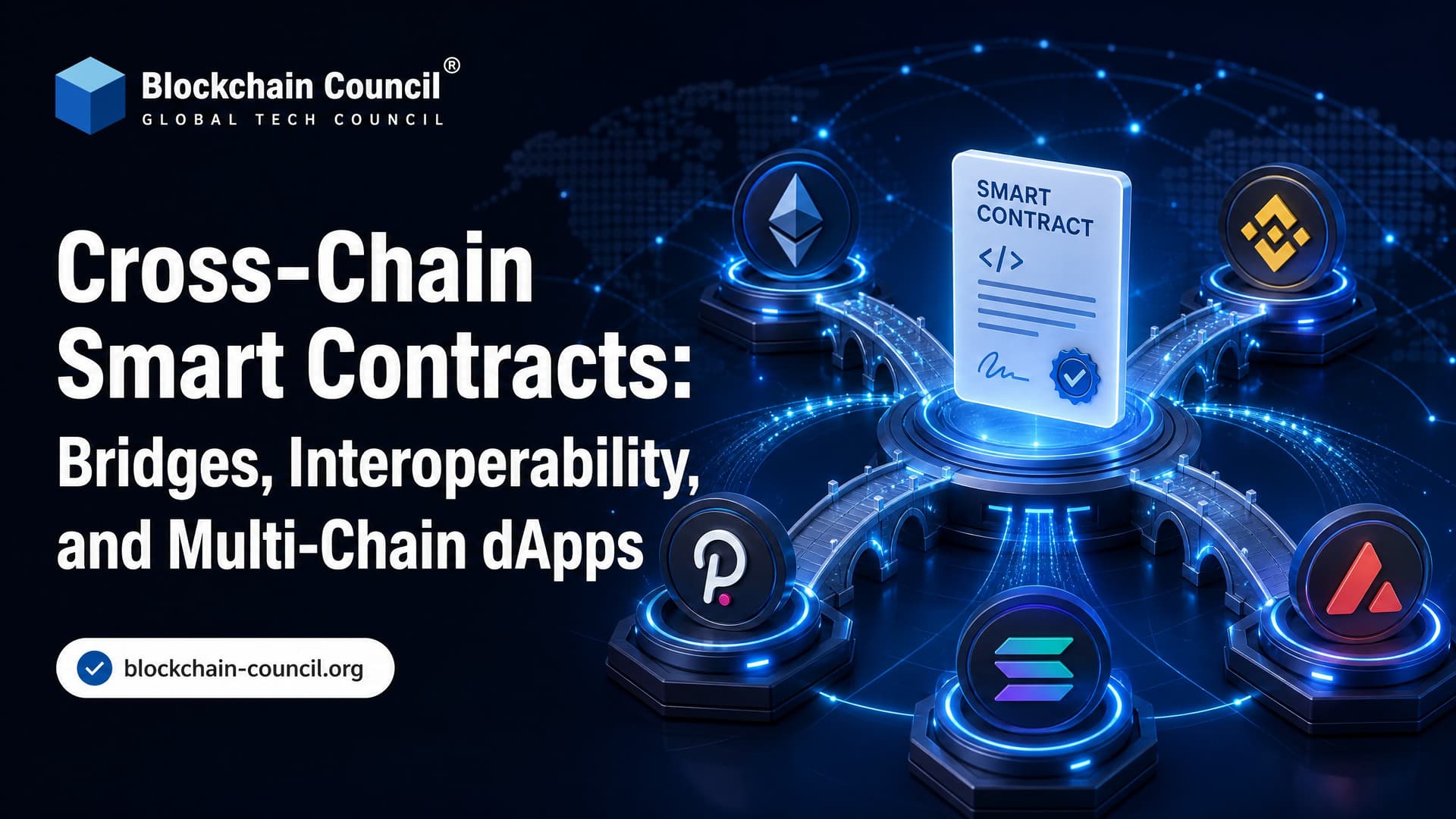
Cross-chain smart contracts let dApps coordinate logic, assets, and state across more than one blockchain. That sounds simple until you build it. A transfer on Ethereum may need to trigger accounting on Arbitrum, settlement on Base, and governance checks on a separate chain. Each hop adds assumptions about validators, oracles, message formats, finality, and upgrade control.
The short version: cross-chain architecture is no longer optional for serious Web3 teams, but bridges remain one of the riskiest pieces of blockchain infrastructure. You need the design discipline of a protocol engineer, not just a deployment script.

What Are Cross-Chain Smart Contracts?
Cross-chain smart contracts are application designs where contracts on one blockchain can trigger actions, synchronize state, or move value on another chain through bridges, messaging protocols, or oracle networks.
This is different from basic multi-chain deployment. If you deploy the same ERC-20 staking contract on Ethereum, Polygon, and BNB Chain, but each version has its own liquidity and governance, you have a multi-chain app. If those contracts can communicate and act as one logical system, you have a cross-chain smart contract architecture.
Cross-chain interoperability in plain terms
Cross-chain interoperability means different blockchain networks can exchange data and value without a centralized exchange or manual off-chain process. Without it, blockchains behave like separate databases. Users bridge manually, liquidity fragments, and developers maintain duplicated state.
Interoperability matters because the market is already multi-chain. Ethereum mainnet, with chain ID 1, is still a major settlement layer. Many users, though, operate on L2s such as Arbitrum, Optimism, Base, and Polygon because fees and transaction speed are better for routine activity. Alternative L1s add their own ecosystems and liquidity. Your application has to meet users where they are.
How Bridges and Messaging Protocols Work
A cross-chain bridge is infrastructure that moves tokens or data between a source chain and a destination chain. Most asset bridges follow one of these patterns:
- Lock and mint: Tokens are locked on the source chain, then wrapped tokens are minted on the destination chain.
- Burn and mint: Tokens are burned on one chain and minted on another, often for native cross-chain assets.
- Liquidity network: Liquidity providers front assets on the destination chain and later settle through the protocol.
Generalized cross-chain protocols go further. They send arbitrary messages, not just tokens. A contract on Chain A can tell a contract on Chain B to update a balance, cast a vote, release collateral, or call another function.
Common interoperability technologies include Chainlink CCIP, LayerZero, Wormhole, Axelar, Inter-Blockchain Communication in the Cosmos ecosystem, and Polkadot XCM. Each uses a different trust model. That detail matters more than the marketing page.
The role of oracles and validators
Cross-chain contracts cannot directly read another blockchain the way they read local contract storage. They need a messenger. Oracles, relayers, validator sets, or light-client systems observe events on one chain and prove or attest those events to another chain.
Take a simple case. A source-chain contract emits an event that says a user deposited 10 tokens. A messaging protocol observes that event, validates it according to its rules, and delivers a message to the destination-chain contract. The destination contract then updates state or releases funds.
Here is where beginners get bitten. The message can be formatted correctly but still be unsafe if the receiver does not check the source chain, sender address, nonce, replay protection, and message domain. In EVM work, I have seen teams confuse block.chainid with protocol-specific chain selectors. Chainlink CCIP, LayerZero, and other systems use their own identifiers in addition to EVM chain IDs. Mix them up, and your test may pass locally while production messages fail or route incorrectly.
Why Multi-Chain dApps Need Cross-Chain Design
Many early dApps handled expansion by redeploying the same contracts on every new chain. It worked for simple products, but it created three hard problems:
- Fragmented liquidity: A lending pool on one chain cannot easily use idle liquidity on another.
- Split governance: Risk parameters, treasury actions, and upgrades become harder to coordinate.
- Weak user experience: Users must bridge manually, switch RPCs, pay gas on several networks, and track wrapped assets.
Cross-chain smart contracts address this by treating chains as components of one application. You might use Ethereum for governance and final settlement, an L2 for user activity, and a high-throughput chain for game or payment interactions.
Common design patterns
- Hub-and-spoke model: One primary chain holds governance, accounting, or risk controls. Other chains act as execution spokes.
- Storefront contracts: Lightweight contracts on secondary chains accept user actions and forward messages to the main protocol.
- Cross-chain liquidity routing: A swap or lending transaction starts on one chain but uses liquidity from another chain.
- Cross-chain governance: Voting happens on a lower-fee chain, while execution occurs on the chain that holds the protocol treasury.
- State synchronization: Contracts update balances, votes, collateral ratios, or access rights across networks.
To be blunt, not every app needs this. If your users live on one chain and your liquidity is local, cross-chain architecture may add risk without adding value. But if your protocol depends on capital efficiency across chains, it becomes a serious design requirement.
Security Risks: Bridges Are Not Just Plumbing
Bridge security has a poor history. Chainalysis has repeatedly flagged cross-chain bridge exploits as a major source of stolen DeFi funds. The Ronin Bridge exploit in 2022 was reported at about $625 million. The Wormhole exploit that same year was reported at about $320 million. These were not small edge cases.
Cross-chain systems add attack surfaces that single-chain contracts do not have:
- Message authenticity: Can the receiver prove the message came from the expected contract on the expected chain?
- Replay attacks: Can an old message be submitted again?
- Validator compromise: What happens if bridge signers, relayers, or oracle nodes are attacked?
- Finality mismatch: Does the destination act before the source-chain transaction is economically final?
- Upgrade risk: Who can change bridge contracts, message libraries, or verification rules?
- Liquidity risk: Can a bridge run short of destination-chain liquidity during stress?
Security-first cross-chain design starts with a written trust model. Who validates the source event? What must they sign? Can they be slashed? Can users dispute a message? Is there a pause function? Who controls it? If those answers are vague, do not ship with meaningful value.
Practical safeguards for developers
- Validate the source: Check the sending chain identifier and the sender contract address on every inbound message.
- Use nonces: Store consumed message IDs to prevent replay.
- Separate accounting from execution: Do not release funds and update complex state in the same unchecked flow.
- Add rate limits: Cap how much value can move per token, route, and time window.
- Plan emergency controls: Pausing cross-chain receipt is sometimes necessary. Keep the scope narrow and governance clear.
- Test forks, not only mocks: Local mocks miss real gas behavior, chain selector mistakes, RPC quirks, and finality assumptions.
A common Hardhat warning, cannot estimate gas; transaction may fail or may require manual gas limit, is easy to ignore during testing. In cross-chain receivers, that warning often points to a failed authorization check, wrong endpoint address, or malformed payload. Treat it as a design signal, not just a tooling annoyance.
Intents and the Future of Cross-Chain UX
Cross-chain user experience is still rough. Users do not want to think about wrapped assets, route selection, destination gas, or finality windows. This is why Intents are getting attention.
With an intent-based model, users express the outcome they want, such as swapping token A on one chain for token B on another. Solvers or protocol participants compete to execute that outcome under defined constraints. ERC-7683, developed by Across Protocol and Uniswap Labs, is an effort to standardize cross-chain Intents across the EVM ecosystem.
This is promising, but it is not magic. Intent systems still need settlement guarantees, solver incentives, dispute handling, and protection from bad execution. They improve UX only when the underlying verification model is sound.
Skills You Need to Build Cross-Chain Smart Contracts
If you want to build multi-chain dApps professionally, focus on these areas:
- Solidity 0.8.x, including custom errors, access control, and upgrade patterns.
- EVM chain IDs, transaction replay protection, and EIP-1559 gas mechanics.
- Token standards such as ERC-20, ERC-721, and ERC-1155.
- Bridge trust models, including multisig, optimistic, oracle-based, and light-client approaches.
- Testing with Foundry or Hardhat against forked networks.
- Threat modeling for relayers, validators, admin keys, and message receivers.
For structured learning, consider Blockchain Council programs such as Certified Smart Contract Developer™, Certified Blockchain Developer™, and Certified Ethereum Expert™. If you are moving from general blockchain knowledge into protocol engineering, start with smart contract fundamentals before you attempt bridge or messaging integrations.
Choosing the Right Architecture
Use a simple decision rule. If your app only needs presence on several chains, independent deployments may be enough. If your app needs shared liquidity, unified governance, or state coordination, design it as a cross-chain system from day one.
Pick interoperability infrastructure based on the trust model, not only developer convenience. Ask for audits. Read incident reports. Test failure paths. Run small limits first. A bridge is not a neutral pipe. It is part of your protocol security boundary.
Your next step: sketch your dApp as a message flow diagram. Mark the source chain, destination chain, validator or oracle layer, receiver checks, replay protection, and emergency stop points. If you cannot explain that diagram to another engineer in five minutes, the design is not ready for mainnet.
Related Articles
View All
Smart Contracts
Cross-Chain Smart Contracts: Designing Interoperable dApps with Bridges, Oracles, and Messaging Protocols
Learn how cross-chain smart contracts enable interoperable dApps using bridges, oracle networks, and messaging protocols, plus key security patterns and design best practices.

Smart Contracts
The Future of Smart Contracts: Trends, Challenges, and Opportunities
Explore the future of smart contracts, including AI, interoperability, tokenization, security risks, regulation, and high-value use cases.

Smart Contracts
AI and Smart Contracts: How Artificial Intelligence Is Transforming Web3 Automation
AI and smart contracts are turning Web3 automation into adaptive systems for DeFi, DAOs, insurance, gaming, and enterprise workflows.
Trending Articles
The Role of Blockchain in Ethical AI Development
How blockchain technology is being used to promote transparency and accountability in artificial intelligence systems.
AWS Career Roadmap
A step-by-step guide to building a successful career in Amazon Web Services cloud computing.
How Blockchain Secures AI Data
Understand how blockchain technology is being applied to protect the integrity and security of AI training data.