

AI and Smart Contracts in DeFi: Automating Risk Management and Fraud Detection

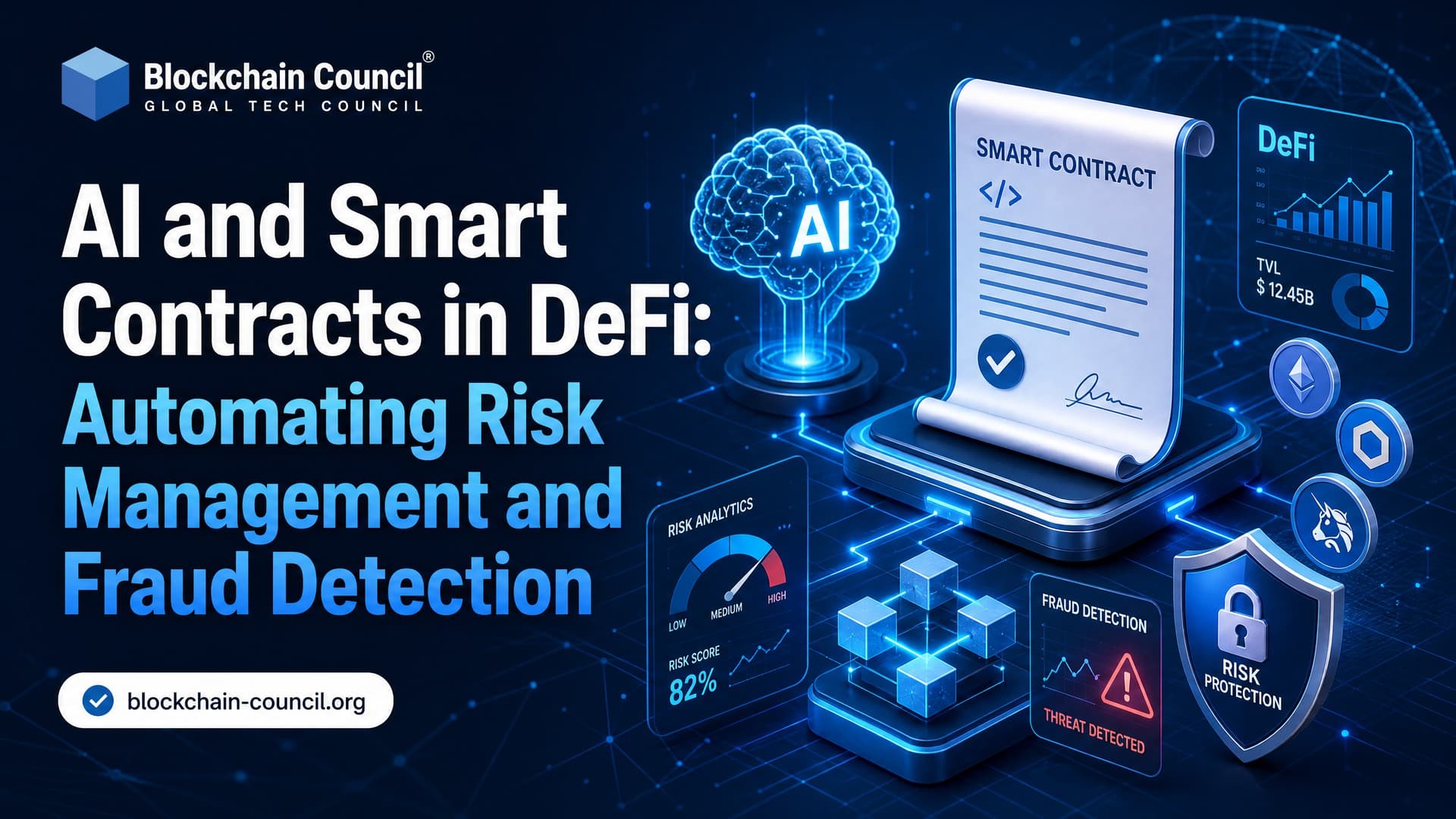
AI and smart contracts in DeFi are beginning to reshape how decentralized protocols monitor risk, detect anomalies, and respond to suspicious activity. While fully autonomous AI-run DeFi systems remain experimental, research teams, security firms, and infrastructure providers are already exploring how machine learning can strengthen existing smart contract controls.
DeFi has grown into a major segment of the crypto economy, with total value locked reaching approximately 129 billion USD in January 2025. As more capital flows through lending markets, decentralized exchanges, derivatives platforms, and liquid staking protocols, automated risk management is no longer optional. It is becoming a core operating requirement.

Why DeFi Needs Smarter Risk Management
DeFi protocols rely on smart contracts to execute financial logic without traditional intermediaries. These contracts can automate lending, collateral management, trading, staking, claims processing, and governance actions. Automation, however, concentrates risk in code, data feeds, governance mechanisms, and market assumptions.
The main risk categories in decentralized finance include:
- Smart contract risk: Bugs, logic errors, upgrade vulnerabilities, and exploits.
- Market risk: Volatility, liquidity shocks, cascading liquidations, and depegs.
- Governance risk: Malicious proposals, voting power concentration, and poor parameter management.
- Oracle and data risk: Incorrect, delayed, or manipulated external data.
- Operational risk: Weak monitoring, poor incident response, and inadequate access controls.
Industry frameworks, including the Enterprise Ethereum Alliance DeFi Risk Assessment Guidelines, emphasize systematic identification, mitigation, and accounting of these risks. In practice, smart contract risk remains one of the most prominent technical concerns because once vulnerable code is deployed, attackers can exploit it quickly and at scale.
Where AI Fits Into DeFi Smart Contracts
AI does not replace deterministic smart contracts. Instead, the emerging model combines off-chain AI analysis with on-chain smart contract execution. AI systems analyze large volumes of data, generate risk scores or alerts, and pass outputs to smart contracts, dashboards, or governance systems through oracles and monitoring pipelines.
This makes AI useful for tasks such as:
- Detecting abnormal wallet behavior and suspicious transaction flows.
- Predicting liquidation risk based on collateral, liquidity, and volatility.
- Identifying flash loan attack patterns before losses cascade.
- Estimating protocol-level exposure during market stress.
- Supporting dynamic parameter changes within strict governance limits.
Security researchers often describe these architectures as AI smart contracts, meaning systems where traditional contract logic interacts with machine learning models, AI agents, APIs, and oracles. The smart contract still enforces rules, while AI provides adaptive insights based on historical and real-time data.
AI-Based Risk Scoring in DeFi
One of the most practical applications of AI and smart contracts in DeFi is risk scoring. Research prototypes have trained AI models on historical DeFi transaction data to estimate risk levels for addresses, transactions, or positions. These scores can then influence how protocols respond to changing conditions.
How Risk Scoring Can Work
A DeFi lending protocol, for example, could use AI-assisted analysis to evaluate:
- Account behavior across multiple protocols.
- Collateral volatility and concentration.
- Liquidity depth in relevant markets.
- Prior interaction with exploit contracts or sanctioned entities.
- Unusual leverage patterns or rapid position changes.
If the system identifies elevated risk, the protocol may trigger predefined responses such as tightening borrowing limits, increasing collateral requirements, slowing withdrawals, or notifying risk committees. The safest designs keep these responses bounded by transparent rules rather than allowing an opaque model to move funds without constraints.
Fraud Detection and Anomaly Monitoring
Fraud detection in DeFi is challenging because blockchains are open, composable, and fast-moving. Attackers can combine flash loans, automated trading, governance manipulation, bridge interactions, and contract calls within a single transaction or a short sequence of blocks.
Existing DeFi security systems already use automation to monitor suspicious activity. Real-time monitoring tools can scan for unusually large withdrawals, liquidity drains, flash loan patterns, price manipulation, or abnormal contract interactions. When thresholds are exceeded, circuit breakers can pause selected functions or halt the protocol while teams investigate.
AI can improve these systems by identifying more complex patterns than static rules alone. Machine learning models can analyze transaction graphs, time-series volatility, wallet clusters, and behavioral deviations. An AI-assisted fraud detection system may flag a coordinated exploit attempt even when each individual transaction appears acceptable in isolation.
Common AI-Assisted Detection Signals
- Sudden transaction volume spikes from new or dormant wallets.
- Rapid asset movement across bridges, mixers, and DeFi protocols.
- Repeated flash loan usage linked to oracle-sensitive trades.
- Abnormal liquidity removal before governance or market events.
- Wallet interactions with contracts similar to known exploit patterns.
For professionals studying these systems, Blockchain Council programs such as Certified Smart Contract Developer, Certified DeFi Expert, and AI-focused certifications can support a structured understanding of both blockchain execution and AI-based analytics.
Adaptive Smart Contracts and Dynamic Risk Controls
AI-enhanced smart contracts can support adaptive DeFi mechanisms, provided they operate within carefully designed guardrails. Instead of using fixed risk parameters that change only through manual governance, protocols can combine algorithmic rules with AI-generated signals.
Potential use cases include:
- Dynamic liquidity management: AI agents can analyze pool performance, volatility, and utilization to recommend liquidity allocation changes.
- Adaptive interest rates: Lending markets can adjust rates based on utilization, market stress, and AI-estimated volatility.
- Automated portfolio adjustment: Vaults can rebalance exposure when risk indicators breach limits.
- Collateral risk monitoring: Protocols can reassess collateral assets when liquidity weakens or price instability increases.
- Insurance support: AI can assist claim assessment by detecting whether a covered event, such as a depeg or exploit, has occurred.
These designs are most credible when AI acts as a decision-support layer and smart contracts enforce transparent limits. For example, a model may recommend changing an interest rate, but the contract should cap how much the rate can change within a given time period.
Security Challenges of AI Smart Contracts
Although AI can improve automated risk management, it also introduces new attack surfaces. A protocol that connects smart contracts to external AI systems must secure not only the contract code but also the model, data pipeline, oracle mechanism, and governance process.
Key Risks to Manage
- Data quality risk: AI outputs are only as reliable as the data used for training and inference.
- Model manipulation: Attackers may attempt to influence inputs to produce favorable risk scores.
- Oracle dependency: Faulty or manipulated data feeds can trigger incorrect contract actions.
- Limited explainability: Black-box models can be difficult for auditors, users, and regulators to evaluate.
- Integration complexity: More components create more points of failure.
This creates a dual-audit requirement. Teams need traditional smart contract audits, formal reviews, and secure deployment practices. They also need AI model validation, training data review, monitoring for model drift, and clear audit trails for AI-influenced decisions.
Best Practices for AI-Driven DeFi Risk Systems
Protocols integrating AI and smart contracts in DeFi should avoid treating AI as an unrestricted controller. A defense-in-depth approach is more appropriate.
- Keep settlement deterministic: Core asset transfers and accounting should remain governed by predictable smart contract logic.
- Use AI for signals, not unchecked authority: AI should produce risk scores, alerts, or recommendations that pass through policy constraints.
- Define circuit breaker rules: Emergency pauses should be transparent, scoped, and governed.
- Secure oracle and API connections: AI outputs entering the blockchain must be authenticated and resistant to manipulation.
- Maintain human and governance oversight: High-impact changes should require review, voting, or multi-signature approval.
- Monitor continuously: Models should be checked for drift, false positives, false negatives, and adversarial behavior.
- Document incident response: Teams should define preparation, identification, containment, recovery, and post-incident learning steps.
These practices align with broader DeFi risk guidance from industry bodies, risk specialists, and security educators that emphasize audits, monitoring, compliance frameworks, and incident response planning.
The Future of AI and Smart Contracts in DeFi
The likely future is not fully autonomous AI moving user funds without oversight. A more realistic trajectory is a modular architecture where smart contracts define guardrails and verifiable state transitions, while AI systems provide predictive analytics, anomaly detection, and parameter recommendations.
DeFi risk management is expected to become more continuous, automated, and data-driven. Standardized security ratings, real-time solvency reporting, and embedded supervision may also become more common. In such environments, AI can help analyze large data sets while smart contracts enforce transparent rules.
Regulatory expectations will likely increase demand for explainable and auditable AI tools. Protocols that can show why an automated risk action occurred, which data informed it, and which smart contract rule enforced it will be better positioned than systems relying on opaque decision-making.
Conclusion
AI and smart contracts in DeFi are converging to automate risk management and strengthen fraud detection, but the field remains early. The strongest current approach is not to hand control to AI, but to combine intelligent off-chain analysis with deterministic on-chain enforcement.
AI can help detect anomalies, predict risk, support dynamic parameter management, and improve incident response. Smart contracts can enforce predefined rules, preserve transparency, and maintain verifiable execution. Together, they offer a path toward safer and more adaptive DeFi systems, provided teams prioritize security audits, explainability, data integrity, and governance from the beginning.
Related Articles
View All
Smart Contracts
Smart Contracts in Insurance: Automating Claims, Payouts, and Risk Management
Smart contracts in insurance automate claims, payouts, underwriting, and risk management, with the strongest use cases in parametric and P&C coverage.

Smart Contracts
Smart Contracts in DAOs: Automating Governance, Voting, and Treasury Management
Learn how Smart Contracts in DAOs automate voting, governance, and treasury management while addressing risks such as voting concentration and compliance.
Smart Contracts
Flash Loan Attacks: How They Exploit DeFi Smart Contracts
Flash loan attacks use same-transaction borrowing to exploit DeFi smart contracts through oracle manipulation, accounting bugs, governance flaws, and more.
Trending Articles
AWS Career Roadmap
A step-by-step guide to building a successful career in Amazon Web Services cloud computing.
How Blockchain Secures AI Data
Understand how blockchain technology is being applied to protect the integrity and security of AI training data.
What is AWS? A Beginner's Guide to Cloud Computing
Everything you need to know about Amazon Web Services, cloud computing fundamentals, and career opportunities.