

Smart Contract Developer Roadmap: Skills, Tools, and Projects to Build in 2026

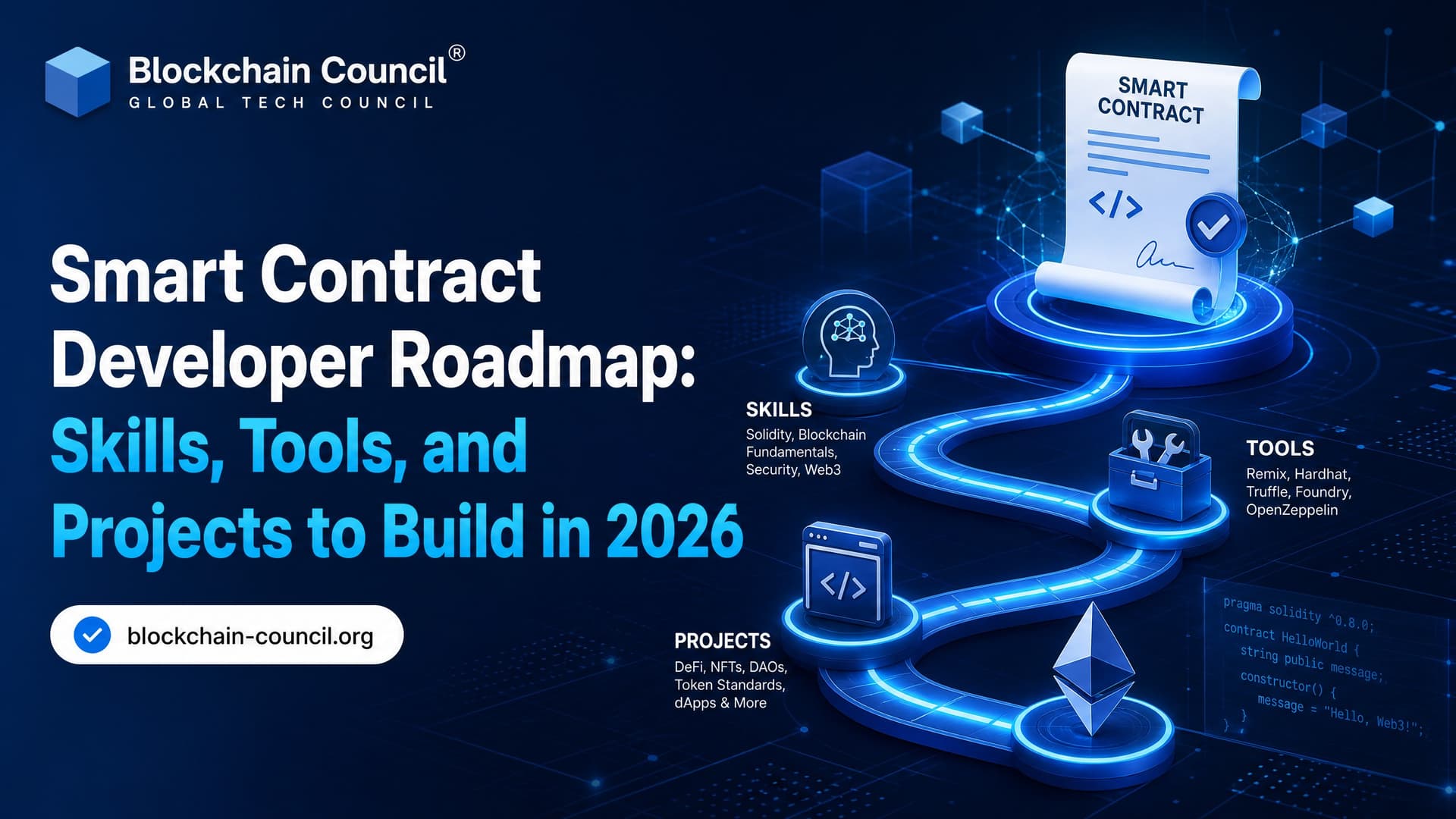
A smart contract developer roadmap is no longer just a list of Solidity tutorials. If you want to work professionally in 2026, you need EVM fluency, disciplined testing, full-stack dApp skills, and a portfolio that proves you can ship secure contracts beyond toy examples.
The shortest practical route is still Ethereum and EVM first. Solidity, Hardhat, OpenZeppelin Contracts, React or Next.js, Ethers.js, and testnet deployments give you the broadest coverage across Ethereum, Polygon, Arbitrum, Optimism, Base, BNB Chain, and other EVM-compatible networks. Rust and Move are worth learning later, but not first unless you are targeting Solana, Sui, or Aptos roles specifically.

Why EVM Skills Still Dominate Smart Contract Hiring
The Ethereum Virtual Machine remains the best starting point because the tooling is mature, the standards are widely used, and many chains share similar contract patterns. ERC-20 tokens, ERC-721 NFTs, proxy contracts, governance modules, and DeFi primitives appear again and again across EVM ecosystems.
This matters for your learning path. You do not want five shallow skillsets. You want one deep one. Start with Solidity 0.8.x, understand gas, learn how transactions are signed and mined, then build projects that run on public testnets. Simple advice. Hard work.
Gas is the fee required to execute operations on the network, and EIP-1559 changed Ethereum fee mechanics by introducing a base fee plus priority fee model. You do not need to become an economics researcher on day one, but you must know why an infinite loop is not just bad code. It is expensive bad code.
Phase 1: Build the Foundations
Programming and computer science basics
If you are new to software development, start with JavaScript or TypeScript. Smart contract teams often expect you to read front-end code, write deployment scripts, and debug JSON-RPC calls. Learn:
- Variables, functions, classes, async programming, and promises
- Data structures such as arrays, maps, sets, stacks, and queues
- Basic networking, HTTP, APIs, and browser developer tools
- Git, GitHub, npm, and command-line workflows
You do not need a computer science degree to begin. You do need patience with debugging. A surprising amount of smart contract development is reading one wrong line in a config file.
Blockchain fundamentals
Before you write serious Solidity, understand the machine you are programming. Focus on:
- Accounts, private keys, public keys, and addresses
- Transactions, blocks, confirmations, and chain IDs
- Ethereum mainnet chain ID 1 and testnet differences
- Gas, calldata, storage, events, and logs
- Consensus, including Ethereum's move to Proof of Stake in 2022
Do not skip this layer. Developers who skip blockchain basics often write contracts that compile but fail in production-like conditions.
Phase 2: Learn Solidity the Right Way
Solidity should be your first smart contract language. Learn the syntax, then immediately connect it to security and gas behavior. Solidity 0.8.x includes built-in overflow and underflow checks, which means old SafeMath patterns are usually unnecessary for standard arithmetic. That is a useful version-specific detail to know.
Cover these Solidity topics in order:
- State variables, memory, calldata, and storage
- Functions, visibility, modifiers, and events
- Payable functions and Ether transfers
- Structs, mappings, arrays, and enums
- Inheritance, interfaces, abstract contracts, and libraries
- Errors, revert reasons, and custom errors
- ERC-20, ERC-721, and ERC-1155 token standards
Use Remix for your first contracts. It is fast, browser-based, and good for seeing how compilation and deployment work. Then move to Hardhat or Foundry. For most JavaScript-first developers, Hardhat is the smoother professional bridge because it fits naturally with npm, TypeScript, Ethers.js, and front-end workflows.
Phase 3: Master the Smart Contract Toolchain
A working smart contract developer roadmap must include tools, not just languages. Your stack should look like this:
- Remix: quick prototypes and beginner deployments
- Hardhat: local development, testing, deployment scripts, and network configuration
- Foundry: fast Solidity-native tests and fuzzing, especially useful for security-heavy work
- OpenZeppelin Contracts: audited implementations for common standards and access control
- Ethers.js: contract reads, writes, wallet integration, and JSON-RPC interaction
- React or Next.js: full-stack dApp interfaces
- IPFS: decentralized metadata storage for NFT projects
- MetaMask: wallet testing and transaction flow validation
One real-world gotcha: OpenZeppelin Contracts 5.x changed some constructor behavior. If you inherit Ownable and forget to pass the initial owner, Solidity can throw: TypeError: No arguments passed to the base constructor. Specify the arguments or mark contract as abstract. Beginners often think Hardhat is broken. It is not. Your base constructor call is missing.
Phase 4: Add Testing and Security From Day One
Security is not an advanced elective. It is the job. Smart contracts can hold user funds, NFT ownership rights, governance authority, and protocol parameters. A bug is not just a failed request. It may be irreversible.
Start with unit tests for every contract. Then add negative tests, edge cases, fuzz tests, and static analysis. Learn the classic vulnerability list early:
- Reentrancy
- Access control mistakes
- Integer overflow and underflow in older Solidity versions
- Unchecked external calls
- Denial of service through unbounded loops
- Oracle manipulation
- Front-running and MEV exposure
- Incorrect upgradeable proxy initialization
Use Checks-Effects-Interactions, OpenZeppelin's ReentrancyGuard where appropriate, role-based access control, and strict test coverage. Tools such as Slither, Mythril, Echidna, and Foundry fuzz tests are common in security workflows. You do not need all of them on week one. You do need the habit of asking, How can this break?
Projects to Build for Your Smart Contract Portfolio
Beginner projects
Start small, but finish properly. Each project should include a README, tests, deployment instructions, and a verified contract on a testnet block explorer.
- Simple storage contract: learn state variables, setters, getters, and deployment.
- Time-locked piggy bank: use payable functions, timestamps, withdrawal rules, and unit tests.
- Basic ERC-20 token: use OpenZeppelin Contracts and test minting, transfers, and allowances.
Intermediate projects
- ERC-721 land registry: represent parcels as NFTs, store metadata on IPFS, and build a simple ownership UI.
- Lottery dApp: emit events, handle user entries, write scripts, and think carefully about randomness.
- Task tracker dApp: connect a React or Next.js front end to contract reads and writes with Ethers.js.
A blunt warning: do not use block.timestamp or blockhash as secure randomness for valuable lotteries. It is acceptable for a learning toy, not for real money. For production-style randomness, study Chainlink VRF and its trust assumptions.
Advanced projects
- Mini DEX: implement token swaps, liquidity pools, fees, events, and slippage checks.
- Upgradeable NFT marketplace: study proxy patterns, initialization, storage layout, listings, bids, and royalties.
- Yield vault: model deposits, shares, withdrawals, accounting, and risk controls.
- DAO governance framework: build proposal creation, voting, quorum, timelocks, and execution.
- Security-first lending protocol: include collateral rules, liquidation paths, oracle checks, and a written threat model.
The audit report matters. Even a self-audit with known risks, test results, assumptions, and unresolved issues signals maturity. Many candidates can deploy a token. Fewer can explain how it fails.
Full-Stack dApp Skills Employers Expect
Smart contract roles increasingly touch the full product stack. You should know how a wallet connects, how a transaction moves from the browser to the RPC provider, and how your UI reacts while a transaction is pending.
Practice these tasks:
- Connect MetaMask or another injected wallet
- Detect the correct chain and request a network switch
- Read contract state with Ethers.js
- Send transactions and wait for receipts
- Listen to contract events
- Show pending, confirmed, and failed transaction states
This is where many back-end-only learners struggle. The contract may be correct, but the user still sees a frozen button. That is not production-ready.
A Practical 2026 Smart Contract Developer Roadmap
- Weeks 1 to 4: Learn JavaScript or TypeScript, blockchain basics, Remix, and simple Solidity contracts.
- Weeks 5 to 8: Move to Hardhat, write tests, deploy to testnets, and build ERC-20 plus ERC-721 projects.
- Weeks 9 to 12: Add security testing, static analysis, fuzzing basics, and a full-stack dApp.
- Months 4 to 6: Build a DeFi or NFT marketplace project with documentation and a testnet deployment.
- Months 7 to 10: Create one advanced security-focused project, contribute to open source, and polish GitHub.
- Beyond 10 months: Specialize in DeFi, NFTs, DAOs, auditing, or multi-chain protocol engineering.
Where Certifications Fit
Certifications will not replace shipped projects, but they can structure your learning and help hiring teams understand your baseline. Consider Blockchain Council's Certified Smart Contract Developer™ if your goal is contract engineering, or Certified Blockchain Developer™ if you want broader blockchain development coverage. Developers aiming at Web3 product roles may also pair this with Certified Web3 Expert™.
Use certification study as a forcing function. Build alongside it. If a module covers ERC-721, deploy an NFT contract. If it covers security, write tests that prove a reentrancy attack fails.
Next Step: Build One Contract This Week
Pick the time-locked piggy bank project, write it in Solidity 0.8.x, test it in Hardhat, and deploy it to an Ethereum testnet. Then publish the GitHub repository with setup steps, test output, contract address, and a short risk note. That single finished project will teach you more than another week of passive reading.
Related Articles
View All
Smart Contracts
Smart Contract Auditing Guide: Process, Tools, and Skills Required
Learn the smart contract audit process, key tools, common vulnerabilities, and skills needed to review Solidity and EVM contracts securely.

Smart Contracts
Smart Contract Certification Guide: How to Validate Your Blockchain Skills
Learn how smart contract certification validates blockchain skills, which developer or auditor path to choose, and how to prove expertise with real projects.

Smart Contracts
Best Smart Contract Development Tools for Solidity, Testing, and Auditing
A practical guide to the best smart contract development tools for Solidity, testing, fuzzing, auditing, formal verification, and monitoring.
Trending Articles
The Role of Blockchain in Ethical AI Development
How blockchain technology is being used to promote transparency and accountability in artificial intelligence systems.
How Blockchain Secures AI Data
Understand how blockchain technology is being applied to protect the integrity and security of AI training data.
Can DeFi 2.0 Bridge the Gap Between Traditional and Decentralized Finance?
The next generation of DeFi protocols aims to connect traditional banking with decentralized finance ecosystems.