

Gas Fees Explained: How Smart Contract Execution Costs Are Calculated
 Suyash Raizada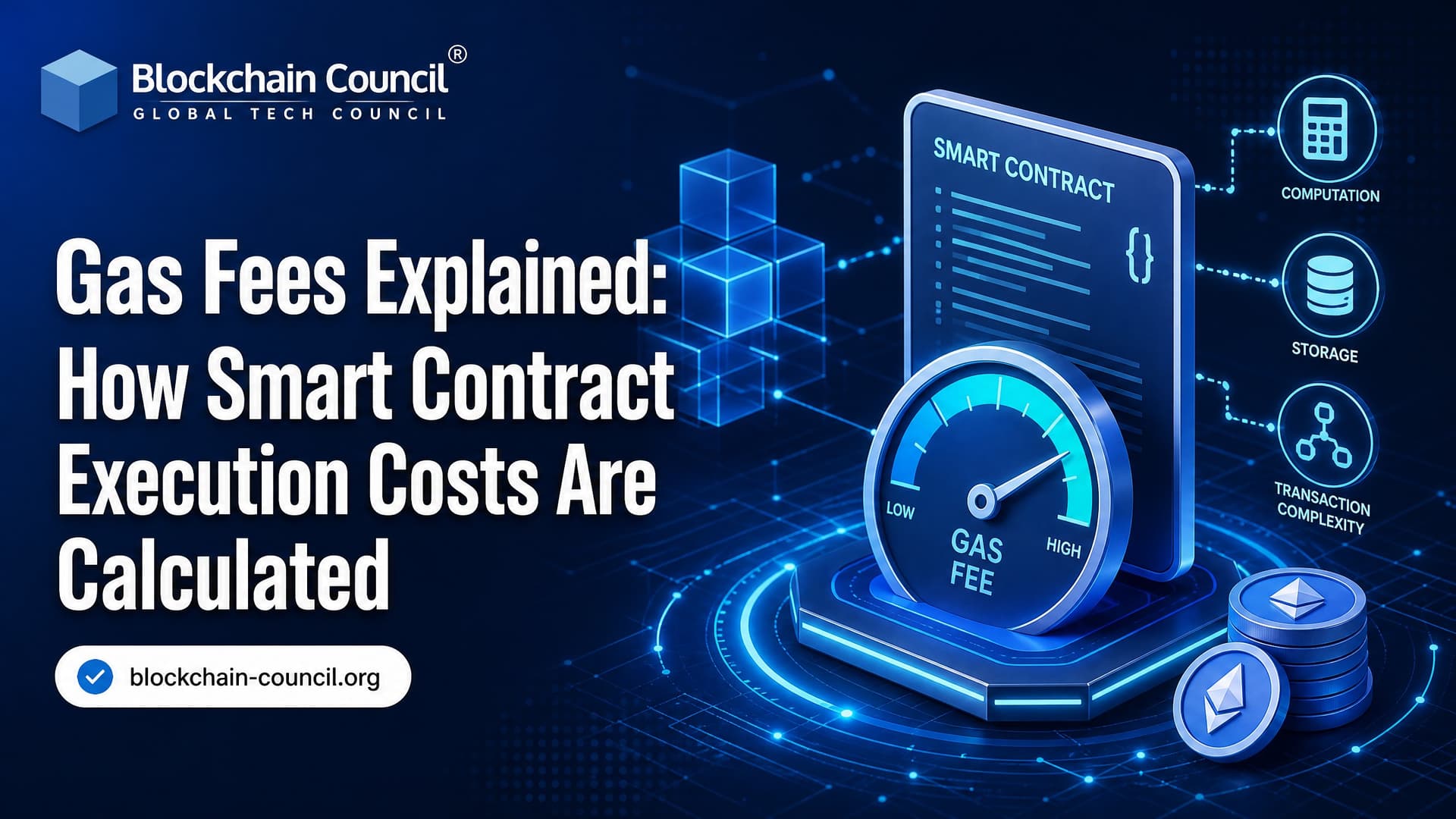
Gas fees are the price you pay for smart contract execution. A blockchain measures how much work your transaction performs, counts that work in gas units, then multiplies those units by a per-unit price set by the network fee market. That sounds simple. The details matter.
If you build contracts, gas is not just a wallet nuisance. It shapes contract design, user retention, deployment cost, and whether your application can run on Ethereum mainnet or should live on an L2. One poorly placed storage write can cost far more than hundreds of arithmetic operations.

What Are Gas Fees?
Gas is a unit of computational work. The gas fee is the monetary amount paid in the network's native asset, such as ETH on Ethereum, MATIC on Polygon, or BNB on BNB Smart Chain.
This split is deliberate. The Ethereum Virtual Machine, or EVM, can assign deterministic gas costs to low-level operations without caring whether ETH trades at 1,000 or 5,000 dollars. The protocol measures work. The market prices that work.
Gas fees exist for three practical reasons:
- Resource pricing: computation, bandwidth, and state storage are scarce shared resources.
- Spam prevention: a cost per transaction makes denial-of-service attacks expensive.
- Validator incentives: validators are paid to include and execute transactions, while Ethereum's base fee is burned under EIP-1559.
How Smart Contract Gas Usage Is Calculated
On Ethereum and EVM-compatible networks, every transaction has a gas meter. As the EVM executes your contract, each opcode deducts gas. When the transaction finishes, the chain knows the exact amount of gas used.
Intrinsic Gas Comes First
A basic ETH transfer from one externally owned account to another costs 21,000 gas. That is the intrinsic cost before any contract logic runs. It covers transaction overhead such as signature verification and basic validation.
Send ETH to a contract and the picture changes. You still pay the intrinsic 21,000 gas, but you also pay for any fallback, receive, or called function logic that executes. That is why sending funds to a multisig wallet or DeFi contract costs more than a simple transfer to a normal wallet address.
Opcode Costs Add Up
Every EVM opcode has a defined gas cost. A simple ADD operation costs 3 gas. That is tiny. Storage is not tiny.
Contract execution cost is roughly:
Gas used = intrinsic gas + opcode gas + storage costs + transaction data costs + call-related costs
This is why developers obsess over storage layout. Writing persistent data to contract storage changes global blockchain state, so it costs far more than working with memory or calldata during execution.
Storage and Data Costs Are the Usual Culprits
Contract deployment and storage-heavy functions are expensive because they create or modify state that every full node must preserve. Ethereum-style contract creation includes a fixed 32,000 gas creation cost, before bytecode and constructor work are counted. Writing a value to a fresh storage slot is one of the most expensive common operations, costing 22,100 gas for a first-time set (a 20,000 gas storage cost plus a 2,100 gas cold access charge).
Transaction input data also has a cost. Zero bytes cost 4 gas each and non-zero bytes cost 16 gas each on Ethereum. You see this in practice when calldata-heavy functions, batch operations, and Merkle proof submissions become surprisingly expensive.
A small practitioner detail: if your local test call works but deployment fails with intrinsic gas too low or Transaction ran out of gas, do not only raise the gas limit. First inspect constructor arguments, bytecode size, and storage initialization. I have seen beginners set ten storage arrays in a constructor, then blame MetaMask when the real issue was contract design.
How Gas Fees Are Priced in Money
Gas usage tells you the quantity of work. The fee model tells you the price per unit.
Legacy Formula: Gas Used x Gas Price
Before EIP-1559, Ethereum used a simpler auction model:
Gas fee = gas used x gas price
Many EVM chains still use a version of this approach. The gas price is usually quoted in gwei, where 1 gwei = 0.000000001 ETH. If a transaction uses 80,000 gas and the gas price is 30 gwei, the fee is 2,400,000 gwei, or 0.0024 ETH.
The gas limit is not the same as gas used. It is a safety cap. If you set a gas limit of 150,000 and the transaction uses 90,000, you pay for 90,000. If execution needs 160,000, the transaction runs out of gas, reverts, and the gas already spent is still paid. Painful, but necessary. Validators did the work.
EIP-1559 Formula: Base Fee Plus Priority Fee
Ethereum now uses the EIP-1559 fee model:
Total fee = (base fee + priority fee) x gas used
The base fee is set by the protocol based on congestion. If recent blocks are above the target gas usage, the base fee rises. If they are below target, it falls. The base fee is burned, meaning it is removed from circulation.
The priority fee, often called the tip, goes to the validator. It helps your transaction compete for inclusion when block space is busy.
Wallets also let you set a max fee per gas. The effective price is capped by your max fee, and any unused difference between your cap and the actual base fee plus priority fee is refunded.
A Simple EIP-1559 Example
Suppose you call a contract function that uses 100,000 gas. The network base fee is 20 gwei. You set a priority fee of 2 gwei and a max fee of 40 gwei.
- Effective gas price: 20 gwei + 2 gwei = 22 gwei
- Total fee: 100,000 x 22 gwei = 2,200,000 gwei
- Base fee burned: 100,000 x 20 gwei
- Validator tip: 100,000 x 2 gwei
If the base fee rises above your max fee before inclusion, your transaction may wait or fail to be included until fees drop.
Why Contract Interactions Cost More Than Transfers
A simple transfer only moves ETH between accounts. A contract call may update balances, emit events, check permissions, call another contract, and write multiple storage slots.
For example, a DeFi deposit may:
- Transfer ERC-20 tokens using transferFrom
- Update a user's position in storage
- Recalculate interest or pool shares
- Emit deposit events
- Call an oracle, router, vault, or reward contract
Each step consumes gas. External calls are especially worth reviewing because they introduce cost and security risk. To be blunt, if a function writes to storage inside a loop over user-controlled input, it is usually a bad design for public mainnet.
Gas Fees on L2s and Other Networks
Layer 2 rollups still use gas-like accounting, but the user fee is usually lower because execution is batched and settled to Ethereum more efficiently. Optimistic rollups and ZK-rollups reduce user-facing costs, though their fee formulas include L2 execution plus the cost of publishing compressed data to L1.
That matters for architecture. Keep high-value settlement and security-critical contracts on Ethereum mainnet when needed. Put frequent user actions, gaming transactions, NFT interactions, and micro-payments on an L2 if the security assumptions fit your use case.
Hedera takes a different route. Its smart contract service supports EVM execution, but fees are tied to USD-based schedules. Hedera documentation describes intrinsic gas, EVM opcode gas, system contract gas, and a 20 percent surcharge after USD-to-gas conversion to cover overhead and usage variation. Enterprises often prefer this style because budgeting is easier.
How Developers Reduce Gas Fees
You cannot control network congestion, but you can control contract efficiency. Start with these habits:
- Minimize storage writes. Store only what must live on chain. Use events for historical logs when possible.
- Use calldata for external function parameters. In Solidity 0.8.x, calldata is cheaper than memory for read-only external inputs.
- Avoid unbounded loops. If a loop can grow with users, it can become impossible to execute.
- Pack storage variables. Smaller integer types can share one 32-byte storage slot when ordered carefully.
- Measure before optimizing. Use Foundry gas snapshots or Hardhat gas reporter instead of guessing.
- Choose the right network. Mainnet is not always the right place for high-frequency actions.
One trade-off: aggressive gas optimization can hurt readability and auditability. Saving 800 gas is not worth hiding critical accounting logic behind clever bit tricks unless the function is called thousands of times per day.
What You Should Learn Next
If you work with Solidity, DeFi, NFTs, or enterprise blockchain systems, gas literacy is a core skill. You should understand EIP-1559, opcode pricing, gas limits, calldata costs, and storage layout before deploying production contracts.
For structured learning, Blockchain Council offers paths such as Certified Blockchain Developer™, Certified Smart Contract Developer™, and Certified Solidity Developer™. If your focus is architecture rather than coding, pair gas fundamentals with blockchain security and Web3 strategy training.
Next step: take one contract you have written, run a gas report, and identify the three most expensive functions. Then ask a hard question. Should those operations happen on L1, on an L2, or off chain with only the final proof or settlement stored on chain?
Related Articles
View All
Smart Contracts
Smart Contract Optimization: Reduce Gas Costs Safely
Learn practical smart contract optimization techniques to reduce gas costs through storage layout, calldata control, batching, tooling, and Layer 2 design.

Smart Contracts
Smart Contract Architecture Explained: Components, Logic, and Execution Flow
Learn smart contract architecture, including components, state, logic, execution flow, upgradeability, automation, security layers, and real-world design patterns.

Smart Contracts
Smart Contract Oracles Explained: Connecting Blockchain Apps to Real-World Data
Smart contract oracles connect blockchain apps to real-world data, enabling DeFi, insurance, IoT, gaming, compliance, and secure Web3 automation.
Trending Articles

Top 5 DeFi Platforms
Explore the leading decentralized finance platforms and what makes each one unique in the evolving DeFi landscape.
What is AWS? A Beginner's Guide to Cloud Computing
Everything you need to know about Amazon Web Services, cloud computing fundamentals, and career opportunities.

Can DeFi 2.0 Bridge the Gap Between Traditional and Decentralized Finance?
The next generation of DeFi protocols aims to connect traditional banking with decentralized finance ecosystems.