

How Smart Contracts Work: Step-by-Step Explanation for Beginners

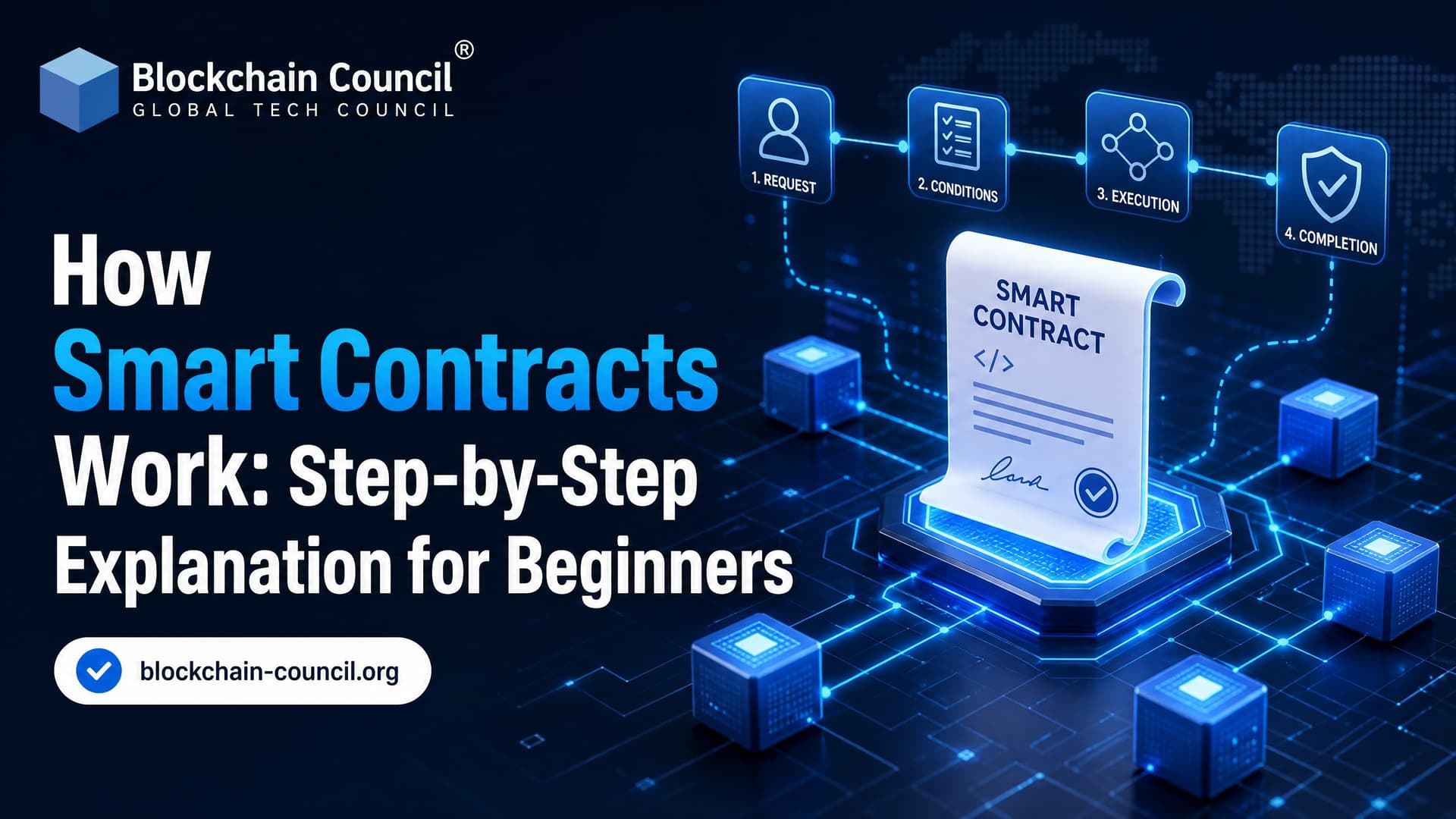
How smart contracts work is simpler than most beginner guides make it sound: a smart contract stores rules on a blockchain, waits for a valid transaction, runs the rules exactly as written, and records the result. No clerk presses approve. No central server quietly edits the outcome. The blockchain network checks the transaction and updates the shared ledger.
That does not make smart contracts magic. They are just programs with money, assets, or permissions attached. Useful, yes. Forgiving, no.

What Is a Smart Contract?
A smart contract is a self-executing digital agreement stored on a blockchain. Its terms are written in code. When predefined conditions are met, the contract automatically performs the programmed action.
Ethereum documentation describes a smart contract as a type of account. It can hold funds and receive transactions, but it is not controlled by a private key like your MetaMask wallet. It is controlled by code.
Think of a vending machine. You insert the right payment, press the correct button, and the machine releases the item. The machine does not negotiate. A smart contract follows the same idea, except the machine is blockchain code and the receipt is recorded on-chain.
How Smart Contracts Work: The Lifecycle in 9 Steps
Step 1: Define the Agreement
Before anyone writes Solidity or deploys anything, the parties define the agreement. This is where many weak smart contracts begin. If the business logic is vague, the code will be vague too.
You need to decide:
- Who can use the contract
- What condition must be met
- What asset, payment, or permission changes hands
- What happens if the condition fails
- Which data source proves the condition
Here is a concrete case. If a buyer sends 2 ETH before a deadline, transfer a tokenized asset to the buyer. If not, keep ownership unchanged and allow refund logic.
Step 2: Write the Smart Contract Code
Developers encode the agreement in a blockchain programming language. On Ethereum and many Ethereum Virtual Machine compatible chains, that language is usually Solidity 0.8.x.
The code defines functions users can call, data the contract stores, and rules for updating that data. Most beginner examples use simple if-then logic:
- If the payment is high enough, accept it
- If the sender is not the owner, reject the action
- If the deadline has passed, stop new deposits
A practical warning: Solidity 0.8.x automatically checks arithmetic overflow and underflow. Older tutorials sometimes use SafeMath everywhere because Solidity 0.7 and earlier needed it. In a modern Hardhat test, an overflow can fail with a message like VM Exception while processing transaction: reverted with panic code 0x11. That detail trips up beginners who copy old code without checking compiler versions.
Step 3: Compile the Code into Bytecode
Blockchains do not execute your readable Solidity file directly. The contract is compiled into bytecode, which the Ethereum Virtual Machine can run.
The compiler also produces an ABI, short for Application Binary Interface. The ABI tells apps and wallets how to call the contract functions. If you have ever clicked a button in a dApp and MetaMask opened a confirmation window, the front end was using the ABI to format that transaction.
Step 4: Deploy the Contract to a Blockchain
Deployment means sending a transaction that contains the compiled bytecode. Once the transaction is included in a block, the contract gets its own address.
On Ethereum, contract creation with the normal CREATE operation derives the contract address from the deployer address and nonce. With CREATE2, the address can be predicted using a salt and bytecode hash. Beginners do not need to memorize the formula yet, but they should understand the core point: after deployment, the contract lives at a specific blockchain address.
Deployment costs gas. Since EIP-1559, Ethereum transactions include a base fee that is burned and a priority fee paid to validators. If your contract stores a lot of data on-chain, deployment gets expensive fast. To be blunt, storing unnecessary text or large arrays on-chain is usually a bad design choice.
Step 5: Trigger the Contract with a Transaction
A smart contract does not wake up on its own. Something triggers it.
That trigger can be:
- A user calling a function from a wallet
- A dApp sending a transaction through a front end
- Another smart contract calling it
- An oracle submitting external data, such as a price or shipment status
When you click swap in a decentralized exchange, your wallet sends a transaction to a smart contract. The transaction includes the function call, input values, your signature, and any cryptocurrency needed for the action.
Step 6: The Network Executes the Logic
After the transaction is broadcast, blockchain nodes process it according to the protocol rules. On Ethereum, the EVM executes the called function using the current blockchain state and the transaction input.
The contract may check:
- Does the sender have permission?
- Is the payment amount correct?
- Has the deadline passed?
- Does the contract have enough balance?
- Did an oracle provide the required data?
If a condition fails, the transaction usually reverts. That means no state change is kept, although the user still pays gas for the computation used. This surprises new developers. A failed transaction is not free.
Step 7: Validators Confirm the Transaction
Execution alone is not enough. The network must agree that the transaction is valid. Ethereum now uses Proof of Stake. Validators propose and attest to blocks, and valid transactions become part of the canonical chain.
This is where decentralization matters. A smart contract is not executed by one company server that can be quietly changed. Many nodes can independently verify the same result from the same inputs. If the contract says a transfer is invalid, the network rejects that state change.
Step 8: The Contract Updates State or Performs an Action
If the transaction is valid, the contract changes its stored data or triggers the next action.
Common smart contract actions include:
- Transferring ERC-20 tokens
- Changing ownership of an ERC-721 NFT
- Recording a vote
- Releasing funds from escrow
- Emitting an event for an off-chain system to read
Events are easy to overlook. They do not change contract storage, but they are very useful for apps, dashboards, and indexers. An ERC-20 transfer, for example, emits a Transfer event that explorers and wallets can track.
Step 9: The Result Is Recorded on the Blockchain
Finally, the transaction and state result are recorded in a block. Anyone can inspect the transaction hash, sender, recipient contract, gas used, logs, and status through a block explorer such as Etherscan.
This record is very hard to alter after confirmation because changing it would require breaking the chain's consensus history. That is why smart contracts are often described as transparent, traceable, and tamper-resistant.
Simple Example: Escrow Payment
Picture a freelance escrow contract.
- You and the freelancer agree on a price and delivery condition.
- A developer writes contract logic that holds your payment.
- The contract is compiled and deployed.
- You deposit funds into the contract.
- An approved reviewer confirms that the work was delivered.
- The contract releases payment to the freelancer.
- The transaction is recorded on-chain.
No bank officer manually approves the release. The contract follows the coded rule. That is powerful, but it also means the reviewer role, dispute process, and refund path must be designed carefully.
Where Smart Contracts Are Used
Smart contracts are now core infrastructure in many blockchain systems, especially Ethereum and EVM-compatible networks.
- DeFi: lending, borrowing, swaps, liquidity pools, and automated payments
- Digital assets: ERC-20 tokens, ERC-721 NFTs, access passes, and tokenized rights
- Supply chains: milestone tracking and conditional payment release
- Enterprise workflows: automated approvals, service-level rules, and audit trails
- Escrow and settlement: conditional transfer of funds or assets
Workflow automation is the common thread. Once conditions are verified, the next action can happen without waiting for manual processing.
Benefits and Trade-Offs
Key Benefits
- Automation: the contract executes when conditions are met
- Transparency: transactions and code behavior can often be inspected
- Traceability: results are recorded on-chain
- Reduced intermediaries: parties rely more on code and network validation
- Predictable execution: the same input and state produce the same result
Real Limitations
Smart contracts are not the right tool for every agreement. If your process needs constant human judgment, private negotiation, or frequent rule changes, putting everything on-chain can make life harder.
Common risks include:
- Bugs that lock or lose funds
- Oracle errors from bad external data
- High gas costs during network congestion
- Poor upgrade design
- Users signing transactions they do not understand
The biggest beginner mistake is treating deployment like publishing a normal web app. A web app bug can often be patched quickly. A deployed smart contract may be immutable unless you planned an upgrade pattern, and upgrade patterns create their own governance risks.
How to Start Learning Smart Contracts
If you want a practical path, start with the basics before chasing complex DeFi strategies.
- Learn blockchain fundamentals: accounts, transactions, blocks, gas, and consensus.
- Study Ethereum smart contract structure: functions, state variables, modifiers, events, and errors.
- Build a small ERC-20 or escrow contract in Solidity 0.8.x.
- Test it locally with Hardhat or Foundry.
- Deploy to a testnet before touching mainnet.
- Read real contracts on Etherscan and compare source code with transactions.
For structured learning, Blockchain Council's Certified Blockchain Expert™ is a solid starting point if you need the full blockchain foundation. If your goal is hands-on development, look at Certified Smart Contract Developer™ as the next step. Developers working around Ethereum can pair this with Ethereum-focused training and security modules.
Final Takeaway
How smart contracts work comes down to one lifecycle: define the terms, write the code, compile it, deploy it, trigger it with a transaction, let the network execute and validate it, then record the result on the blockchain.
Start small. Build a contract that holds a deposit and releases it only when a condition is met. Test the failure cases first, not last. Then move to tokens, oracles, and upgrade patterns once you can explain every state change your contract makes.
Related Articles
View All
Smart Contracts
The Future of Smart Contracts: Trends, Challenges, and Opportunities
Explore the future of smart contracts, including AI, interoperability, tokenization, security risks, regulation, and high-value use cases.

Smart Contracts
AI and Smart Contracts: How Artificial Intelligence Is Transforming Web3 Automation
AI and smart contracts are turning Web3 automation into adaptive systems for DeFi, DAOs, insurance, gaming, and enterprise workflows.

Smart Contracts
Cross-Chain Smart Contracts: Bridges, Interoperability, and Multi-Chain dApps
Cross-chain smart contracts connect dApps across Ethereum, L2s, and other L1s, but bridges and message validation demand careful security design. Learn the key patterns and risks.
Trending Articles

Top 5 DeFi Platforms
Explore the leading decentralized finance platforms and what makes each one unique in the evolving DeFi landscape.

Can DeFi 2.0 Bridge the Gap Between Traditional and Decentralized Finance?
The next generation of DeFi protocols aims to connect traditional banking with decentralized finance ecosystems.
How to Install Claude Code
Learn how to install Claude Code on macOS, Linux, and Windows using the native installer, plus verification, authentication, and troubleshooting tips.